Home Page > Picture Archives > Year 2024 > Album 3612 > Photo 21          
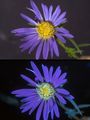
Snow-on-the-prairie (Euphorbia bicolor) when...Forest north from Montgomery. Texas  
Previous
Previous
Next
Next
Browse current photo album: Sam Houston Forest, Texas

Snow-on-the-prairie (Euphorbia bicolor) when exposed to regular daylight as well as when illuminated by a 365 nm ultraviolet (UV-A) blacklight collected on North Wilderness Trail of Little Lake Creek Wilderness in Sam Houston National Forest north from Montgomery. Texas, August 31, 2024

#3612-21
a b c
Thumbnail 3612-21: Snow-on-the-prairie (Euphorbia bicolor...north from Montgomery. Texas Show full size picture

Histogram
Shooting data

X-Large Image
Similar   Thumbnail of picture 3612-26: Flowering spurge (Euphorbia corollata) when exposed to regular ... north from Montgomery. Texas, August 31, 2024 Thumbnail of picture 3612-23: Southern prairie aster (Eurybia hemispherica) when exposed to regular ... north from Montgomery. Texas, August 31, 2024 Thumbnail of picture 3612-22: Gayfeather (Liatris bracteata(?)) when exposed to regular daylight as ... north from Montgomery. Texas, August 31, 2024 Thumbnail of picture 3612-28: Crustose lichens on a thin oak when exposed to regular daylight as ... north from Montgomery. Texas, August 31, 2024 Thumbnail of picture 3612-29: Pertusaria and other crustose lichens on a thin oak when exposed to ... north from Montgomery. Texas, August 31, 2024
1996  1997  1998  1999  2000  2001  2002  2003  2004  2005  2006  2007  2008  2009  2010  2011  2012  2013  2014  2015  2016  2017  2018  2019  2020  2021  2022  2023  2024  2025  2026 
New version    Slide Show    Most Popular    Full List    Statistics    Technical Details         Home Page

The image presents two photographs of Snow-on-the-prairie plants, captured under different lighting conditions.

**Top Photograph: Daylight Exposure**

* The plant's leaves and stems display a green color with white stripes.
* Small, yellowish flowers are visible among the leaves.
* The background is dark, suggesting that the photograph was taken in low-light conditions or at night.

**Bottom Photograph: Ultraviolet (UV-A) Blacklight Exposure**

* The same Snow-on-the-prairie plant is now illuminated by a 365 nm UV-A blacklight.
* The colors of the leaves and stems appear more vibrant, with shades of blue and purple visible.
* The yellowish flowers have become more prominent, appearing as bright yellow or orange in color.
* The background remains dark.

**Comparison**

The two photographs demonstrate how different lighting conditions can affect the appearance of plants. While daylight exposure reveals subtle colors and details, UV-A blacklight illumination enhances the plant's natural pigments, making its features more visible. This comparison highlights the importance of considering various lighting conditions when observing or photographing plants. – AI vision

Snow-on-the-prairie (Euphorbia bicolor) al exponerse a la luz diurna regular, así como cuando se ilumina con una luz negra ultravioleta de 365 nm recogida en el North Wilderness Trail del Little Lake Creek Wilderness en Sam Houston National Forest al norte de Montgomery. Texas, agosto 31, 2024. La imagen presenta dos fotografías de plantas Snow-on-the-prairie, capturadas bajo diferentes condiciones de iluminación.

**Fotografía superior: Exposición a la luz diurna**
* Las hojas y tallos de la planta muestran un color verde con rayas blancas.
* Son visibles flores amarillentas entre las hojas.
* El fondo es oscuro, lo que sugiere que la fotografía se tomó en condiciones de poca luz o de noche.

**Fotografía inferior: Exposición a una luz negra ultravioleta (UV-A)**
* La misma planta Snow-on-the-prairie está iluminada con una luz negra UV-A de 365 nm.
* Los colores de las hojas y tallos parecen más vibrantes, con tonalidades de azul y morado visibles.
* Las flores amarillentas son más prominentes, apareciendo en color amarillo o naranja brillante.
* El fondo sigue siendo oscuro.

**Comparación**
Las dos fotografías demuestran cómo diferentes condiciones de iluminación pueden afectar la apariencia de las plantas. Mientras que la exposición a la luz diurna revela colores y detalles sutiles, la iluminación con luz negra UV-A potencia los pigmentos naturales de la planta, haciendo que sus características sean más visibles. Esta comparación subraya la importancia de tener en cuenta diferentes condiciones de iluminación al observar o fotografiar plantas. – Spanish translation


Keyword variants

North Wilderness Trail photo album
high resolution online digital collection
Lake Creek Wilderness pix
Houston National Forest photocapture
Lone Star State
Little Lake picture
United States
picture gallery
documentary photographs
daily pics
TX
travelogue
snapshots
sightseeing
photowalks
photoblog
littel
graphic
fotografias
foto
America