
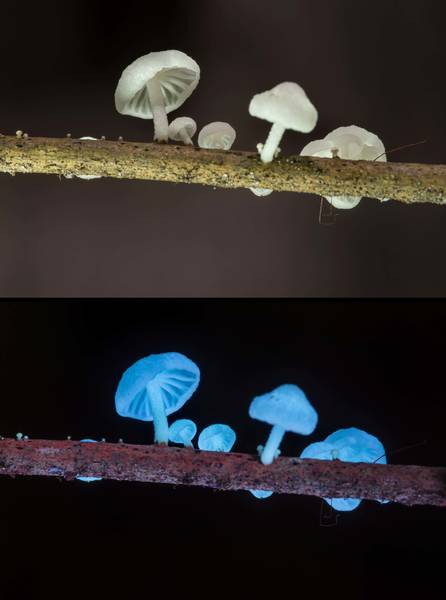

Tiny white Marasmius-like gilled mushrooms on a twig when exposed to regular daylight as well as when illuminated by a 365 nm ultraviolet (UV-A) blacklight from Sand Branch Loop Trail in Sam Houston National Forest near Montgomery. Texas


Album 3613: Lake Somerville - Sam Houston Forest, Texas, September 1 - 2, 2024
The image showcases a remarkable display of bioluminescence in fungi, specifically highlighting the Marasmius-like gilled mushrooms' ability to emit light when exposed to ultraviolet (UV-A) radiation.
**Image Composition**
* The top half of the image features a twig with several small white mushrooms growing on it. These mushrooms are likely Marasmius species due to their appearance.
* The bottom half of the image shows the same twig and mushrooms, but this time illuminated by a 365 nm UV-A blacklight.
**Bioluminescence in Fungi**
* When exposed to UV-A radiation, the mushrooms emit a bright blue-green light. This is a result of a chemical reaction involving luciferin and oxygen.
* The intensity of the bioluminescence varies depending on the type of mushroom and environmental conditions.
* The Marasmius-like gilled mushrooms in this image exhibit a relatively weak bioluminescence compared to some other species.
**Context and Significance**
* The image was taken by a photographer using a 365 nm UV-A blacklight at night, highlighting the unique ability of these fungi to emit light in low-light environments.
* This phenomenon is known as photobioluminescence and is an important adaptation for certain fungal species that rely on it for attracting prey or communicating with other organisms. – AI vision
🇪🇸 Descripción en español / Spanish Description
Los pequeños hongos Marasmius de color blanco con forma de seta y las hifas en una ramita se iluminan al exponerlos a la luz diurna regular, así como cuando se ilumina con luz ultravioleta (UV-A) negra del Sand Branch Loop Trail en el bosque nacional Sam Houston cercano a Montgomery, Texas, el 2 de septiembre de 2024. La imagen muestra una notabilísima exhibición de bioluminiscencia en los hongos, resaltando especialmente la habilidad de los hongos Marasmius-like con setas para emitir luz cuando se exponen a radiación ultravioleta (UV-A).
**Composición de la Imagen** * La mitad superior de la imagen presenta una ramita con varias setas blancas pequeñas creciendo en ella. Estas setas son probablemente especies Marasmius debido a su apariencia. * La mitad inferior de la imagen muestra la misma ramita y las setas, pero esta vez iluminadas por una luz negra de 365 nm UV-A.
**Bioluminescencia en los Hongos** * Cuando se exponen a radiación UV-A, las setas emiten una luz azul verdosa brillante. Esto es el resultado de una reacción química que involucra luciferina y oxígeno. * La intensidad de la bioluminiscencia varía según el tipo de seta y las condiciones ambientales. * Los hongos Marasmius-like con setas en esta imagen presentan una bioluminiscencia relativamente débil en comparación con otras especies.
**Contexto y Significado** * La imagen fue tomada por un fotógrafo usando una luz negra de 365 nm UV-A por la noche, destacando la capacidad única de estos hongos para emitir luz en entornos con poca luz. * Este fenómeno se conoce como fotobioluminiscencia y es una adaptación importante para ciertas especies de hongos que dependen de ella para atraer presas o comunicarse con otros organismos. – Spanish translation


