
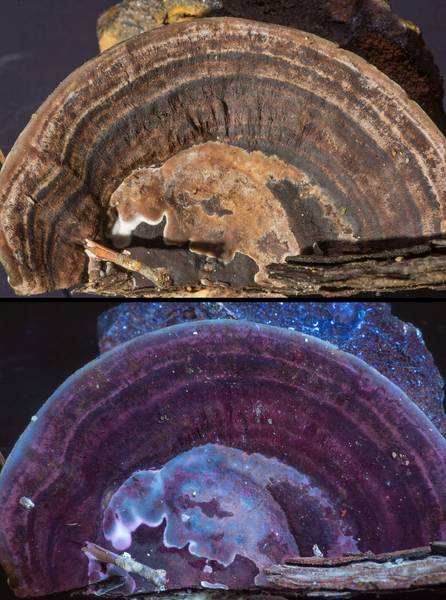

Top view of polypore mushrooms Nigroporus vinosus when exposed to regular daylight as well as when illuminated by a 365 nm ultraviolet (UV-A) blacklight from Sand Branch Loop Trail in Sam Houston National Forest near Montgomery. Texas


Album 3616: Sam Houston Forest, Texas, September 7, 2024
The image presents a striking comparison between two photographs of polypore mushrooms, specifically **Nigroporus vinosus**, showcasing their appearance under regular daylight and ultraviolet (UV-A) blacklight illumination.
**Top Photograph: Daylight**
* The top photograph features a brownish mushroom with concentric rings, reminiscent of tree rings.
* The colors are muted, ranging from light to dark brown, giving the mushroom an earthy tone.
* A small white patch is visible at the center of the mushroom.
**Bottom Photograph: UV-A Blacklight Illumination**
* In contrast, the bottom photograph reveals a vibrant display under UV-A blacklight illumination.
* The mushroom exhibits a range of colors, including purple, blue, and pink, which are not apparent in natural light.
* The concentric rings are still visible but appear more defined and intense under UV-A illumination.
**Conclusion**
The image highlights the unique properties of **Nigroporus vinosus**, demonstrating how certain fungi can fluoresce or change color when exposed to specific wavelengths of light. This phenomenon is likely due to the presence of fluorescent pigments within the mushroom's cells, which absorb and emit light at different frequencies. The contrast between the two photographs underscores the importance of considering multiple lighting conditions when studying or observing these fascinating organisms. – AI vision
🇪🇸 Descripción en español / Spanish Description
La vista desde arriba de hongos poliporos Nigroporus vinosus cuando se exponen a la luz diurna habitual, así como cuando se iluminan con una luz negra ultravioleta (UV-A) de 365 nm desde el Sand Branch Loop Trail en el Bosque Nacional Sam Houston cerca de Montgomery. Texas, 7 de septiembre de 2024. La imagen presenta una sorprendente comparación entre dos fotografías de hongos poliporos, específicamente **Nigroporus vinosus**, mostrando su aspecto bajo luz diurna habitual e iluminación con luz negra ultravioleta (UV-A).
**Fotografía superior: Luz Diurna** *La fotografía superior muestra un hongo parduzco con anillos concéntricos, que recuerdan a los anillos de los árboles. *Los colores están atenuados, variando del marrón claro al oscuro, dando al hongo un tono terroso. *Se observa una pequeña mancha blanca en el centro del hongo.
**Fotografía inferior: Iluminación con luz negra ultravioleta (UV-A)** *En contraste, la fotografía inferior revela una exhibición vibrante bajo iluminación de luz negra ultravioleta (UV-A). *El hongo presenta una gama de colores, incluyendo morado, azul y rosa, que no son evidentes a la luz natural. *Los anillos concéntricos todavía son visibles pero parecen más definidos e intensos bajo iluminación UV-A.
**Conclusión:** La imagen destaca las propiedades únicas de **Nigroporus vinosus**, demostrando cómo ciertos hongos pueden fluorescer o cambiar de color cuando se exponen a longitudes de onda específicas de luz. Este fenómeno es probable que se deba a la presencia de pigmentos fluorescentes dentro de las células del hongo, que absorben y emiten luz a diferentes f. – Spanish translation


