
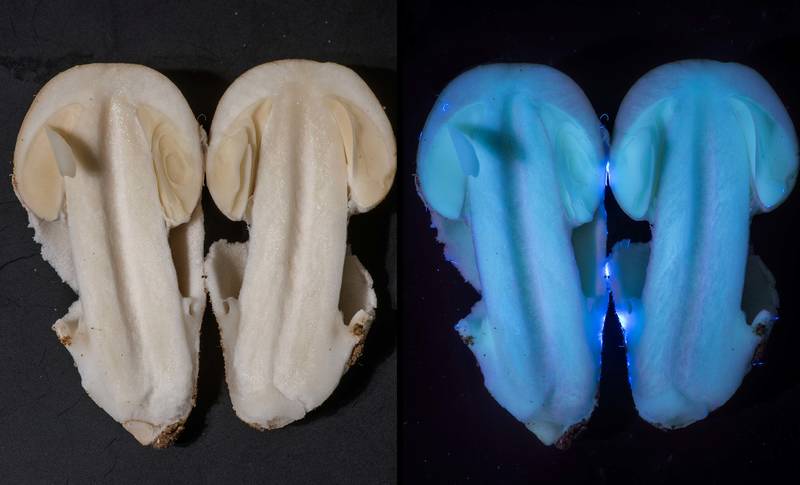

Cross section of a young Amanita mushroom when exposed to regular daylight as well as when illuminated by a 365 nm ultraviolet (UV-A) blacklight from Sand Branch Loop Trail in Sam Houston National Forest near Montgomery. Texas


Album 3613: Lake Somerville - Sam Houston Forest, Texas, September 1 - 2, 2024
The image presents a comparative analysis of a young Amanita mushroom's cross section under two distinct lighting conditions: regular daylight and illumination by a 365 nm ultraviolet (UV-A) blacklight.
**Visual Observations**
* The top half of the image displays the mushroom's cross section when exposed to regular daylight.
+ The tissue appears pale yellowish-white with brown edges, suggesting the presence of melanin or other pigments contributing to its coloration.
* In contrast, the bottom half of the image shows the same cross section illuminated by a 365 nm UV-A blacklight.
+ A striking blue-green fluorescence is visible throughout the tissue, indicating the presence of fluorescent compounds.
**Key Observations**
* The mushroom's tissue exhibits significant differences in appearance when viewed under different lighting conditions.
* The use of a UV-A blacklight reveals the presence of fluorescent compounds within the tissue that are not apparent under regular daylight.
**Conclusion**
The image effectively highlights the importance of considering the effects of light on the appearance and properties of biological samples. By comparing the two images, it becomes clear that the mushroom's fluorescence is only visible when exposed to UV-A radiation, demonstrating the significance of this technique in scientific research and analysis. – AI vision
🇪🇸 Descripción en español / Spanish Description
La sección transversal de un hongo Amanita joven cuando se expone a la luz diurna regular y cuando está iluminado con una luz negra ultravioleta (UV-A) de 365 nm desde el Sendero Sand Branch Loop en el Bosque Nacional Sam Houston cerca de Montgomery. Texas, 2 de septiembre de 2024. La imagen presenta un análisis comparativo de una sección transversal joven del hongo Amanita bajo dos condiciones de iluminación distintas: luz diurna regular e iluminación por una luz negra ultravioleta (UV-A) de 365 nm. **Observaciones visuales** * La mitad superior de la imagen muestra la sección transversal del hongo cuando está expuesto a luz diurna regular. + El tejido aparece blanco amarillento pálido con bordes marrones, lo que sugiere la presencia de melanina u otros pigmentos que contribuyen a su coloración. * En contraste, la mitad inferior de la imagen muestra la misma sección transversal iluminada por una luz negra UV-A de 365 nm. + Es visible una fluorescencia verde azulada en todo el tejido, lo que indica la presencia de compuestos fluorescentes. **Observaciones clave** * El tejido del hongo presenta diferencias significativas en su aspecto cuando se observa bajo diferentes condiciones de iluminación. * El uso de una luz negra UV-A revela la presencia de compuestos fluorescentes dentro del tejido que no son evidentes bajo luz diurna regular. **Conclusión** La imagen destaca efectivamente la importancia de considerar los efectos de la luz en el aspecto y las propiedades de las muestras biológicas. Al comparar las dos imágenes, queda claro que la fluorescencia del hongo solo es visible cuando se expone a radiación UV-A, lo que demuestra la importancia de esta técnica en la investigación y análisis científicos. – Spanish translation


