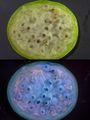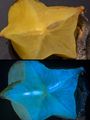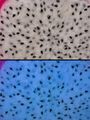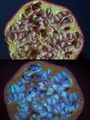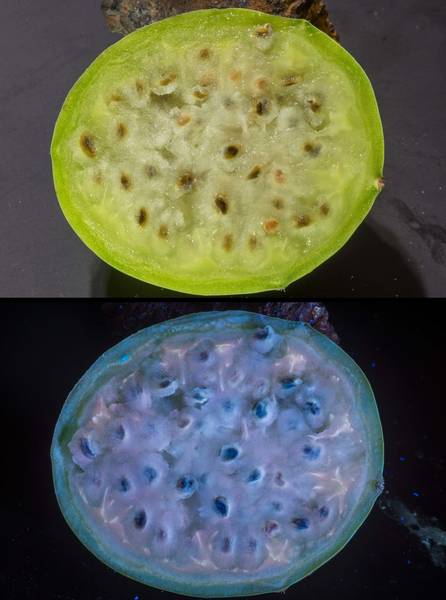

Section of prickly pear (cactus fruit) when exposed to regular daylight as well as when illuminated by a 365 nm ultraviolet (UV-A) blacklight from a supermarket. College Station, Texas


Album 3614: College Station, Texas, September 3 - 5, 2024
The image presents a comparative analysis of the appearance of prickly pear (cactus fruit) under regular daylight and when illuminated by a 365 nm ultraviolet (UV-A) blacklight from a supermarket. The top half of the image features a cross-section of the cactus fruit exposed to regular daylight, while the bottom half displays the same section illuminated by the UV-A blacklight.
**Top Half: Daylight Exposure**
* **Coloration:** The fruit exhibits a vibrant green hue with numerous dark spots scattered throughout its interior.
* **Texture:** The flesh appears smooth and slightly translucent, allowing for an unobstructed view of the internal structure.
* **Gel-like Substance:** A gel-like substance is visible within the fruit, which is likely responsible for its juicy texture when consumed.
**Bottom Half: UV-A Blacklight Exposure**
* **Illumination Pattern:** The UV-A blacklight casts a distinctive pattern on the surface of the fruit, accentuating its natural ridges and valleys.
* **Glowing Effect:** The gel-like substance within the fruit emits a soft blue glow when illuminated by the UV-A blacklight, indicating the presence of fluorescent compounds that absorb UV radiation and re-emit it at longer wavelengths.
* **Internal Structure:** The internal structure of the fruit becomes more visible under UV-A illumination, revealing a network of fine white fibers that are not apparent in daylight.
**Comparison and Conclusion**
The comparison between the two images highlights the unique properties of the prickly pear fruit when exposed to different light sources. While regular daylight accentuates its coloration and texture, the UV-A blacklight reveals additional details about its internal structure and composition. This phenomenon is likely due to the presence of fluorescent compounds that respond to UV radiation, providing valuable insights into the fruit's biology and potential applications in food technology or research. – AI vision
🇪🇸 Descripción en español / Spanish Description
La sección del piñón (fruto de cactus) cuando se expone a la luz diurna regular y también cuando se ilumina con una luz negra ultravioleta (UV-A) de 365 nm en un supermercado. College Station, Texas, 3 de septiembre de 2024. La imagen presenta un análisis comparativo del aspecto del piñón (fruto de cactus) bajo luz diurna regular y cuando se ilumina con una luz negra ultravioleta de 365 nm en un supermercado. La mitad superior de la imagen muestra una sección transversal del fruto expuesto a luz diurna, mientras que la parte inferior muestra la misma sección iluminada con luz UV-A.
**Mitad superior: Exposición a la Luz Diurna**
* **Coloración:** El fruto exhibe un tono verde vibrante con numerosas manchas oscuras dispersas por su interior.
* **Textura:** La carne aparece lisa y ligeramente translúcida, permitiendo una vista sin obstáculos de la estructura interna.
* **Sustancia gelatinosa:** Es visible una sustancia gelatinosa dentro del fruto, que es probablemente responsable de su textura jugosa cuando se consume.
**Mitad inferior: Exposición a UV-A**
* **Patrón de iluminación:** La luz UV-A proyecta un patrón distintivo sobre la superficie del fruto, acentuando sus aristas y valles naturales.
* **Efecto luminoso:** La sustancia gelatinosa dentro del fruto emite un suave brillo azul cuando se ilumina con luz UV-A, lo que indica la presencia de compuestos fluorescentes que absorben radiación ultravioleta y la reemiten a longitudes de onda más largas.
* **Estructura interna:** La estructura interna del fruto se vuelve más visible bajo iluminación UV-A, revelando una red de finas fibras blancas que no son evidentes a simple vista.
**Comparación y Conclusión**
La comparación entre las dos imágenes destaca las propiedades únicas del fruto del piñón cuando se expone a diferentes fuentes de luz. Mientras que la luz diurna regular acentúa su coloración y textura, la luz negra UV-A revela detalles adicionales sobre su estructura interna y composición. Este fenómeno es probablemente debido a la presencia de compuestos fluorescentes que responden a la radiación ultravioleta, proporcionando valiosas percepciones sobre la biología del fruto y las potenciales aplicaciones en tecnología alimenticia o investigación. – Spanish translation