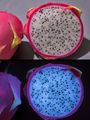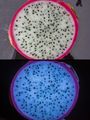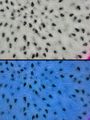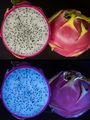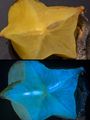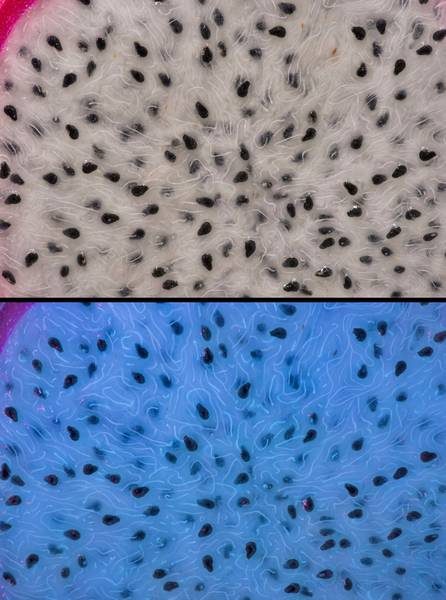

Section of red dragon fruit (Ivan Big Tree, 3040) when exposed to regular daylight as well as when illuminated by a 365 nm ultraviolet (UV-A) blacklight from HEB Supermarket. College Station, Texas


Album 3622: College Station, Texas, September 16 - 18, 2024
The image presents a comparison of the appearance of dragon fruit, specifically its red variety, under two different lighting conditions: regular daylight and illumination by a 365 nm ultraviolet (UV-A) blacklight. The photograph is divided into two sections, with the top section depicting the dragon fruit in daylight and the bottom section showing it under UV-A light.
**Section 1: Dragon Fruit Under Regular Daylight**
* **Coloration:** The dragon fruit exhibits its natural red coloration when exposed to regular daylight.
* **Texture:** The surface of the fruit appears smooth, with a subtle sheen that suggests its freshness and quality.
* **Pattern:** Small, scattered seeds are visible on the surface of the fruit, adding texture and visual interest.
**Section 2: Dragon Fruit Under UV-A Light**
* **Coloration:** When illuminated by a 365 nm ultraviolet (UV-A) blacklight from HEB Supermarket, the dragon fruit undergoes significant color change. The red hue becomes more pronounced, taking on a deeper, richer tone that is more vibrant than under regular daylight.
* **Texture:** The texture of the fruit remains smooth but appears slightly more luminous and radiant when exposed to UV-A light.
* **Pattern:** The pattern of seeds on the surface of the fruit becomes more defined and stands out against the enhanced red background. This could be due to the increased visibility of the seeds' dark coloration under UV-A illumination.
**Overall Observation**
The comparison between the two lighting conditions reveals that dragon fruit exhibits a significant color change when exposed to UV-A light. The natural red color deepens and becomes more vibrant, making the fruit appear even more appealing. This observation suggests that UV-A light could be used as an effective method for enhancing the visual appeal of dragon fruits in both commercial and home settings. Furthermore, it implies that the use of UV-A lighting may have potential applications beyond food presentation, such as in medical or scientific research where enhanced visibility of certain features is beneficial. – AI vision
🇪🇸 Descripción en español / Spanish Description
Sección del fruto del dragón rojo (Ivan Big Tree, 3040) cuando se expone a la luz diurna regular y también cuando se ilumina con una luz negra de ultravioleta (UV-A) de 365 nm en HEB Supermarket. College Station, Texas, 16 de septiembre de 2024. La imagen presenta una comparación de la apariencia del fruto del dragón, específicamente su variedad roja, bajo dos condiciones de iluminación diferentes: luz diurna regular e iluminación por una luz negra ultravioleta (UV-A) de 365 nm. La sección está dividida en dos partes, con la parte superior mostrando el fruto del dragón a la luz del día y la parte inferior mostrándolo bajo la luz UV-A.
**Sección 1: Fruta del Dragón bajo Luz Diurna Regular**
* **Coloración:** La fruta del dragón muestra su coloración roja natural cuando se expone a la luz diurna regular. * **Textura:** La superficie de la fruta parece suave, con un brillo sutil que sugiere su frescura y calidad. * **Patrón:** Son visibles semillas pequeñas y dispersas en la superficie de la fruta, añadiendo textura e interés visual.
**Sección 2: Fruta del Dragón bajo Luz UV-A**
* **Coloración:** Cuando se ilumina con una luz negra ultravioleta (UV-A) de 365 nm de HEB Supermarket, la fruta del dragón sufre un cambio de color significativo. El tono rojo se vuelve más pronunciado, tomando un tono más profundo y rico que es más vibrante que bajo la luz diurna regular. * **Textura:** La textura de la fruta sigue siendo suave, pero parece ligeramente más luminosa y radiante cuando se expone a la luz UV-A. * **Patrón:** El patrón de semillas en la superficie de la fruta se vuelve más definido y destaca contra el fondo rojo mejorado. Esto podría ser debido a la mayor visibilidad del color oscuro de las semillas bajo iluminación UV-A.
**Observación General** La comparación entre las dos condiciones de iluminación revela que la fruta del dragón experimenta un cambio de color significativo cuando se expone a la luz UV-A. El rojo natural se profundiza y se vuelve más vibrante, haciendo que la fruta parezca incluso más atractiva. Esta observación sugiere que la luz UV-A podría ser un método eficaz para mejorar el atractivo visual de las frutas del dragón en entornos comerciales y domésticos. Además, implica que el uso de la iluminación UV-A podría tener aplicaciones potenciales más allá de la presentación de alimentos, como en investigación médica o científica donde la mayor visibilidad de ciertas características es beneficiosa. – Spanish translation