 |
| |||||||||||||||

| ||||||||||||||||


| Similar | 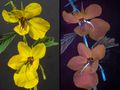  |
  |
  |
  |
  |
| |||||||||||||||||||||||||||
| |||||||||||||||||||||||||||
| 1996 1997 1998 1999 2000 2001 2002 2003 2004 2005 2006 2007 2008 2009 2010 2011 2012 2013 2014 2015 2016 2017 2018 2019 2020 2021 2022 2023 2024 2025 2026 | |||||||||||||||||||||||||||
| New version Slide Show Most Popular Full List Statistics Technical Details Home Page | |||||||||||||||||||||||||||
The image presents a striking contrast between two photographs of the same plant species, Partridge pea (Cassia fasciculata), captured under different lighting conditions. The top photograph showcases the plant as it appears in regular daylight, while the bottom photograph reveals its vibrant colors when illuminated by a 365 nm ultraviolet (UV-A) blacklight. **Top Photograph: Daylight Illumination** * **Plant Appearance:** The Partridge pea plant features yellow petals with red markings at their centers. **Bottom Photograph: UV-A Blacklight Illumination** * **Plant Appearance:** Under the 365 nm ultraviolet (UV-A) blacklight illumination, the Partridge pea plant exhibits significantly altered colors. **Comparison and Implications** The juxtaposition of these two photographs highlights the dramatic effect of UV-A light on plant pigmentation. The change from yellow to pinkish-red in the petals suggests that the plant contains anthocyanins, which are responsible for this shift under ultraviolet illumination. This phenomenon is not unique to Partridge pea but has been observed in various other plant species as well. In conclusion, the image effectively demonstrates how UV-A light can alter the visible colors of certain plants by activating pigments such as anthocyanins. This observation underscores the importance of considering lighting conditions when studying or observing plant morphology and coloration. – AI vision |
La partridge pea (Cassia fasciculata) cuando se expone a la luz del día regular, así como cuando se ilumina con una luz negra ultravioleta de 365 nm en Lick Creek Park, College Station, Texas, el 5 de septiembre de 2024. La imagen presenta un contraste sorprendente entre dos fotografías de la misma especie vegetal, partridge pea (Cassia fasciculata), capturadas en diferentes condiciones de iluminación. La fotografía superior muestra la planta como aparece a la luz del día regular, mientras que la fotografía inferior revela sus colores vibrantes cuando se ilumina con una luz negra ultravioleta de 365 nm. Fotografía superior: Iluminación diurna * Apariencia de la planta: La planta de partridge pea presenta pétalos amarillos con marcas rojas en el centro. Fondo: El fondo de esta fotografía es oscuro, lo que sugiere que se tomó en un área sombreada o de noche para minimizar la interferencia de la luz externa y enfatizar la coloración natural de la planta. Fotografía inferior: Iluminación con luz negra UV-A * Apariencia de la planta: Bajo iluminación ultravioleta de 365 nm, la partridge pea presenta colores significativamente alterados. Pétalos: Los pétalos ahora aparecen rosado-rojos, un cambio notable desde su tono amarillo original. Marcas centrales: Las marcas rojas en el centro de los pétalos se han vuelto más pronunciadas y vibrantes bajo la luz UV-A. Fondo: De manera similar a la fotografía superior, el fondo de esta imagen también es oscuro, lo que indica que se capturó en condiciones de baja iluminación para resaltar los efectos de la luz negra UV-A sobre la coloración de la planta. Comparación e implicaciones |
Keyword variants
high resolution online digital collection
Lick Creek Park photograph
Berlin on the Brazos
Rock Prairie Rd
Lone Star State
Greens Prairie Road
United States
picture gallery
photo album
nature trails
Nature Park
documentary photographs
daily pics
conservative town
Brazos County
wildlife
TX
travelogue
snapshots
sightseeing
photowalks
photoblog
graphic
fotografias
foto
Bryan
America
Aggieland