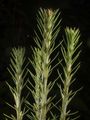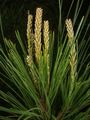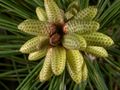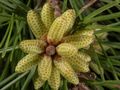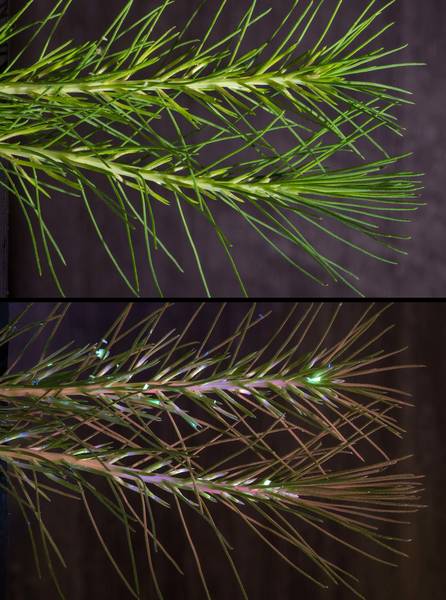

Shoots of loblolly pine (Pinus taeda) both in natural light and under 365 nm ultraviolet (UV-A) blacklight from Richards Loop Trail in Sam Houston National Forest near Montgomery. Texas


Album 3615: Sam Houston Forest, Texas, September 6, 2024
The image features two photographs of shoots from a loblolly pine tree, captured under different lighting conditions.
* **Top Image: Natural Light**
* The top photograph showcases the shoots in their natural state.
* The needles are a vibrant green color and appear healthy, with no visible signs of damage or decay.
* The background is dark, which helps to highlight the details of the plant's structure.
* **Bottom Image: Under 365 nm Ultraviolet (UV-A) Blacklight**
* The bottom photograph displays the same shoots under UV-A blacklight.
* Upon exposure to the ultraviolet light, some areas on the needles exhibit a fluorescent effect, emitting a pale blue-green color.
* This phenomenon is likely due to the presence of flavonoids or other compounds that fluoresce when exposed to UV radiation.
In summary, the image presents a comparison between the natural appearance of loblolly pine shoots and their response to UV-A blacklight. While the top image highlights the plant's normal physiological state, the bottom image reveals additional details about its chemical composition, particularly in areas where fluorescent effects are observed. – AI vision
🇪🇸 Descripción en español / Spanish Description
Tomillos de pino (Pinus taeda) tanto a la luz natural como bajo una luz negra ultravioleta (UV-A) de 365 nm desde el Richards Loop Trail en el Bosque Nacional Sam Houston cerca de Montgomery, Texas, el 6 de septiembre de 2024. La imagen presenta dos fotografías de brotes de un árbol de pino de loblolly, capturadas bajo diferentes condiciones de iluminación. * **Imagen superior: Luz natural** * La imagen superior muestra los brotes en su estado natural. * Las agujas tienen un color verde vibrante y parecen sanas, sin signos visibles de daño o descomposición. * El fondo es oscuro, lo que ayuda a destacar los detalles de la estructura de la planta. * **Imagen inferior: Bajo luz negra ultravioleta (UV-A) de 365 nm** * La imagen inferior muestra los mismos brotes bajo luz UV-A. * Al exponerse a la luz ultravioleta, algunas áreas de las agujas presentan un efecto fluorescente, emitiendo un color verde pálido. * Este fenómeno es probablemente debido a la presencia de flavonoides u otros compuestos que se vuelven fluorescentes cuando están expuestos a radiación UV. En resumen, la imagen presenta una comparación entre el aspecto natural de los brotes de pino loblolly y su respuesta a la luz negra UV-A. Mientras que la imagen superior destaca el estado fisiológico normal de la planta, la imagen inferior revela detalles adicionales sobre su composición química, particularmente en áreas donde se observan efectos fluorescentes. – Spanish translation