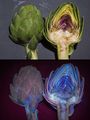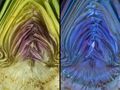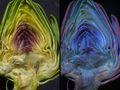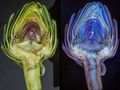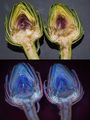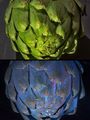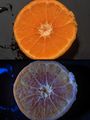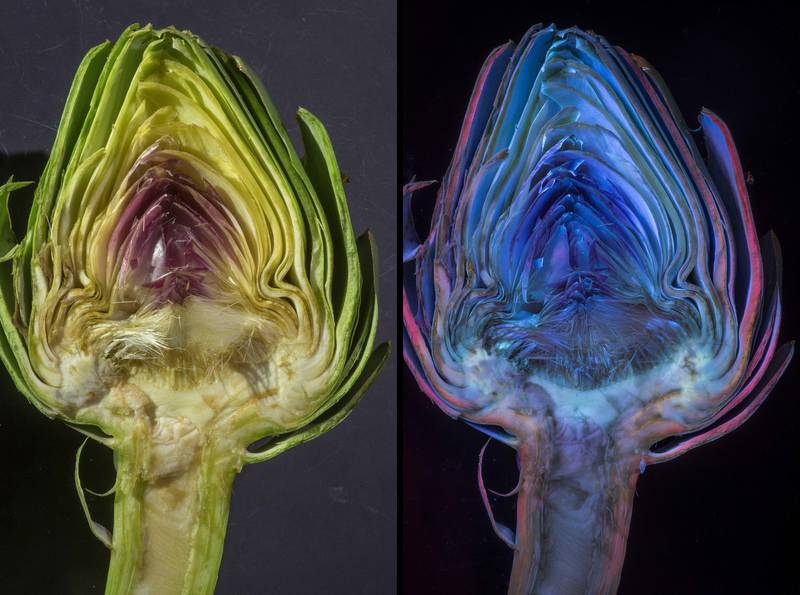

Section of globe artichike when exposed to regular daylight as well as when illuminated by a 365 nm ultraviolet (UV-A) blacklight from Kroger supermarket. College Station, Texas


Album 3617: College Station, Texas, September 8 - 10, 2024
The image presents a striking comparison between two photographs of an artichoke, showcasing its appearance under regular daylight and when illuminated by a 365 nm ultraviolet (UV-A) blacklight.
**Photograph on the Left: Daylight**
* The photograph on the left captures the artichoke in natural light.
* The artichoke's outer leaves are greenish-yellow with hints of purple, while its inner leaves display a vibrant purple color.
* The center of the artichoke appears to be a deep red or maroon hue.
**Photograph on the Right: UV-A Blacklight**
* In contrast, the photograph on the right reveals the artichoke's true colors when exposed to the 365 nm ultraviolet (UV-A) blacklight from Kroger supermarket.
* The outer leaves are now a bright yellow-green color with red highlights.
* The inner leaves exhibit an intense blue-purple hue.
* The center of the artichoke has transformed into a deep blue or indigo color.
**Overall Comparison**
The two photographs demonstrate that the artichoke's colors change significantly when exposed to UV-A blacklight. While the daylight photograph shows a more muted palette, the UV-A blacklight photograph reveals a much brighter and more vibrant display of colors. This contrast highlights the unique properties of the artichoke and its response to different lighting conditions. – AI vision
🇪🇸 Descripción en español / Spanish Description
Sección de la parte superior del glóbulo del alcachofa cuando se expone a luz diurna normal, así como también cuando se ilumina con una lámpara negra ultravioleta (UV-A) de 365 nm en el supermercado Kroger. College Station, Texas, 10 de septiembre de 2024. La imagen presenta una sorprendente comparación entre dos fotografías de un alcachofa, mostrando su apariencia bajo luz diurna normal y cuando se ilumina con una lámpara negra ultravioleta (UV-A) de 365 nm. **Fotografía a la izquierda: Luz Diurna** *La fotografía a la izquierda captura el alcachofa en luz natural. *Las hojas exteriores del alcachofa son de color amarillo verdoso con matices morados, mientras que sus hojas interiores muestran un vibrante color púrpura. *El centro del alcachofa parece ser de un tono rojo oscuro o marrón. **Fotografía a la derecha: Luz UV-A** *Por el contrario, la fotografía de la derecha revela los verdaderos colores del alcachofa cuando se expone a la luz ultravioleta (UV-A) de 365 nm del supermercado Kroger. *Las hojas exteriores ahora tienen un color verde amarillento con resaltos rojos. *Las hojas interiores presentan un intenso tono azul púrpura. *El centro del alcachofa ha cambiado a un tono azul oscuro o índigo. **Comparación general** Las dos fotografías demuestran que los colores del alcachofa cambian significativamente cuando se expone a la luz UV-A. Mientras que la fotografía de luz diurna muestra una paleta más atenuada, la fotografía con luz UV-A revela una presentación mucho más brillante y vibrante de colores. Este contraste resalta las propiedades únicas del alcachofa y su respuesta a diferentes condiciones de iluminación. – Spanish translation