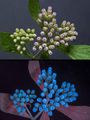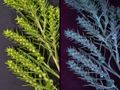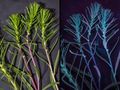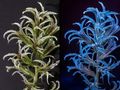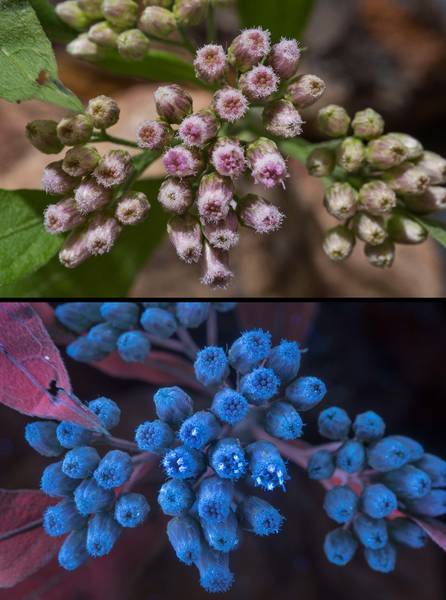

Flowers of salt-marsh fleabane (Pluchea odorata) when exposed to regular daylight as well as when illuminated by a 365 nm ultraviolet (UV-A) blacklight from Lick Creek ParkLick Creek: Background Notes. College Station, Texas


Album 3618: College Station, Texas, September 11 - XX, 2024
The top half of the image shows what appears to be a cluster of small, pinkish flowers on a green stem with leaves. The bottom half of the image shows the same cluster but is illuminated by an ultraviolet (UV-A) blacklight that makes the flowers appear blue.
These images appear to show the same cluster of salt-marsh fleabane flowers under two different lighting conditions: regular daylight and UV-A light at 365 nm, likely a special-purpose blacklight designed for use in forensic science or plant biology. The top image shows the flower cluster as it appears naturally, with pinkish flowers on green stems surrounded by leaves. The bottom photo was taken using a UV-A blacklight from Lick Creek Park. These images were captured by an unknown photographer at an unspecified location on September 11, 2024.
The ultraviolet light makes the flowers appear blue because certain wavelengths of UV light are absorbed more readily by plant pigments such as anthocyanins and chlorophylls. This phenomenon is known as bioluminescence, which occurs when a substance emits light in response to an external stimulus, like radiation or temperature changes. In this case, the UV-A blacklight causes the flowers to absorb certain wavelengths of light and re-emit them at longer wavelengths, resulting in the blue coloration seen in the bottom photo.
Overall, these images demonstrate how different lighting conditions can affect our perception of plant colors and highlight the unique properties of bioluminescent organisms like salt-marsh fleabane. By using specialized equipment like UV-A blacklights, scientists can gain insights into plant biology and ecology that would otherwise remain hidden to the naked eye. – AI vision
🇪🇸 Descripción en español / Spanish Description
Flores de la genciana marina (Pluchea odorata) cuando se exponen a luz diurna regular, así como cuando se iluminan con una lámpara negra ultravioleta (UV-A) de 365 nm del Lick Creek Park. College Station, Texas, 11 de septiembre de 2024. La mitad superior de la imagen muestra lo que parecen ser un racimo de pequeñas flores rosadas en un tallo verde con hojas. La mitad inferior de la imagen muestra el mismo racimo, pero iluminado por una lámpara negra ultravioleta (UV-A) que hace que las flores aparezcan azules. Estas imágenes parecen mostrar el mismo racimo de flores de genciana marina bajo dos condiciones de iluminación diferentes: luz diurna regular y luz UV-A a 365 nm, probablemente una lámpara negra especializada diseñada para su uso en ciencias forenses o biología vegetal. La imagen superior muestra el racimo de flores tal como aparece naturalmente, con flores rosadas en tallos verdes rodeados de hojas. La foto inferior se tomó usando una lámpara negra UV-A del Lick Creek Park. Estas imágenes fueron capturadas por un fotógrafo desconocido en una ubicación no especificada el 11 de septiembre de 2024. La luz ultravioleta hace que las flores parezcan azules porque ciertas longitudes de onda de la luz UV son absorbidas más fácilmente por los pigmentos vegetales, como las antocianinas y las clorofilas. Este fenómeno se conoce como bioluminiscencia, que ocurre cuando una sustancia emite luz en respuesta a un estímulo externo, como radiación o cambios de temperatura. En este caso, la lámpara negra UV-A hace que las flores absorban ciertas longitudes de onda de luz y las reemitan en longitudes de onda más largas, dando como resultado la coloración azul vista en la foto inferior. En general, estas imágenes demuestran cómo diferentes condiciones de iluminación pueden afectar nuestra percepción de los colores de las plantas y resaltan las propiedades únicas de organismos bioluminescentes como la genciana marina. Al usar equipo especializado como lámparas negras UV-A, los científicos pueden obtener información sobre la biología y ecología vegetal que de otra manera permanecería oculta a simple vista. – Spanish translation