 |
| |||||||||||||||

| ||||||||||||||||


| Similar |   |
  |
  |
  |
  |
| |||||||||||||||||||||||||||
| |||||||||||||||||||||||||||
| 1996 1997 1998 1999 2000 2001 2002 2003 2004 2005 2006 2007 2008 2009 2010 2011 2012 2013 2014 2015 2016 2017 2018 2019 2020 2021 2022 2023 2024 2025 2026 | |||||||||||||||||||||||||||
| New version Slide Show Most Popular Full List Statistics Technical Details Home Page | |||||||||||||||||||||||||||
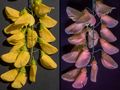
The image presents a comparative display of rattlebush (Sesbania drummondii) pods under two distinct lighting conditions: regular daylight and exposure to a 365 nm ultraviolet (UV-A) blacklight from Lick Creek Park, College Station, Texas. **Left Image: Regular Daylight** * The left image shows the rattlebush pods in their natural state, illuminated by regular daylight. **Right Image: UV-A Blacklight Illumination** * In contrast, the right image depicts the same rattlebush pods under the illumination of a 365 nm ultraviolet (UV-A) blacklight. **Comparison and Observations** * A striking difference between the two images is the dramatic change in coloration when the pods are exposed to the UV-A blacklight. In conclusion, this image effectively illustrates the transformative effect of UV-A radiation on the coloration of rattlebush pods. By comparing these two images side-by-side, we gain a deeper understanding of the complex interactions between light, matter, and life at the microscopic scale. – AI vision |
El ratoncillo (Sesbania drummondii) al ser expuesto a la luz diurna regular, así como cuando se ilumina con una luz negra ultravioleta de 365 nm del Parque Lick Creek. College Station, Texas, 11 de septiembre de 2024. La imagen presenta una exhibición comparativa de vainas de ratoncillo (Sesbania drummondii) en dos condiciones de iluminación distintas: luz diurna regular y exposición a una luz negra ultravioleta de 365 nm del Parque Lick Creek, College Station, Texas. **Imagen izquierda: luz diurna regular** * La imagen izquierda muestra las vainas de ratoncillo en su estado natural, iluminadas por luz diurna regular. * Las vainas exhiben un color verde vibrante con variaciones sutiles en el tono y la textura. * Parecen saludables e intactos, sin signos visibles de daño o descomposición. **Imagen derecha: iluminación por luz negra ultravioleta de 365 nm** * En contraste, la imagen de la derecha representa las mismas vainas de ratoncillo bajo la iluminación de una luz negra ultravioleta de 365 nm. * Las vainas exhiben un rango de colores, desde amarillo pálido hasta morado oscuro, dependiendo de su orientación y posición con respecto a la fuente de luz. * Notablemente, algunas áreas de las vainas aparecen más intensamente coloreadas que otras, lo que sugiere que la radiación UV-A puede estar causando cambios localizados en la pigmentación o fluorescencia. **Comparación y observaciones** * Una diferencia notable entre las dos imágenes es el cambio drástico en la coloración cuando las vainas están expuestas a la luz UV-A negra. * El uso de una luz negra ultravioleta de 365 nm permite la visualización de detalles sutiles que pueden no ser evidentes bajo condiciones de iluminación regulares. * Esta técnica puede proporcionar insights valiosos en la estructura y composición de tejidos vegetales, ayudando potencialmente en la identificación y análisis de diversos procesos biológicos. En conclusión, esta imagen ilustra efectivamente el efecto transformador de la radiación UV-A sobre la coloración de las vainas del ratoncillo. Al comparar estas dos imágenes lado a lado, obtenemos una comprensión más profunda de las interacciones complejas entre luz, materia y vida a escala microscópica. – Spanish translation |
Keyword variants
high resolution online digital collection
Lick Creek Park picture
Berlin on the Brazos
Rock Prairie Rd
Lone Star State
Greens Prairie Road
United States
picture gallery
photo album
nature trails
Nature Park
documentary photographs
daily pics
conservative town
Brazos County
wildlife
TX
travelogue
snapshots
sightseeing
photowalks
photoblog
graphic
fotografias
foto
Bryan
America
Aggieland