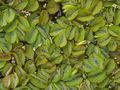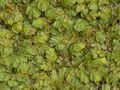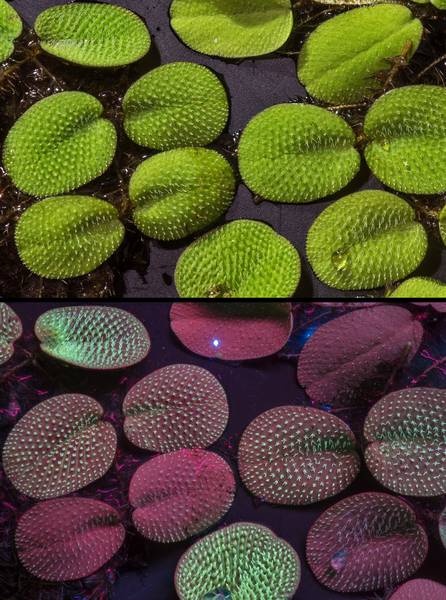

Giant salvinia (Salvinia molesta) when exposed to regular daylight as well as when illuminated by a 365 nm ultraviolet (UV-A) blacklight collected on Stubblefield section of Lone Star hiking trail in Sam Houston National Forest. Texas


Album 3621: Sam Houston Forest, Texas, September 15, 2024
The image displays two photographs of Giant salvinia (Salvinia molesta), a type of aquatic fern, collected from Stubblefield section of Lone Star hiking trail in Sam Houston National Forest, Texas on September 15, 2024. The top photograph depicts Giant salvinia under regular daylight conditions, while the bottom image shows it illuminated by a 365 nm ultraviolet (UV-A) blacklight.
In the top image, the Giant salvinia appears as vibrant green disks with small white spines covering their surfaces. In contrast, the bottom photograph reveals that when exposed to UV-A light, these disks emit a bright pinkish-red color, suggesting the presence of fluorescent pigments. These pigments are thought to play a role in attracting pollinators and protecting against herbivores.
The photographs were taken by an unknown photographer who likely used specialized equipment to capture high-quality images of the Giant salvinia in both daylight and UV-A light conditions. The resulting images provide valuable insights into the unique characteristics of this aquatic fern species. – AI vision
🇪🇸 Descripción en español / Spanish Description
Salvinia gigante (Salvinia molesta) cuando se expone a la luz del día habitual, así como cuando se ilumina con una luz negra ultravioleta de 365 nm recolectada en la sección Stubblefield del sendero Lone Star en el Bosque Nacional Sam Houston. Texas, 15 de septiembre de 2024. La imagen muestra dos fotografías de Salvinia gigante (Salvinia molesta), un tipo de helecho acuático, recolectadas de la sección Stubblefield del sendero Lone Star en el Bosque Nacional Sam Houston, Texas el 15 de septiembre de 2024. La fotografía superior representa Salvinia gigante bajo condiciones de luz regular, mientras que la imagen inferior lo muestra iluminado con una luz negra ultravioleta de 365 nm. En la imagen superior, el salvinia gigante aparece como discos verdes vibrantes con pequeñas espinas blancas cubriendo sus superficies. Por el contrario, la fotografía inferior revela que cuando se expone a luz UV-A, estos discos emiten un color rosa brillante, lo que sugiere la presencia de pigmentos fluorescentes. Se cree que estos pigmentos desempeñan un papel en atraer polinizadores y proteger contra los herbívoros. Las fotografías fueron tomadas por un fotógrafo desconocido que probablemente utilizó equipamiento especializado para capturar imágenes de alta calidad del salvinia gigante tanto en condiciones de luz diurna como UV-A. Las imágenes resultantes proporcionan información valiosa sobre las características únicas de esta especie de helecho acuático. – Spanish translation