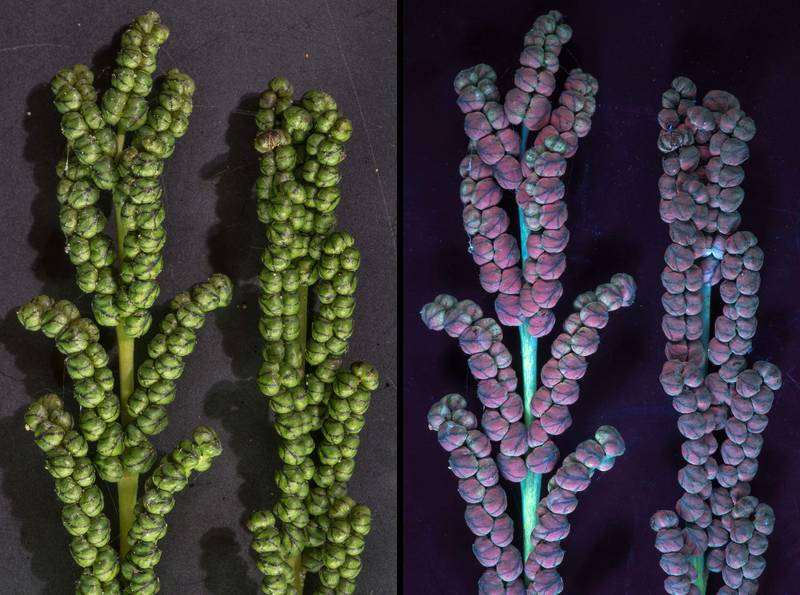

Fertile fronds of bead fern (Onoclea sensibilis) both in natural light and under 365 nm ultraviolet (UV-A) blacklight collected on Stubblefield section of Lone Star hiking trail in Sam Houston National Forest. Texas


Album 3621: Sam Houston Forest, Texas, September 15, 2024
The image presents a striking comparison between two photographs of the same plant species, taken under different lighting conditions.
**Natural Light Photograph**
* The left-hand photograph captures the bead fern (Onoclea sensibilis) in its natural state, illuminated by ordinary light.
* The fronds are depicted as greenish-yellow stalks bearing clusters of small, rounded leaves that resemble beads.
* This image provides a clear view of the plant's morphology and structure.
**Ultraviolet Light Photograph**
* In contrast, the right-hand photograph showcases the same plant under 365 nm ultraviolet (UV-A) blacklight.
* The fronds exhibit a distinctive pinkish-red fluorescence, particularly pronounced on the tips of the leaves.
* This effect is likely due to the presence of fluorescent pigments or other compounds in the plant that absorb UV radiation and emit light at longer wavelengths.
**Comparison and Implications**
* The comparison between these two images highlights the unique properties of certain plants when exposed to different types of light.
* The fluorescence observed under UV-A blacklight may be an adaptation for attracting pollinators, such as insects, or for other ecological purposes.
* This phenomenon is not limited to the bead fern and can be found in various plant species that possess fluorescent pigments.
Overall, the image demonstrates the importance of considering multiple factors, including lighting conditions, when studying and understanding the biology and ecology of plants. – AI vision
🇪🇸 Descripción en español / Spanish Description
Las frondas fértiles de la helecho perla (Onoclea sensibilis) tanto bajo luz natural como bajo luz negra ultravioleta de 365 nm recolectadas en la sección Stubblefield del sendero Lone Star en el Bosque Nacional Sam Houston, Texas. El 15 de septiembre de 2024. La imagen presenta una sorprendente comparación entre dos fotografías de la misma especie de planta tomadas bajo diferentes condiciones de iluminación. **Fotografía con Luz Natural** * La fotografía de la izquierda captura el helecho perla (Onoclea sensibilis) en su estado natural, iluminado por luz común. * Las frondas se representan como tallos amarillo verdoso que sostienen racimos de pequeñas hojas redondeadas que parecen perlas. * Esta imagen proporciona una vista clara de la morfología y estructura de la planta. **Fotografía con Luz Ultravioleta** * En contraste, la fotografía de la derecha muestra la misma planta bajo luz negra ultravioleta de 365 nm. * Las frondas exhiben una distintiva fluorescencia rosácea, particularmente pronunciada en las puntas de las hojas. * Este efecto se debe probablemente a la presencia de pigmentos fluorescentes u otros compuestos en la planta que absorben radiación ultravioleta y emiten luz a longitudes de onda más largas. **Comparación e Implicaciones** * La comparación entre estas dos imágenes destaca las propiedades únicas de ciertas plantas cuando se exponen a diferentes tipos de luz. * La fluorescencia observada bajo luz ultravioleta puede ser una adaptación para atraer polinizadores, como insectos, o para otros fines ecológicos. * Este fenómeno no se limita al helecho perla y se puede encontrar en varias especies de plantas que poseen pigmentos fluorescentes. En general, la imagen demuestra la importancia de considerar múltiples factores, incluidas las condiciones de iluminación, al estudiar y comprender la biología y ecología de las plantas. – Spanish translation