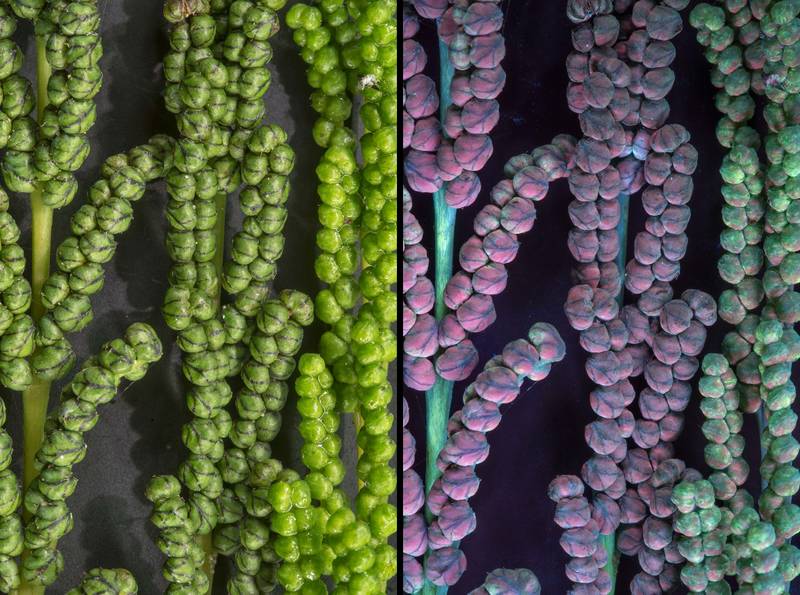

Bead fern (Onoclea sensibilis) when exposed to regular daylight as well as when illuminated by a 365 nm ultraviolet (UV-A) blacklight collected on Stubblefield section of Lone Star hiking trail in Sam Houston National Forest. Texas


Album 3621: Sam Houston Forest, Texas, September 15, 2024
The image presents a comparative analysis of the bead fern plant's appearance under two different lighting conditions: regular daylight and UV-A blacklight illumination. The left half of the image showcases the plant as it naturally appears in daylight, while the right half reveals its unique characteristics when exposed to the 365 nm ultraviolet (UV-A) blacklight.
**Daylight Image Analysis**
* **Plant Structure:** The bead fern exhibits a distinctive frond structure, comprising multiple leaflets that are densely packed and resemble beads.
* **Coloration:** In daylight, the plant displays a vibrant green coloration, with no visible signs of fluorescence or unusual pigmentation.
* **Background:** The background is dark gray, providing a neutral contrast to the plant's natural colors.
**UV-A Blacklight Image Analysis**
* **Plant Structure:** Under UV-A blacklight illumination, the bead fern's frond structure remains largely unchanged, with no significant alterations in its shape or arrangement.
* **Fluorescence:** However, the plant exhibits a pronounced fluorescence effect, characterized by a bright pinkish-purple coloration that is most intense on the adaxial (upper) surface of each leaflet.
* **Background:** The background remains dark gray, allowing the fluorescent colors to stand out more prominently.
**Comparison and Observations**
* **Color Contrast:** The UV-A blacklight illumination accentuates the plant's natural green coloration, creating a striking contrast between the daylight and UV-A images.
* **Fluorescence Pattern:** The fluorescence effect is localized to specific areas of the leaflets, suggesting that certain pigments or compounds within the plant are responsible for this phenomenon.
* **Implications:** This image highlights the importance of considering multiple lighting conditions when studying plant morphology and physiology. The UV-A blacklight illumination reveals aspects of the bead fern's biology that would otherwise remain invisible in daylight.
In conclusion, the image effectively demonstrates how different lighting conditions can significantly impact our understanding of plant appearance and structure. By comparing the effects of regular daylight with those of UV-A blacklight illumination, we gain valuable insights into the unique characteristics of the bead fern and its potential applications in fields such as botany, ecology, and conservation. – AI vision
🇪🇸 Descripción en español / Spanish Description
La helecho cacao (Onoclea sensibilis) al ser expuesto a la luz diurna regular y cuando es iluminado por una lámpara negra de ultravioletas de 365 nm (UV-A) recolectada en la sección Stubblefield del sendero para excursiones Lone Star en el Bosque Nacional Sam Houston, Texas, el 15 de septiembre de 2024. La imagen presenta un análisis comparativo del aspecto de la planta helecho cacao bajo dos condiciones de iluminación diferentes: luz diurna regular e iluminación ultravioleta UV-A. La mitad izquierda de la imagen muestra la planta tal como aparece naturalmente a la luz del día, mientras que la mitad derecha revela sus características únicas cuando se expone a los rayos ultravioletas de 365 nm. **Análisis de imágenes en luz diurna** * **Estructura de la planta:** El helecho cacao exhibe una estructura de hojuelas distintiva, compuesta por múltiples hojuelas empaquetadas densamente y que recuerdan a perlas. * **Coloración:** En luz diurna, la planta presenta un color verde vibrante, sin signos visibles de fluorescencia o pigmentación inusual. * **Fondo:** El fondo es gris oscuro, lo que proporciona un contraste neutro con los colores naturales de la planta. **Análisis de imágenes bajo luz negra UV-A** * **Estructura de la planta:** Bajo iluminación ultravioleta UV-A, la estructura del helecho cacao permanece en gran medida inalterada, sin alteraciones significativas en su forma o disposición. * **Fluorescencia:** Sin embargo, la planta presenta un efecto de fluorescencia notable, caracterizado por una coloración rosada brillante que es más intensa en la superficie adaxial (superior) de cada hojuela. * **Fondo:** El fondo sigue siendo gris oscuro, lo que permite que los colores fluorescentes resalten con mayor prominencia. **Comparación y observaciones** * **Contraste de color:** La iluminación UV-A acentúa la coloración verde natural de la planta, creando un contraste notable entre las imágenes de luz diurna y UV-A. * **Patrón de fluorescencia:** El efecto de fluorescencia está localizado en áreas específicas de las hojuelas, lo que sugiere que ciertos pigmentos o compuestos dentro de la planta son responsables de este fenómeno. * **Implicaciones:** Esta imagen destaca la importancia de considerar múltiples condiciones de iluminación al estudiar la morfología y fisiología vegetales. La iluminación UV-A revela aspectos de la biología del helecho cacao que de otra manera permanecerían invisibles a simple vista. En conclusión, la imagen demuestra efectivamente cómo diferentes condiciones de iluminación pueden impactar significativamente nuestra comprensión del aspecto y estructura de las plantas. Al comparar los efectos de la luz diurna regular con los de la iluminación UV-A, se obtienen conocimientos valiosos sobre las características únicas del helecho cacao y sus potenciales aplicaciones en campos como la botánica, ecología y conservación. – Spanish translation