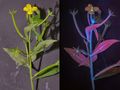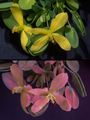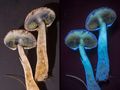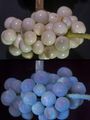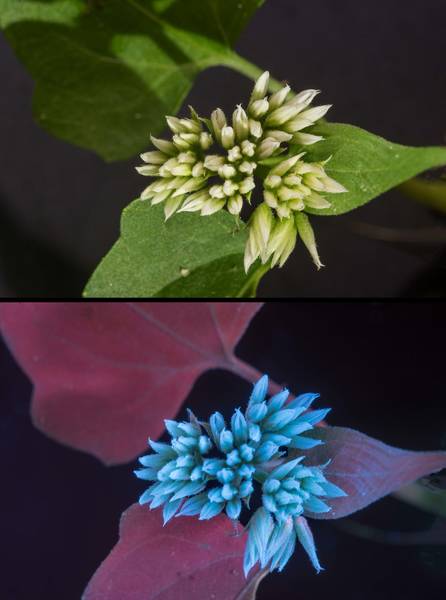

Climbing hempvine (Mikania scandens) when exposed to regular daylight as well as when illuminated by a 365 nm ultraviolet (UV-A) blacklight collected on Stubblefield section of Lone Star hiking trail in Sam Houston National Forest. Texas


Album 3621: Sam Houston Forest, Texas, September 15, 2024
The image presents a striking comparison between the appearance of climbing hempvine (Mikania scandens) under regular daylight and when illuminated by a blacklight that emits ultraviolet radiation at a wavelength of 365 nm, specifically UV-A light.
**Image Composition**
* The top half of the image features the plant's flower in natural daylight.
+ In daylight, the flower appears white or pale yellow, with small buds tightly clustered together.
+ The leaves are green and appear healthy.
* The bottom half of the image shows the same plant but under UV-A blacklight illumination.
+ Under UV-A light, the flower exhibits a dramatic change in color, turning blue.
+ This transformation is likely due to the absorption of specific wavelengths of ultraviolet radiation by pigments present in the flower.
**Background and Context**
* The background of the image appears dark, suggesting that it was taken at night or in low-light conditions.
* The use of a blacklight with a narrow wavelength range (365 nm) allows for the visualization of fluorescent effects in plants and other materials.
**Conclusion**
The image highlights the ability of certain wavelengths of ultraviolet radiation to induce fluorescence in specific pigments, revealing new details about plant biology. This phenomenon can be used in various fields such as botany, ecology, and conservation science. – AI vision
🇪🇸 Descripción en español / Spanish Description
El enredadera hempvine (Mikania scandens) al exponerla a la luz diurna habitual y cuando se ilumina con una lámpara negra de ultravioletas (UV-A) de 365 nm recogida en la sección Stubblefield del sendero Lone Star en el Bosque Nacional Sam Houston, Texas. 15 de septiembre de 2024. La imagen presenta una comparación sorprendente entre el aspecto de la enredadera hempvine (Mikania scandens) bajo luz diurna habitual y cuando se ilumina con una lámpara negra que emite radiación ultravioleta a una longitud de onda de 365 nm, específicamente luz UV-A.
**Composición de la imagen** * La mitad superior de la imagen muestra la flor de la planta bajo luz natural. + En daylight, el color de la flor aparece blanco o amarillo pálido, con pequeños brotes agrupados juntos. + Las hojas son verdes y parecen sanas. * La mitad inferior de la imagen muestra la misma planta, pero bajo iluminación ultravioleta UV-A. + Bajo luz UV-A, la flor presenta un cambio drástico en el color, volviéndose azul. + Este cambio es probable que se deba a la absorción de longitudes de onda específicas de radiación ultravioleta por pigmentos presentes en la flor.
**Antecedentes y contexto** * El fondo de la imagen aparece oscuro, lo que sugiere que fue tomada de noche o en condiciones de poca luz. * El uso de una lámpara negra con un estrecho rango de longitudes de onda (365 nm) permite la visualización de efectos fluorescentes en plantas y otros materiales. **Conclusión** La imagen destaca la capacidad de ciertas longitudes de onda de radiación ultravioleta para inducir fluorescencia en pigmentos específicos, revelando nuevos detalles sobre la biología vegetal. Este fenómeno puede usarse en varios campos como botánica, ecología y ciencias de la conservación. – Spanish translation