 |
| |||||||||||||||

| ||||||||||||||||


| Similar | 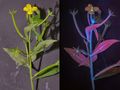  |
  |
  |
  |
  |
| |||||||||||||||||||||||||||
| |||||||||||||||||||||||||||
| 1996 1997 1998 1999 2000 2001 2002 2003 2004 2005 2006 2007 2008 2009 2010 2011 2012 2013 2014 2015 2016 2017 2018 2019 2020 2021 2022 2023 2024 2025 2026 | |||||||||||||||||||||||||||
| New version Slide Show Most Popular Full List Statistics Technical Details Home Page | |||||||||||||||||||||||||||
The image presents a striking comparison between the appearance of climbing hempvine (Mikania scandens) under regular daylight and when illuminated by a blacklight that emits ultraviolet radiation at a wavelength of 365 nm, specifically UV-A light. **Image Composition** * The top half of the image features the plant's flower in natural daylight. **Background and Context** * The background of the image appears dark, suggesting that it was taken at night or in low-light conditions. **Conclusion** The image highlights the ability of certain wavelengths of ultraviolet radiation to induce fluorescence in specific pigments, revealing new details about plant biology. This phenomenon can be used in various fields such as botany, ecology, and conservation science. – AI vision |
El enredadera hempvine (Mikania scandens) al exponerla a la luz diurna habitual y cuando se ilumina con una lámpara negra de ultravioletas (UV-A) de 365 nm recogida en la sección Stubblefield del sendero Lone Star en el Bosque Nacional Sam Houston, Texas. 15 de septiembre de 2024. La imagen presenta una comparación sorprendente entre el aspecto de la enredadera hempvine (Mikania scandens) bajo luz diurna habitual y cuando se ilumina con una lámpara negra que emite radiación ultravioleta a una longitud de onda de 365 nm, específicamente luz UV-A. **Composición de la imagen** * La mitad superior de la imagen muestra la flor de la planta bajo luz natural. + En daylight, el color de la flor aparece blanco o amarillo pálido, con pequeños brotes agrupados juntos. + Las hojas son verdes y parecen sanas. * La mitad inferior de la imagen muestra la misma planta, pero bajo iluminación ultravioleta UV-A. + Bajo luz UV-A, la flor presenta un cambio drástico en el color, volviéndose azul. + Este cambio es probable que se deba a la absorción de longitudes de onda específicas de radiación ultravioleta por pigmentos presentes en la flor. **Antecedentes y contexto** * El fondo de la imagen aparece oscuro, lo que sugiere que fue tomada de noche o en condiciones de poca luz. * El uso de una lámpara negra con un estrecho rango de longitudes de onda (365 nm) permite la visualización de efectos fluorescentes en plantas y otros materiales. **Conclusión** La imagen destaca la capacidad de ciertas longitudes de onda de radiación ultravioleta para inducir fluorescencia en pigmentos específicos, revelando nuevos detalles sobre la biología vegetal. Este fenómeno puede usarse en varios campos como botánica, ecología y ciencias de la conservación. – Spanish translation |
Keyword variants
high resolution online digital collection
Houston National Forest photograph
Lone Star State
United States
picture gallery
photo album
documentary photographs
daily pics
TX
travelogue
snapshots
sightseeing
photowalks
photoblog
graphic
fotografias
foto
America