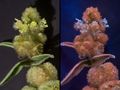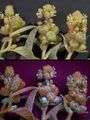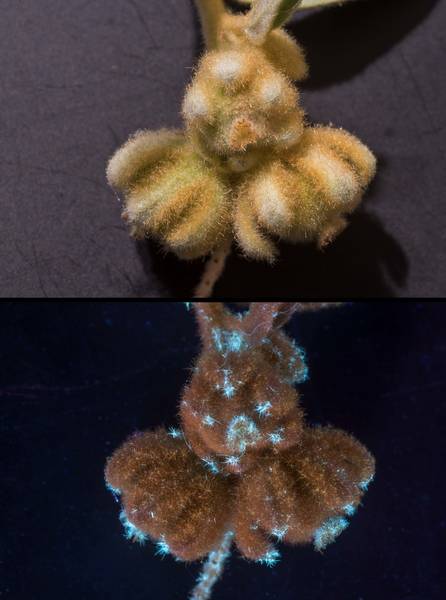

Fruits of woolly croton (hogwort, Croton capitatus) when exposed to regular daylight as well as when illuminated by a 365 nm ultraviolet (UV-A) blacklight from David E. Schob Nature Preserve at 906 Ashburn St. College Station, Texas


Album 3622: College Station, Texas, September 16 - 18, 2024
The image presents a comparative view of woolly croton fruits under two distinct lighting conditions: regular daylight and ultraviolet (UV-A) blacklight illumination. The top photograph displays three round fruits with fuzzy, yellowish-orange exteriors that resemble cotton balls or small pom-poms. These fruits are positioned on a dark background, allowing the viewer to focus on their texture and color.
In contrast, the bottom photograph captures the same fruit cluster under UV-A light. This reveals the presence of blue fluorescent spots scattered across the surface of the fuzzy fruits. The background in this image is also dark, but it appears slightly lighter than that of the top photograph due to the enhanced visibility of the blue fluorescence.
The overall effect of the two photographs is striking, showcasing how different lighting conditions can alter our perception and appreciation of natural objects. By juxtaposing these images, we gain a deeper understanding of the unique characteristics of woolly croton fruits and their ability to absorb and reflect light in various ways. – AI vision
🇪🇸 Descripción en español / Spanish Description
Los frutos del crotón lanudo (hogwort, Croton capitatus) cuando se exponen a la luz diurna regular y también cuando están iluminados por una luz negra ultravioleta (UV-A) de 365 nm en el Parque Natural David E. Schob en 906 Ashburn Street, College Station, Texas, septiembre 18, 2024. La imagen presenta una vista comparativa de los frutos del crotón lanudo bajo dos condiciones de iluminación distintas: luz diurna regular e iluminación con luz negra ultravioleta (UV-A). La fotografía superior muestra tres frutos redondos con exteriores peludos y anaranjados amarillentos que recuerdan a pelotas de algodón o pompones pequeños. Estos frutos están posicionados sobre un fondo oscuro, lo que permite al espectador centrarse en su textura y color. En contraste, la fotografía inferior captura el mismo racimo de frutos bajo luz UV-A. Esto revela la presencia de manchas fluorescentes azules dispersadas a través de los frutos peludos. El fondo en esta imagen también es oscuro, pero aparece ligeramente más claro que el de la fotografía superior debido a la mayor visibilidad de la fluorescencia azul. El efecto general de las dos fotografías es sorprendente, mostrando cómo diferentes condiciones de iluminación pueden alterar nuestra percepción y apreciación de objetos naturales. Yuntando estas imágenes, adquirimos una comprensión más profunda de las características únicas de los frutos del crotón lanudo y su habilidad para absorber y reflejar la luz de distintas formas. – Spanish translation