
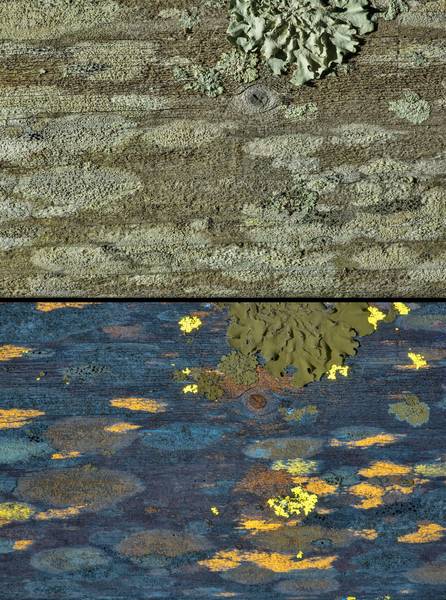

Wooden bench with lichens when exposed to regular daylight as well as when illuminated by a 365 nm ultraviolet (UV-A) blacklight in David E. Schob Nature Preserve at 906 Ashburn St. College Station, Texas


Album 3631: College Station and Sam Houston Forest, Texas, October 11 - 13, 2024
The image shows two side-by-side images of a wooden bench with lichens under different lighting conditions: regular daylight and ultraviolet (UV-A) blacklight illumination. The top image is taken during daytime exposure to natural light, while the bottom image captures the same scene under UV-A blacklight.
**Top Image (Daytime):**
* The bench appears brown or grayish-brown due to age.
* Lichens are visible but do not exhibit any significant color changes compared to their appearance in daylight.
**Bottom Image (UV-A Blacklight Illumination):**
* Under UV-A blacklight, the lichens display a vibrant yellow-green fluorescence, indicating the presence of fluorescent pigments known as mycosporine-like amino acids (MAAs).
* The bench itself does not show any notable color change under UV-A light.
**Key Observations:**
* Lichens respond to UV-A blacklight by fluorescing due to MAAs.
* The bench's appearance remains unchanged under both lighting conditions.
This image illustrates the unique property of some lichens to emit fluorescent signals when exposed to specific wavelengths of light, such as those from UV-A blacklights. This phenomenon is crucial for understanding how these organisms interact with their environment and can serve as a tool in ecological research and monitoring biodiversity. – AI vision
🇪🇸 Descripción en español / Spanish Description
Banco de madera con líquenes cuando se expone a la luz del día normal, así como también cuando se ilumina con una luz negra ultravioleta (UV-A) de 365 nm en el David E. Schob Nature Preserve ubicado en 906 Ashburn Street. College Station, Texas, el 11 de octubre del 2024. La imagen muestra dos imágenes juntas de un banco de madera con líquenes bajo diferentes condiciones de iluminación: luz diurna normal e iluminación por una luz negra ultravioleta (UV-A). La imagen superior se toma durante la exposición diurna a la luz natural, mientras que la imagen inferior captura la misma escena bajo UV-A.
**Imagen Superior (Día):** * El banco aparece marrón o marrón grisáceo debido a su edad. * Los líquenes son visibles pero no muestran cambios de color significativos en comparación con su apariencia bajo luz diurna.**Imagen Inferior (Iluminación por Luz Negra Ultravioleta):**
* Bajo la luz UV-A, los líquenes presentan una fluorescencia amarillo verde brillante, lo que indica la presencia de pigmentos fluorescentes conocidos como aminoácidos microsorínicos (MAAs). * El banco en sí no muestra ningún cambio notable de color bajo luz UV-A. **Observaciones Clave:**
* Los líquenes responden a la luz UV-A fluoresciendo debido a los MAAs. * La apariencia del banco se mantiene invariable bajo ambas condiciones de iluminación. Esta imagen ilustra la propiedad única de algunos líquenes de emitir señales fluorescentes cuando se exponen a longitudes de onda específicas de luz, como las provenientes de luces UV-A. Este fenómeno es crucial para entender cómo estos organismos interactúan con su medio ambiente y puede servir como una herramienta en la investigación ecológica y monitoreo de biodiversidad. – Spanish translation


