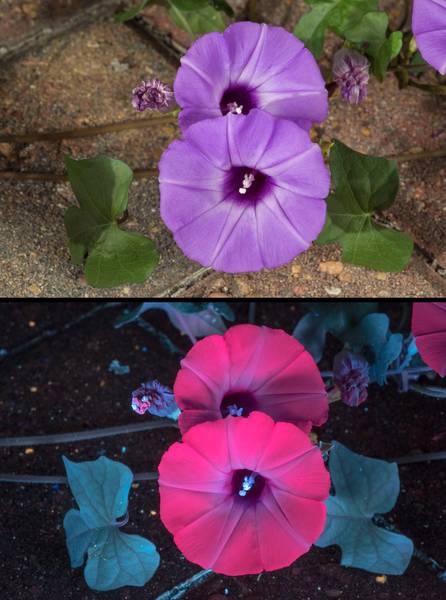

Morning glory (Ipomoea cordatotriloba) when exposed to regular daylight as well as when illuminated by a 365 nm ultraviolet (UV-A) blacklight in David E. Schob Nature Preserve at 906 Ashburn St. College Station, Texas


Album 3631: College Station and Sam Houston Forest, Texas, October 11 - 13, 2024
The image depicts two photographs of the same morning glory (Ipomoea cordatotriloba) plant taken under different lighting conditions. The top photo shows the flower in natural daylight, while the bottom photo reveals its vibrant colors when illuminated by a 365 nm ultraviolet (UV-A) blacklight.
**Natural Daylight Photo**
* **Flower Color**: The purple morning glory flowers are visible in the center of the image.
* **Background**: The background is blurred and appears to be soil or sand, with some green leaves visible behind the flower.
* **Lighting Condition**: The photo was taken during regular daylight hours.
**UV-A Blacklight Photo**
* **Flower Color**: Under UV-A blacklight illumination, the morning glory flowers display a vibrant pinkish-red color.
* **Background**: The background is still blurred and appears to be soil or sand, but with more pronounced shadows due to the UV light.
* **Lighting Condition**: The photo was taken using a 365 nm ultraviolet (UV-A) blacklight.
**Comparison of Photos**
The main difference between the two photos is the color of the morning glory flowers. In natural daylight, they appear purple, while under UV-A blacklight illumination, they display a vibrant pinkish-red color. This suggests that the morning glory plant has fluorescent properties, which become visible when exposed to certain wavelengths of light.
**Conclusion**
The image provides an interesting comparison of how different lighting conditions can affect the appearance of a flower. The use of UV-A blacklight illumination reveals the unique fluorescent properties of the morning glory plant, making it appear more vibrant and colorful than in natural daylight. This phenomenon highlights the importance of considering the lighting conditions when observing or photographing plants. – AI vision
🇪🇸 Descripción en español / Spanish Description
La Gloriosa mañana (Ipomoea cordatotriloba) cuando se expone a la luz del día regular, así como cuando se ilumina con una luz negra de longitud de onda ultravioleta (UV-A) de 365 nm en el David E. Schob Nature Preserve en 906 Ashburn Street. College Station, Texas, 11 de octubre del 2024. La imagen muestra dos fotografías de la misma planta Gloriosa mañana (Ipomoea cordatotriloba) tomadas en diferentes condiciones de iluminación. La foto superior muestra la flor a la luz del día natural, mientras que la foto inferior revela sus colores vibrantes cuando se ilumina con una luz negra ultravioleta (UV-A) de 365 nm.
**Foto de Luz Natural**: * **Color de las Flores**: Las flores moradas son visibles en el centro de la imagen. * **Fondo**: El fondo está borroso y parece ser tierra o arena, con algo de hojas verdes visibles detrás de la flor. * **Condición de Iluminación**: La foto se tomó durante las horas regulares del día. **Foto de Luz UV-A**: * **Color de las Flores**: Bajo iluminación ultravioleta (UV-A) de 365 nm, las flores de la gloriosa mañana exhiben un color rosado vibrante. * **Fondo**: El fondo sigue estando borroso y parece ser tierra o arena, pero con sombras más pronunciadas debido a la luz UV. * **Condición de Iluminación**: La foto se tomó usando una luz negra ultravioleta (UV-A) de 365 nm.
**Comparación de Fotos**: El principal diferencia entre las dos fotos es el color de las flores de la Gloriosa mañana. En la luz natural, aparecen púrpuras y bajo iluminación UV-A, muestran un color rosado vibrante. Esto sugiere que la planta tiene propiedades fluorescentes, que se vuelven visibles cuando se expone a ciertas longitudes de onda de luz.
**Conclusión**: La imagen proporciona una interesante comparación de cómo diferentes condiciones de iluminación pueden afectar la apariencia de una flor. El uso de iluminación UV-A revela las propiedades fluorescentes únicas de la planta Gloriosa mañana, haciéndola parecer más vibrante y colorida que bajo luz natural. Este fenómeno subraya la importancia de considerar las condiciones de iluminación al observar o fotografiar plantas. – Spanish translation