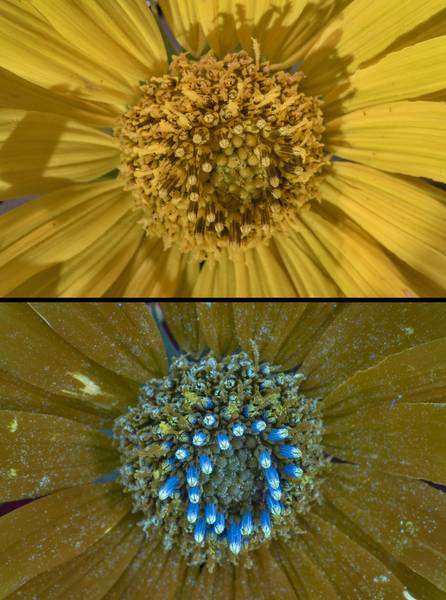

Center of Maximilian sunflower (Helianthus maximiliani) both in natural light and under 365 nm ultraviolet (UV-A) blacklight from David E. Schob Nature Preserve at 906 Ashburn St. College Station, Texas


Album 3622: College Station, Texas, September 16 - 18, 2024
The image presents a comparative analysis of the center of a Maximilian sunflower (Helianthus maximiliani) under natural light and ultraviolet (UV-A) blacklight illumination.
**Natural Light:**
* The top half of the image showcases the center of the flower in its natural state.
* A bright yellow color dominates the petals, with a prominent cluster of tiny, cream-colored stamens at the center.
* The stamens are densely packed and appear to be slightly curved towards the center of the flower.
**UV-A Blacklight:**
* The bottom half of the image reveals the same area under UV-A blacklight illumination.
* A significant change is observed in the appearance of the stamens, which now display a vibrant blue coloration.
* This blue hue is particularly pronounced on the tips of the stamens, giving them a striking contrast to the surrounding yellow petals.
**Comparison and Implications:**
* The use of UV-A blacklight highlights the presence of ultraviolet-absorbing pigments in the flower's reproductive structures.
* These pigments are likely responsible for attracting pollinators, such as bees or butterflies, which can see into the ultraviolet spectrum.
* The blue coloration under UV-A light may serve as a visual cue to guide these pollinators towards the nectar-rich center of the flower.
Overall, the image effectively demonstrates the importance of considering both natural and ultraviolet light when studying plant morphology and behavior. – AI vision
🇪🇸 Descripción en español / Spanish Description
El centro del girasol de Maximiliano (Helianthus maximiliani) tanto bajo luz natural como bajo luz negra de longitud de onda de 365 nm ultravioleta (UV-A) del David E. Schob Nature Preserve en 906 Ashburn Street, College Station, Texas, el 18 de septiembre de 2024. La imagen presenta un análisis comparativo del centro de un girasol de Maximiliano (Helianthus maximiliani) bajo luz natural e iluminación ultravioleta (UV-A). **Luz natural:** * La mitad superior de la imagen muestra el centro de la flor en su estado natural. * Un color amarillo brillante domina los pétalos, con un grupo prominente de estambres crema-coloreados pequeños en el centro. * Los estambres están densamente empaquetados y parecen estar ligeramente curvados hacia el centro de la flor. **Luz ultravioleta-A:** * La mitad inferior de la imagen muestra la misma área bajo iluminación con luz negra ultravioleta-A. * Un cambio significativo se observa en la apariencia de los estambres, que ahora presentan un color azul vibrante. * Este tono azul es particularmente pronunciado en las puntas de los estambres, lo que les da un contraste sorprendente con los pétalos amarillos circundantes. **Comparación e implicaciones:** * El uso de luz negra ultravioleta-A destaca la presencia de pigmentos absorbentes de ultravioleta en las estructuras reproductivas de la flor. * Es probable que estos pigmentos sean los responsables de atraer polinizadores, como abejas o mariposas, que pueden ver el espectro ultravioleta. * El azul bajo luz ultravioleta-A puede servir como señal visual para guiar a estos polinizadores hacia el centro de la flor rico en néctar. **En general, la imagen demuestra efectivamente la importancia de considerar tanto la luz natural como la ultravioleta al estudiar la morfología y el comportamiento de las plantas**. – Spanish translation