
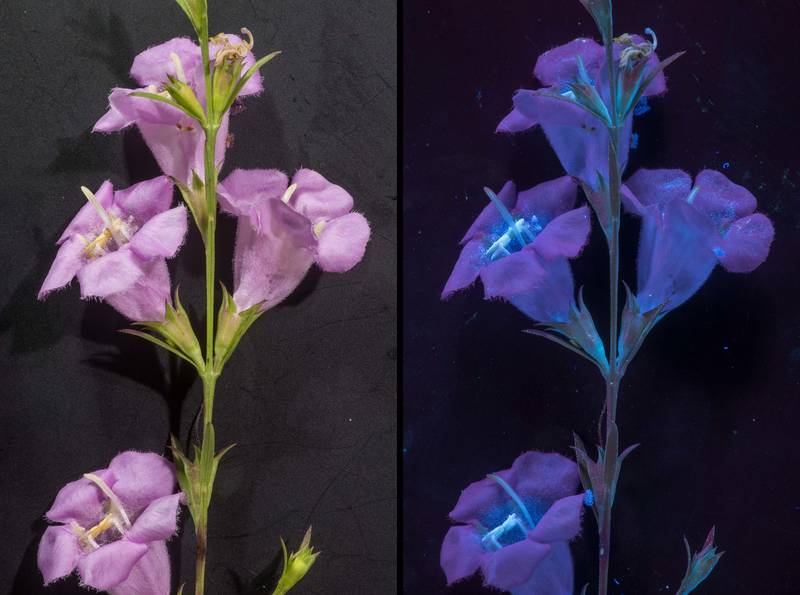

Purple gerardia (false foxglove, Agalinis) when exposed to regular daylight as well as when illuminated by a 365 nm ultraviolet (UV-A) blacklight from Lick Creek Greenway Trail. College Station, Texas


Album 3623: College Station - Sam Houston Forest, Texas, September 19 - 21, 2024
The image presents a striking comparison of purple gerardia flowers under two different lighting conditions: regular daylight and UV-A blacklight illumination. The photograph is divided into two halves, with the left side showing the plant's appearance in natural light and the right side displaying its response to 365 nm ultraviolet (UV-A) blacklight from Lick Creek Greenway Trail.
**Left Side: Regular Daylight**
* The purple gerardia flowers are depicted in their natural state.
* Their petals exhibit a soft, delicate lavender hue.
* The stems appear green and slender.
* The background is dark gray, which helps to accentuate the subtle colors of the flowers.
**Right Side: UV-A Blacklight Illumination**
* The same plant is shown under the influence of 365 nm ultraviolet (UV-A) blacklight.
* The purple gerardia flowers glow with an intense blue-purple fluorescence, creating a striking contrast against the dark gray background.
* This effect highlights the presence of fluorescent pigments in the flower's petals and stems.
**Comparison and Observations**
* The use of UV-A blacklight causes the purple gerardia flowers to fluoresce intensely, revealing their unique ability to absorb ultraviolet light and emit it back as visible light.
* This phenomenon is often referred to as "fluorescence" or "bioluminescence."
* The image showcases the fascinating interaction between light and biological materials, demonstrating how UV-A blacklight can be used to visualize and study the properties of fluorescent pigments in plants.
Overall, the image effectively illustrates the remarkable effects of UV-A blacklight on purple gerardia flowers, highlighting their ability to absorb and emit light in a way that is not visible under regular daylight conditions. – AI vision
🇪🇸 Descripción en español / Spanish Description
La gérardia púrpura (falso amapolas, Agalinis) cuando se expone a la luz del día normal y también cuando se ilumina con una luz negra ultravioleta de 365 nm desde el Lick Creek Greenway Trail. Sendero College Station, Texas, 19 de septiembre de 2024. La imagen presenta una comparación sorprendente de las flores de gérardia púrpura en diferentes condiciones de iluminación: luz del día normal e iluminación con luz negra ultravioleta (UV-A) de 365 nm desde el Lick Creek Greenway Trail. **Lado izquierdo: Luz del día** * Las flores de gérardia púrpura se muestran en su estado natural. * Sus pétalos exhiben un tono lavanda suave y delicado. * Los tallos aparecen verdes y esbeltos. * El fondo es gris oscuro, lo que ayuda a acentuar los colores sutiles de las flores. **Lado derecho: Iluminación con luz negra UV-A** * La misma planta se muestra bajo la influencia de luz negra ultravioleta (UV-A) de 365 nm. * Las flores de gérardia púrpura brillan con una fluorescencia azul-púrpura intensa, creando un contraste sorprendente contra el fondo gris oscuro. * Este efecto destaca la presencia de pigmentos fluorescentes en los pétalos y tallos de las flores. **Comparación y observaciones** * El uso de luz negra UV-A hace que las flores de gérardia púrpura florezcan intensamente, revelando su capacidad única para absorber la luz ultravioleta y emitirla como luz visible. * Este fenómeno se conoce comúnmente como "fluorescencia" o "bioluminiscencia". * La imagen muestra la fascinante interacción entre la luz y los materiales biológicos, demostrando cómo se puede utilizar la luz negra UV-A para visualizar y estudiar las propiedades de los pigmentos fluorescentes en las plantas. **En general, la imagen ilustra eficazmente los efectos notables de la luz negra UV-A sobre las flores de gérardia púrpura, destacando su capacidad para absorber y emitir luz de una manera que no es visible en condiciones de luz del día normal. – Spanish translation


