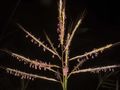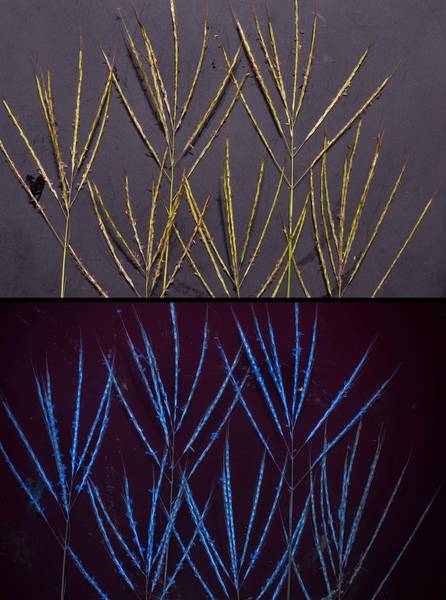

King ranch bluestem grass (Bothriochloa ischaemum) when exposed to regular daylight as well as when illuminated by a 365 nm ultraviolet (UV-A) blacklight from Lick Creek Greenway Trail. College Station, Texas


Album 3623: College Station - Sam Houston Forest, Texas, September 19 - 21, 2024
The image presents a comparative analysis of King Ranch Bluestem grass under two distinct lighting conditions: regular daylight and ultraviolet (UV-A) blacklight illumination. The photograph is divided into two sections, each showcasing a different aspect of the plant's appearance.
**Daylight Exposure**
* **Background:** A dark grey background provides a neutral backdrop for the grass.
* **Grass Appearance:** In this section, the King Ranch Bluestem grass appears as a typical yellowish-green color, characteristic of its species. The blades are slender and elongated, with a smooth texture that suggests they are relatively healthy.
**UV-A Blacklight Illumination**
* **Background:** The background remains dark grey but exhibits some subtle variations in tone due to the blacklight's effect.
* **Grass Appearance:** When exposed to UV-A blacklight, the grass undergoes a significant transformation. Its color shifts dramatically, becoming a vibrant blue hue that contrasts sharply with its natural yellowish-green appearance under daylight conditions. This change is particularly pronounced along the edges and tips of the blades, where the effect seems most intense.
**Key Observations**
* **Color Change:** The most striking aspect of this comparison is the profound color shift induced by UV-A blacklight illumination. This phenomenon highlights the unique properties of certain plant species in reacting to specific wavelengths of light.
* **Structural Details:** While the overall appearance changes, detailed observations reveal that the structural integrity and texture of the grass remain largely unchanged between the two lighting conditions. The blades retain their slender profile and smooth surface.
**Conclusion**
In conclusion, this image effectively illustrates how King Ranch Bluestem grass responds to different lighting environments. The transformation from its natural yellowish-green color to a vibrant blue under UV-A blacklight illumination underscores the complex interactions between plants and light. This phenomenon can offer insights into plant biology and potentially inform applications in fields such as botany or environmental science. – AI vision
🇪🇸 Descripción en español / Spanish Description
La hierba King Ranch Bluestem (Bothriochloa ischaemum) cuando se expone a la luz del día regular, así como cuando se ilumina con una luz negra de longitud de onda de 365 nm UV-A en Lick Creek Greenway Trail. College Station, Texas, 19 de septiembre de 2024. La imagen presenta un análisis comparativo del pasto King Ranch Bluestem bajo dos condiciones de iluminación distintas: luz diurna regular e iluminación ultravioleta (UV-A) negra. La fotografía se divide en dos secciones, cada una presentando un aspecto diferente de la apariencia de la planta. **Exposición a Luz Diurna** * **Fondo:** Un fondo gris oscuro proporciona un contexto neutro para el pasto. * **Apariencia del Pasto:** En esta sección, la hierba King Ranch Bluestem aparece en su típico color verdoso amarillento, característico de su especie. Las hojas son delgadas y alargadas, con una textura lisa que sugiere que están relativamente sanas. **Iluminación Ultravioleta (UV-A)** * **Fondo:** El fondo sigue siendo gris oscuro pero exhibe variaciones sutiles de tono debido al efecto de la luz negra. * **Apariencia del Pasto:** Cuando se expone a la iluminación UV-A, el pasto sufre una transformación significativa. Su color cambia drásticamente, convirtiéndose en un tono azul vibrante que contrasta fuertemente con su aspecto natural bajo la luz diurna. Este cambio es particularmente pronunciado a lo largo de los bordes y las puntas de las hojas, donde el efecto parece más intenso. **Observaciones Clave** * **Cambio de Color:** El aspecto más impactante de esta comparación es la profunda transformación inducida por la iluminación UV-A. Este fenómeno resalta las propiedades únicas de ciertas especies de plantas para reaccionar a longitudes de onda específicas de luz. * **Detalles Estructurales:** Aunque el aspecto general cambia, las observaciones detalladas revelan que la integridad estructural y la textura del pasto permanecen prácticamente inalteradas entre las dos condiciones de iluminación. Las hojas retienen su perfil delgado y superficie lisa. **Conclusión** En conclusión, esta imagen ilustra efectivamente cómo reacciona el pasto King Ranch Bluestem a distintos entornos de iluminación. El cambio del color natural amarillento al azul bajo la luz negra ultravioleta de 365 nm subraya las complejas interacciones entre plantas y luz. Este fenómeno puede ofrecer insights en biología vegetal e información potencialmente útil en ámbitos como la botánica o ciencia ambiental. – Spanish translation