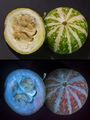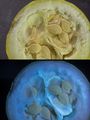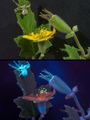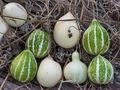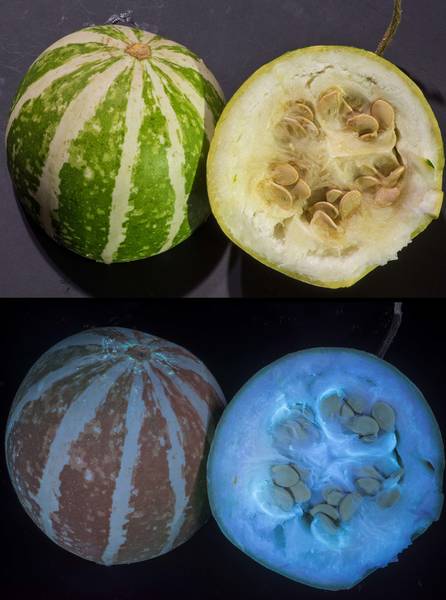

Dissected buffalo gourd both in natural light and under 365 nm ultraviolet (UV-A) blacklight from Nails Creek Unit of Somerville Lake State Park. Texas


Album 3624: Lake Somerville, Texas, September 22, 2024
The image presents a comparative analysis of the same buffalo gourd specimen in two distinct lighting conditions: natural light and under ultraviolet (UV-A) blacklight. The top section showcases the fruit's exterior and interior under natural illumination, while the bottom section reveals its appearance under UV-A blacklight.
**Natural Light:**
* The buffalo gourd is depicted as a greenish-yellow sphere with white stripes.
* A cross-section of the fruit on the right side exposes tan seeds arranged in rows within the core.
* The exterior of the fruit exhibits small, white dots that may be indicative of hairs or other features.
* The background surrounding the fruit appears to be black, although this could be a result of image processing rather than an actual surface.
**UV-A Blacklight:**
* Under UV-A blacklight illumination, the buffalo gourd's appearance changes significantly.
* The fruit's exterior turns blue, with white stripes becoming more pronounced and appearing almost white against the blue background.
* The interior of the fruit also appears blue, with tan seeds remaining visible within the core.
* The background surrounding the fruit remains black.
**Comparison:**
* The most striking difference between the two images is the dramatic change in coloration under UV-A blacklight illumination.
* While the natural light image reveals a more muted greenish-yellow hue on the exterior and tan seeds within the core, the UV-A blacklight image transforms these colors to blue, with white stripes becoming even more prominent.
**Conclusion:**
The image effectively demonstrates the impact of different lighting conditions on the appearance of a buffalo gourd specimen. The use of UV-A blacklight illumination reveals new details about the fruit's coloration and texture, highlighting its potential applications in fields such as botany or forensic science. Overall, this comparison provides valuable insights into the effects of various lighting sources on plant morphology. – AI vision
🇪🇸 Descripción en español / Spanish Description
Disecada calabaza búfala tanto a la luz natural como bajo una luz negra de longitud de onda ultravioleta (UV-A) de 365 nm en la Unidad Nails Creek del Parque Estatal Somerville Lake, Texas, el 22 de septiembre de 2024. La imagen presenta un análisis comparativo del mismo espécimen de calabaza búfala en dos condiciones de iluminación distintas: luz natural y bajo luz negra ultravioleta (UV-A). La parte superior muestra el exterior e interior de la fruta con iluminación natural, mientras que la parte inferior revela su apariencia bajo luz UV-A. **Luz Natural:** *La calabaza búfala se representa como una esfera amarillo verdosa con rayas blancas. *Una sección transversal de la fruta en el lado derecho expone semillas tostadas dispuestas en filas dentro del núcleo. *El exterior de la fruta exhibe pequeños puntos blancos que pueden ser indicativos de pelos u otras características. *El fondo que rodea a la fruta parece ser negro, aunque esto podría ser el resultado del procesamiento de imágenes en lugar de una superficie real.**Luz UV-A:** *Bajo iluminación con luz negra UV-A, la apariencia de la calabaza búfala cambia significativamente. *El exterior de la fruta se vuelve azul, con rayas blancas que se vuelven más prominentes y parecen casi blancas contra el fondo azul. *El interior de la fruta también aparece azul, manteniendo visible las semillas tostadas dentro del núcleo. *El fondo que rodea a la fruta sigue siendo negro. **Comparación:** *La diferencia más impactante entre las dos imágenes es el drástico cambio en la coloración bajo iluminación con luz negra UV-A. *Mientras que la imagen de luz natural revela un tono amarillo verdoso más moderado en el exterior y semillas tostadas visibles dentro del núcleo, la imagen UV-A transforma estos colores a azul, con rayas blancas aún más prominentes. **Conclusión:** La imagen demuestra efectivamente el impacto de diferentes condiciones de iluminación en la apariencia de un espécimen de calabaza búfala. El uso de luz negra UV-A revela nuevos detalles sobre la coloración y textura de la fruta, resaltando su potencial aplicaciones en campos como la botánica o la ciencia forense. En general, esta comparación proporciona importantes insights sobre los efectos de diferentes fuentes de iluminación en la morfología de las plantas. – Spanish translation