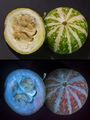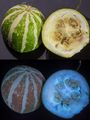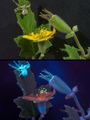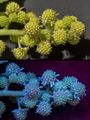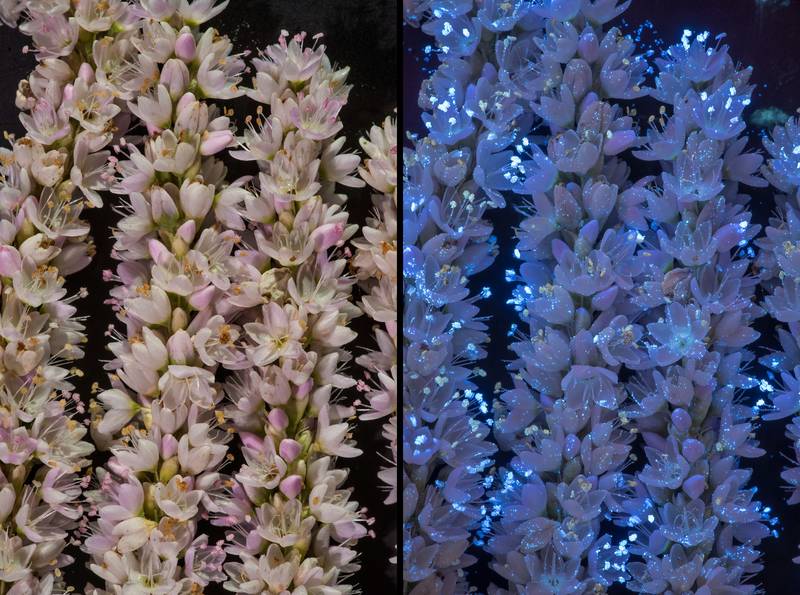

Flowers of smartweed (Persicaria, Polygonum) both in natural light and under 365 nm ultraviolet (UV-A) blacklight from Nails Creek Unit of Somerville Lake State Park. Texas


Album 3624: Lake Somerville, Texas, September 22, 2024
The image features two photographs of smartweed flowers, one taken in natural light and the other under 365 nm ultraviolet (UV-A) blacklight. The natural light photograph shows the flowers as white with pinkish hues on their stamens.
* **Natural Light Photograph**
* The photo is a close-up view of the flower heads.
* The flower buds are closed, and the petals are not visible due to being tightly wrapped around the central stem.
* The stamen, which are usually yellowish in color, have turned pinkish in this particular species.
* **UV-A Blacklight Photograph**
* This photo is also a close-up view of the flower heads but taken under UV-A blacklight.
* Under UV-A light, the flowers appear to glow and reflect back a blue-green hue.
* The stamen remain pinkish in color.
The primary difference between the two photographs is that the natural light photograph captures the flowers' appearance as they naturally occur, while the UV-A blacklight photograph reveals a unique aspect of their structure and properties when exposed to ultraviolet radiation. This highlights the importance of considering different lighting conditions when observing or capturing images of biological specimens. – AI vision
🇪🇸 Descripción en español / Spanish Description
Las flores de la maleza inteligente (Persicaria, Polygonum) tanto a la luz natural como bajo luz negra ultravioleta (UV-A) de 365 nm en Nails Creek Unit of Somerville Lake State Park. Texas, septiembre 22, 2024. La imagen presenta dos fotografías de flores de maleza inteligente, una tomada a la luz natural y otra bajo luz negra ultravioleta (UV-A) de 365 nm. La fotografía tomada con luz natural muestra las flores blancas con tonos rosados en sus estambres.
**Fotografía de Luz Natural** *La foto es una vista cercana a las cabezas de flor. *Los botones florales están cerrados y los pétalos no son visibles debido a que están envueltos apretadamente alrededor del tallo central. *Los estambres, que por lo general son de color amarillento, han adquirido un tono rosado en esta especie particular.
**Fotografía bajo Luz Ultravioleta A (UV-A)** *Esta foto también es una vista cercana a las cabezas de flor tomada bajo luz ultravioleta A. *Bajo la luz UV-A, las flores parecen brillar y reflejar un tono azul verdoso. *Los estambres siguen teniendo un tono rosado. La principal diferencia entre las dos fotografías es que la fotografía tomada con luz natural capta la apariencia de las flores tal como se presentan en su estado natural, mientras que la fotografía bajo UV-A revela un aspecto único de su estructura y propiedades cuando son expuestas a radiación ultravioleta. Esto destaca la importancia de considerar diferentes condiciones de iluminación al observar o capturar imágenes de especímenes biológicos. – Spanish translation