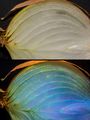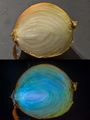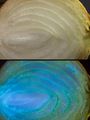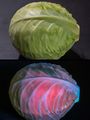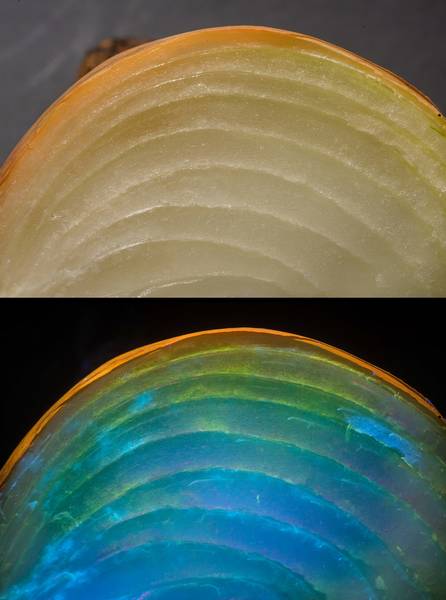

Close-up of yellow onion both in natural light and under 365 nm ultraviolet (UV-A) blacklight from HEB supermarket. College Station, Texas


Album 3627: College Station, Texas, October 2 - 4, 2024
The image presents a close-up view of a yellow onion, showcasing its appearance in natural light and under 365 nm ultraviolet (UV-A) blacklight.
**Natural Light Image:**
* The top half of the image displays the onion's surface illuminated by natural light.
* The onion's outer layers are translucent and slightly yellowish-white.
* The inner layers appear more opaque and have a subtle sheen, likely due to the presence of moisture or oils within the cells.
* The overall coloration is characteristic of a typical yellow onion.
**UV-A Blacklight Image:**
* The bottom half of the image shows the same onion surface illuminated by 365 nm UV-A blacklight.
* Under this specific wavelength of light, the onion's natural pigments fluoresce, producing an intense blue-green glow on its surface.
* The UV-A blacklight highlights the outer layers, making them appear more vibrant and fluorescent compared to the inner layers.
* This effect is likely due to the presence of flavonoids or other compounds that absorb UV radiation and emit light at shorter wavelengths.
**Comparison:**
* A notable difference between the two images is the appearance of the onion's surface under natural light versus UV-A blacklight.
* While the natural light image reveals the onion's subtle coloration, the UV-A blacklight image highlights its fluorescent properties.
* This comparison demonstrates how different lighting conditions can alter our perception of an object's appearance and reveal hidden characteristics.
**Conclusion:**
The image effectively showcases the unique optical properties of a yellow onion under various lighting conditions. The use of 365 nm UV-A blacklight reveals the onion's fluorescent capabilities, which may not be immediately apparent in natural light. This visual representation highlights the importance of considering multiple perspectives when examining an object's appearance and behavior. – AI vision
🇪🇸 Descripción en español / Spanish Description
En primer plano de la cebolla amarilla tanto a la luz natural como bajo la luz negra ultravioleta (UV-A) de 365 nm del supermercado HEB. College Station, Texas, 3 de octubre de 2024. La imagen presenta un primer plano de una cebolla amarilla, mostrando su aspecto a la luz natural y bajo la luz negra ultravioleta (UV-A) de 365 nm. **Imagen con Luz Natural:** * La mitad superior de la imagen muestra la superficie de la cebolla iluminada por la luz del día. * Las capas externas de la cebolla son traslúcidas y ligeramente amarillentas. * Las capas internas parecen más opacas y tienen un ligero brillo, probablemente debido a la presencia de humedad o aceites dentro de las células. * La coloración general es característica de una cebolla amarilla típica. **Imagen con Luz Negra UV-A:** * La mitad inferior de la imagen muestra la misma superficie de la cebolla iluminada por luz negra UV-A de 365 nm. * Bajo esta longitud de onda específica de luz, los pigmentos naturales de la cebolla fluorescen, produciendo un intenso brillo verde-azulado en su superficie. * La luz negra UV-A resalta las capas externas, haciéndolas parecer más vibrantes y fluorescentes en comparación con las capas internas. * Este efecto se debe probablemente a la presencia de flavonoides u otros compuestos que absorben radiación UV y emiten luz a longitudes de onda más cortas. **Comparación:** * Una diferencia notable entre las dos imágenes es el aspecto de la superficie de la cebolla bajo luz natural versus UV-A negra. * Mientras que la imagen con luz natural revela la coloración sutil de la cebolla, la imagen con luz UV-A negra resalta sus propiedades fluorescentes. * Esta comparación demuestra cómo diferentes condiciones de iluminación pueden alterar nuestra percepción del aspecto y las características ocultas de un objeto. **Conclusión:** La imagen muestra eficazmente las propiedades ópticas únicas de una cebolla amarilla bajo varias condiciones de iluminación. El uso de luz UV-A de 365 nm revela las capacidades fluorescentes de la cebolla, lo que podría no ser inmediatamente evidente a simple vista. Esta representación visual destaca la importancia de considerar múltiples perspectivas al examinar el aspecto y el comportamiento de un objeto. – Spanish translation