 |
| |||||||||||||||

| ||||||||||||||||


| Similar | 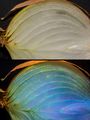  |
  |
  |
  |
  |
| |||||||||||||||||||||||||||
| |||||||||||||||||||||||||||
| 1996 1997 1998 1999 2000 2001 2002 2003 2004 2005 2006 2007 2008 2009 2010 2011 2012 2013 2014 2015 2016 2017 2018 2019 2020 2021 2022 2023 2024 2025 2026 | |||||||||||||||||||||||||||
| New version Slide Show Most Popular Full List Statistics Technical Details Home Page | |||||||||||||||||||||||||||
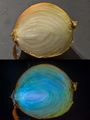
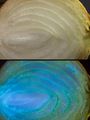
The image presents a close-up view of a yellow onion, showcasing its appearance in natural light and under 365 nm ultraviolet (UV-A) blacklight. **Natural Light Image:** * The top half of the image displays the onion's surface illuminated by natural light. **UV-A Blacklight Image:** * The bottom half of the image shows the same onion surface illuminated by 365 nm UV-A blacklight. **Comparison:** * A notable difference between the two images is the appearance of the onion's surface under natural light versus UV-A blacklight. **Conclusion:** The image effectively showcases the unique optical properties of a yellow onion under various lighting conditions. The use of 365 nm UV-A blacklight reveals the onion's fluorescent capabilities, which may not be immediately apparent in natural light. This visual representation highlights the importance of considering multiple perspectives when examining an object's appearance and behavior. – AI vision |
En primer plano de la cebolla amarilla tanto a la luz natural como bajo la luz negra ultravioleta (UV-A) de 365 nm del supermercado HEB. College Station, Texas, 3 de octubre de 2024. La imagen presenta un primer plano de una cebolla amarilla, mostrando su aspecto a la luz natural y bajo la luz negra ultravioleta (UV-A) de 365 nm. **Imagen con Luz Natural:** * La mitad superior de la imagen muestra la superficie de la cebolla iluminada por la luz del día. * Las capas externas de la cebolla son traslúcidas y ligeramente amarillentas. * Las capas internas parecen más opacas y tienen un ligero brillo, probablemente debido a la presencia de humedad o aceites dentro de las células. * La coloración general es característica de una cebolla amarilla típica. **Imagen con Luz Negra UV-A:** * La mitad inferior de la imagen muestra la misma superficie de la cebolla iluminada por luz negra UV-A de 365 nm. * Bajo esta longitud de onda específica de luz, los pigmentos naturales de la cebolla fluorescen, produciendo un intenso brillo verde-azulado en su superficie. * La luz negra UV-A resalta las capas externas, haciéndolas parecer más vibrantes y fluorescentes en comparación con las capas internas. * Este efecto se debe probablemente a la presencia de flavonoides u otros compuestos que absorben radiación UV y emiten luz a longitudes de onda más cortas. **Comparación:** * Una diferencia notable entre las dos imágenes es el aspecto de la superficie de la cebolla bajo luz natural versus UV-A negra. * Mientras que la imagen con luz natural revela la coloración sutil de la cebolla, la imagen con luz UV-A negra resalta sus propiedades fluorescentes. * Esta comparación demuestra cómo diferentes condiciones de iluminación pueden alterar nuestra percepción del aspecto y las características ocultas de un objeto. **Conclusión:** La imagen muestra eficazmente las propiedades ópticas únicas de una cebolla amarilla bajo varias condiciones de iluminación. El uso de luz UV-A de 365 nm revela las capacidades fluorescentes de la cebolla, lo que podría no ser inmediatamente evidente a simple vista. Esta representación visual destaca la importancia de considerar múltiples perspectivas al examinar el aspecto y el comportamiento de un objeto. – Spanish translation |
Keyword variants
high resolution online digital collection
Berlin on the Brazos
Lone Star State
United States
picture gallery
photo album
documentary photographs
daily pics
conservative town
Brazos County
TX
travelogue
snapshots
sightseeing
photowalks
photoblog
graphic
fotografias
foto
Bryan
America
Aggieland