Home Page > Picture Archives > Year 2024 > Album 3627 > Photo 11          
Section of yellow onion when exposed to regular...supermarket. College Station, Texas  
Previous
Previous
Next
Next
Browse current photo album: College Station, Texas

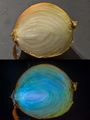
Section of yellow onion when exposed to regular daylight as well as when illuminated by a 365 nm ultraviolet (UV-A) blacklight from HEB supermarket. College Station, Texas, October 3, 2024

#3627-11
a
Thumbnail 3627-11: Section of yellow onion when exposed to...College Station, Texas Show full size picture

Histogram
Shooting data

X-Large Image
Similar   Thumbnail of picture 3627-09: Yellow onion when exposed to regular daylight as well as when ... College Station, Texas, October 3, 2024 Thumbnail of picture 3609-13: Section of a tangerine from Kroger supermarket when exposed to regular ... College Station, Texas, August 27, 2024 Thumbnail of picture 3642-33: Section of pineapple when exposed to regular daylight as well as when ... College Station, Texas, November 15, 2024 Thumbnail of picture 3609-09: Section of an orange from Kroger supermarket when exposed to regular ... College Station, Texas, August 27, 2024 Thumbnail of picture 3642-34: Section of top of a pineapple when exposed to regular daylight as well ... College Station, Texas, November 15, 2024
1996  1997  1998  1999  2000  2001  2002  2003  2004  2005  2006  2007  2008  2009  2010  2011  2012  2013  2014  2015  2016  2017  2018  2019  2020  2021  2022  2023  2024  2025  2026 
New version    Slide Show    Most Popular    Full List    Statistics    Technical Details         Home Page

The image presents a striking comparison between two sections of yellow onions, one exposed to regular daylight and the other illuminated by a 365 nm ultraviolet (UV-A) blacklight from HEB supermarket.

**Section Exposed to Regular Daylight**

* The top half of the image displays a section of yellow onion cut open.
* The onion is illuminated by natural light, which accentuates its yellow color.
* The layers of the onion are visible, showcasing its layered structure.
* The onion appears pale and translucent due to the absence of UV-A radiation.

**Section Illuminated by 365 nm Ultraviolet (UV-A) Blacklight**

* The bottom half of the image shows a section of the same yellow onion, this time illuminated by a 365 nm UV-A blacklight from HEB supermarket.
* Under the UV-A light, the onion exhibits a vibrant blue coloration.
* The layers of the onion are more pronounced than in the daylight-exposed section, with each layer displaying a distinct blue hue.
* The UV-A radiation has caused the formation of fluorescent compounds within the onion, which emit light at 365 nm.

**Comparison and Conclusion**

The image highlights the significant difference in appearance between the two sections of yellow onions. While the daylight-exposed section appears pale and translucent, the UV-A-illuminated section displays a vibrant blue coloration due to the presence of fluorescent compounds that emit light at 365 nm. This phenomenon demonstrates the unique interaction between UV-A radiation and biological materials, leading to the formation of visible light in certain wavelengths. – AI vision

Sección de cebolla amarilla cuando se expone a la luz diurna regular así como cuando se ilumina con una luz negra ultravioleta (UV-A) de 365 nm del supermercado HEB. College Station, Texas, 3 de octubre de 2024. La imagen presenta una comparación sorprendente entre dos secciones de cebollas amarillas, una expuesta a la luz diurna regular y la otra iluminada con una luz negra ultravioleta (UV-A) de 365 nm del supermercado HEB. **Sección Expuesta a Luz Diurna Regular** *La mitad superior de la imagen muestra una sección de cebolla amarilla cortada por la mitad. *La cebolla está iluminada por luz natural, lo que acentúa su color amarillo. *Las capas de la cebolla son visibles, mostrando su estructura en capas. *La cebolla aparece pálida y traslúcida debido a la ausencia de radiación UV-A.**Sección Iluminada con Luz Negra Ultravioleta (UV-A) de 365 nm**
*La mitad inferior de la imagen muestra una sección de la misma cebolla amarilla, esta vez iluminada con una luz negra UV-A de 365 nm del supermercado HEB. *Bajo la luz UV-A, la cebolla exhibe un intenso color azul. *Las capas de la cebolla son más prominentes que en la sección expuesta a la luz diurna, mostrando cada capa un tono azul distinto. *La radiación UV-A ha causado la formación de compuestos fluorescentes dentro de la cebolla, que emiten luz a 365 nm. **Comparación y Conclusión** La imagen destaca la diferencia significativa en el aspecto entre las dos secciones de cebollas amarillas. Mientras que la sección expuesta a la luz diurna regular parece pálida y traslúcida, la sección iluminada con UV-A muestra un intenso color azul debido a la presencia de compuestos fluorescentes que emiten luz a 365 nm. Este fenómeno demuestra la interacción única entre la radiación UV-A y los materiales biológicos, lo que lleva a la formación de luz visible en ciertas longitudes de onda. – Spanish translation


Keyword variants

high resolution online digital collection
Berlin on the Brazos
Lone Star State
United States
picture gallery
photo album
documentary photographs
daily pics
conservative town
Brazos County
TX
travelogue
snapshots
sightseeing
photowalks
photoblog
graphic
fotografias
foto
Bryan
America
Aggieland