 |
| |||||||||||||||

| ||||||||||||||||


| Similar |   |
  |
  |
  |
  |
| |||||||||||||||||||||||||||
| |||||||||||||||||||||||||||
| 1996 1997 1998 1999 2000 2001 2002 2003 2004 2005 2006 2007 2008 2009 2010 2011 2012 2013 2014 2015 2016 2017 2018 2019 2020 2021 2022 2023 2024 2025 2026 | |||||||||||||||||||||||||||
| New version Slide Show Most Popular Full List Statistics Technical Details Home Page | |||||||||||||||||||||||||||
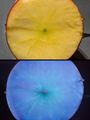
The image presents a comparative analysis of an osage orange fruit section under two distinct lighting conditions: regular daylight and ultraviolet (UV-A) illumination by a 365 nm blacklight. The purpose of this comparison is to highlight the effects of UV light on the visual appearance of the fruit. * **Top Section** * **Bottom Section** In summary, the image demonstrates a significant change in color when exposed to UV light compared to regular daylight. The deep blue coloration under UV illumination suggests that the fruit contains fluorescent compounds that absorb and emit light at specific wavelengths. This phenomenon is likely due to the presence of flavonoids or other pigments within the fruit that fluoresce under UV radiation. – AI vision |
Sección de la manzana de caballo (manzana sanguinaria, Maclura) cuando se expone a luz diurna regular y cuando está iluminada con una lámpara negra de ultravioleta (UV-A) de 365 nm en Bee Creek Park. College Station, Texas, el 4 de octubre de 2024. La imagen presenta un análisis comparativo de una sección de manzana sanguinaria bajo dos condiciones distintas de iluminación: luz diurna regular e iluminación ultravioleta (UV-A) mediante una lámpara negra de 365 nm. El propósito de esta comparación es resaltar los efectos de la luz UV en el aspecto visual del fruto. **Sección superior** **Sección inferior** En resumen, la imagen muestra un cambio significativo en el color cuando se expone a luz UV en comparación con la luz diurna regular. La coloración azul oscuro bajo iluminación UV sugiere que el fruto contiene compuestos fluorescentes que absorben y emiten luz a longitudes de onda específicas. Es probable que este fenómeno se deba a la presencia de flavonoides u otros pigmentos dentro del fruto que fluorescen bajo radiación UV. – Spanish translation |
Keyword variants
high resolution online digital collection
Berlin on the Brazos
Bee Creek Park picture
Lone Star State
United States
picture gallery
photo album
documentary photographs
daily pics
conservative town
Brazos County
TX
travelogue
snapshots
sightseeing
photowalks
photoblog
graphic
fotografias
foto
Bryan
America
Aggieland