 |
| |||||||||||||||

| ||||||||||||||||


| Similar |   |
  |
  |
  |
  |
| |||||||||||||||||||||||||||
| |||||||||||||||||||||||||||
| 1996 1997 1998 1999 2000 2001 2002 2003 2004 2005 2006 2007 2008 2009 2010 2011 2012 2013 2014 2015 2016 2017 2018 2019 2020 2021 2022 2023 2024 2025 2026 | |||||||||||||||||||||||||||
| New version Slide Show Most Popular Full List Statistics Technical Details Home Page | |||||||||||||||||||||||||||
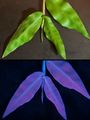
The image presents a comparative analysis of the Beefsteak plant's (Perilla frutescens) coloration under two distinct lighting conditions: regular daylight and illumination by a 365 nm ultraviolet (UV-A) blacklight. **Left Image: Regular Daylight** * The left image depicts the Beefsteak plant in its natural state, illuminated by regular daylight. **Right Image: UV-A Blacklight Illumination** * In contrast, the right image showcases the same plant when exposed to a 365 nm ultraviolet (UV-A) blacklight from Caney Creek section of Lone Star Hiking Trail in Sam Houston National Forest north from Montgomery. Texas. **Comparison and Observations** * A notable difference between the two images is the emergence of vibrant colors in the UV-A blacklight-illuminated plant, particularly the pinkish-red hue that dominates its appearance. **Conclusion** The image effectively illustrates the impact of UV-A blacklight illumination on the Beefsteak plant's coloration, highlighting the presence of fluorescent pigments that become visible under this specific lighting condition. This phenomenon demonstrates the importance of considering multiple factors when studying plant coloration and highlights the role of specialized lighting conditions in revealing previously hidden aspects of a species' appearance. – AI vision |
Plantain (Perilla frutescens) cuando se expone a la luz diurna normal, así como cuando está iluminada por una lámpara negra de ultravioletas (UV-A) de 365 nm en el tramo Caney Creek del Sendero para excursiones solitarias en el Bosque Nacional Sam Houston al norte de Montgomery. Texas, 10 de octubre de 2024. La imagen presenta un análisis comparativo de la coloración de las hojas de plantain (Perilla frutescens) bajo dos condiciones distintas de iluminación: luz diurna normal e iluminación con una lámpara negra de UV-A de 365 nm. **Imagen izquierda: Luz diurna normal** * La imagen izquierda muestra la planta plantain en su estado natural, iluminada por luz diurna normal. * Las hojas presentan un matiz verdoso-amarillento con pequeños toques rojos y morados a lo largo de los márgenes. * La coloración general parece atenuada y carece de cualquier fluorescencia significativa o colores vibrantes. **Imagen derecha: Iluminación con lámpara negra UV-A** * En contraste, la imagen derecha muestra la misma planta expuesta a una lámpara negra de UV-A de 365 nm en el tramo Caney Creek del Sendero para excursiones solitarias en el Bosque Nacional Sam Houston al norte de Montgomery. Texas. * Bajo esta condición especial de iluminación, las hojas presentan una transformación sorprendente, con una coloración predominantemente rosa-rojiza que domina su aspecto. * Los márgenes conservan algunos tonos verdoso-amarillentos, pero ya no son la característica principal de la coloración de las hojas. **Comparación y observaciones** * Una diferencia notable entre las dos imágenes es el surgimiento de colores vibrantes en la planta iluminada con lámpara negra UV-A, particularmente el tono rosa-rojizo que domina su apariencia. * La imagen de luz diurna carece de este nivel de fluorescencia y presenta una paleta más sutil. * El aumento de la visibilidad de los tonos verde amarillentos a lo largo de los márgenes en la imagen derecha sugiere que estos pigmentos son más sensibles a la luz UV-A que los pigmentos verdoso-amarillos responsables del color general de las hojas. **Conclusión** La imagen ilustra efectivamente el impacto de la iluminación con lámpara negra UV-A en la coloración de la planta plantain, destacando la presencia de pigmentos fluorescentes que se vuelven visibles bajo esta condición especial de iluminación. Este fenómeno demuestra la importancia de considerar múltiples factores al estudiar la coloración de las plantas y destaca el papel de las condiciones de iluminación especializadas a la hora de revelar aspectos previamente ocultos del aspecto de una especie. – Spanish translation |
Keyword variants
Star Hiking Trail picture gallery
high resolution online digital collection
Houston National Forest picture
Lone Star State
United States
photo album
documentary photographs
daily pics
TX
travelogue
snapshots
sightseeing
photowalks
photoblog
graphic
fotografias
foto
America