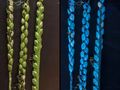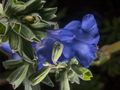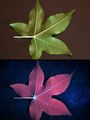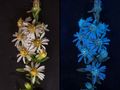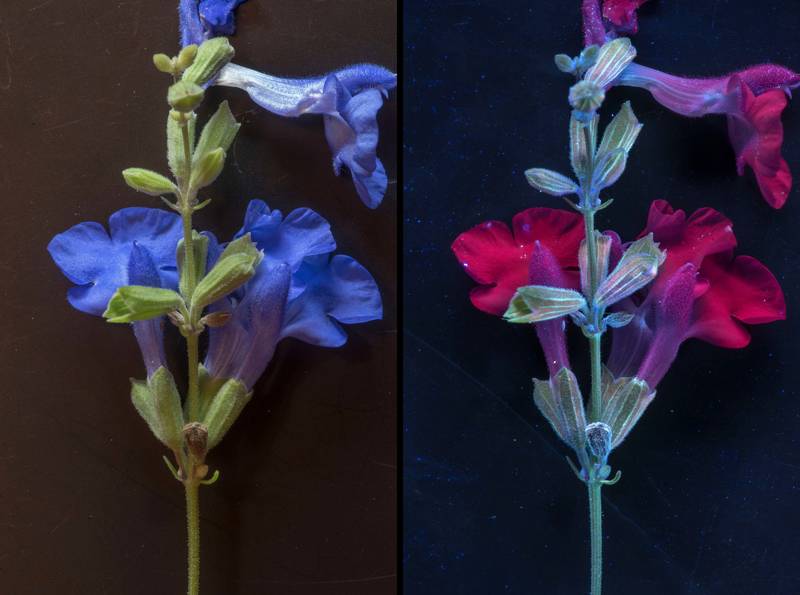

Pitcher sage (Salvia azurea) when exposed to regular daylight as well as when illuminated by a 365 nm ultraviolet (UV-A) blacklight from Sam Houston National Forest. Richards, Texas


Album 3631: College Station and Sam Houston Forest, Texas, October 11 - 13, 2024
The image presents two photographs of the same Pitcher Sage plant, showcasing its appearance under regular daylight and when illuminated by a UV-A blacklight. The left photograph features the plant against a dark background, with the flowers displaying their natural coloration.
In contrast, the right photograph reveals the same plant but this time it is illuminated by a 365 nm UV-A blacklight from Sam Houston National Forest. This illumination causes the flowers to glow and change color, resulting in a striking visual effect.
The image highlights the unique properties of the Pitcher Sage plant when exposed to different types of light sources. The use of a UV-A blacklight not only enhances the visibility of the flowers' colors but also demonstrates how certain plants can absorb and reflect specific wavelengths of light, leading to changes in their appearance. This phenomenon is particularly noteworthy for those interested in botany or photography, as it showcases the intricate relationship between light and color in the natural world.
Overall, the image provides a fascinating glimpse into the visual effects that can occur when plants are exposed to different types of lighting conditions. It serves as a reminder of the importance of considering the role of light in shaping our perception of the natural world and highlights the potential for creative exploration through photography and scientific inquiry. – AI vision
🇪🇸 Descripción en español / Spanish Description
La salvia azul (Salvia azurea) cuando está expuesta a la luz diurna habitual y también cuando se ilumina con una lámpara negra de ultravioleta (UV-A) de 365 nm del Bosque Nacional Sam Houston. Richards, Texas, 12 de octubre de 2024. La imagen presenta dos fotografías de la misma planta de salvia azul, mostrando su aspecto bajo luz diurna habitual y cuando se ilumina con una lámpara negra UV-A. La fotografía de la izquierda presenta la planta sobre un fondo oscuro, mostrando las flores en su coloración natural. En contraste, la fotografía de la derecha presenta la misma planta, esta vez iluminada con una lámpara negra UV-A de 365 nm del Bosque Nacional Sam Houston. Esta iluminación hace que las flores brille y cambien de color, resultando en un efecto visual impactante. La imagen destaca las propiedades únicas de la planta de salvia azul cuando se expone a diferentes tipos de fuentes de luz. El uso de una lámpara negra UV-A no solo mejora la visibilidad del color de las flores, sino que también demuestra cómo ciertas plantas pueden absorber y reflejar longitudes de onda específicas de luz, lo que lleva a cambios en su apariencia. Este fenómeno es particularmente notable para aquellos interesados en botánica o fotografía, ya que muestra la relación intrincada entre la luz y el color en el mundo natural. En general, la imagen proporciona un fascinante vistazo a los efectos visuales que pueden suceder cuando las plantas se exponen a diferentes tipos de condiciones de iluminación. Sirve como recordatorio de la importancia de considerar el papel de la luz en moldear nuestra percepción del mundo natural y destaca el potencial para exploración creativa a través de fotografía e investigación científica. – Spanish translation