Home Page > Picture Archives > Year 2024 > Album 3632 > Photo 09          
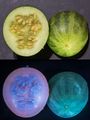
Section of wild muskmelon (Cucumis melo, Dudaim...Creek Park. College Station, Texas  
Previous
Previous
Next
Next
Browse current photo album: College Station-Sam Houston Forest, Texas

Section of wild muskmelon (Cucumis melo, Dudaim melon) when exposed to regular daylight as well as when illuminated by a 365 nm ultraviolet (UV-A) blacklight from Lick Creek Park. College Station, Texas, October 16, 2024

#3632-09
a
Thumbnail 3632-09: Section of wild muskmelon (Cucumis melo...Park. College Station, Texas Show full size picture

Histogram
Shooting data

X-Large Image
Similar   Thumbnail of picture 3632-10: Wild muskmelon (Cucumis melo, Dudaim melon) both in natural light and ... Park. College Station, Texas, October 16, 2024 Thumbnail of picture 1114-26: Half eaten fruit of wild muskmelon (Cucumis melo, Dudaim melon) on ... in Lake Bryan Park. Bryan, Texas, October 31, 2012 Thumbnail of picture 988-02: Frozen wild muskmelon (Cucumis melo, Dudaim melon, gourd family) in ... College Station, Texas, December 1, 2011 Thumbnail of picture 988-21: Frozen fruits of wild muskmelon (Cucumis melo, Dudaim melon, gourd ... College Station, Texas, December 7, 2011 Thumbnail of picture 1123-20: Wild muskmelon (Cucumis melo, Dudaim melon) on utility cutting in Lake Bryan Park. Bryan, Texas, December 4, 2012
1996  1997  1998  1999  2000  2001  2002  2003  2004  2005  2006  2007  2008  2009  2010  2011  2012  2013  2014  2015  2016  2017  2018  2019  2020  2021  2022  2023  2024  2025  2026 
New version    Slide Show    Most Popular    Full List    Statistics    Technical Details         Home Page

The image presents a comparative analysis of the effects of UV-A radiation on the seeds of wild muskmelon plants, showcasing the differences between regular daylight and exposure to a 365 nm ultraviolet (UV-A) blacklight from Lick Creek Park.

* **Top Section: Regular Daylight**
* The top section displays a cross-section of a wild muskmelon plant under regular daylight conditions.
* The seeds appear pale yellowish-white, indicating their natural coloration without any external stimulation.
* This section serves as the baseline for comparison with the effects of UV-A radiation on the same type of seed.
* **Bottom Section: UV-A Radiation**
* In contrast, the bottom section illustrates the same wild muskmelon plant when illuminated by a 365 nm ultraviolet (UV-A) blacklight from Lick Creek Park.
* Upon exposure to UV-A radiation, the seeds exhibit a striking transformation, turning blue.
* This phenomenon is likely due to the interaction between the UV-A light and the pigments present in the seed, causing them to fluoresce and appear blue under ultraviolet illumination.

In summary, the image effectively demonstrates how exposure to UV-A radiation can significantly alter the appearance of wild muskmelon seeds, highlighting their natural coloration when not exposed to such radiation. This visual representation provides valuable insights into the effects of environmental factors on plant development and seed characteristics. – AI vision

La sección del melón silvestre (Cucumis melo, Dudaim melon) cuando se expone a la luz diurna regular y cuando se ilumina con una lámpara negra de UV-A de 365 nm en el Lick Creek Park. College Station, Texas, 16 de octubre de 2024. La imagen presenta un análisis comparativo de los efectos de la radiación UV-A sobre las semillas de plantas de melón silvestre, mostrando las diferencias entre la luz diurna regular y la exposición a una lámpara negra de UV-A de 365 nm en Lick Creek Park. * **Sección superior: Luz diurna regular**
* La sección superior muestra un corte transversal de una planta de melón silvestre en condiciones de luz diurna regular. * Las semillas aparecen de color amarillo pálido, lo que indica su coloración natural sin ninguna estimulación externa. * Esta sección sirve como la línea de referencia para la comparación con los efectos de la radiación UV-A sobre el mismo tipo de semilla. * **Sección inferior: Radiación UV-A**
* En contraste, la sección inferior ilustra la misma planta de melón silvestre cuando se ilumina con una lámpara negra de UV-A de 365 nm en Lick Creek Park. * Tras la exposición a la radiación UV-A, las semillas presentan una transformación sorprendente, volviéndose de color azul. * Este fenómeno se debe probablemente a la interacción entre la luz UV-A y los pigmentos presentes en la semilla, haciendo que éstas fluoreszcan y adquieran un aspecto azul bajo iluminación ultravioleta. En resumen, la imagen demuestra eficazmente cómo la exposición a la radiación UV-A puede alterar significativamente el aspecto de las semillas de melón silvestre, destacando su coloración natural cuando no se exponen a dicha radiación. Esta representación visual proporciona información valiosa sobre los efectos de factores ambientales en el desarrollo de las plantas y las características de las semillas. – Spanish translation


Keyword variants

high resolution online digital collection
Lick Creek Park shot
Berlin on the Brazos
Rock Prairie Rd
Lone Star State
Greens Prairie Road
United States
picture gallery
photo album
nature trails
Nature Park
documentary photographs
daily pics
conservative town
Brazos County
wildlife
TX
travelogue
snapshots
sightseeing
photowalks
photoblog
graphic
fotografias
foto
Bryan
America
Aggieland