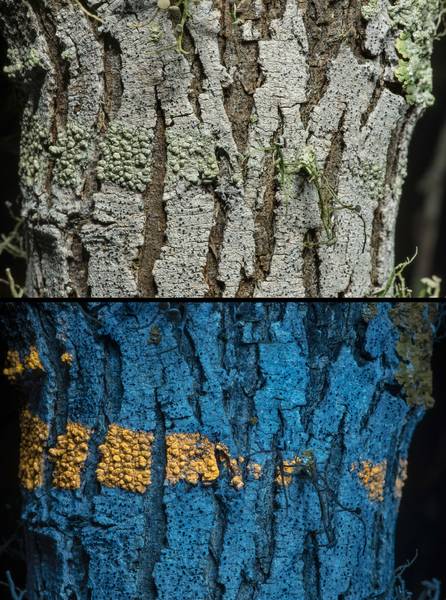

Pertusaria and other crustose lichen on bark of a small honey mesquite tree when exposed to regular daylight as well as when illuminated by a 365 nm ultraviolet (UV-A) blacklight in Lick Creek ParkLick Creek: Background Notes. College Station, Texas


Album 3636: College Station - Lake Somerville, Texas, October 25 - 26, 2024
The image features a small honey mesquite tree trunk covered with various types of crustose lichen. The top half of the image showcases the lichens under regular daylight conditions.
**Lichens Under Daylight Conditions**
* The bark appears light gray with scattered greenish-gray patches.
* A few strands of brown, hairy moss are visible in the upper right-hand corner.
* The background is black, providing a stark contrast to the tree trunk and lichens.
The bottom half of the image displays the same scene illuminated by a 365 nm ultraviolet (UV-A) blacklight. This reveals that some of the lichens glow bright yellow when exposed to UV light, while others appear dull gray or white.
**Lichens Under Ultraviolet Light**
* The yellow glowing areas are likely due to the presence of certain pigments, such as psoralen or bergapten, which absorb UV radiation and emit fluorescence.
* These pigments can be found in various types of lichens, including Pertusaria species.
**Significance of the Image**
The image highlights the importance of considering multiple factors when studying lichens. By examining them under both regular daylight conditions and ultraviolet light, researchers can gain a more comprehensive understanding of their characteristics and behaviors.
* The presence of yellow glowing areas suggests that some lichens may have adaptations to attract pollinators or other organisms.
* Further research is needed to determine the specific functions of these pigments and how they contribute to the ecological success of these organisms. – AI vision
🇪🇸 Descripción en español / Spanish Description
La Pertusaria y otros líquenes costrosos en la corteza de un pequeño árbol de mezquite cuando se exponen a luz diurna regular, así como también cuando se iluminan con una luz negra ultravioleta (UV-A) de 365 nm en el Lick Creek Park. College Station, Texas, 25 de octubre del 2024. La imagen muestra un tronco de un pequeño árbol de mezquite cubierto con diferentes tipos de líquenes costrosos. La mitad superior de la imagen exhibe los líquenes bajo condiciones de luz diurna normal. **Líquenes Bajo Luz Diurna** *La corteza aparece gris claro con parches verde-grisáceos dispersados. *Algunas hebras de musgo peludo marrón son visibles en la esquina superior derecha. *El fondo es negro, proporcionando un fuerte contraste con el tronco del árbol y los líquenes. La mitad inferior de la imagen presenta la misma escena iluminada con una luz negra ultravioleta (UV-A) de 365 nm. Esto revela que algunos de los líquenes emiten un brillo amarillo brillante cuando se exponen a la luz UV, mientras que otros aparecen gris o blanco opacos. **Líquenes Bajo Luz Ultravioleta** *Los áreas que emiten un brillo amarillo son probablemente debido a la presencia de ciertos pigmentos, como el psoraleno o bergapteno, que absorben radiación UV y emiten fluorescencia. *Estos pigmentos pueden encontrarse en diferentes tipos de líquenes, incluyendo especies de Pertusaria. **Significado de la Imagen** La imagen destaca la importancia de considerar múltiples factores cuando se estudian los líquenes. Al examinarlos bajo condiciones de luz diurna normal y ultravioleta, los investigadores pueden obtener una comprensión más integral de sus características y comportamientos. *La presencia de áreas que emiten un brillo amarillo sugiere que algunos líquenes podrían tener adaptaciones para atraer polinizadores u otros organismos. *Se necesita investigación adicional para determinar las funciones específicas de estos pigmentos y cómo contribuyen al éxito ecológico de estos organismos. – Spanish translation