
Dvortsovaya Square, Alexandriysky Stolp (Alexander Column, Pillar), and General Staff building from a window of Hermitage museum. Saint Petersburg, Russia, 3:59 p.m. June 25, 2003

Dvortsovaya Square, Alexandriysky Stolp (Alexander Column, Pillar), and Winter Palace (Hermitage museum). Saint Petersburg, Russia, June 25, 2003

Dvortsovaya Square, Alexandriysky Stolp (Alexander Column, Pillar), and Winter Palace (Hermitage museum). Saint Petersburg, Russia, June 25, 2003

Dvortsovaya Square, Alexandriysky Stolp (Alexander Column, Pillar), and General Staff building from a window of Hermitage museum. Saint Petersburg, Russia, 3:59 p.m. June 25, 2003

Alexandriysky Stolp (Alexander Column, Pillar) on Dvortsovaya Square. Saint Petersburg, Russia, February 5, 2018

Bronze plague at the base of Alexander Column on Dvortsovaya Square. Saint Petersburg, Russia, December 29, 2016

Angel with some metalware on a bronze plague at the base of Alexander Column on Dvortsovaya Square. Saint Petersburg, Russia, December 29, 2016

One of the Small Chinese Bridges (Small Iron Bridges) crossing the Krestovy Canal. Originally wooden (1781), they were replaced with cast iron versions forged at the Sestroretsk Arms Factory in 1786. Designed by Charles Cameron, who also planned the nearby Chinese Village. The bridge features intricate iron lattice railings and is framed by distinctive porticoes formed of paired columns with "Chinese-style" curved sheet-iron roofs. The columns are painted to mimic colored marble, and the structure was fully restored in the 21st century. Aleksandrovsky (Alexander) Park in Pushkin (former Tsarskoe Selo) near Saint Petersburg, Russia, October 10, 2025

The view through the porticoes of one Small Chinese Bridge (often called the Second Small Chinese Bridge) that frames the Cross Bridge in the distance. The twin porticoes, with their "Chinese" peaked roofs and paired columns, create a natural proscenium that directs the eye straight down the canal. The foreground showcases the bridge s vibrant ironwork--geometric lattices and gilded details--contrasting with the brick arch of the Cross Bridge and the soft autumn foliage beyond. This alignment exemplifies the park s deliberate theatricality, using architectural "wings" (the porticoes) to stage the view of the central pavilion. Aleksandrovsky (Alexander) Park in Pushkin (former Tsarskoe Selo) near Saint Petersburg, Russia, October 10, 2025

The textural complexity of the park s planting, which moves beyond simple color contrast. The towering, evergreen spruces (likely Norway spruce) act as dark, architectural columns that anchor the scene, breaking up the horizontal sweep of the deciduous canopy. Their deep, somber green provides a necessary counterpoint to the "burning" oranges and yellows of the maples and birches, preventing the scene from becoming visually flat. The untouched, grassy banks and fallen logs floating in the water reinforce the "wild forest" illusion (a deliberate design choice known as paysage), evoking the moody, introspective landscapes of Russian Realist painters like Shishkin or Nesterov. Aleksandrovsky (Alexander) Park in Pushkin (former Tsarskoe Selo) near Saint Petersburg, Russia, October 10, 2025
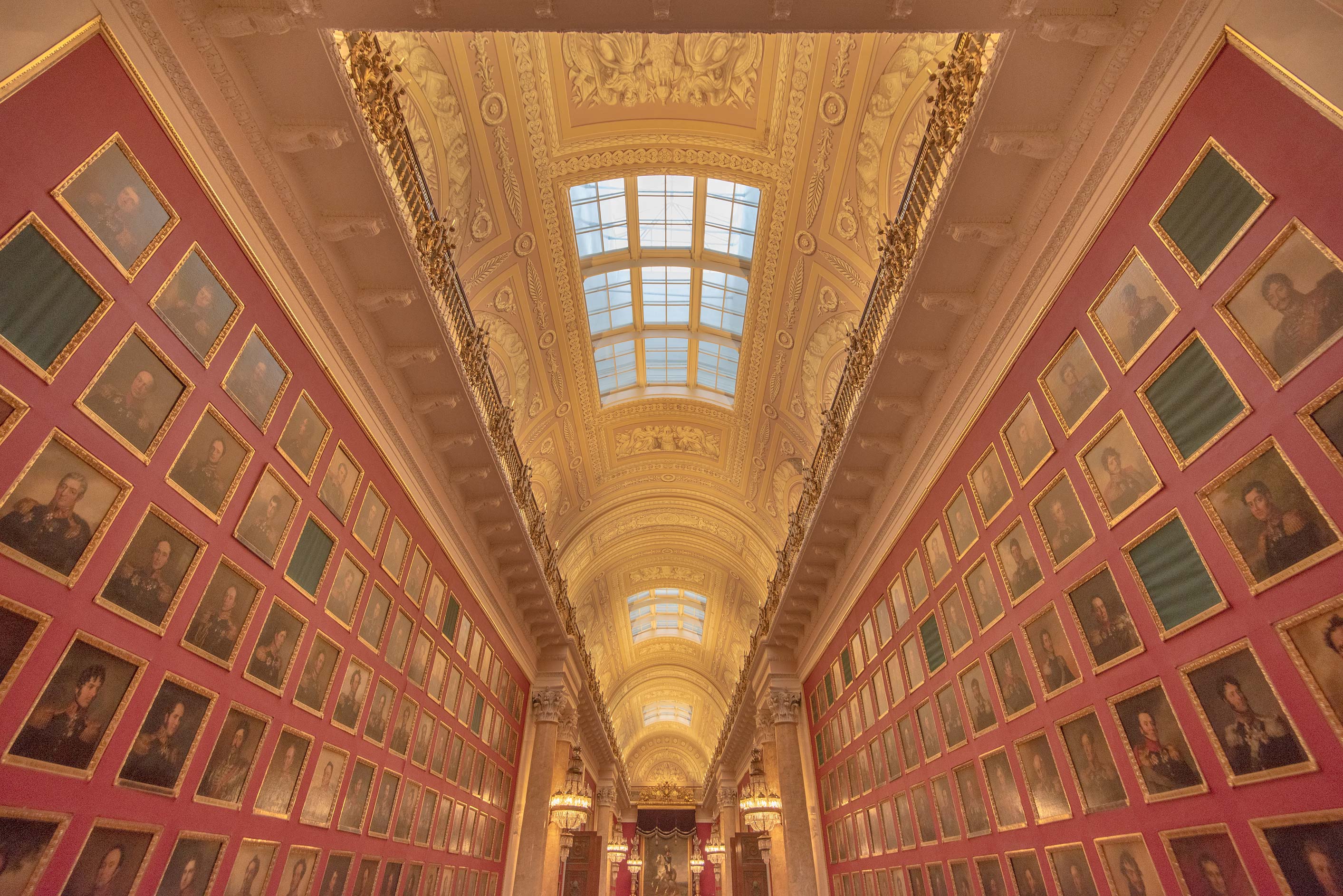
Designed by architect Carlo Rossi in 1826 and rebuilt by Vasily Stasov after the 1837 fire, the Military Gallery of 1812 in the Winter Palace features red-upholstered walls densely hung with five tiers of gilt-framed portraits of Russian generals who fought against Napoleon--painted primarily by English artist George Dawe and his assistants, alongside green silk-draped frames representing generals who died without surviving portraits. Overhead, a coffered barrel-vaulted ceiling decorated with stucco military trophies and glazed skylights runs between gilded upper gallery railings, leading the eye toward paired Corinthian columns, tiered chandeliers, and a monumental equestrian portrait of Emperor Alexander I at the far end in the State Hermitage Museum in Saint Petersburg, Russia, September 10, 2026

Angled view along the fluted Bremen sandstone colonnade of the Private Garden (Sobstvenny Sadik) pergola, built in 1865-1866 by architect Alexander Vidov. Thick cascades of crimson and gold Virginia creeper drape over the open lattice roof and columns, while carved red granite vases stand between the bases along the gravel path in Ekaterininsky (Catherine) Park of Pushkin (former Tsarskoe Selo), a suburb of Saint Petersburg. Russia, September 22, 2026

One of the Small Chinese Bridges spanning the Krestovy Canal toward the Chinese Village, originally designed in wood by Charles Cameron in 1781 and recast in iron at the Sestroretsk Arms Factory in 1786 under architect Karl Speckle. Framed by mature oaks turning yellow-green in early autumn, the bridge features decorative iron lattice railings and paired column porticoes crowned with sheet-iron pagoda roofs, dragon volutes, and Chinese umbrellas in Aleksandrovsky (Alexander) Park of Pushkin (former Tsarskoe Selo), a suburb of Saint Petersburg. Russia, September 22, 2026

Side elevation of one of the Small Chinese Bridges (1786, after designs by Charles Cameron) spanning the Krestovy Canal, highlighting its painted cast-iron arch spandrels adorned with winged dragons, lattice railings with coral-branch motifs, and paired Chinoiserie column porticoes. Framed beneath overhanging oak branches turning yellow and orange in early autumn, the Krestovy (Cross) Bridge and its octagonal gazebo appear down the canal in the background in Aleksandrovsky (Alexander) Park of Pushkin (former Tsarskoe Selo), a suburb of Saint Petersburg. Russia, September 22, 2026
