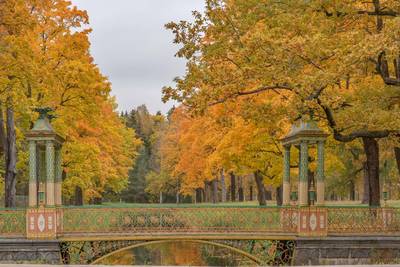
Looking down the Krestovy Canal from the deck of one of the Small Chinese Bridges. The cast-iron railing belongs to the Small Chinese Bridge, characterized by its geometric lattice and gilded ball details, cast at the Sestroretsk Arms Factory. The structure in the distance is the Krestovy Bridge (Cross Bridge), positioned centrally over the canal axis. This perspective illustrates the linear layout of the "New Garden" section of Alexander Park, visually connecting the two Chinoiserie-style crossings. Aleksandrovsky (Alexander) Park in Pushkin (former Tsarskoe Selo) near Saint Petersburg, Russia, October 10, 2025  View from the Small Chinese Bridge looks down the Krestovy Canal in the opposite direction from the Cross Bridge. The photo captures the linear vista of the canal, flanked by an avenue of mature maple trees displaying vibrant autumn colors. The foreground highlights the Small Chinese Bridge s decorative iron railing, featuring a geometric lattice pattern with gilded rosettes, cast in 1786. This section of the canal borders the regular "New Garden" area, leading toward the Chinese Village. Aleksandrovsky (Alexander) Park in Pushkin (former Tsarskoe Selo) near Saint Petersburg, Russia, October 10, 2025  The view through the porticoes of one Small Chinese Bridge (often called the Second Small Chinese Bridge) that frames the Cross Bridge in the distance. The twin porticoes, with their "Chinese" peaked roofs and paired columns, create a natural proscenium that directs the eye straight down the canal. The foreground showcases the bridge s vibrant ironwork--geometric lattices and gilded details--contrasting with the brick arch of the Cross Bridge and the soft autumn foliage beyond. This alignment exemplifies the park s deliberate theatricality, using architectural "wings" (the porticoes) to stage the view of the central pavilion. Aleksandrovsky (Alexander) Park in Pushkin (former Tsarskoe Selo) near Saint Petersburg, Russia, October 10, 2025  Layered perspective of the Krestovy Canal s Chinoiserie architecture. The Small Chinese Bridge frames the scene with its limestone portico and iron lattice railing (1786). The canal leads the eye directly to the Cross Bridge (1779), its arch rising over the water with the distinct "globular pendant" hanging from the vault. The bridges are aligned along the canal s axis, creating a visual corridor characteristic of the park s "New Garden" layout, emphasized here by the autumnal frame of maple trees. Aleksandrovsky (Alexander) Park in Pushkin (former Tsarskoe Selo) near Saint Petersburg, Russia, October 10, 2025  Bolshoy Lamskoy Bridge (Great Lamsky Bridge). It was built in 1820-1822 by the Scottish architect Adam Menelaws, who was instrumental in shaping the park s romantic "English" landscape style. The bridge spans the Lamsky Ponds near the Llama Pavilion, originally serving the utilitarian purpose of connecting the Lamsky stables (which housed exotic llamas from Peru) to the rest of the park. Originally a cast-iron structure, it has been carefully restored to preserve its intricate metal latticework railings, which feature a distinct geometric pattern characteristic of the Russian Empire style. Aleksandrovsky (Alexander) Park in Pushkin (former Tsarskoe Selo) near Saint Petersburg, Russia, October 10, 2025  Maple alley near Chinese Bridges of Krestovy Canal in Aleksandrovsky (Alexander) Park. Pushkin (former Tsarskoe Selo) near Saint Petersburg, Russia, October 10, 2025  Small Chinese and Krestovy bridges of Krestovy Canal in Alexander Park. Pushkin (former Tsarskoe Selo) near Saint Petersburg, Russia, May 23, 2019  Chinese Bridges of Krestovy Canal in Aleksandrovsky (Alexander) Park. Pushkin (former Tsarskoe Selo) near Saint Petersburg, Russia, September 19, 2013  Chinese and Krestovy Bridges in Aleksandrovsky (Alexander) Park. Pushkin (former Tsarskoe Selo) near Saint Petersburg, Russia, September 19, 2013  Chinese Gazebo (often called the Creaking Pagoda or Skripuchaya Besedka) which is one of the most eccentric and picturesque structures in Catherine Park. Built between 1778 and 1786, this pavilion was designed by Yury Felten (Georg Friedrich Veldten) at the height of the 18th-century craze for Chinoiserie (Chinese-style art). The pavilion gets its popular nickname from the metal weather vane on its roof. Shaped like a Chinese banner, it was intentionally designed to creak loudly in the wind. Originally, such pavilions served as tea houses or resting spots for the Empress and her court during their walks. Pushkin (former Tsarskoe Selo) near Saint Petersburg, Russia, October 10, 2025  Krestovy Bridge (Cross Bridge) located in Alexander Park in the town of Pushkin (formerly Tsarskoe Selo), near Saint Petersburg. It has Chinoiserie (Chinese-style) architecture, popular in the 18th century. A pavilion rests on four joined arches over the canal, creating a cross shape. It features glazed bricks (crimson, yellow, blue) and a curved "fish scale" roof. Built in 1779 by the Neyelovs for Catherine the Great, it is a key landmark of the park s "New Garden" area. Russia, October 10, 2025  Iron Chinese dragon on a bridge in Alexander Park. Pushkin (former Tsarskoe Selo) near Saint Petersburg, Russia, December 3, 2016  Small Chinese Bridges in Aleksandrovsky Park. Pushkin (former Tsarskoe Selo), south from Saint Petersburg, Russia, May 30, 2011  This view from the Small Chinese Bridge captures the northwestern stretch of the Krestovy Canal. The canal creates a straight, reflective corridor lined with golden maples, emphasizing the transition from the formal "New Garden" to the more naturalistic landscape park areas. Looking northwest, the canal leads toward the Alexander Palace and its kitchen buildings, which are situated to the right of this axis, hidden behind the dense tree line. The scene highlights the park s quiet, wooded character, contrasting with the architectural focus of the opposite view towards the Cross Bridge. Aleksandrovsky (Alexander) Park in Pushkin (former Tsarskoe Selo) near Saint Petersburg, Russia, October 10, 2025  Chinese bridges in Alexander Park. Pushkin (former Tsarskoe Selo), south from Saint Petersburg, Russia, October 6, 2017  Rusty iron of Small (Upper) Lamsky Bridge in Aleksandrovsky (Alexander) Park. Pushkin (former Tsarskoe Selo) near Saint Petersburg, Russia, September 19, 2013  Small Lamsky Bridge (Maly Lamskoy Bridge), built in the early 20th century (around 1900) to replace an earlier wooden crossing. Aleksandrovsky (Alexander) Park in Pushkin (former Tsarskoe Selo) near Saint Petersburg, Russia, October 10, 2025  Chinese and Cross bridges in Alexander Park. Pushkin (former Tsarskoe Selo), south from Saint Petersburg, Russia, October 6, 2017  Chinese and Cross bridges in Alexander Palace. Pushkin (former Tsarskoe Selo) near Saint Petersburg, Russia, October 13, 2016  Canal and Small Chinese Bridge in Alexander Park in Pushkin (former Tsarskoe Selo) near Saint Petersburg. Russia, May 18, 2021  Chinese bridges in Alexander Park. Pushkin (former Tsarskoe Selo) near Saint Petersburg, Russia, December 3, 2016  One of Chinese bridges in Alexander Park. Pushkin (former Tsarskoe Selo) near Saint Petersburg, Russia, December 3, 2016  Chinese and Cross bridges in Alexander Park. Pushkin (former Tsarskoe Selo) near Saint Petersburg, Russia, December 3, 2016  Side view of Chinese bridges in Alexander Park. Pushkin (former Tsarskoe Selo) near Saint Petersburg, Russia, December 3, 2016  Iron foot bridge of Vittolovsky Canal in Alexander Park. Pushkin (former Tsarskoe Selo), south from Saint Petersburg, Russia, October 6, 2017  Smaller Chinese Bridge and Cross Bridge (Krestovy Most) in Alexander Park. Pushkin (former Tsarskoe Selo), south from Saint Petersburg, Russia, October 3, 2016  Small Chinese Bridge in Aleksandrovsky Park. Pushkin (former Tsarskoe Selo), south from Saint Petersburg, Russia, May 30, 2011  Small Chinese Bridge in Alexander Park in Pushkin (former Tsarskoe Selo) near Saint Petersburg. Russia, May 18, 2021  The central alley leading to the Arsenal Pavilion, a red-brick neo-Gothic structure designed by Adam Menelaws. Completed in 1834, the Arsenal resembles a medieval castle with crenellated towers and massive arched windows. It was originally built to house Nicholas I s vast collection of medieval arms and armor. The straight alley is a remnant of the formal layout from the earlier "Monbijou" pavilion that stood here, now framed by the mature trees of the surrounding landscape park. After severe damage in WWII, the building was restored and reopened in 2016 as a museum displaying imperial weaponry. Aleksandrovsky (Alexander) Park in Pushkin (former Tsarskoe Selo) near Saint Petersburg, Russia, October 10, 2025  Small Chineese Bridge of Krestovy Canal in Aleksandrovsky (Alexander) Park of Pushkin (former Tsarskoe Selo), a suburb of Saint Petersburg. Russia, September 25, 2017  Graceful, humpbacked silhouette of the bridge, designed to arch elegantly over the narrow waterway connecting the ponds. The bridge s single, shallow arch is constructed from dark iron, supported by massive granite abutments on either bank. Delicate lattice pattern of the wrought-iron railing is clearly visible against the backdrop of the forest. Sergievka Park, Old Peterhof, west from Saint Petersburg, Russia, October 13, 2025  Oaks near Small Chineese Bridge of Krestovy Canal in Aleksandrovsky (Alexander) Park of Pushkin (former Tsarskoe Selo), a suburb of Saint Petersburg. Russia, September 25, 2017  Small Chinese Bridge in Alexander Park. Pushkin (former Tsarskoe Selo), south from Saint Petersburg, Russia, September 24, 2015  Granite and iron bridge in Sergievka Park. The bridge s corners are anchored by sturdy, rough-hewn granite bollards (posts) with rounded tops, which support a decorative black iron railing. The railing features a simple, geometric lattice pattern, typical of the functional yet aesthetic engineering found in the Peterhof estate parks. Old Peterhof, west from Saint Petersburg, Russia, October 13, 2025  This rustic bench is a distinctive feature of landscaping style, known as the "Sentimentalist" tradition. Unlike the ornate iron benches, this bench is made of simple, whitewashed logs. This design choice is deliberate, reflecting the 18th-century fashion for "rural simplicity" (championed by Maria Feodorovna and designers like Charles Cameron). Pavlovsk, a suburb of Saint Petersburg, Russia, October 15, 2025  Metal bridge located near the Small Caprice (Malyi Kapriz) in Catherine Park. It spans the water channel connecting the Upper Ponds (Verkhnie Prudki) with the Longitudinal Pond (Prodolny Prud). The bridge is a graceful, single-span metal structure with a simple but elegant wrought-iron railing featuring gilded rosette details. Pushkin (former Tsarskoe Selo) near Saint Petersburg, Russia, October 10, 2025  A view to northwest along the Krestovy Canal. The canal leads away from the Cross Bridge towards the northwest, deeper into the park s wooded areas. Aleksandrovsky (Alexander) Park in Pushkin (former Tsarskoe Selo) near Saint Petersburg, Russia, October 10, 2025  This stone bridge serves as a picturesque crossing over the Kristatelka River ravine, situated at the foot of the slope directly beneath the Leuchtenberg Palace. As part of the 19th-century Sergievka ensemble, this bridge links the wilder, lower ravine paths (near the "Adam s Head" boulder) with the landscaped grounds surrounding the palace on the upper terrace. It features a solid masonry arch topped with simple iron railings, designed to provide a functional yet scenic vantage point for viewing the deep ravine that defines the estate s geography. Sergievka Park, Old Peterhof, west from Saint Petersburg, Russia, October 13, 2025  Chinese Bridge in Alexander Park. Pushkin (former Tsarskoe Selo) near Saint Petersburg, Russia, October 13, 2016  Fall colors of maples along Krestovy Canal. Aleksandrovsky (Alexander) Park in Pushkin (former Tsarskoe Selo) near Saint Petersburg, Russia, October 10, 2025  Dragon on Chinese Bridge in Alexander Park. Pushkin (former Tsarskoe Selo) near Saint Petersburg, Russia, October 13, 2016  Smaller Chinese Bridge in Alexander Park. Pushkin (former Tsarskoe Selo), south from Saint Petersburg, Russia, October 3, 2016  Marble Bridge (also known as the Palladian Bridge) in Catherine Park, Pushkin, enveloped in the vibrant colors of a Russian autumn. Built in the 1770s, it features a graceful colonnade of Ionic columns carved from blue-grey Ural marble, resting on a sturdy granite base. The bridge spans a narrow channel connecting the Great Pond to smaller neighboring ponds and the "Swan Islands." In the foreground, several mallard ducks glide peacefully across the water. Pushkin (former Tsarskoe Selo) near Saint Petersburg, Russia, October 10, 2025  A.S. on Chinese Bridge in Aleksandrovsky Park in Pushkin (former Tsarskoe Selo, suburb of Saint Petersburg). Russia, January 27, 2000  Iron statue near Chinese Palace in Upper Park in Lomonosov (Oranienbaum). West from Saint Petersburg, Russia, October 11, 2016  One of Chinese Bridges (restored in 1998 and 2002) in Monrepo park. Vyborg, Russia, August 12, 2012  Iron sculpture Three Graces near Chinese Palace in Upper Park in Lomonosov (Oranienbaum). West from Saint Petersburg, Russia, October 11, 2016  Chinese Theater in Alexander Park. Pushkin (former Tsarskoe Selo) near Saint Petersburg, Russia, October 13, 2016  Iron Bridge near Big Pond in Catherine Park. Pushkin (former Tsarskoe Selo) near Saint Petersburg, Russia, September 23, 2016  Chinese Summer House (Creaking, or Pagoda, 1778 - 1786) in Ekaterininsky Park. Pushkin (former Tsarskoe Selo), south from Saint Petersburg, Russia, May 30, 2011  Big Lamsky Pond (Bolshoy Lamskoy Prud), part of a system of ponds originally dug in the early 19th century to drain the park s marshy terrain. Aleksandrovsky (Alexander) Park in Pushkin (former Tsarskoe Selo) near Saint Petersburg, Russia, October 10, 2025  Chinese Dragon in Alexander Park. Pushkin (former Tsarskoe Selo), south from Saint Petersburg, Russia, October 6, 2017  Chinese Theatre in Alexander Park. Pushkin (former Tsarskoe Selo), south from Saint Petersburg, Russia, October 6, 2017  Iron Bridge of Upper Ponds in Catherine Park. Pushkin (former Tsarskoe Selo) near Saint Petersburg, Russia, September 23, 2016  Krestovy Canal in Aleksandrovsky (Alexander) Park. Pushkin (former Tsarskoe Selo) near Saint Petersburg, Russia, September 19, 2013  Krestovy Canal in Aleksandrovsky (Alexander) Park of Pushkin (former Tsarskoe Selo), a suburb of Saint Petersburg. Russia, September 25, 2017  Krestovy Bridge in Aleksandrovsky (Alexander) Park. Pushkin (former Tsarskoe Selo) near Saint Petersburg, Russia, September 19, 2013  Alley and iron benches in Catherine Park. Pushkin (former Tsarskoe Selo) near Saint Petersburg, Russia, October 13, 2016  Turkish Bath, a picturesque pavilion situated on a small peninsula in the Great Pond in Catherine Park. Commissioned by Emperor Nicholas I, this was the last structure built in the imperial park, completed between 1850 and 1852. It was designed by Ippolito Monighetti, who used the appearance of a Turkish mosque as his inspiration. The building features a central gilded dome, a tall minaret crowned with a crescent, and intricate relief ornaments on the white facade. The pavilion serves as a victory monument to the Russo-Turkish War of 1828-1829. Pushkin (former Tsarskoe Selo) near Saint Petersburg, Russia, October 10, 2025  Gothic Gate (Goticheskie Vorota) in the landscape section of Catherine Park. Erected in 1778, the gate was designed by the architect Yury Felten (Georg Friedrich Veldten). The design mimics a Gothic cathedral portal, featuring slender columns that branch into pointed arches with intricate "lace-like" tracery. Pushkin (former Tsarskoe Selo) near Saint Petersburg, Russia, October 10, 2025  A playful piece of garden art utilizing an antique wrought-iron bed frame, creating a literal "flower bed". The dark, heavily rusted metal frame features a classic design with curved corners and vertical iron spindles on both the headboard and footboard. Rather than holding a mattress, the space between the head and foot of the bed is completely filled with densely growing, low-profile green vegetation, pruned flat to mimic the shape and height of a mattress. This living "mattress" blends seamlessly into the surrounding garden landscape, with various other plants, shrubs, and spring-blooming bulbs growing freely around the base of the rusty metal legs and intertwined through the iron bars. Antique Rose Emporium. Independence, Texas, March 5, 2026  Chinese Theater in Alexander Park. Pushkin (former Tsarskoe Selo) near Saint Petersburg, Russia, December 3, 2016  Ruins of Chinese Theater in Alexander Park in Pushkin (former Tsarskoe Selo) near Saint Petersburg. Russia, May 18, 2021  Marble Bridge (also known as the Palladian Bridge or Siberian Marble Gallery) in Catherine Park. Built in 1772-1774 by the architect Vasily Neelov, it is modeled after the famous Palladian Bridge at Wilton House in England (designed by Inigo Jones and Roger Morris). The bridge is constructed entirely from Ural marble (hence "Siberian"). It features a covered Ionic colonnade resting on a rusticated arch base. It spans a narrow channel connecting the Great Pond with the smaller neighboring ponds (Swan Islands). Pushkin (former Tsarskoe Selo) near Saint Petersburg, Russia, October 10, 2025  A modest stone bridge with simple iron railings crossings a quiet, reflective section of the Kristatelka River, showcasing the "Golden Autumn". Sergievka Park, Old Peterhof, west from Saint Petersburg, Russia, October 13, 2025  One of Chinese Bridges in Monrepo (Mon Repos) Park. Vyborg, north from Saint Petersburg, Russia, October 7, 2016  Entrance of Chinese Theater in Alexander Park. Pushkin (former Tsarskoe Selo) near Saint Petersburg, Russia, December 3, 2016  Chinese Theater in Alexander Park. Pushkin (former Tsarskoe Selo), south from Saint Petersburg, Russia, September 24, 2015  Old larch tree near Chinese Theater in Alexander Park. Pushkin (former Tsarskoe Selo) near Saint Petersburg, Russia, May 23, 2019  Kitchen Ruin (Kukhnya-Ruina) which is one of the most historically fascinating and visually authentic follies in Catherine Park. Built between 1785 and 1786, it was designed by the Italian architect Giacomo Quarenghi. It was constructed specifically to serve as a "service pavilion" (a kitchen) for the nearby Concert Hall. Quarenghi incorporated authentic ancient Roman fragments into its brick walls. These include broken columns, capitals, cornices, and friezes with carved garlands, which were brought to Russia from Italy. The headless statue in the niche is a prominent feature, emphasizing the theme of lost time and the decay of empires. Pushkin (former Tsarskoe Selo) near Saint Petersburg, Russia, October 10, 2025  Chinese Gazebo (often called the Creaking Pagoda or Skripuchaya Besedka) in Catherine Park. Pushkin (former Tsarskoe Selo) near Saint Petersburg, Russia, October 10, 2025  Small (Upper) Lamsky Bridge in Aleksandrovsky (Alexander) Park. Pushkin (former Tsarskoe Selo) near Saint Petersburg, Russia, September 19, 2013  Chinese Village, now apartments for businessmen, in Catherine Park of Pushkin (former Tsarskoe Selo), a suburb of Saint Petersburg, Russia, June 21, 2009  Devil s Bridge (Chertov Most), also known as the Cascade, located near the Upper Ponds in Catherine Park. Built in the 1770s, likely designed by the architect Vasily Neyelov or possibly Antonio Rinaldi, this structure is a classic example of the romantic "ruin" aesthetic popular in 18th-century landscape gardening. Pushkin (former Tsarskoe Selo) near Saint Petersburg, Russia, October 10, 2025  Columns of Cameron Gallery in Catherine Park. Pushkin (former Tsarskoe Selo) near Saint Petersburg, Russia, September 23, 2016  Shaking and Metal bridges in Alexander Park in Pushkin (former Tsarskoe Selo) near Saint Petersburg. Russia, May 18, 2021  Iron knob with lichens of a cast iron fence of a tomb both in natural light and under 365 nm ultraviolet (UV-A) blacklight in Odd Fellow Cemetery. Anderson, Texas, November 9, 2024  Iron stand with lichens of a cast iron tomb fence both in natural light and under 365 nm ultraviolet (UV-A) blacklight in Odd Fellow Cemetery. Anderson, Texas, November 9, 2024  A stone arch bridge of the Kristatelka River situated downstream from the "Adam s Head" sculpture. The bridge features a solid, polished masonry arch topped with a simple, functional black iron railing. Spanning a cascade of moss-covered boulders and small waterfalls, the bridge sits deep within the ravine, creating a secluded atmosphere amplified by the dense canopy of trees. Sergievka Park, Old Peterhof, west from Saint Petersburg, Russia, October 13, 2025  Road near Small (Upper) Lamsky Bridge in Aleksandrovsky (Alexander) Park. Pushkin (former Tsarskoe Selo) near Saint Petersburg, Russia, September 19, 2013  View from Small (Upper) Lamsky Bridge in Aleksandrovsky (Alexander) Park. Pushkin (former Tsarskoe Selo) near Saint Petersburg, Russia, September 19, 2013  Iron cedar tree with lichens of a cast iron tomb fence both in natural light and under 365 nm ultraviolet (UV-A) blacklight in Odd Fellow Cemetery. Anderson, Texas, November 9, 2024  Iron decoration with lichens of a cast iron tomb fence when exposed to regular daylight as well as when illuminated by a 365 nm ultraviolet (UV-A) blacklight in Odd Fellow Cemetery. Anderson, Texas, November 9, 2024  Lower Lamsky Bridge (Nizhny Lamskoy Bridge). It acts as a dam between the ponds and the Kuzminka River. Aleksandrovsky (Alexander) Park in Pushkin (former Tsarskoe Selo) near Saint Petersburg, Russia, October 10, 2025  Monument to Alexander Lanskoy (often referred to as the Pamyatnik Lanskomu or simply the marble pedestal/urn), located on the Rose Field (Rozovoe Pole) in Catherine Park. It was erected by Catherine the Great in memory of her young favorite, Alexander Lanskoy, who died suddenly in 1784 at the age of 26. The monument is an example of Neoclassical funerary art, likely designed by Antonio Rinaldi or possibly Giacomo Quarenghi. It features a high pedestal made of grey and pink marble, adorned with bas-reliefs and inscriptions (though these are often weathered). Pushkin (former Tsarskoe Selo) near Saint Petersburg, Russia, October 10, 2025  "Framed" perspective looking towards the trees near the Marble Bridge in Catherine Park. The arches create a "picture window" effect, a classic technique in landscape architecture designed to direct the viewer s gaze to specific idealized scenes of nature. The stone ball finials on the balustrade add a rhythmic, formal element that contrasts with the organic chaos of the forest background. Pushkin (former Tsarskoe Selo) near Saint Petersburg, Russia, October 10, 2025  Krestovy Canal and Cross Bridge (Krestovy Most) near Catherine Palace. Pushkin (former Tsarskoe Selo), south from Saint Petersburg, Russia, May 30, 2011  Ruins of the former "Okhotnichy Domik" (Hunting Lodge) restaurant, built in 1958 in the Stalinist Neoclassical style. The structure, located near Prospekt Engelsa, features a distinctive rotunda with columns and a now-exposed skeletal dome, having fallen into disrepair after a fire in 2010. The ruins are now heavily vandalized with graffiti and overgrown with vegetation, standing as a decaying relic of Soviet-era recreational architecture within the park. Udelnyi Park, St. Petersburg, Russia, October 4, 2025  Iron foot bridges in Wolf Pen Creek Park. College Station, Texas, April 19, 2020  Cast iron fence of Alexander Garden. Saint Petersburg, Russia, July 25, 2005  Cross Bridge (Krestovy Most) in Alexander Park. Pushkin (former Tsarskoe Selo), south from Saint Petersburg, Russia, October 3, 2016  Fall colors near Marble Bridge (also known as the Palladian Bridge or Siberian Marble Gallery) in Catherine Park. Pushkin (former Tsarskoe Selo) near Saint Petersburg, Russia, October 10, 2025  Bolshoy Lamskoy Bridge (Large Lamskoy Bridge) area, which connects the Big and Upper Lamskoy Ponds. Aleksandrovsky (Alexander) Park in Pushkin (former Tsarskoe Selo) near Saint Petersburg, Russia, October 10, 2025  Va"ike-Karja Street (Va"ike-Karja ta"nav), likely taken near its intersection with Suur-Karja Street. The building on the right with the large grey stone archway and iron gates corresponds to Va"ike-Karja 1 (also known as the Saarinen House), a prominent Art Nouveau building designed by Finnish architect Eliel Saarinen. The street features a mix of architectural styles. The grey stone building on the right is a notable example of early 20th-century national romanticism. Further down the street, you can see pastel-colored facades typical of Tallinn s Old Town. Tallinn, Estonia, October 16, 2025  Apollo Colonnade in Pavlovsk Park. Originally built by Charles Cameron in 1783, this was a complete double ring of limestone columns surrounding the Apollo Belvedere statue. However, in 1817, a violent thunderstorm struck the colonnade, collapsing part of the structure. The owners decided not to repair it, realizing that the "broken" form created a much more poetic, ancient feel that perfectly suited the Romantic era s obsession with decay and nature reclaiming art. Pavlovsk, a suburb of Saint Petersburg, Russia, October 15, 2025  Pyramid Pavilion, located in a quiet, shady corner of Catherine Park in Tsarskoe Selo (Pushkin). It was originally built in 1770-1772 by the architect Vasily Neyelov and later reconstructed by Charles Cameron in 1782-1783. The pavilion was designed to resemble an ancient Egyptian mausoleum, reflecting the Romantic era s fascination with antiquity and melancholy ruins. It is constructed of brick and faced with trimmed granite. Buried behind the pyramid are three of the Empress s favorite Italian greyhounds: Tom Anderson, Zemira, and Duchesse. Saint Petersburg, Russia, October 10, 2025  Kitchen Pond near Krestovy Canal in Alexander Park. Pushkin (former Tsarskoe Selo), south from Saint Petersburg, Russia, September 24, 2015  Swamp in area of Chinese bridges in Monrepo (Mon Repos) Park. Vyborg, Russia, September 14, 2013  Chinese Theatre, destroyed during the war, in Alexandrovskiy Park of Pushkin (former Tsarskoe Selo, residence of Russian tsars). Near Sankt Petersburg, Russia, October 22, 2000 |