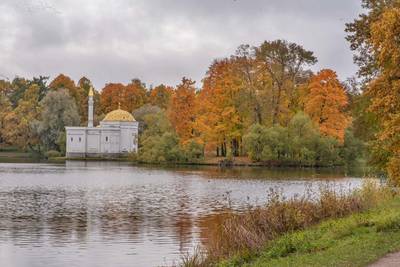
Turkish Bath Pavilion (1850 - 1852) in Ekaterininsky Park. Pushkin (former Tsarskoe Selo), south from Saint Petersburg, Russia, May 30, 2011  Upper Bath Pavilion reflected perfectly in the Mirror Pond in Catherine Park. Built in 1777-1779 by the architects Ilya and Vasily Neelov, this pavilion is a fine example of Early Classicism. The building features a modest yet elegant yellow facade with a central arched entrance and circular windows (oculi) adorned with garlands. Pushkin (former Tsarskoe Selo) near Saint Petersburg, Russia, October 10, 2025  The central alley leading to the Arsenal Pavilion, a red-brick neo-Gothic structure designed by Adam Menelaws. Completed in 1834, the Arsenal resembles a medieval castle with crenellated towers and massive arched windows. It was originally built to house Nicholas I s vast collection of medieval arms and armor. The straight alley is a remnant of the formal layout from the earlier "Monbijou" pavilion that stood here, now framed by the mature trees of the surrounding landscape park. After severe damage in WWII, the building was restored and reopened in 2016 as a museum displaying imperial weaponry. Aleksandrovsky (Alexander) Park in Pushkin (former Tsarskoe Selo) near Saint Petersburg, Russia, October 10, 2025  Turkish Bath on Great Pond in Catherine Park. Pushkin (former Tsarskoe Selo), south from Saint Petersburg, Russia, September 24, 2015  Turkish Bath from north end of Great Pond in Catherine Park. Pushkin (former Tsarskoe Selo), south from Saint Petersburg, Russia, September 24, 2015  One of the two towers forming the Red (Turkish) Cascade (Krasnyy/Turetskiy Kaskad) in Catherine Park. It serves as both a decorative dam and a symbolic monument. Pushkin (former Tsarskoe Selo) near Saint Petersburg, Russia, October 10, 2025  Turkish Bath and Big Pond in Catherine Park. Pushkin (former Tsarskoe Selo) near Saint Petersburg, Russia, December 3, 2016  Turkish Bath on Big Pond in Catherine Park. Pushkin (former Tsarskoe Selo) near Saint Petersburg, Russia, December 3, 2016  Red Cascade or Turkish Cascade in Catherine Park. The Red Cascade is a dam that regulates the water level between the Upper Ponds and the Great Pond. The two "towers" flanking the crossing are designed in the Gothic style, featuring red brick walls with white limestone details, pointed arches, and niche windows. It was built in the 1780s by the engineer Ivan Gerard, likely based on designs by the architect Vasily Neelov. Pushkin (former Tsarskoe Selo) near Saint Petersburg, Russia, October 10, 2025  Turkish Bath and Chesma Pillar on Big Pond in Catherine Park. Pushkin (former Tsarskoe Selo) near Saint Petersburg, Russia, December 3, 2016  Turkish Bath in Catherine Park. Pushkin (former Tsarskoe Selo) near Saint Petersburg, Russia, May 23, 2019  Evening Hall (Vecherniy Zal) in Catherine Park. It was built between 1796 and 1810 under the supervision of architect P.V. Neyelov (and possibly Luigi Rusca). This pavilion was intended for evening gatherings, small concerts, and balls. The building is a simple, rectangular Classical structure with a low dome and large arched windows Pushkin (former Tsarskoe Selo) near Saint Petersburg, Russia, October 10, 2025  Turkish Bath in Ekaterininsky (Catherine) Park of Pushkin (former Tsarskoe Selo), a suburb of Saint Petersburg. Russia, September 7, 2013  Chinese Gazebo (often called the Creaking Pagoda or Skripuchaya Besedka) which is one of the most eccentric and picturesque structures in Catherine Park. Built between 1778 and 1786, this pavilion was designed by Yury Felten (Georg Friedrich Veldten) at the height of the 18th-century craze for Chinoiserie (Chinese-style art). The pavilion gets its popular nickname from the metal weather vane on its roof. Shaped like a Chinese banner, it was intentionally designed to creak loudly in the wind. Originally, such pavilions served as tea houses or resting spots for the Empress and her court during their walks. Pushkin (former Tsarskoe Selo) near Saint Petersburg, Russia, October 10, 2025  Children s Island (Ostrov Detskogo Domika) of the Great Pond concealed within the dense autumn foliage in Catherine Park. Built in 1830 by architect Alexei Gornostayev, it was a playhouse created for the children of Emperor Nicholas I. Pushkin (former Tsarskoe Selo) near Saint Petersburg, Russia, October 10, 2025  Grotto Pavilion and Great Pond (Bolshoy Prud) in Catherine Park. Pushkin (former Tsarskoe Selo) near Saint Petersburg, Russia, October 10, 2025  Red (Turkish) Cascade in Catherine Park. Pushkin (former Tsarskoe Selo) near Saint Petersburg, Russia, October 13, 2016  Azure blue walls and white columns of Grotto Pavilion sitting on the edge of Great Pond (Bolshoy Prud) in Catherine Park. Pushkin (former Tsarskoe Selo) near Saint Petersburg, Russia, October 10, 2025  Upper Bath Pavilion reflected perfectly in the Mirror Pond in Catherine Park. This artificial pond was created in 1719-1722, by the garden masters Jan Roosen and Johann Vocht. Pushkin (former Tsarskoe Selo) near Saint Petersburg, Russia, October 10, 2025  Towers of Red (Turkish) Cascade in Catherine Park. Pushkin (former Tsarskoe Selo) near Saint Petersburg, Russia, October 13, 2016  Stone towers of Red (Turkish) Cascade in Catherine Park. Pushkin (former Tsarskoe Selo) near Saint Petersburg, Russia, October 13, 2016  Turkish Cascade in Catherine Park. Pushkin (former Tsarskoe Selo) near Saint Petersburg, Russia, September 23, 2016  View of Turkish Cascade in Catherine Park. Pushkin (former Tsarskoe Selo) near Saint Petersburg, Russia, September 23, 2016  Hermitage Pavilion in Catherine Park, designed by the Italian court architect Francesco Bartolomeo Rastrelli in Elizabethan Baroque style. Pushkin (former Tsarskoe Selo) near Saint Petersburg, Russia, October 10, 2025  The stall labeled "Moskva" that honors a favorite horse of Emperor Nicholas I in Pensioner Stable (Pensionnaya Konyushnya) in Alexander Park, Tsarskoe Selo. This horse, a veteran of military reviews like the one in Elisavetgrad, spent its retirement in the stable built by the Emperor for his own and his predecessor s faithful steeds. The nameplate was reinstated during the 2024-2025 restoration of the pavilion. Saint Petersburg, Russia, September 21, 2025  Pyramid Pavilion, located in a quiet, shady corner of Catherine Park in Tsarskoe Selo (Pushkin). It was originally built in 1770-1772 by the architect Vasily Neyelov and later reconstructed by Charles Cameron in 1782-1783. The pavilion was designed to resemble an ancient Egyptian mausoleum, reflecting the Romantic era s fascination with antiquity and melancholy ruins. It is constructed of brick and faced with trimmed granite. Buried behind the pyramid are three of the Empress s favorite Italian greyhounds: Tom Anderson, Zemira, and Duchesse. Saint Petersburg, Russia, October 10, 2025  Krestovy Bridge (Cross Bridge) located in Alexander Park in the town of Pushkin (formerly Tsarskoe Selo), near Saint Petersburg. It has Chinoiserie (Chinese-style) architecture, popular in the 18th century. A pavilion rests on four joined arches over the canal, creating a cross shape. It features glazed bricks (crimson, yellow, blue) and a curved "fish scale" roof. Built in 1779 by the Neyelovs for Catherine the Great, it is a key landmark of the park s "New Garden" area. Russia, October 10, 2025  Metal Bridge and Turkish Cascade from Palladiev (Siberian) Bridge in Catherine Park. Pushkin (former Tsarskoe Selo) near Saint Petersburg, Russia, September 23, 2016  Monument to Alexander Lanskoy (often referred to as the Pamyatnik Lanskomu or simply the marble pedestal/urn), located on the Rose Field (Rozovoe Pole) in Catherine Park. It was erected by Catherine the Great in memory of her young favorite, Alexander Lanskoy, who died suddenly in 1784 at the age of 26. The monument is an example of Neoclassical funerary art, likely designed by Antonio Rinaldi or possibly Giacomo Quarenghi. It features a high pedestal made of grey and pink marble, adorned with bas-reliefs and inscriptions (though these are often weathered). Pushkin (former Tsarskoe Selo) near Saint Petersburg, Russia, October 10, 2025  Katalnaya Gorka Pavilion (Sliding Hill Pavilion), a masterpiece of 18th-century architecture located in the Upper Park of Oranienbaum. Designed by Antonio Rinaldi, this 33-meter-high pavilion is a striking blend of Baroque and early Classicism. Its festive, light-blue and white facade, tiered "wedding-cake" shape, and crowning bell-shaped dome make it resemble a lighthouse rising above the park s trees. Oranienbaum palace-and-park ensemble in Lomonosov (a suburb of St. Petersburg), Russia, October 13, 2025  Red Cascade or Turkish Cascade in Catherine Park. The Rust Red (8A611E) of the brickwork complements the surrounding Golden Orange (BB812a) foliage perfectly. The rough texture of the brick and the stepped stone cascade creates a rustic, "ruin-like" aesthetic that was highly fashionable in 18th-century landscape design. Pushkin (former Tsarskoe Selo) near Saint Petersburg, Russia, October 10, 2025  Devil s Bridge (Chertov Most), also known as the Cascade, located near the Upper Ponds in Catherine Park. Built in the 1770s, likely designed by the architect Vasily Neyelov or possibly Antonio Rinaldi, this structure is a classic example of the romantic "ruin" aesthetic popular in 18th-century landscape gardening. Pushkin (former Tsarskoe Selo) near Saint Petersburg, Russia, October 10, 2025  Bolshoy Lamskoy Bridge (Great Lamsky Bridge). It was built in 1820-1822 by the Scottish architect Adam Menelaws, who was instrumental in shaping the park s romantic "English" landscape style. The bridge spans the Lamsky Ponds near the Llama Pavilion, originally serving the utilitarian purpose of connecting the Lamsky stables (which housed exotic llamas from Peru) to the rest of the park. Originally a cast-iron structure, it has been carefully restored to preserve its intricate metal latticework railings, which feature a distinct geometric pattern characteristic of the Russian Empire style. Aleksandrovsky (Alexander) Park in Pushkin (former Tsarskoe Selo) near Saint Petersburg, Russia, October 10, 2025  Marble Bridge (also known as the Palladian Bridge or Siberian Marble Gallery) in Catherine Park. Built in 1772-1774 by the architect Vasily Neelov, it is modeled after the famous Palladian Bridge at Wilton House in England (designed by Inigo Jones and Roger Morris). The bridge is constructed entirely from Ural marble (hence "Siberian"). It features a covered Ionic colonnade resting on a rusticated arch base. It spans a narrow channel connecting the Great Pond with the smaller neighboring ponds (Swan Islands). Pushkin (former Tsarskoe Selo) near Saint Petersburg, Russia, October 10, 2025  Hall on the Island in Catherine Park, view from Ferry Crossing. It was originally built in the late 1740s by the architect Savva Chevakinsky in the Baroque style, with decorations based on sketches by Rastrelli. In 1794, under Catherine the Great, the architect Giacomo Quarenghi completely rebuilt it in the Classical style. He simplified the decor, giving it the restrained, elegant appearance seen today--white walls, large arched windows, and a modest green roof. Pushkin (former Tsarskoe Selo) near Saint Petersburg, Russia, October 10, 2025  Grotto Pavilion and Chesma Pillar on Big Pond in Catherine Park. Pushkin (former Tsarskoe Selo) near Saint Petersburg, Russia, December 3, 2016  Metal bridge located near the Small Caprice (Malyi Kapriz) in Catherine Park. It spans the water channel connecting the Upper Ponds (Verkhnie Prudki) with the Longitudinal Pond (Prodolny Prud). The bridge is a graceful, single-span metal structure with a simple but elegant wrought-iron railing featuring gilded rosette details. Pushkin (former Tsarskoe Selo) near Saint Petersburg, Russia, October 10, 2025  A poetic tribute "Pushkin was here" to the great Russian poet Alexander Pushkin in Catherine Park. The symbols on the bench carry specific meanings related to his time at the Imperial Lyceum (located just nearby), where he studied from 1811 to 1817. The Bicorne Hat (Cocked Hat): This represents the uniform worn by the students of the Imperial Lyceum. The Open Book: A symbol of his literary genius and his constant immersion in reading and writing poetry, often done while wandering this very park. Pushkin (former Tsarskoe Selo) near Saint Petersburg, Russia, October 10, 2025  Turkish pavilion Abu Nabut (built in 1820) served to water caravans and travellers at Ben Tsvi Street in Tel Aviv. The Middle East, July 15, 2000  Hermitage Pavilion in Catherine Park. Pushkin (former Tsarskoe Selo) near Saint Petersburg, Russia, October 13, 2016  Grotto Pavilion in Catherine Park. Pushkin (former Tsarskoe Selo) near Saint Petersburg, Russia, October 13, 2016  Marble Bridge (also known as the Palladian Bridge) in Catherine Park, Pushkin, enveloped in the vibrant colors of a Russian autumn. Built in the 1770s, it features a graceful colonnade of Ionic columns carved from blue-grey Ural marble, resting on a sturdy granite base. The bridge spans a narrow channel connecting the Great Pond to smaller neighboring ponds and the "Swan Islands." In the foreground, several mallard ducks glide peacefully across the water. Pushkin (former Tsarskoe Selo) near Saint Petersburg, Russia, October 10, 2025  "Golden Autumn" of the shores of the Great Pond in Catherine Park. Pushkin (former Tsarskoe Selo) near Saint Petersburg, Russia, October 10, 2025  Alley near Hermitage Pavilion in Catherine Park. Pushkin (former Tsarskoe Selo) near Saint Petersburg, Russia, October 13, 2016  Pavilion Evening Hall in Catherine Park. Pushkin (former Tsarskoe Selo) near Saint Petersburg, Russia, October 13, 2016  Entrance of Hermitage Pavilion in Catherine Park. Pushkin (former Tsarskoe Selo) near Saint Petersburg, Russia, October 13, 2016  Alley to Hermitage Pavilion in Catherine Park. Pushkin (former Tsarskoe Selo) near Saint Petersburg, Russia, October 13, 2016  Entrance of Hermitage Pavilion in Catherine Park. Pushkin (former Tsarskoe Selo) near Saint Petersburg, Russia, October 13, 2016  "Natural" path of English Landscape Park near Great Pond in Catherine Park. Pushkin (former Tsarskoe Selo) near Saint Petersburg, Russia, October 10, 2025  Rich tapestry of deciduous trees on the shores of the Great Pond in Catherine Park. Pushkin (former Tsarskoe Selo) near Saint Petersburg, Russia, October 10, 2025  One of the Small Chinese Bridges (Small Iron Bridges) crossing the Krestovy Canal. Originally wooden (1781), they were replaced with cast iron versions forged at the Sestroretsk Arms Factory in 1786. Designed by Charles Cameron, who also planned the nearby Chinese Village. The bridge features intricate iron lattice railings and is framed by distinctive porticoes formed of paired columns with "Chinese-style" curved sheet-iron roofs. The columns are painted to mimic colored marble, and the structure was fully restored in the 21st century. Aleksandrovsky (Alexander) Park in Pushkin (former Tsarskoe Selo) near Saint Petersburg, Russia, October 10, 2025  Fall colors of Children s Island (Ostrov Detskogo Domika) of the Great Pond in Catherine Park. Pushkin (former Tsarskoe Selo) near Saint Petersburg, Russia, October 10, 2025  Hermitage Pavilion in Catherine Park in Pushkin (former Tsarskoe Selo) near Saint Petersburg. Russia, May 18, 2021  Secluded path winding through the English Landscape Park, near the Swan Islands at the southern end of the Great Pond in Catherine Park. Pushkin (former Tsarskoe Selo) near Saint Petersburg, Russia, October 10, 2025  Princess Lieven Column in Pavlovsk Park. The column is dedicated to Princess Charlotte Lieven, the beloved governess of Emperor Paul I s children. It stands on the Parade Field (Russian: :041f:0430:0440:0430:0434:043d:043e:0435 :043f:043e:043b:0435:feff), specifically on the peninsula between the Rose Pavilion Ponds. Originally, this column was crowned with a gilded metal ball (sphere), which gave it a more finished look. Pavlovsk, a suburb of Saint Petersburg, Russia, October 15, 2025  Example of Art Nouveau architecture in Tallinn, located at Pikk 18. It was designed by the renowned Baltic German architect Jacques Rosenbaum and completed in 1910. The design is celebrated for its flamboyant and fantastical style, which stands in stark contrast to the surrounding medieval architecture. The building is often referred to as the Draakoni Gallery (Dragon Gallery) because of the two large, sculpted dragons flanking the main ground-floor window. These sculptures were created by the famous Riga sculptor August Volz. The fac,ade is uniquely decorated with Egyptian-inspired themes, including reliefs of sphinxes and pharaonic figures at the top of the pilasters, adding to its exotic and eclectic appearance. The building features a distinctive curved corner tower with a slender spire, oval windows, and intricate floral ornaments typical of the late Art Nouveau period. Tallinn, Estonia, October 16, 2025  Kitchen Ruin (Kukhnya-Ruina) which is one of the most historically fascinating and visually authentic follies in Catherine Park. Built between 1785 and 1786, it was designed by the Italian architect Giacomo Quarenghi. It was constructed specifically to serve as a "service pavilion" (a kitchen) for the nearby Concert Hall. Quarenghi incorporated authentic ancient Roman fragments into its brick walls. These include broken columns, capitals, cornices, and friezes with carved garlands, which were brought to Russia from Italy. The headless statue in the niche is a prominent feature, emphasizing the theme of lost time and the decay of empires. Pushkin (former Tsarskoe Selo) near Saint Petersburg, Russia, October 10, 2025  Kitchen Ruin Pavilion in Catherine Park. Pushkin (former Tsarskoe Selo) near Saint Petersburg, Russia, December 3, 2016  The view through the porticoes of one Small Chinese Bridge (often called the Second Small Chinese Bridge) that frames the Cross Bridge in the distance. The twin porticoes, with their "Chinese" peaked roofs and paired columns, create a natural proscenium that directs the eye straight down the canal. The foreground showcases the bridge s vibrant ironwork--geometric lattices and gilded details--contrasting with the brick arch of the Cross Bridge and the soft autumn foliage beyond. This alignment exemplifies the park s deliberate theatricality, using architectural "wings" (the porticoes) to stage the view of the central pavilion. Aleksandrovsky (Alexander) Park in Pushkin (former Tsarskoe Selo) near Saint Petersburg, Russia, October 10, 2025  Imperial Horse Cemetery at the Pensioner s Stable in Tsarskoe Selo. This cemetery is the final resting place for over 120 favorite horses of the Russian Emperors, from Alexander I to Nicholas II. The neat rows of white tombstones are the result of a major restoration project completed recently. Saint Petersburg, Russia, September 21, 2025  Gothic Gate (Goticheskie Vorota) in the landscape section of Catherine Park. Erected in 1778, the gate was designed by the architect Yury Felten (Georg Friedrich Veldten). The design mimics a Gothic cathedral portal, featuring slender columns that branch into pointed arches with intricate "lace-like" tracery. Pushkin (former Tsarskoe Selo) near Saint Petersburg, Russia, October 10, 2025  Metal bridge located near the Small Caprice (Malyi Kapriz) in Catherine Park. It spans the water channel connecting the Upper Ponds (Verkhnie Prudki) with the Longitudinal Pond (Prodolny Prud). This area is a critical junction in the park s hydraulic system, where water flows from the upper terraces down towards the Great Pond. Pushkin (former Tsarskoe Selo) near Saint Petersburg, Russia, October 10, 2025  Fall foliage of Children s Island (Ostrov Detskogo Domika) of the Great Pond concealed within the dense autumn foliage in Catherine Park. Pushkin (former Tsarskoe Selo) near Saint Petersburg, Russia, October 10, 2025  Reddish foliage of Children s Island (Ostrov Detskogo Domika) of the Great Pond concealed within the dense autumn foliage in Catherine Park. Pushkin (former Tsarskoe Selo) near Saint Petersburg, Russia, October 10, 2025  Ramp Alley (Rampovaya Alleya) whic is a historic avenue in Catherine Park, known for its grand canopy of ancient trees and its connection to imperial history. Pushkin (former Tsarskoe Selo) near Saint Petersburg, Russia, October 10, 2025  Upper Bath in Catherine Park. Pushkin (former Tsarskoe Selo), south from Saint Petersburg, Russia, October 6, 2017  Leuchtenberg Palace, designed by architect Andrei Stackenschneider and completed in 1842. The facade reflects the Late Classicism style (resembling a Roman villa), characterized by a grand portico with Corinthian columns, symmetrical window arrangements, and a pediment that gives the structure a noble, temple-like appearance. The palace s yellow stucco walls show signs of weathering and peeling paint, contributing to the estate s romantic, slightly melancholic atmosphere of a "forgotten" royal residence. The palace is situated on a terrace overlooking the Gulf of Finland, with its color palette harmonizing with the surrounding golden autumn foliage, reinforcing the seamless blend of architecture and nature intended by its designers. Sergievka Park, Old Peterhof, west from Saint Petersburg, Russia, October 13, 2025  This view from Rataskaevu Street looks directly towards the imposing St. Nicholas Church (Niguliste kirik), creating one of the most picturesque and architecturally significant scenes in Tallinn s Old Town. The dominant feature is the massive tower of St. Nicholas Church, dedicated to the patron saint of merchants and sailors. The church, originally built in the 13th century as a fortress-church, showcases a mix of Gothic and Baroque elements. The current Baroque spire (added in the late 17th century) rises high above the street, while the lower sections reveal the heavy limestone walls typical of medieval defense structures. At the base of the tower, one can see the Small Chapel (Va"ike kabel) and the Clodt Chapel. The smaller, yellow-and-white structure with the arched entrance (left foreground) is the Chapel of St. Matthew (later St. George), adding a touch of color and intricate detail to the otherwise austere stone facade. Estonia, October 16, 2025  Neoclassical apartment building located at 108 Bolshoy Sampsonievsky Prospect (corner of Serdobolskaya Street), viewed across Serdobolsky Pond. The dominant structure is a residential complex known locally as the House of Specialists or sometimes nicknamed the "Bastille near Lanskaya". Designed by architects Viktor F. Belov, V.A. Potapov, and M.P. Savkevich. Built between 1953 and 1956, representing the late Stalinist "Empire" style. It was commissioned by the Klimov Plant (Zavod im. Klimova), a major manufacturer of aviation engines, to house its employees. Lesnoy Park (Lesotekhnicheskiy Universitet), Saint Petersburg, Russia, October 14, 2025  Italian Pergola located in the Private Garden (Sobstvenny Sadik) of Catherine Park. The pergola was built in 1865 (mid-19th century) during the reign of Alexander II. It was designed specifically to be covered in climbing plants, creating a shaded walkway or "veranda" that offered respite from the sun while allowing views of the obelisk and the surrounding landscape. Pushkin (former Tsarskoe Selo) near Saint Petersburg, Russia, October 10, 2025  Stone Hall Pavilion (Kammenoe Zalo) in Oranienbaum Park. It is a light pink, two-story stone pavilion designed by architect Antonio Rinaldi (built mid-18th century) for Grand Duke Peter Fedorovich. Originally used for concerts, masquerades, and dances, it later served as a Lutheran church. Oranienbaum palace-and-park ensemble in Lomonosov (a suburb of St. Petersburg), Russia, October 13, 2025  Northern end of Vene Street (Vene ta"nav) at the intersection with Olevima"gi and Bremeni ka"ik. The red brick building on the immediate left is located at Vene 28. It is a historic structure that was originally built in 1912 as a residential building and briefly housed the Estonian Provisional Government in 1918. It stands out with its industrial-style red brick facade contrasting with the medieval stone walls nearby. The large limestone wall with the archway on the far left is part of the city s defensive fortifications, specifically near the Bremen Tower (Bremeni torn). The archway leads into Bremen Passage (Bremeni ka"ik), a short, atmospheric walkway that connects Vene Street to Uus Street through the city wall. The tower itself, a 15th-century horseshoe-shaped defensive structure, is located just behind this wall. In the background, at the end of the street, you can see the yellow tower and facade of the Orthodox Church of St. Nicholas (Nikolai kirik) at Vene 24. Designed by architect Luigi Rusca and built between 1820-1827, this Neoclassical church serves a congregation under the Moscow Patriarchate and is known for its valuable iconostasis. It sits on the site of a much older church that served Novgorod merchants in the Middle Ages. Tallinn, Estonia, October 16, 2025  Temple of Friendship in Pavlovsk Park. Built by Charles Cameron between 1780 and 1784, it was the very first building constructed in the park. It was officially dedicated to Empress Catherine the Great by her son Paul (the future Emperor) and his wife Maria Feodorovna as a gesture of thanks for gifting them the Pavlovsk lands. However, it was also a politically savvy move to rename it the "Temple of Friendship" to honor the visit of Joseph II, the Holy Roman Emperor, framing it as a symbol of enlightened European alliance. Pavlovsk, a suburb of Saint Petersburg, Russia, October 15, 2025  Great Pond and Admiralty in Catherine Park in Pushkin (former Tsarskoe Selo) near Saint Petersburg. Russia, May 18, 2021  Great Pond and Hall of the Island in Catherine Park in Pushkin (former Tsarskoe Selo) near Saint Petersburg. Russia, May 18, 2021  Marble Bridge of Great Pond in Catherine Park. Pushkin (former Tsarskoe Selo) near Saint Petersburg, Russia, May 23, 2019  Cape Star of Great Pond in Catherine Park in Pushkin (former Tsarskoe Selo) near Saint Petersburg. Russia, May 18, 2021  Cape Star and Great Pond in Catherine Park in Pushkin (former Tsarskoe Selo) near Saint Petersburg. Russia, May 18, 2021  Great Pond and Marble Bridge in Catherine Park in Pushkin (former Tsarskoe Selo) near Saint Petersburg. Russia, May 18, 2021  Maples near the Small Caprice (Malyi Kapriz) in Catherine Park. Pushkin (former Tsarskoe Selo) near Saint Petersburg, Russia, October 10, 2025  A grotto near the Chapelle pavilion in Alexander Park. Pushkin (former Tsarskoe Selo), south from Saint Petersburg, Russia, October 6, 2017  Great Pond, Admiralty and Hall of the Island in Catherine Park in Pushkin (former Tsarskoe Selo) near Saint Petersburg. Russia, May 18, 2021  A road around Great Pond in Catherine Park. Pushkin (former Tsarskoe Selo), south from Saint Petersburg, Russia, September 24, 2015  Great Pond in Ekaterininsky (Catherine) Park of Pushkin (former Tsarskoe Selo), a suburb of Saint Petersburg. Russia, September 25, 2017  Empty Island of Great Pond in Catherine Park. Pushkin (former Tsarskoe Selo) near Saint Petersburg, Russia, September 19, 2013  Alley north from Great Pond in Catherine Park. Pushkin (former Tsarskoe Selo) near Saint Petersburg, Russia, September 19, 2013  North end of Great Pond in Catherine Park. Pushkin (former Tsarskoe Selo), south from Saint Petersburg, Russia, September 24, 2015  Granite bath tub of Catherine the Great in Babolovsky Park. Pushkin (former Tsarsoe Selo) near Saint Petersburg, Russia, May 25, 2014  This stone bridge serves as a picturesque crossing over the Kristatelka River ravine, situated at the foot of the slope directly beneath the Leuchtenberg Palace. As part of the 19th-century Sergievka ensemble, this bridge links the wilder, lower ravine paths (near the "Adam s Head" boulder) with the landscaped grounds surrounding the palace on the upper terrace. It features a solid masonry arch topped with simple iron railings, designed to provide a functional yet scenic vantage point for viewing the deep ravine that defines the estate s geography. Sergievka Park, Old Peterhof, west from Saint Petersburg, Russia, October 13, 2025  View of Great Pond in Ekaterininsky (Catherine) Park of Pushkin (former Tsarskoe Selo), a suburb of Saint Petersburg. Russia, September 25, 2017  Foliage of Empty Island of Great Pond in Catherine Park. Pushkin (former Tsarskoe Selo) near Saint Petersburg, Russia, September 19, 2013  Great Pond in Catherine Park, near Marble Bridge. Pushkin (former Tsarskoe Selo), south from Saint Petersburg, Russia, September 24, 2015  Marble Bridge at Great Pond in Catherine Park. Pushkin (former Tsarskoe Selo), south from Saint Petersburg, Russia, September 24, 2015  Great Pond in Catherine Park, with Grotto in background. Pushkin (former Tsarskoe Selo), south from Saint Petersburg, Russia, September 24, 2015  Marble Bridge of Great Pond in Catherine Park. Pushkin (former Tsarskoe Selo), south from Saint Petersburg, Russia, September 24, 2015  Empty Island of Great Pond in Catherine Park. Pushkin (former Tsarskoe Selo), south from Saint Petersburg, Russia, September 24, 2015  Trees of Empty Island of Great Pond in Catherine Park. Pushkin (former Tsarskoe Selo) near Saint Petersburg, Russia, September 19, 2013  Fall colors in area of the Small Caprice (Malyi Kapriz) in Catherine Park. Pushkin (former Tsarskoe Selo) near Saint Petersburg, Russia, October 10, 2025  Autumn landscape of Third Pond of Grand Cascade in Catherine Park from Pavlovsky Bridge of Sadovaya Street. Pushkin (former Tsarskoe Selo) near Saint Petersburg, Russia, October 10, 2025 |