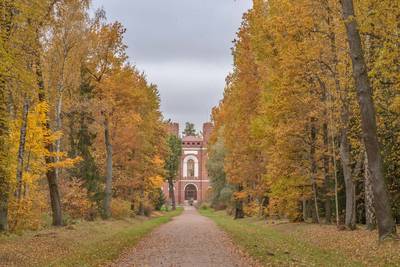
Bolshoy Lamskoy Bridge (Great Lamsky Bridge). It was built in 1820-1822 by the Scottish architect Adam Menelaws, who was instrumental in shaping the park s romantic "English" landscape style. The bridge spans the Lamsky Ponds near the Llama Pavilion, originally serving the utilitarian purpose of connecting the Lamsky stables (which housed exotic llamas from Peru) to the rest of the park. Originally a cast-iron structure, it has been carefully restored to preserve its intricate metal latticework railings, which feature a distinct geometric pattern characteristic of the Russian Empire style. Aleksandrovsky (Alexander) Park in Pushkin (former Tsarskoe Selo) near Saint Petersburg, Russia, October 10, 2025  Turkish Bath, a picturesque pavilion situated on a small peninsula in the Great Pond in Catherine Park. Commissioned by Emperor Nicholas I, this was the last structure built in the imperial park, completed between 1850 and 1852. It was designed by Ippolito Monighetti, who used the appearance of a Turkish mosque as his inspiration. The building features a central gilded dome, a tall minaret crowned with a crescent, and intricate relief ornaments on the white facade. The pavilion serves as a victory monument to the Russo-Turkish War of 1828-1829. Pushkin (former Tsarskoe Selo) near Saint Petersburg, Russia, October 10, 2025  Upper Bath Pavilion reflected perfectly in the Mirror Pond in Catherine Park. Built in 1777-1779 by the architects Ilya and Vasily Neelov, this pavilion is a fine example of Early Classicism. The building features a modest yet elegant yellow facade with a central arched entrance and circular windows (oculi) adorned with garlands. Pushkin (former Tsarskoe Selo) near Saint Petersburg, Russia, October 10, 2025  Evening Hall (Vecherniy Zal) in Catherine Park. It was built between 1796 and 1810 under the supervision of architect P.V. Neyelov (and possibly Luigi Rusca). This pavilion was intended for evening gatherings, small concerts, and balls. The building is a simple, rectangular Classical structure with a low dome and large arched windows Pushkin (former Tsarskoe Selo) near Saint Petersburg, Russia, October 10, 2025  Alley north-west from Arsenal in Aleksandrovsky (Alexander) Park. Pushkin (former Tsarskoe Selo) near Saint Petersburg, Russia, September 19, 2013  Ancient linden alley near the Feodorovsky Gorodok (Fyodorovsky Town) which is a remnant of the park s imperial landscape design. The gnarled, dark trunks of the linden trees (Tilia) create a solemn, cathedral-like atmosphere. Pushkin (former Tsarskoe Selo) near Saint Petersburg, Russia, October 10, 2025  One of the Small Chinese Bridges (Small Iron Bridges) crossing the Krestovy Canal. Originally wooden (1781), they were replaced with cast iron versions forged at the Sestroretsk Arms Factory in 1786. Designed by Charles Cameron, who also planned the nearby Chinese Village. The bridge features intricate iron lattice railings and is framed by distinctive porticoes formed of paired columns with "Chinese-style" curved sheet-iron roofs. The columns are painted to mimic colored marble, and the structure was fully restored in the 21st century. Aleksandrovsky (Alexander) Park in Pushkin (former Tsarskoe Selo) near Saint Petersburg, Russia, October 10, 2025  Alley near Arsenal in Aleksandrovsky Park. Pushkin (former Tsarskoe Selo), south from Saint Petersburg, Russia, May 30, 2011  Pyramid Pavilion, located in a quiet, shady corner of Catherine Park in Tsarskoe Selo (Pushkin). It was originally built in 1770-1772 by the architect Vasily Neyelov and later reconstructed by Charles Cameron in 1782-1783. The pavilion was designed to resemble an ancient Egyptian mausoleum, reflecting the Romantic era s fascination with antiquity and melancholy ruins. It is constructed of brick and faced with trimmed granite. Buried behind the pyramid are three of the Empress s favorite Italian greyhounds: Tom Anderson, Zemira, and Duchesse. Saint Petersburg, Russia, October 10, 2025  Ancient oak trunk in Alexander Park showcases the sculptural quality of the park s veteran trees. The trunk features a massive, gnarled root flare and deep, craggy bark fissures, indicators of its significant age (likely over 200 years). These "veteran trees" are living monuments from the imperial era. Northern part of Aleksandrovsky (Alexander) Park in Pushkin (former Tsarskoe Selo) near Saint Petersburg, Russia, October 10, 2025  Red Cascade or Turkish Cascade in Catherine Park. The Red Cascade is a dam that regulates the water level between the Upper Ponds and the Great Pond. The two "towers" flanking the crossing are designed in the Gothic style, featuring red brick walls with white limestone details, pointed arches, and niche windows. It was built in the 1780s by the engineer Ivan Gerard, likely based on designs by the architect Vasily Neelov. Pushkin (former Tsarskoe Selo) near Saint Petersburg, Russia, October 10, 2025  Chinese Gazebo (often called the Creaking Pagoda or Skripuchaya Besedka) which is one of the most eccentric and picturesque structures in Catherine Park. Built between 1778 and 1786, this pavilion was designed by Yury Felten (Georg Friedrich Veldten) at the height of the 18th-century craze for Chinoiserie (Chinese-style art). The pavilion gets its popular nickname from the metal weather vane on its roof. Shaped like a Chinese banner, it was intentionally designed to creak loudly in the wind. Originally, such pavilions served as tea houses or resting spots for the Empress and her court during their walks. Pushkin (former Tsarskoe Selo) near Saint Petersburg, Russia, October 10, 2025  "Framed" perspective looking towards the trees near the Marble Bridge in Catherine Park. The arches create a "picture window" effect, a classic technique in landscape architecture designed to direct the viewer s gaze to specific idealized scenes of nature. The stone ball finials on the balustrade add a rhythmic, formal element that contrasts with the organic chaos of the forest background. Pushkin (former Tsarskoe Selo) near Saint Petersburg, Russia, October 10, 2025  Birch trees near Lamsky Pavilion in Aleksandrovsky (Alexander) Park. Pushkin (former Tsarskoe Selo) near Saint Petersburg, Russia, September 19, 2013  Italian Pergola located in the Private Garden (Sobstvenny Sadik) of Catherine Park. The pergola was built in 1865 (mid-19th century) during the reign of Alexander II. It was designed specifically to be covered in climbing plants, creating a shaded walkway or "veranda" that offered respite from the sun while allowing views of the obelisk and the surrounding landscape. Pushkin (former Tsarskoe Selo) near Saint Petersburg, Russia, October 10, 2025  Alley to Hermitage Pavilion in Catherine Park. Pushkin (former Tsarskoe Selo) near Saint Petersburg, Russia, October 13, 2016  Alley near Hermitage Pavilion in Catherine Park. Pushkin (former Tsarskoe Selo) near Saint Petersburg, Russia, October 13, 2016  Central axis of the "Old Garden" (Regular Park), known as Hermitage Alley (Ermitazhnaya alleya) in Catherine Park. In the 18th century, this alley was the promenade for courtiers moving between the formal receptions at the Palace and the intimate, private parties at the Hermitage. Pushkin (former Tsarskoe Selo) near Saint Petersburg, Russia, October 10, 2025  Baroque stone capital (likely from the dismantled Monbijou Pavilion) featuring reliefs of putti (cherubs), now displayed as a decorative artifact at the entrance of the Pensioner Stable in Alexander Park. Pushkin (former Tsarskoe Selo), south from Saint Petersburg, Russia, September 21, 2025  Fly agaric mushrooms (Amanita muscaria) on a road south-west from Arsenal in Aleksandrovsky (Alexander) Park. Pushkin (former Tsarskoe Selo) near Saint Petersburg, Russia, September 19, 2013  Fly agaric mushroom (Amanita muscaria) on a road south-west from Arsenal in Aleksandrovsky (Alexander) Park. Pushkin (former Tsarskoe Selo) near Saint Petersburg, Russia, September 19, 2013  The view through the porticoes of one Small Chinese Bridge (often called the Second Small Chinese Bridge) that frames the Cross Bridge in the distance. The twin porticoes, with their "Chinese" peaked roofs and paired columns, create a natural proscenium that directs the eye straight down the canal. The foreground showcases the bridge s vibrant ironwork--geometric lattices and gilded details--contrasting with the brick arch of the Cross Bridge and the soft autumn foliage beyond. This alignment exemplifies the park s deliberate theatricality, using architectural "wings" (the porticoes) to stage the view of the central pavilion. Aleksandrovsky (Alexander) Park in Pushkin (former Tsarskoe Selo) near Saint Petersburg, Russia, October 10, 2025  Orange fly agaric mushrooms (Amanita muscaria) on a road south-west from Arsenal in Aleksandrovsky (Alexander) Park. Pushkin (former Tsarskoe Selo) near Saint Petersburg, Russia, September 19, 2013  Maple alley near Chinese Bridges of Krestovy Canal in Aleksandrovsky (Alexander) Park. Pushkin (former Tsarskoe Selo) near Saint Petersburg, Russia, October 10, 2025  Arsenal in Alexander Park. Pushkin (former Tsarskoe Selo), south from Saint Petersburg, Russia, October 6, 2017  Small Lamsky Bridge (Maly Lamskoy Bridge), built in the early 20th century (around 1900) to replace an earlier wooden crossing. Aleksandrovsky (Alexander) Park in Pushkin (former Tsarskoe Selo) near Saint Petersburg, Russia, October 10, 2025  Looking down the Krestovy Canal from the deck of one of the Small Chinese Bridges. The cast-iron railing belongs to the Small Chinese Bridge, characterized by its geometric lattice and gilded ball details, cast at the Sestroretsk Arms Factory. The structure in the distance is the Krestovy Bridge (Cross Bridge), positioned centrally over the canal axis. This perspective illustrates the linear layout of the "New Garden" section of Alexander Park, visually connecting the two Chinoiserie-style crossings. Aleksandrovsky (Alexander) Park in Pushkin (former Tsarskoe Selo) near Saint Petersburg, Russia, October 10, 2025  This view from the Small Chinese Bridge captures the northwestern stretch of the Krestovy Canal. The canal creates a straight, reflective corridor lined with golden maples, emphasizing the transition from the formal "New Garden" to the more naturalistic landscape park areas. Looking northwest, the canal leads toward the Alexander Palace and its kitchen buildings, which are situated to the right of this axis, hidden behind the dense tree line. The scene highlights the park s quiet, wooded character, contrasting with the architectural focus of the opposite view towards the Cross Bridge. Aleksandrovsky (Alexander) Park in Pushkin (former Tsarskoe Selo) near Saint Petersburg, Russia, October 10, 2025  Forest north from Arsenal in Alexander Park. Pushkin (former Tsarskoe Selo), south from Saint Petersburg, Russia, October 6, 2017  Area north from Arsenal in Alexander Park. Pushkin (former Tsarskoe Selo), south from Saint Petersburg, Russia, October 6, 2017  Ramp Alley (Rampovaya Alleya) whic is a historic avenue in Catherine Park, known for its grand canopy of ancient trees and its connection to imperial history. Pushkin (former Tsarskoe Selo) near Saint Petersburg, Russia, October 10, 2025  Northern honey mushrooms (Armillaria borealis) on a lawn near Arsenal in Alexander Park. Pushkin (former Tsarskoe Selo), south from Saint Petersburg, Russia, September 21, 2025  Lamsky Pavilion in Aleksandrovsky (Alexander) Park. Pushkin (former Tsarskoe Selo) near Saint Petersburg, Russia, September 19, 2013  Devil s Bridge (Chertov Most), also known as the Cascade, located near the Upper Ponds in Catherine Park. Built in the 1770s, likely designed by the architect Vasily Neyelov or possibly Antonio Rinaldi, this structure is a classic example of the romantic "ruin" aesthetic popular in 18th-century landscape gardening. Pushkin (former Tsarskoe Selo) near Saint Petersburg, Russia, October 10, 2025  The park s blend of formal structure and natural landscape during autumn. The image captures a long, straight avenue typical of the park s 18th-century layout, creating a mesmerizing "tunnel" effect. :200b Oranienbaum palace-and-park ensemble in Lomonosov (a suburb of St. Petersburg), Russia, October 13, 2025  View from the Small Chinese Bridge looks down the Krestovy Canal in the opposite direction from the Cross Bridge. The photo captures the linear vista of the canal, flanked by an avenue of mature maple trees displaying vibrant autumn colors. The foreground highlights the Small Chinese Bridge s decorative iron railing, featuring a geometric lattice pattern with gilded rosettes, cast in 1786. This section of the canal borders the regular "New Garden" area, leading toward the Chinese Village. Aleksandrovsky (Alexander) Park in Pushkin (former Tsarskoe Selo) near Saint Petersburg, Russia, October 10, 2025  Arsenal ruins in Aleksandrovsky Park in Pushkin (former Tsarskoe Selo, suburb of Saint Petersburg). Russia, January 27, 2000  Fall colors of red-barked dogwood near Arsenal in Alexander Park. Pushkin (former Tsarskoe Selo), south from Saint Petersburg, Russia, October 6, 2017  This view from Rataskaevu Street looks directly towards the imposing St. Nicholas Church (Niguliste kirik), creating one of the most picturesque and architecturally significant scenes in Tallinn s Old Town. The dominant feature is the massive tower of St. Nicholas Church, dedicated to the patron saint of merchants and sailors. The church, originally built in the 13th century as a fortress-church, showcases a mix of Gothic and Baroque elements. The current Baroque spire (added in the late 17th century) rises high above the street, while the lower sections reveal the heavy limestone walls typical of medieval defense structures. At the base of the tower, one can see the Small Chapel (Va"ike kabel) and the Clodt Chapel. The smaller, yellow-and-white structure with the arched entrance (left foreground) is the Chapel of St. Matthew (later St. George), adding a touch of color and intricate detail to the otherwise austere stone facade. Estonia, October 16, 2025  The path, leading northeast from the Big Lamsky Pond, illustrating the transition into the more secluded "wilderness" areas of the park. Aleksandrovsky (Alexander) Park in Pushkin (former Tsarskoe Selo) near Saint Petersburg, Russia, October 10, 2025  Hermitage Pavilion in Catherine Park, designed by the Italian court architect Francesco Bartolomeo Rastrelli in Elizabethan Baroque style. Pushkin (former Tsarskoe Selo) near Saint Petersburg, Russia, October 10, 2025  Common bonnet mushrooms (Mycena galericulata) north from Arsenal in Alexander Park. Pushkin (former Tsarskoe Selo), south from Saint Petersburg, Russia, October 6, 2017  Arsenal Tower in Alexander Park of Pushkin (former Tsarskoe Selo), a suburb of Saint Petersburg, Russia, June 21, 2009  Lai Street in the Old Town. The row of gabled buildings on the right is known as the "Three Brothers". These medieval merchant houses are less famous than the "Three Sisters" on Pikk Street but are equally historically significant. The white facade in the immediate foreground (right) features a neo-Gothic or historicist style, likely dating from a later renovation (potentially 19th or early 20th century) that unified earlier medieval structures. One can clearly see the transition from the plastered, light-colored facade in the foreground to the simpler, pastel-yellow medieval warehouse-style building next to it. These buildings often retain their original "diele-dornse" layout (a large front room for business and living quarters behind). The perspective highlights the massive scale of St. Olaf s Church (Oleviste kirik) at the end of the street (Lai 50). The tower s copper spire, weathered to green, creates a striking contrast with the red tile roofs and the autumn foliage on the left. Tallinn, Estonia, October 16, 2025  Central Alley in Alexander Park. Pushkin (former Tsarskoe Selo), south from Saint Petersburg, Russia, October 6, 2017  A building at 5 lit. B Engelsa Prospect which is a surviving historical service corps of the Orlovo-Novosiltsevskaya Almshouse complex. This small brick structure was originally built as one of the auxiliary buildings (likely for staff or utility purposes) for the larger almshouse institution. The main complex, located at Engelsa 1-5, was a major philanthropic center established in the 1830s. The complex was designed by the renowned architect Iosif Charlemagne (Joseph-Maria Charlemagne-Baudet) in the late Classicist style. It was constructed between 1834 and 1841. Lesnoy Park (Lesotekhnicheskiy Universitet), Saint Petersburg, Russia, October 14, 2025  This is the No~elasilma ("Eye of the Needle") Gate, a reconstructed section of the medieval urban fabric located at the end of Niguliste Street. Originally, this area was a densely built-up part of the Old Town, near the historic Harju Gate. However, the neighborhood was largely destroyed during the March 1944 Soviet bombing, which leveled about 20% of Tallinn s buildings, particularly in the Harju and Niguliste street areas. The ruins stood for decades before the area was cleared and later redeveloped as a green space and memorial. The No~elasilma Gate itself was reconstructed in 2006-2007 as part of an effort to restore the medieval street network and mark the historical boundary of the former churchyard. The structure consists of two limestone walls with arched openings, mimicking the narrow passageways typical of the medieval city. Looking through the gate, you see the cobblestones of Niguliste Street. In the background stands a distinct corner tower with a red tiled roof, part of the residential block that survived or was restored after the war. The modern apartment buildings on the left (Harju Street area) are post-war constructions, filling the void left by the bombing. The gate now serves as a poignant reminder of the city s lost layers and its resilience. Estonia, October 16, 2025  The view from Ru"u"tli Street (Knight Street) offers a quintessential glimpse into Tallinn s medieval past, framed by the looming presence of St. Nicholas Church (Niguliste kirik). Ru"u"tli Street itself is steeped in darker history. In the medieval period, it was home to the town s prison and the executioner s house, leading to it being avoided by respectable citizens. The executioner, a figure of fear and superstition, lived here because his profession made him a social pariah, and the street was even fenced off at night to prevent vandalism and "fouling" by locals who despised him. Estonia, October 16, 2025  Stone Hall Pavilion (Kammenoe Zalo) in Oranienbaum Park. It is a light pink, two-story stone pavilion designed by architect Antonio Rinaldi (built mid-18th century) for Grand Duke Peter Fedorovich. Originally used for concerts, masquerades, and dances, it later served as a Lutheran church. Oranienbaum palace-and-park ensemble in Lomonosov (a suburb of St. Petersburg), Russia, October 13, 2025  Northern end of Vene Street (Vene ta"nav) at the intersection with Olevima"gi and Bremeni ka"ik. The red brick building on the immediate left is located at Vene 28. It is a historic structure that was originally built in 1912 as a residential building and briefly housed the Estonian Provisional Government in 1918. It stands out with its industrial-style red brick facade contrasting with the medieval stone walls nearby. The large limestone wall with the archway on the far left is part of the city s defensive fortifications, specifically near the Bremen Tower (Bremeni torn). The archway leads into Bremen Passage (Bremeni ka"ik), a short, atmospheric walkway that connects Vene Street to Uus Street through the city wall. The tower itself, a 15th-century horseshoe-shaped defensive structure, is located just behind this wall. In the background, at the end of the street, you can see the yellow tower and facade of the Orthodox Church of St. Nicholas (Nikolai kirik) at Vene 24. Designed by architect Luigi Rusca and built between 1820-1827, this Neoclassical church serves a congregation under the Moscow Patriarchate and is known for its valuable iconostasis. It sits on the site of a much older church that served Novgorod merchants in the Middle Ages. Tallinn, Estonia, October 16, 2025  Petrovsky Bridge in Oranienbaum Park. The bridge is a three-arched stone structure built in 1910 (designed by O. Paulson) to replace an older wooden one. It features rough-hewn stone masonry on the lower arches contrasting with lighter brick detailing and white balustrades along the top. It spans the Karasta River, which flows through a valley currently filled with vibrant orange and golden foliage from the surrounding maple and oak trees. Oranienbaum palace-and-park ensemble in Lomonosov (a suburb of St. Petersburg), Russia, October 13, 2025  Gothic Gate (Goticheskie Vorota) in the landscape section of Catherine Park. Erected in 1778, the gate was designed by the architect Yury Felten (Georg Friedrich Veldten). The design mimics a Gothic cathedral portal, featuring slender columns that branch into pointed arches with intricate "lace-like" tracery. Pushkin (former Tsarskoe Selo) near Saint Petersburg, Russia, October 10, 2025  Naturalistic path winding through a dense grove of mature trees, including oaks and maples, which display a vibrant palette of ochre, rust, and lime green. Aleksandrovsky (Alexander) Park in Pushkin (former Tsarskoe Selo) near Saint Petersburg, Russia, October 10, 2025  This is the interior of St. Nicholas Church (Niguliste kirik), now a museum of medieval art, looking towards the east end of the nave. The centerpiece is the magnificent High Altar retable (visible in the distance), a masterpiece of late medieval art created by the workshop of Lu"beck master Hermen Rode between 1478 and 1481. It is one of the largest and best-preserved altarpieces of its kind in Europe, measuring over six meters wide when fully open. The artwork depicts the lives of St. Nicholas and St. Victor, alongside more than thirty sculptures of saints. Coat-of-Arms Epitaphs: The white limestone walls of the nave are adorned with a unique collection of large, colorful coat-of-arms epitaphs (seen on the right wall). These were dedicated to wealthy local merchants and nobility from the 17th and 18th centuries, serving as memorials for those buried within the church. Estonia, October 16, 2025  Big Lamsky Pond (Bolshoy Lamskoy Prud), part of a system of ponds originally dug in the early 19th century to drain the park s marshy terrain. Aleksandrovsky (Alexander) Park in Pushkin (former Tsarskoe Selo) near Saint Petersburg, Russia, October 10, 2025  Tunnel-like quality of the linden alley, a hallmark of 19th-century Russian park design. The interlocking branches of the mature linden trees (Tilia) form a "gothic arch" overhead, completely enclosing the path. This creates a sense of protection and separation from the outside world, which aligns with the secluded, monastic theme of the nearby Feodorovsky Gorodok. Pushkin (former Tsarskoe Selo) near Saint Petersburg, Russia, October 10, 2025  Looking south from the Friendship Bridge, this view captures the recreational and spiritual side of the city, contrasting with the military fortifications seen on the other side. The prominent spire in the distance belongs to the Narva Alexander s Cathedral, an Evangelical Lutheran church built in the late 19th century. Its distinct octagonal tower is a major city landmark that survived severe damage during WWII. Along the riverbank, one see the modern architecture of the Joaorg Beach Building (the low, tiered structure nestled in the trees). This area serves as a popular public space with a swimming beach, gym, and promenade, offering locals a place to relax by the river. Estonia, October 16, 2025  The stall labeled "Moskva" that honors a favorite horse of Emperor Nicholas I in Pensioner Stable (Pensionnaya Konyushnya) in Alexander Park, Tsarskoe Selo. This horse, a veteran of military reviews like the one in Elisavetgrad, spent its retirement in the stable built by the Emperor for his own and his predecessor s faithful steeds. The nameplate was reinstated during the 2024-2025 restoration of the pavilion. Saint Petersburg, Russia, September 21, 2025  St. Nicholas Church (Niguliste kirik), located at Niguliste 3 in Tallinn s Old Town. Although originally built as a fortress church in the 13th century dedicated to Saint Nicholas (patron of sailors and merchants), it is no longer a functioning place of worship. Today, it houses the Niguliste Museum, a branch of the Art Museum of Estonia, dedicated to medieval ecclesiastical art. The church was founded by Westphalian merchants in the 1230s and was one of the wealthiest in the city. It was heavily damaged during the Soviet bombing of Tallinn in March 1944, losing its roof and most of its interior, but was meticulously restored in the following decades. The tower, rebuilt with a Baroque spire, now features a glass elevator and a viewing platform offering panoramic views of the city. The church sits on a rise just south of the Town Hall Square, surrounded by a green area that was once a cemetery. The street in the foreground is Niguliste Street, leading up from the lower town. Tallinn, Estonia, October 16, 2025  Path in a forest south from Arsenal in Alexander Park. Pushkin (former Tsarskoe Selo), south from Saint Petersburg, Russia, September 24, 2015  Mushrooms dead man s fingers (Xylaria polymorpha) on old low linden stump south-west from Arsenal in Alexander Park in Pushkin (former Tsarskoe Selo) near Saint Petersburg. Russia, May 18, 2021  A grotto near the Chapelle pavilion in Alexander Park. Pushkin (former Tsarskoe Selo), south from Saint Petersburg, Russia, October 6, 2017  Path in a forest south-east from Arsenal in Alexander Park. Pushkin (former Tsarskoe Selo), south from Saint Petersburg, Russia, September 24, 2015  Classical linden alley in the Upper Park, a perfectly straight, tree-lined corridor, a hallmark of the formal garden design elements retained within the landscape park. Oranienbaum palace-and-park ensemble in Lomonosov (a suburb of St. Petersburg), Russia, October 13, 2025  Vana Turg (Old Market) square, dominated by the Peppersack restaurant building. The central white building with the high gable and hoist beam is Peppersack (Viru 2 / Vana turg 6). Dating back to 1370, this historic structure was originally a merchant s house and granary. The name "Peppersack" refers to a nickname given to wealthy merchants (who traded in expensive spices like pepper) or possibly a specific owner, Hans Peppersack. Today, it is a popular medieval-themed restaurant known for its sword-fighting shows and hearty Estonian cuisine. To the right of Peppersack is the Art Nouveau building housing Scheeli Restaurant (Vana turg 2). Known for its elegant interior and romantic atmosphere, it offers a contrast to the rustic medieval style of its neighbor, serving refined European cuisine in a setting that recalls the 1920s. The square features a stunning ensemble of Gothic and Art Nouveau architecture. The Peppersack building retains its medieval pulley system (visible on the facade), which was used to hoist goods into the storage floors. The red sack hanging from the facade is a playful nod to the building s name. This spot is a major intersection in the Old Town, where Viru Street meets the Old Market, just steps away from the Town Hall Square. Tallinn, Estonia, October 16, 2025  This panoramic view from the tower of St. Nicholas Church looks south-west towards Toompea Hill, capturing the dense layering of Tallinn s medieval and religious history. The striking structure with black onion domes is the Alexander Nevsky Cathedral, an Orthodox cathedral built in 1900 in the Russian Revival style. Its imposing presence on Toompea Hill contrasts sharply with the surrounding red-tiled roofs, symbolizing the complex history of the Russian era in Estonia. In the foreground and middle distance, you can see key parts of the city s defensive network: The square tower with the tall red roof in the foreground is the Maiden Tower, a 14th-century defensive structure that now houses a cafe. Just behind and slightly to the left of the Maiden Tower (partially obscured) is the massive Kiek in de Ko"k artillery tower, whose Low German name ("Peep into the Kitchen") referred to the guards ability to see into nearby homes. Connective sections of the medieval city wall run between these towers, marking the boundary between the lower town and the upper citadel. The green space visible near the base of the wall is the Danish King s Garden (Taani kuninga aed). According to legend, this is where the Danish flag (Dannebrog) fell from the sky during a battle in 1219, turning the tide in favor of the Danes. The garden sits on the slope directly facing St. Nicholas Church. Estonia, October 16, 2025  Naturalistic style of the English landscape garden, which dominates the areas surrounding the formal canals, with rich textural contrast between the golden maples and dark evergreen firs, creating a painterly composition typical of 19th-century Russian park design. The untamed, wilder growth of the underbrush and tall grasses contrasts with the manicured lawns found elsewhere, evoking a sense of romantic melancholy suited to the "golden autumn" season. The dense, layered foliage creates an intimate, enclosed space that feels removed from the grand palace architecture, focusing entirely on the mood of the forest. Aleksandrovsky (Alexander) Park in Pushkin (former Tsarskoe Selo) near Saint Petersburg, Russia, October 10, 2025  Redbud foliage in a forest south-east from Arsenal in Alexander Park. Pushkin (former Tsarskoe Selo), south from Saint Petersburg, Russia, September 24, 2015  Hall on the Island in Catherine Park, view from Ferry Crossing. It was originally built in the late 1740s by the architect Savva Chevakinsky in the Baroque style, with decorations based on sketches by Rastrelli. In 1794, under Catherine the Great, the architect Giacomo Quarenghi completely rebuilt it in the Classical style. He simplified the decor, giving it the restrained, elegant appearance seen today--white walls, large arched windows, and a modest green roof. Pushkin (former Tsarskoe Selo) near Saint Petersburg, Russia, October 10, 2025  Gothic Gate and spruce alley in Catherine Park. Pushkin (former Tsarskoe Selo) near Saint Petersburg, Russia, September 23, 2016  Imperial Horse Cemetery at the Pensioner s Stable in Tsarskoe Selo. This cemetery is the final resting place for over 120 favorite horses of the Russian Emperors, from Alexander I to Nicholas II. The neat rows of white tombstones are the result of a major restoration project completed recently. Saint Petersburg, Russia, September 21, 2025  Ancient oak tree trunk. Many oaks in the park are over 200 years old, some dating back to the park s initial landscaping in the 18th and 19th centuries. The gnarled, textured bark and massive girth signify its age and resilience. Northern part of Aleksandrovsky (Alexander) Park in Pushkin (former Tsarskoe Selo) near Saint Petersburg, Russia, October 10, 2025  Kitchen Ruin (Kukhnya-Ruina) which is one of the most historically fascinating and visually authentic follies in Catherine Park. Built between 1785 and 1786, it was designed by the Italian architect Giacomo Quarenghi. It was constructed specifically to serve as a "service pavilion" (a kitchen) for the nearby Concert Hall. Quarenghi incorporated authentic ancient Roman fragments into its brick walls. These include broken columns, capitals, cornices, and friezes with carved garlands, which were brought to Russia from Italy. The headless statue in the niche is a prominent feature, emphasizing the theme of lost time and the decay of empires. Pushkin (former Tsarskoe Selo) near Saint Petersburg, Russia, October 10, 2025  The wilder, naturalistic aesthetic of Alexander Park s landscape section. The visual appeal lies in the layered textures of the undergrowth--a mix of golden birch leaves and red shrubbery--creating a chaotic but harmonious "tapestry" effect. Unlike the formal alleys, this scene emphasizes density and verticality, with thin birch trunks contrasting against the soft, diffuse background of the forest depth. It evokes the intimacy of a forest interior (uncultivated nature), a deliberate romantic counterpoint to the manicured geometry of the nearby "New Garden". Aleksandrovsky (Alexander) Park in Pushkin (former Tsarskoe Selo) near Saint Petersburg, Russia, October 10, 2025  Formal alley of manicured spruce trees in the Lower Park of Oranienbaum, leading towards an entrance gate. Oranienbaum palace-and-park ensemble in Lomonosov (a suburb of St. Petersburg), Russia, October 13, 2025  This view from the St. Nicholas Church tower focuses on the southwestern edge of the Old Town, dominated by medieval fortifications and the lush greenery of Toompea s slopes. The massive round tower on the right is Kiek in de Ko"k ("Peep into the Kitchen"), a 15th-century artillery tower. Its formidable stone walls, over 4 meters thick, were designed to withstand cannon fire, making it the most powerful defensive tower in the Baltic region during its time. Today, it houses a fortification museum. Below the tower, the cobblestone street running vertically is Ru"u"tli Street, historically home to the city s executioner and later a quiet residential area. To the left of Ru"u"tli Street, the large building with the expansive red-tiled roof is the Swedish St. Michael s Church (Rootsi-Mihkli kirik). Originally a medieval hospital and poorhouse, it was converted into a church for the Swedish garrison and community. Its simple, robust architecture contrasts with the more ornate merchant houses found elsewhere in the Old Town. Estonia, October 16, 2025  Forest at Elevaya Alley near a dam of Kuzminka River at Nizhne Lamsky Pond in Aleksandrovsky (Alexander) Park. Pushkin (former Tsarskoe Selo) near Saint Petersburg, Russia, September 19, 2013  Grotto Pavilion in Catherine Park. Pushkin (former Tsarskoe Selo) near Saint Petersburg, Russia, October 13, 2016  Hermitage Pavilion in Catherine Park. Pushkin (former Tsarskoe Selo) near Saint Petersburg, Russia, October 13, 2016  Grotto Pavilion and Great Pond (Bolshoy Prud) in Catherine Park. Pushkin (former Tsarskoe Selo) near Saint Petersburg, Russia, October 10, 2025  Entrance of Hermitage Pavilion in Catherine Park. Pushkin (former Tsarskoe Selo) near Saint Petersburg, Russia, October 13, 2016  Entrance of Hermitage Pavilion in Catherine Park. Pushkin (former Tsarskoe Selo) near Saint Petersburg, Russia, October 13, 2016  Pavilion Evening Hall in Catherine Park. Pushkin (former Tsarskoe Selo) near Saint Petersburg, Russia, October 13, 2016  Mushrooms Plicaturopsis crispa on a log in Aleksandrovsky (Alexander) Park in Pushkin (former Tsarskoe Selo) near Saint Petersburg, Russia, October 10, 2025  Alley in Alexander Park. Pushkin (former Tsarskoe Selo), south from Saint Petersburg, Russia, May 13, 2016  Maple fall foliage at Elevaya Alley near a dam of Kuzminka River at Nizhne Lamsky Pond in Aleksandrovsky (Alexander) Park. Pushkin (former Tsarskoe Selo) near Saint Petersburg, Russia, September 19, 2013  Soykinskaya Alley (or Road) in Oranienbaum Park. This is a major thoroughfare in the Upper Park, notable for its impressive width and the straight, long perspective it creates, reminiscent of the "prospekts" designed in the 18th century. The alley is flanked by mature, stately trees--predominantly oaks and lindens--whose canopies form a "golden tunnel" overhead. The fallen leaves completely cover the ground, creating a continuous carpet of orange and yellow that mirrors the canopy above. Oranienbaum palace-and-park ensemble in Lomonosov (a suburb of St. Petersburg), Russia, October 13, 2025  Caps of mushrooms Plicaturopsis crispa on a log in Aleksandrovsky (Alexander) Park in Pushkin (former Tsarskoe Selo) near Saint Petersburg, Russia, October 10, 2025  Young mushrooms Plicatura nivea on a log in Aleksandrovsky (Alexander) Park in Pushkin (former Tsarskoe Selo) near Saint Petersburg, Russia, October 10, 2025  Krestovy Bridge (Cross Bridge) located in Alexander Park in the town of Pushkin (formerly Tsarskoe Selo), near Saint Petersburg. It has Chinoiserie (Chinese-style) architecture, popular in the 18th century. A pavilion rests on four joined arches over the canal, creating a cross shape. It features glazed bricks (crimson, yellow, blue) and a curved "fish scale" roof. Built in 1779 by the Neyelovs for Catherine the Great, it is a key landmark of the park s "New Garden" area. Russia, October 10, 2025  Red Cascade or Turkish Cascade in Catherine Park. The Rust Red (8A611E) of the brickwork complements the surrounding Golden Orange (BB812a) foliage perfectly. The rough texture of the brick and the stepped stone cascade creates a rustic, "ruin-like" aesthetic that was highly fashionable in 18th-century landscape design. Pushkin (former Tsarskoe Selo) near Saint Petersburg, Russia, October 10, 2025  A poetic tribute "Pushkin was here" to the great Russian poet Alexander Pushkin in Catherine Park. The symbols on the bench carry specific meanings related to his time at the Imperial Lyceum (located just nearby), where he studied from 1811 to 1817. The Bicorne Hat (Cocked Hat): This represents the uniform worn by the students of the Imperial Lyceum. The Open Book: A symbol of his literary genius and his constant immersion in reading and writing poetry, often done while wandering this very park. Pushkin (former Tsarskoe Selo) near Saint Petersburg, Russia, October 10, 2025  Lamb Farm (Lamskoy Pavilion) in Alexander Park of Pushkin (former Tsarskoe Selo), a suburb of Saint Petersburg, Russia, June 21, 2009  Mushrooms Plicaturopsis crispa together with Plicatura nivea on a log in Aleksandrovsky (Alexander) Park in Pushkin (former Tsarskoe Selo) near Saint Petersburg, Russia, October 10, 2025  Texture of corticioid fungus Plicatura nivea on a log in Aleksandrovsky (Alexander) Park in Pushkin (former Tsarskoe Selo) near Saint Petersburg, Russia, October 10, 2025  Fall colors of maples along Krestovy Canal. Aleksandrovsky (Alexander) Park in Pushkin (former Tsarskoe Selo) near Saint Petersburg, Russia, October 10, 2025  Growth of corticioid fungus Plicatura nivea on a log in Aleksandrovsky (Alexander) Park in Pushkin (former Tsarskoe Selo) near Saint Petersburg, Russia, October 10, 2025  Corticioid mushrooms Plicatura nivea on a cut surface of a log in Aleksandrovsky (Alexander) Park in Pushkin (former Tsarskoe Selo) near Saint Petersburg, Russia, October 10, 2025  Underside of caps of mushrooms Plicaturopsis crispa on a log in Aleksandrovsky (Alexander) Park in Pushkin (former Tsarskoe Selo) near Saint Petersburg, Russia, October 10, 2025 |