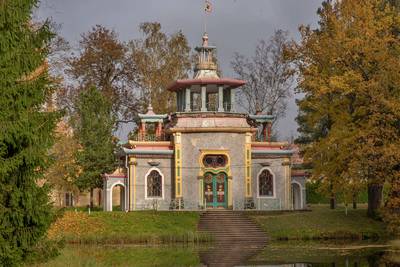
Chinese Gazebo (often called the Creaking Pagoda or Skripuchaya Besedka) in Catherine Park. Pushkin (former Tsarskoe Selo) near Saint Petersburg, Russia, October 10, 2025  Krestovy Bridge (Cross Bridge) located in Alexander Park in the town of Pushkin (formerly Tsarskoe Selo), near Saint Petersburg. It has Chinoiserie (Chinese-style) architecture, popular in the 18th century. A pavilion rests on four joined arches over the canal, creating a cross shape. It features glazed bricks (crimson, yellow, blue) and a curved "fish scale" roof. Built in 1779 by the Neyelovs for Catherine the Great, it is a key landmark of the park s "New Garden" area. Russia, October 10, 2025  Gothic Gate (Goticheskie Vorota) in the landscape section of Catherine Park. Erected in 1778, the gate was designed by the architect Yury Felten (Georg Friedrich Veldten). The design mimics a Gothic cathedral portal, featuring slender columns that branch into pointed arches with intricate "lace-like" tracery. Pushkin (former Tsarskoe Selo) near Saint Petersburg, Russia, October 10, 2025  Chinese Summer House (Creaking, or Pagoda, 1778 - 1786) in Ekaterininsky Park. Pushkin (former Tsarskoe Selo), south from Saint Petersburg, Russia, May 30, 2011  One of the Small Chinese Bridges (Small Iron Bridges) crossing the Krestovy Canal. Originally wooden (1781), they were replaced with cast iron versions forged at the Sestroretsk Arms Factory in 1786. Designed by Charles Cameron, who also planned the nearby Chinese Village. The bridge features intricate iron lattice railings and is framed by distinctive porticoes formed of paired columns with "Chinese-style" curved sheet-iron roofs. The columns are painted to mimic colored marble, and the structure was fully restored in the 21st century. Aleksandrovsky (Alexander) Park in Pushkin (former Tsarskoe Selo) near Saint Petersburg, Russia, October 10, 2025  Hermitage Pavilion in Catherine Park, designed by the Italian court architect Francesco Bartolomeo Rastrelli in Elizabethan Baroque style. Pushkin (former Tsarskoe Selo) near Saint Petersburg, Russia, October 10, 2025  Pyramid Pavilion, located in a quiet, shady corner of Catherine Park in Tsarskoe Selo (Pushkin). It was originally built in 1770-1772 by the architect Vasily Neyelov and later reconstructed by Charles Cameron in 1782-1783. The pavilion was designed to resemble an ancient Egyptian mausoleum, reflecting the Romantic era s fascination with antiquity and melancholy ruins. It is constructed of brick and faced with trimmed granite. Buried behind the pyramid are three of the Empress s favorite Italian greyhounds: Tom Anderson, Zemira, and Duchesse. Saint Petersburg, Russia, October 10, 2025  Stone Hall Pavilion (Kammenoe Zalo) in Oranienbaum Park. It is a light pink, two-story stone pavilion designed by architect Antonio Rinaldi (built mid-18th century) for Grand Duke Peter Fedorovich. Originally used for concerts, masquerades, and dances, it later served as a Lutheran church. Oranienbaum palace-and-park ensemble in Lomonosov (a suburb of St. Petersburg), Russia, October 13, 2025  Devil s Bridge (Chertov Most), also known as the Cascade, located near the Upper Ponds in Catherine Park. Built in the 1770s, likely designed by the architect Vasily Neyelov or possibly Antonio Rinaldi, this structure is a classic example of the romantic "ruin" aesthetic popular in 18th-century landscape gardening. Pushkin (former Tsarskoe Selo) near Saint Petersburg, Russia, October 10, 2025  Creaking or Chinese Summer-House (pagoda) in Ekaterininsky (Catherine) Park of Pushkin (former Tsarskoe Selo), a suburb of Saint Petersburg. Russia, September 7, 2013  Turkish Bath, a picturesque pavilion situated on a small peninsula in the Great Pond in Catherine Park. Commissioned by Emperor Nicholas I, this was the last structure built in the imperial park, completed between 1850 and 1852. It was designed by Ippolito Monighetti, who used the appearance of a Turkish mosque as his inspiration. The building features a central gilded dome, a tall minaret crowned with a crescent, and intricate relief ornaments on the white facade. The pavilion serves as a victory monument to the Russo-Turkish War of 1828-1829. Pushkin (former Tsarskoe Selo) near Saint Petersburg, Russia, October 10, 2025  Reflection of Creaking or Chinese Summer-House (pagoda) in Upper Ponds in Ekaterininsky (Catherine) Park of Pushkin (former Tsarskoe Selo), a suburb of Saint Petersburg. Russia, September 7, 2013  The view through the porticoes of one Small Chinese Bridge (often called the Second Small Chinese Bridge) that frames the Cross Bridge in the distance. The twin porticoes, with their "Chinese" peaked roofs and paired columns, create a natural proscenium that directs the eye straight down the canal. The foreground showcases the bridge s vibrant ironwork--geometric lattices and gilded details--contrasting with the brick arch of the Cross Bridge and the soft autumn foliage beyond. This alignment exemplifies the park s deliberate theatricality, using architectural "wings" (the porticoes) to stage the view of the central pavilion. Aleksandrovsky (Alexander) Park in Pushkin (former Tsarskoe Selo) near Saint Petersburg, Russia, October 10, 2025  Reflection of Chinese Summer House (Creaking, or Pagoda) in Ekaterininsky Park. Pushkin (former Tsarskoe Selo), south from Saint Petersburg, Russia, May 30, 2011  Katalnaya Gorka Pavilion (Sliding Hill Pavilion), a masterpiece of 18th-century architecture located in the Upper Park of Oranienbaum. Designed by Antonio Rinaldi, this 33-meter-high pavilion is a striking blend of Baroque and early Classicism. Its festive, light-blue and white facade, tiered "wedding-cake" shape, and crowning bell-shaped dome make it resemble a lighthouse rising above the park s trees. Oranienbaum palace-and-park ensemble in Lomonosov (a suburb of St. Petersburg), Russia, October 13, 2025  Kitchen Ruin (Kukhnya-Ruina) which is one of the most historically fascinating and visually authentic follies in Catherine Park. Built between 1785 and 1786, it was designed by the Italian architect Giacomo Quarenghi. It was constructed specifically to serve as a "service pavilion" (a kitchen) for the nearby Concert Hall. Quarenghi incorporated authentic ancient Roman fragments into its brick walls. These include broken columns, capitals, cornices, and friezes with carved garlands, which were brought to Russia from Italy. The headless statue in the niche is a prominent feature, emphasizing the theme of lost time and the decay of empires. Pushkin (former Tsarskoe Selo) near Saint Petersburg, Russia, October 10, 2025  View from the Small Chinese Bridge looks down the Krestovy Canal in the opposite direction from the Cross Bridge. The photo captures the linear vista of the canal, flanked by an avenue of mature maple trees displaying vibrant autumn colors. The foreground highlights the Small Chinese Bridge s decorative iron railing, featuring a geometric lattice pattern with gilded rosettes, cast in 1786. This section of the canal borders the regular "New Garden" area, leading toward the Chinese Village. Aleksandrovsky (Alexander) Park in Pushkin (former Tsarskoe Selo) near Saint Petersburg, Russia, October 10, 2025  The central alley leading to the Arsenal Pavilion, a red-brick neo-Gothic structure designed by Adam Menelaws. Completed in 1834, the Arsenal resembles a medieval castle with crenellated towers and massive arched windows. It was originally built to house Nicholas I s vast collection of medieval arms and armor. The straight alley is a remnant of the formal layout from the earlier "Monbijou" pavilion that stood here, now framed by the mature trees of the surrounding landscape park. After severe damage in WWII, the building was restored and reopened in 2016 as a museum displaying imperial weaponry. Aleksandrovsky (Alexander) Park in Pushkin (former Tsarskoe Selo) near Saint Petersburg, Russia, October 10, 2025  Looking down the Krestovy Canal from the deck of one of the Small Chinese Bridges. The cast-iron railing belongs to the Small Chinese Bridge, characterized by its geometric lattice and gilded ball details, cast at the Sestroretsk Arms Factory. The structure in the distance is the Krestovy Bridge (Cross Bridge), positioned centrally over the canal axis. This perspective illustrates the linear layout of the "New Garden" section of Alexander Park, visually connecting the two Chinoiserie-style crossings. Aleksandrovsky (Alexander) Park in Pushkin (former Tsarskoe Selo) near Saint Petersburg, Russia, October 10, 2025  Bolshoy Lamskoy Bridge (Great Lamsky Bridge). It was built in 1820-1822 by the Scottish architect Adam Menelaws, who was instrumental in shaping the park s romantic "English" landscape style. The bridge spans the Lamsky Ponds near the Llama Pavilion, originally serving the utilitarian purpose of connecting the Lamsky stables (which housed exotic llamas from Peru) to the rest of the park. Originally a cast-iron structure, it has been carefully restored to preserve its intricate metal latticework railings, which feature a distinct geometric pattern characteristic of the Russian Empire style. Aleksandrovsky (Alexander) Park in Pushkin (former Tsarskoe Selo) near Saint Petersburg, Russia, October 10, 2025  Hall on the Island in Catherine Park, view from Ferry Crossing. It was originally built in the late 1740s by the architect Savva Chevakinsky in the Baroque style, with decorations based on sketches by Rastrelli. In 1794, under Catherine the Great, the architect Giacomo Quarenghi completely rebuilt it in the Classical style. He simplified the decor, giving it the restrained, elegant appearance seen today--white walls, large arched windows, and a modest green roof. Pushkin (former Tsarskoe Selo) near Saint Petersburg, Russia, October 10, 2025  Italian Pergola located in the Private Garden (Sobstvenny Sadik) of Catherine Park. The pergola was built in 1865 (mid-19th century) during the reign of Alexander II. It was designed specifically to be covered in climbing plants, creating a shaded walkway or "veranda" that offered respite from the sun while allowing views of the obelisk and the surrounding landscape. Pushkin (former Tsarskoe Selo) near Saint Petersburg, Russia, October 10, 2025  Upper Bath Pavilion reflected perfectly in the Mirror Pond in Catherine Park. Built in 1777-1779 by the architects Ilya and Vasily Neelov, this pavilion is a fine example of Early Classicism. The building features a modest yet elegant yellow facade with a central arched entrance and circular windows (oculi) adorned with garlands. Pushkin (former Tsarskoe Selo) near Saint Petersburg, Russia, October 10, 2025  Red Cascade or Turkish Cascade in Catherine Park. The Red Cascade is a dam that regulates the water level between the Upper Ponds and the Great Pond. The two "towers" flanking the crossing are designed in the Gothic style, featuring red brick walls with white limestone details, pointed arches, and niche windows. It was built in the 1780s by the engineer Ivan Gerard, likely based on designs by the architect Vasily Neelov. Pushkin (former Tsarskoe Selo) near Saint Petersburg, Russia, October 10, 2025  Layered perspective of the Krestovy Canal s Chinoiserie architecture. The Small Chinese Bridge frames the scene with its limestone portico and iron lattice railing (1786). The canal leads the eye directly to the Cross Bridge (1779), its arch rising over the water with the distinct "globular pendant" hanging from the vault. The bridges are aligned along the canal s axis, creating a visual corridor characteristic of the park s "New Garden" layout, emphasized here by the autumnal frame of maple trees. Aleksandrovsky (Alexander) Park in Pushkin (former Tsarskoe Selo) near Saint Petersburg, Russia, October 10, 2025  Grotto Pavilion and Great Pond (Bolshoy Prud) in Catherine Park. Pushkin (former Tsarskoe Selo) near Saint Petersburg, Russia, October 10, 2025  Maple alley near Chinese Bridges of Krestovy Canal in Aleksandrovsky (Alexander) Park. Pushkin (former Tsarskoe Selo) near Saint Petersburg, Russia, October 10, 2025  Chinese Village, now apartments for businessmen, in Catherine Park of Pushkin (former Tsarskoe Selo), a suburb of Saint Petersburg, Russia, June 21, 2009  Grotto Pavilion in Catherine Park. Pushkin (former Tsarskoe Selo) near Saint Petersburg, Russia, October 13, 2016  Hermitage Pavilion in Catherine Park. Pushkin (former Tsarskoe Selo) near Saint Petersburg, Russia, October 13, 2016  Chinese Bridge in Alexander Park. Pushkin (former Tsarskoe Selo) near Saint Petersburg, Russia, October 13, 2016  Chinese Theater in Alexander Park. Pushkin (former Tsarskoe Selo) near Saint Petersburg, Russia, October 13, 2016  Evening Hall (Vecherniy Zal) in Catherine Park. It was built between 1796 and 1810 under the supervision of architect P.V. Neyelov (and possibly Luigi Rusca). This pavilion was intended for evening gatherings, small concerts, and balls. The building is a simple, rectangular Classical structure with a low dome and large arched windows Pushkin (former Tsarskoe Selo) near Saint Petersburg, Russia, October 10, 2025  Marble Bridge (also known as the Palladian Bridge or Siberian Marble Gallery) in Catherine Park. Built in 1772-1774 by the architect Vasily Neelov, it is modeled after the famous Palladian Bridge at Wilton House in England (designed by Inigo Jones and Roger Morris). The bridge is constructed entirely from Ural marble (hence "Siberian"). It features a covered Ionic colonnade resting on a rusticated arch base. It spans a narrow channel connecting the Great Pond with the smaller neighboring ponds (Swan Islands). Pushkin (former Tsarskoe Selo) near Saint Petersburg, Russia, October 10, 2025  Azure blue walls and white columns of Grotto Pavilion sitting on the edge of Great Pond (Bolshoy Prud) in Catherine Park. Pushkin (former Tsarskoe Selo) near Saint Petersburg, Russia, October 10, 2025  Pavilion Evening Hall in Catherine Park. Pushkin (former Tsarskoe Selo) near Saint Petersburg, Russia, October 13, 2016  Alley near Hermitage Pavilion in Catherine Park. Pushkin (former Tsarskoe Selo) near Saint Petersburg, Russia, October 13, 2016  Entrance of Hermitage Pavilion in Catherine Park. Pushkin (former Tsarskoe Selo) near Saint Petersburg, Russia, October 13, 2016  Alley to Hermitage Pavilion in Catherine Park. Pushkin (former Tsarskoe Selo) near Saint Petersburg, Russia, October 13, 2016  Entrance of Hermitage Pavilion in Catherine Park. Pushkin (former Tsarskoe Selo) near Saint Petersburg, Russia, October 13, 2016  Dragon on Chinese Bridge in Alexander Park. Pushkin (former Tsarskoe Selo) near Saint Petersburg, Russia, October 13, 2016  Chinese Dragon in Alexander Park. Pushkin (former Tsarskoe Selo), south from Saint Petersburg, Russia, October 6, 2017  Chinese bridges in Alexander Park. Pushkin (former Tsarskoe Selo), south from Saint Petersburg, Russia, October 6, 2017  Chinese Theatre in Alexander Park. Pushkin (former Tsarskoe Selo), south from Saint Petersburg, Russia, October 6, 2017  Pil Tower Bridge (Pil-bashnyy most), with the iconic Pil Tower (Pil-bashnya) visible in the background. The tower is one of the most charming "follies" in the park. Originally built in 1797 by Vincenzo Brenna, it was designed to look like a rustic water mill, complete with a thatched roof and stairs. Pavlovsk, a suburb of Saint Petersburg, Russia, October 6, 2025  Smaller Chinese Bridge in Alexander Park. Pushkin (former Tsarskoe Selo), south from Saint Petersburg, Russia, October 3, 2016  Chinese and Cross bridges in Alexander Park. Pushkin (former Tsarskoe Selo), south from Saint Petersburg, Russia, October 6, 2017  Chinese and Cross bridges in Alexander Palace. Pushkin (former Tsarskoe Selo) near Saint Petersburg, Russia, October 13, 2016 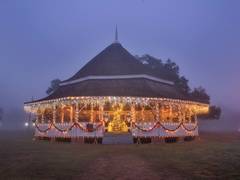 Historic octagonal pavilion (1895) located in Virginia Field Park. It features a distinctive two-tiered roof and elaborate Victorian gingerbread trim ("carpenter Gothic" details). It was designed for concerts, community gatherings, and dancing. It has also been dedicated as the Karen Renee Wiese Memorial Pavilion in more recent years. Calvert, Texas, December 13, 2025  Hermitage Pavilion in Catherine Park in Pushkin (former Tsarskoe Selo) near Saint Petersburg. Russia, May 18, 2021  Upper Bath Pavilion reflected perfectly in the Mirror Pond in Catherine Park. This artificial pond was created in 1719-1722, by the garden masters Jan Roosen and Johann Vocht. Pushkin (former Tsarskoe Selo) near Saint Petersburg, Russia, October 10, 2025  Chinese bridges in Alexander Park. Pushkin (former Tsarskoe Selo) near Saint Petersburg, Russia, December 3, 2016  One of Chinese bridges in Alexander Park. Pushkin (former Tsarskoe Selo) near Saint Petersburg, Russia, December 3, 2016  Ruins of Chinese Theater in Alexander Park in Pushkin (former Tsarskoe Selo) near Saint Petersburg. Russia, May 18, 2021  Small Chinese Bridge in Alexander Park in Pushkin (former Tsarskoe Selo) near Saint Petersburg. Russia, May 18, 2021  Chinese Theater in Alexander Park. Pushkin (former Tsarskoe Selo) near Saint Petersburg, Russia, December 3, 2016  Central axis of the "Old Garden" (Regular Park), known as Hermitage Alley (Ermitazhnaya alleya) in Catherine Park. In the 18th century, this alley was the promenade for courtiers moving between the formal receptions at the Palace and the intimate, private parties at the Hermitage. Pushkin (former Tsarskoe Selo) near Saint Petersburg, Russia, October 10, 2025  Chinese Theatre, destroyed during the war, in Alexandrovskiy Park of Pushkin (former Tsarskoe Selo, residence of Russian tsars). Near Sankt Petersburg, Russia, October 22, 2000  Kitchen Ruin Pavilion in Catherine Park. Pushkin (former Tsarskoe Selo) near Saint Petersburg, Russia, December 3, 2016  A.S. on Chinese Bridge in Aleksandrovsky Park in Pushkin (former Tsarskoe Selo, suburb of Saint Petersburg). Russia, January 27, 2000  Chinese and Cross bridges in Alexander Park. Pushkin (former Tsarskoe Selo) near Saint Petersburg, Russia, December 3, 2016  Canal and Small Chinese Bridge in Alexander Park in Pushkin (former Tsarskoe Selo) near Saint Petersburg. Russia, May 18, 2021  Small Chinese Bridge in Aleksandrovsky Park. Pushkin (former Tsarskoe Selo), south from Saint Petersburg, Russia, May 30, 2011  Chinese Theater in Alexander Park. Pushkin (former Tsarskoe Selo), south from Saint Petersburg, Russia, September 24, 2015  Small Chinese Bridges in Aleksandrovsky Park. Pushkin (former Tsarskoe Selo), south from Saint Petersburg, Russia, May 30, 2011  Old larch tree near Chinese Theater in Alexander Park. Pushkin (former Tsarskoe Selo) near Saint Petersburg, Russia, May 23, 2019  Entrance of Chinese Theater in Alexander Park. Pushkin (former Tsarskoe Selo) near Saint Petersburg, Russia, December 3, 2016  Smaller Chinese Bridge and Cross Bridge (Krestovy Most) in Alexander Park. Pushkin (former Tsarskoe Selo), south from Saint Petersburg, Russia, October 3, 2016  Small Chinese Bridge in Alexander Park. Pushkin (former Tsarskoe Selo), south from Saint Petersburg, Russia, September 24, 2015  Iron Chinese dragon on a bridge in Alexander Park. Pushkin (former Tsarskoe Selo) near Saint Petersburg, Russia, December 3, 2016  Side view of Chinese bridges in Alexander Park. Pushkin (former Tsarskoe Selo) near Saint Petersburg, Russia, December 3, 2016  Chinese and Krestovy Bridges in Aleksandrovsky (Alexander) Park. Pushkin (former Tsarskoe Selo) near Saint Petersburg, Russia, September 19, 2013  So~prus Cinema (Kino So~prus). The building is a striking example of Stalinist Empire style (Socialist Classicism) architecture, completed in 1955. Its grand fac,ade features a curved colonnade of octagonal columns and decorative reliefs symbolizing various arts and industries. Originally designed by architect Friedrich Wendach, the project was completed by Peeter Tarvas and August Volberg after Wendach was repressed by Soviet authorities. The name "So~prus" means "friendship" in Estonian. Some sources suggest it was named to mark improved relations between the Soviet Union and China at the time. In the 1990s, financial difficulties led to the closure of one hall, which was converted into a nightclub and casino. Today, the building houses both the cinema and the popular Club Hollywood. Tallinn, Estonia, October 16, 2025  Area near a metal bridge located near the Small Caprice (Malyi Kapriz) in Catherine Park. Pushkin (former Tsarskoe Selo) near Saint Petersburg, Russia, October 10, 2025  Grotto Pavilion and Chesma Pillar on Big Pond in Catherine Park. Pushkin (former Tsarskoe Selo) near Saint Petersburg, Russia, December 3, 2016  Chinese Bridges of Krestovy Canal in Aleksandrovsky (Alexander) Park. Pushkin (former Tsarskoe Selo) near Saint Petersburg, Russia, September 19, 2013  Red Cascade or Turkish Cascade in Catherine Park. The Rust Red (8A611E) of the brickwork complements the surrounding Golden Orange (BB812a) foliage perfectly. The rough texture of the brick and the stepped stone cascade creates a rustic, "ruin-like" aesthetic that was highly fashionable in 18th-century landscape design. Pushkin (former Tsarskoe Selo) near Saint Petersburg, Russia, October 10, 2025  "Framed" perspective looking towards the trees near the Marble Bridge in Catherine Park. The arches create a "picture window" effect, a classic technique in landscape architecture designed to direct the viewer s gaze to specific idealized scenes of nature. The stone ball finials on the balustrade add a rhythmic, formal element that contrasts with the organic chaos of the forest background. Pushkin (former Tsarskoe Selo) near Saint Petersburg, Russia, October 10, 2025  View of Pikk Street (Pikk ta"nav), one of the most architecturally diverse streets in Tallinn s Old Town. The spectacular grey Art Nouveau building on the right (with the corner turret) is a masterpiece designed by architect Jacques Rosenbaum in 1910. It is famous for its fantastical facade featuring two large dragons and Egyptian-inspired motifs. Today, the ground floor houses the Draakoni Gallery. On the left side of the street (the red and grey facade), one can see the St. Canute s Guild Hall (Kanuti Gildi Saal). Originally built in the 13th century and remodeled in the 19th century with Tudor-style windows and statues of St. Canute and Martin Luther on the facade. It now serves as a contemporary performing arts center. The yellow building on the immediate right foreground is Pikk 22, which houses the Estonian Handicraft House (Eesti Ka"sito"o" Maja). This shop is a go-to place for authentic Estonian folk art and crafts. Tallinn, Estonia, October 16, 2025  Small Chinese and Krestovy bridges of Krestovy Canal in Alexander Park. Pushkin (former Tsarskoe Selo) near Saint Petersburg, Russia, May 23, 2019  Big Lamsky Pond (Bolshoy Lamskoy Prud), part of a system of ponds originally dug in the early 19th century to drain the park s marshy terrain. Aleksandrovsky (Alexander) Park in Pushkin (former Tsarskoe Selo) near Saint Petersburg, Russia, October 10, 2025  scenery near the Chinese Palace in the Upper Park. The foreground features a massive, aged oak tree with a prominent hollow in its trunk. This "veteran tree" adds a sense of history and wildness, characteristic of 19th-century English landscape gardens that prized such picturesque imperfections. Oranienbaum palace-and-park ensemble in Lomonosov (a suburb of St. Petersburg), Russia, October 13, 2025  Debarcader (train shed) of the Vitebsky Railway Station, Russian Art Nouveau (Style Moderne). Massive riveted steel spans were designed by architect Stanislav Brzhozovsky and engineer Sima Minash. It is serving the historic route to Tsarskoye Selo (Pushkin) and Pavlovsk. Saint Petersburg, Russia, October 15, 2025  Monument to Alexander Lanskoy (often referred to as the Pamyatnik Lanskomu or simply the marble pedestal/urn), located on the Rose Field (Rozovoe Pole) in Catherine Park. It was erected by Catherine the Great in memory of her young favorite, Alexander Lanskoy, who died suddenly in 1784 at the age of 26. The monument is an example of Neoclassical funerary art, likely designed by Antonio Rinaldi or possibly Giacomo Quarenghi. It features a high pedestal made of grey and pink marble, adorned with bas-reliefs and inscriptions (though these are often weathered). Pushkin (former Tsarskoe Selo) near Saint Petersburg, Russia, October 10, 2025  A grotto near the Chapelle pavilion in Alexander Park. Pushkin (former Tsarskoe Selo), south from Saint Petersburg, Russia, October 6, 2017  Small Lamsky Bridge (Maly Lamskoy Bridge), built in the early 20th century (around 1900) to replace an earlier wooden crossing. Aleksandrovsky (Alexander) Park in Pushkin (former Tsarskoe Selo) near Saint Petersburg, Russia, October 10, 2025  Creaking Summer House in Catherine Park. Pushkin (former Tsarskoe Selo) near Saint Petersburg, Russia, December 3, 2016  Creaking Summer House in Catherine Park. Pushkin (former Tsarskoe Selo) near Saint Petersburg, Russia, September 23, 2016  Creaking Summer House in Catherine Park. Pushkin (former Tsarskoe Selo), south from Saint Petersburg, Russia, September 24, 2015  Marble Bridge (also known as the Palladian Bridge) in Catherine Park, Pushkin, enveloped in the vibrant colors of a Russian autumn. Built in the 1770s, it features a graceful colonnade of Ionic columns carved from blue-grey Ural marble, resting on a sturdy granite base. The bridge spans a narrow channel connecting the Great Pond to smaller neighboring ponds and the "Swan Islands." In the foreground, several mallard ducks glide peacefully across the water. Pushkin (former Tsarskoe Selo) near Saint Petersburg, Russia, October 10, 2025  Northern end of Vene Street (Vene ta"nav) at the intersection with Olevima"gi and Bremeni ka"ik. The red brick building on the immediate left is located at Vene 28. It is a historic structure that was originally built in 1912 as a residential building and briefly housed the Estonian Provisional Government in 1918. It stands out with its industrial-style red brick facade contrasting with the medieval stone walls nearby. The large limestone wall with the archway on the far left is part of the city s defensive fortifications, specifically near the Bremen Tower (Bremeni torn). The archway leads into Bremen Passage (Bremeni ka"ik), a short, atmospheric walkway that connects Vene Street to Uus Street through the city wall. The tower itself, a 15th-century horseshoe-shaped defensive structure, is located just behind this wall. In the background, at the end of the street, you can see the yellow tower and facade of the Orthodox Church of St. Nicholas (Nikolai kirik) at Vene 24. Designed by architect Luigi Rusca and built between 1820-1827, this Neoclassical church serves a congregation under the Moscow Patriarchate and is known for its valuable iconostasis. It sits on the site of a much older church that served Novgorod merchants in the Middle Ages. Tallinn, Estonia, October 16, 2025  Creaking Summer House near Upper Ponds in Catherine Park. Pushkin (former Tsarskoe Selo) near Saint Petersburg, Russia, September 19, 2013  Creaking Summer House in Ekaterininsky (Catherine) Park of Pushkin (former Tsarskoe Selo), a suburb of Saint Petersburg. Russia, September 25, 2017  Stairs of Creaking Summer House near Upper Ponds in Catherine Park. Pushkin (former Tsarskoe Selo) near Saint Petersburg, Russia, September 19, 2013  Creaking Summer House and Upper Ponds in Catherine Park. Pushkin (former Tsarskoe Selo), south from Saint Petersburg, Russia, September 24, 2015  Metal bridge located near the Small Caprice (Malyi Kapriz) in Catherine Park. It spans the water channel connecting the Upper Ponds (Verkhnie Prudki) with the Longitudinal Pond (Prodolny Prud). The bridge is a graceful, single-span metal structure with a simple but elegant wrought-iron railing featuring gilded rosette details. Pushkin (former Tsarskoe Selo) near Saint Petersburg, Russia, October 10, 2025  Hermitage Pavilion in Ekaterininsky Park. Pushkin (former Tsarskoe Selo), south from Saint Petersburg, Russia, May 30, 2011  Metal Bridge of Swan Ponds in Catherine Park. Pushkin (former Tsarskoe Selo) near Saint Petersburg, Russia, May 23, 2019  A building at 5 lit. B Engelsa Prospect which is a surviving historical service corps of the Orlovo-Novosiltsevskaya Almshouse complex. This small brick structure was originally built as one of the auxiliary buildings (likely for staff or utility purposes) for the larger almshouse institution. The main complex, located at Engelsa 1-5, was a major philanthropic center established in the 1830s. The complex was designed by the renowned architect Iosif Charlemagne (Joseph-Maria Charlemagne-Baudet) in the late Classicist style. It was constructed between 1834 and 1841. Lesnoy Park (Lesotekhnicheskiy Universitet), Saint Petersburg, Russia, October 14, 2025 |