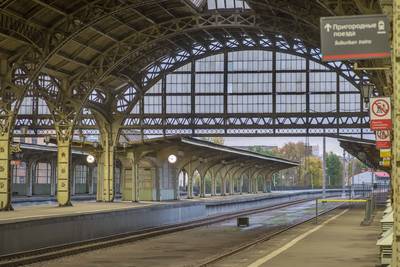
Debarcadere (train shed) of the Vitebsky Railway Station in St. Petersburg (industrial Art Nouveau architecture). Russia, October 6, 2025  Hermitage Pavilion in Catherine Park, designed by the Italian court architect Francesco Bartolomeo Rastrelli in Elizabethan Baroque style. Pushkin (former Tsarskoe Selo) near Saint Petersburg, Russia, October 10, 2025  Bolshoy Lamskoy Bridge (Great Lamsky Bridge). It was built in 1820-1822 by the Scottish architect Adam Menelaws, who was instrumental in shaping the park s romantic "English" landscape style. The bridge spans the Lamsky Ponds near the Llama Pavilion, originally serving the utilitarian purpose of connecting the Lamsky stables (which housed exotic llamas from Peru) to the rest of the park. Originally a cast-iron structure, it has been carefully restored to preserve its intricate metal latticework railings, which feature a distinct geometric pattern characteristic of the Russian Empire style. Aleksandrovsky (Alexander) Park in Pushkin (former Tsarskoe Selo) near Saint Petersburg, Russia, October 10, 2025  Red Cascade or Turkish Cascade in Catherine Park. The Red Cascade is a dam that regulates the water level between the Upper Ponds and the Great Pond. The two "towers" flanking the crossing are designed in the Gothic style, featuring red brick walls with white limestone details, pointed arches, and niche windows. It was built in the 1780s by the engineer Ivan Gerard, likely based on designs by the architect Vasily Neelov. Pushkin (former Tsarskoe Selo) near Saint Petersburg, Russia, October 10, 2025  Hall on the Island in Catherine Park, view from Ferry Crossing. It was originally built in the late 1740s by the architect Savva Chevakinsky in the Baroque style, with decorations based on sketches by Rastrelli. In 1794, under Catherine the Great, the architect Giacomo Quarenghi completely rebuilt it in the Classical style. He simplified the decor, giving it the restrained, elegant appearance seen today--white walls, large arched windows, and a modest green roof. Pushkin (former Tsarskoe Selo) near Saint Petersburg, Russia, October 10, 2025  Marble Bridge (also known as the Palladian Bridge or Siberian Marble Gallery) in Catherine Park. Built in 1772-1774 by the architect Vasily Neelov, it is modeled after the famous Palladian Bridge at Wilton House in England (designed by Inigo Jones and Roger Morris). The bridge is constructed entirely from Ural marble (hence "Siberian"). It features a covered Ionic colonnade resting on a rusticated arch base. It spans a narrow channel connecting the Great Pond with the smaller neighboring ponds (Swan Islands). Pushkin (former Tsarskoe Selo) near Saint Petersburg, Russia, October 10, 2025  Devil s Bridge (Chertov Most), also known as the Cascade, located near the Upper Ponds in Catherine Park. Built in the 1770s, likely designed by the architect Vasily Neyelov or possibly Antonio Rinaldi, this structure is a classic example of the romantic "ruin" aesthetic popular in 18th-century landscape gardening. Pushkin (former Tsarskoe Selo) near Saint Petersburg, Russia, October 10, 2025  Memorial Gates "To My Dear Fellow Servants", a historical monument located on the boundary of the Catherine Park in Pushkin (Tsarskoye Selo). Saint Petersburg, Russia, October 10, 2025  The surviving granite base of the 1917 railway water tower on Station Square in Toksovo, Leningrad Oblast. Designed in the Nordic National Romantic style by Finnish architect Urho Pa"llia" for the Saint Petersburg-Hiitola railway line, the structure features rusticated Karelian stone quoins, a segmental arched portal, and a date plaque; its upper half-timbered wooden reservoir reservoir tier had burned down in the 1990s, leaving the masonry plinth derelict prior to receiving regional cultural heritage status. 8 miles north from Saint Petersburg. Russia, August 1, 2012  Train in Vitebsky Railway Station. Saint Petersburg, Russia, August 23, 2013  Gothic Gate (Goticheskie Vorota) in the landscape section of Catherine Park. Erected in 1778, the gate was designed by the architect Yury Felten (Georg Friedrich Veldten). The design mimics a Gothic cathedral portal, featuring slender columns that branch into pointed arches with intricate "lace-like" tracery. Pushkin (former Tsarskoe Selo) near Saint Petersburg, Russia, October 10, 2025  Steel arches of Vitebsky Vokzal (train station). Saint Petersburg. Russia, July 10, 2010  Main Staircase of the Mikhailovsky Palace designed by the architect Carlo Rossi in the 1820s in Russian Museum. Saint Petersburg, Russia, September 24, 2025  Rebuilding of the Forest Building (Russian: Lesnoy Korpus) in a major reconstruction project at the historic Sestroretsk Resort (Sestroretsky Kurort). The original Sestroretsk Resort was a famous health spa complex founded in 1898 by engineer Peter Avenarius. It featured several grand wooden structures, including a massive Kursaal (concert hall), a mud bath facility, and the Forest Building. The resort was a hub for St. Petersburg s elite and intelligentsia in the early 20th century. The original Forest Building was a beautiful wooden hotel and sanatorium building constructed in the early 1900s. It was a key part of the ensemble but was destroyed during World War II. The new structure faithfully replicates the "Northern Art Nouveau" style of the original resort architecture, characterized by its complex roofline, spires, towers, and wooden detailing that harmonizes with the surrounding pine forest and dunes. The exterior appears nearly complete, showing the elaborate wooden facade, the large central dome, and the corner towers with their needle-like spires. The scaffolding indicates that finishing work is still in progress. Saint Petersburg, Russia, October 9, 2025  Chinese Gazebo (often called the Creaking Pagoda or Skripuchaya Besedka) which is one of the most eccentric and picturesque structures in Catherine Park. Built between 1778 and 1786, this pavilion was designed by Yury Felten (Georg Friedrich Veldten) at the height of the 18th-century craze for Chinoiserie (Chinese-style art). The pavilion gets its popular nickname from the metal weather vane on its roof. Shaped like a Chinese banner, it was intentionally designed to creak loudly in the wind. Originally, such pavilions served as tea houses or resting spots for the Empress and her court during their walks. Pushkin (former Tsarskoe Selo) near Saint Petersburg, Russia, October 10, 2025  Marble Bridge (also known as the Palladian Bridge) in Catherine Park, Pushkin, enveloped in the vibrant colors of a Russian autumn. Built in the 1770s, it features a graceful colonnade of Ionic columns carved from blue-grey Ural marble, resting on a sturdy granite base. The bridge spans a narrow channel connecting the Great Pond to smaller neighboring ponds and the "Swan Islands." In the foreground, several mallard ducks glide peacefully across the water. Pushkin (former Tsarskoe Selo) near Saint Petersburg, Russia, October 10, 2025  Example of Art Nouveau architecture in Tallinn, located at Pikk 18. It was designed by the renowned Baltic German architect Jacques Rosenbaum and completed in 1910. The design is celebrated for its flamboyant and fantastical style, which stands in stark contrast to the surrounding medieval architecture. The building is often referred to as the Draakoni Gallery (Dragon Gallery) because of the two large, sculpted dragons flanking the main ground-floor window. These sculptures were created by the famous Riga sculptor August Volz. The fac,ade is uniquely decorated with Egyptian-inspired themes, including reliefs of sphinxes and pharaonic figures at the top of the pilasters, adding to its exotic and eclectic appearance. The building features a distinctive curved corner tower with a slender spire, oval windows, and intricate floral ornaments typical of the late Art Nouveau period. Tallinn, Estonia, October 16, 2025  Artificial waterfall on the Karasta River in Oranienbaum Park serving as a connection between the Upper and Lower Parks. It is a tiered spillway designed with granite steps that allow the water to cascade gracefully from the Lower Pond, flowing underneath a massive stone bridge (the Lower Bridge/Dam Bridge) Oranienbaum palace-and-park ensemble in Lomonosov (a suburb of St. Petersburg), Russia, October 13, 2025  Pyramid Pavilion, located in a quiet, shady corner of Catherine Park in Tsarskoe Selo (Pushkin). It was originally built in 1770-1772 by the architect Vasily Neyelov and later reconstructed by Charles Cameron in 1782-1783. The pavilion was designed to resemble an ancient Egyptian mausoleum, reflecting the Romantic era s fascination with antiquity and melancholy ruins. It is constructed of brick and faced with trimmed granite. Buried behind the pyramid are three of the Empress s favorite Italian greyhounds: Tom Anderson, Zemira, and Duchesse. Saint Petersburg, Russia, October 10, 2025  Fac,ade of Pikk 18, arguably the most famous Art Nouveau building in Tallinn, known as the Dragon Gallery (Draakoni Galerii). Designed by the renowned Baltic German architect Jacques Rosenbaum and completed in 1910, this building is a prime example of late Art Nouveau (Jugendstil) architecture. The two massive, sculpted dragons flanking the ground-floor window are the building s namesake and most iconic feature. They were created by the sculptor August Volz. Above the dragons, the fac,ade features two stern female figures with Egyptian headdresses projecting from the pilasters. These, along with sphinxes and other exotic ornaments on the upper levels, reflect the eclectic and fantastical influences typical of Rosenbaum s style. The large, horseshoe-shaped window on the ground floor and the undulating gable at the top create a sense of movement and fluidity that contrasts sharply with the rigid lines of the adjacent classical and medieval buildings. Originally built as an apartment house for the merchant Reinhold Reichmann, the ground floor has housed the Draakoni Gallery since 1983, an exhibition space managed by the Estonian Artists Association. The green light visible in the window belongs to a fashion boutique or exhibition currently occupying the space. Tallinn, Estonia, October 16, 2025  Entrance stairs in Vitebsky Vokzal train station, now reconstructed as a historic site of the first train station in Russia. Saint Petersburg, Russia, January 1, 2006  Enclosed pedestrian overpass at the Kannelyarvi railway station, located on the Karelian Isthmus roughly 75 km northwest of St. Petersburg. This overpass is a modular steel structure clad in translucent polycarbonate panels. The structure is a characteristic example of the standardized "blue tube" pedestrian bridges installed by Russian Railways (RZD) during the widespread modernization of the St. Petersburg-Vyborg line in the late 2000s. Russia, October 1, 2025  Kitchen Ruin (Kukhnya-Ruina) which is one of the most historically fascinating and visually authentic follies in Catherine Park. Built between 1785 and 1786, it was designed by the Italian architect Giacomo Quarenghi. It was constructed specifically to serve as a "service pavilion" (a kitchen) for the nearby Concert Hall. Quarenghi incorporated authentic ancient Roman fragments into its brick walls. These include broken columns, capitals, cornices, and friezes with carved garlands, which were brought to Russia from Italy. The headless statue in the niche is a prominent feature, emphasizing the theme of lost time and the decay of empires. Pushkin (former Tsarskoe Selo) near Saint Petersburg, Russia, October 10, 2025  Children s Island (Ostrov Detskogo Domika) of the Great Pond concealed within the dense autumn foliage in Catherine Park. Built in 1830 by architect Alexei Gornostayev, it was a playhouse created for the children of Emperor Nicholas I. Pushkin (former Tsarskoe Selo) near Saint Petersburg, Russia, October 10, 2025  Ancient oak tree trunk. Many oaks in the park are over 200 years old, some dating back to the park s initial landscaping in the 18th and 19th centuries. The gnarled, textured bark and massive girth signify its age and resilience. Northern part of Aleksandrovsky (Alexander) Park in Pushkin (former Tsarskoe Selo) near Saint Petersburg, Russia, October 10, 2025  Evening Hall (Vecherniy Zal) in Catherine Park. It was built between 1796 and 1810 under the supervision of architect P.V. Neyelov (and possibly Luigi Rusca). This pavilion was intended for evening gatherings, small concerts, and balls. The building is a simple, rectangular Classical structure with a low dome and large arched windows Pushkin (former Tsarskoe Selo) near Saint Petersburg, Russia, October 10, 2025  The central alley leading to the Arsenal Pavilion, a red-brick neo-Gothic structure designed by Adam Menelaws. Completed in 1834, the Arsenal resembles a medieval castle with crenellated towers and massive arched windows. It was originally built to house Nicholas I s vast collection of medieval arms and armor. The straight alley is a remnant of the formal layout from the earlier "Monbijou" pavilion that stood here, now framed by the mature trees of the surrounding landscape park. After severe damage in WWII, the building was restored and reopened in 2016 as a museum displaying imperial weaponry. Aleksandrovsky (Alexander) Park in Pushkin (former Tsarskoe Selo) near Saint Petersburg, Russia, October 10, 2025  Metal bridge located near the Small Caprice (Malyi Kapriz) in Catherine Park. It spans the water channel connecting the Upper Ponds (Verkhnie Prudki) with the Longitudinal Pond (Prodolny Prud). The bridge is a graceful, single-span metal structure with a simple but elegant wrought-iron railing featuring gilded rosette details. Pushkin (former Tsarskoe Selo) near Saint Petersburg, Russia, October 10, 2025  Metal bridge located near the Small Caprice (Malyi Kapriz) in Catherine Park. It spans the water channel connecting the Upper Ponds (Verkhnie Prudki) with the Longitudinal Pond (Prodolny Prud). This area is a critical junction in the park s hydraulic system, where water flows from the upper terraces down towards the Great Pond. Pushkin (former Tsarskoe Selo) near Saint Petersburg, Russia, October 10, 2025  Vitebsky Railway Station. Saint Petersburg, Russia, August 23, 2013  Grand staircase and monument of Russian Tsar Nikolay I (that recently replaced V. I. Lenin) in Vitebsky Vokzal (train station). Saint Petersburg. Russia, July 10, 2010  A building at 5 lit. B Engelsa Prospect which is a surviving historical service corps of the Orlovo-Novosiltsevskaya Almshouse complex. This small brick structure was originally built as one of the auxiliary buildings (likely for staff or utility purposes) for the larger almshouse institution. The main complex, located at Engelsa 1-5, was a major philanthropic center established in the 1830s. The complex was designed by the renowned architect Iosif Charlemagne (Joseph-Maria Charlemagne-Baudet) in the late Classicist style. It was constructed between 1834 and 1841. Lesnoy Park (Lesotekhnicheskiy Universitet), Saint Petersburg, Russia, October 14, 2025  Hall of Vitebsky Railway Station. Saint Petersburg, Russia, August 23, 2013  Old Passenger Terminal of Tallinn Airport. Built between 1945 and 1954 (opened in 1955), this building is a classic example of Stalinist architecture. Its symmetrical facade, rusticated ground floor, and the distinctive control tower with a viewing gallery reflect the monumental style favored in the Soviet Union during that period. An earlier Art Deco/Functionalist terminal was designed in 1938 by the architect Arthur Ju"rvetson, but construction was halted by World War II. The post-war redesign incorporated the Soviet aesthetic. This building served as the main passenger terminal until 1980, when a new, larger terminal (the current one) was built for the Moscow Olympics sailing regatta held in Tallinn. Today, this historic building has been repurposed for VIP services and administrative offices. It stands separately from the modern glass-and-steel terminal but remains an integral part of the airport s history, visible to passengers taxiing on the runway. View from a window of an airplane from Tallinn to Helsinki. Estonia, October 17, 2025  One of the Small Chinese Bridges (Small Iron Bridges) crossing the Krestovy Canal. Originally wooden (1781), they were replaced with cast iron versions forged at the Sestroretsk Arms Factory in 1786. Designed by Charles Cameron, who also planned the nearby Chinese Village. The bridge features intricate iron lattice railings and is framed by distinctive porticoes formed of paired columns with "Chinese-style" curved sheet-iron roofs. The columns are painted to mimic colored marble, and the structure was fully restored in the 21st century. Aleksandrovsky (Alexander) Park in Pushkin (former Tsarskoe Selo) near Saint Petersburg, Russia, October 10, 2025  Italian Pergola located in the Private Garden (Sobstvenny Sadik) of Catherine Park. The pergola was built in 1865 (mid-19th century) during the reign of Alexander II. It was designed specifically to be covered in climbing plants, creating a shaded walkway or "veranda" that offered respite from the sun while allowing views of the obelisk and the surrounding landscape. Pushkin (former Tsarskoe Selo) near Saint Petersburg, Russia, October 10, 2025  Grand stairs of Vitebsky Railway Station. Saint Petersburg, Russia, August 23, 2013  Entrance hall of Vitebsky Railway Station. Saint Petersburg, Russia, August 23, 2013  Pikk Street (Pikk ta"nav) in Tallinn s Old Town, specifically showing the facades of two notable Art Nouveau buildings at numbers 18 and 16. The building on the right with the dramatic facade featuring dragon sculptures is the famous "Dragon Gallery" (Draakoni galerii). Designed by architect Jacques Rosenbaum and completed in 1910, it is a masterpiece of Art Nouveau architecture. The facade is adorned with fantastical elements, including two large dragons flanking the ground-floor window, Egyptian women, and sphinxes. It currently houses an art gallery managed by the Estonian Artists Association. The building directly next to it on the left (the narrower one with large windows) is Pikk 16. It currently houses the BonVerre shop, visible through the ground-floor window, which specializes in beverages and gourmet products. Further down the street on the left (the grey building with the green flag) is the Kanuti Gildi Saal (St. Canute s Guild Hall), a historic building that now serves as a contemporary performing arts center. Tallinn, Estonia, October 16, 2025  Grand Cascade (also known as the Ruined Cascade), located near the Round Pond in the Old Sylvia/White Birch district of Pavlovsk Park. Designed by Vincenzo Brenna in 1794, it was built to look like a romantic "antique ruin." Pavlovsk, a suburb of Saint Petersburg, Russia, October 6, 2025  Ramp Alley (Rampovaya Alleya) whic is a historic avenue in Catherine Park, known for its grand canopy of ancient trees and its connection to imperial history. Pushkin (former Tsarskoe Selo) near Saint Petersburg, Russia, October 10, 2025  "Framed" perspective looking towards the trees near the Marble Bridge in Catherine Park. The arches create a "picture window" effect, a classic technique in landscape architecture designed to direct the viewer s gaze to specific idealized scenes of nature. The stone ball finials on the balustrade add a rhythmic, formal element that contrasts with the organic chaos of the forest background. Pushkin (former Tsarskoe Selo) near Saint Petersburg, Russia, October 10, 2025  A.S. in front of a black Lenin s monument on Vitebsky railway station. Saint Petersburg, Russia, April 7, 1999.  This wide-angle view of Pikk Street (Pikk ta"nav) showcases a striking contrast of architectural styles, featuring two of the street s most notable buildings at addresses Pikk 18 and Pikk 20. The Dragon Gallery (Pikk 18): To the right stands one of Tallinn s most eccentric Art Nouveau masterpieces, designed by architect Jacques Rosenbaum and completed in 1910. Its fac,ade is a riot of symbolism, featuring two large dragons flanking the ground-floor window (hence the name "Draakoni Galerii") and Egyptian-inspired sphinxes and female figures on the upper levels. The curved bay window and elaborate curvilinear gable are hallmarks of Rosenbaum s highly decorative style. It currently houses an art gallery run by the Estonian Artists Association. On the left is the St. Canute s Guild Hall (Kanuti Gildi Hoone). This complex facade, with its statues of St. Canute (King of Denmark) and Martin Luther, dates to a major reconstruction in the 1860s in the Tudor Gothic style. Historically, this was the headquarters for the Guild of St. Canute, which organized the city s master artisans (goldsmiths, hatters, bakers, etc.). Today, it functions as the Kanuti Gildi SAAL, a contemporary performing arts center, October 16, 2025  Va"ike-Karja Street (Va"ike-Karja ta"nav), likely taken near its intersection with Suur-Karja Street. The building on the right with the large grey stone archway and iron gates corresponds to Va"ike-Karja 1 (also known as the Saarinen House), a prominent Art Nouveau building designed by Finnish architect Eliel Saarinen. The street features a mix of architectural styles. The grey stone building on the right is a notable example of early 20th-century national romanticism. Further down the street, you can see pastel-colored facades typical of Tallinn s Old Town. Tallinn, Estonia, October 16, 2025  A poetic tribute "Pushkin was here" to the great Russian poet Alexander Pushkin in Catherine Park. The symbols on the bench carry specific meanings related to his time at the Imperial Lyceum (located just nearby), where he studied from 1811 to 1817. The Bicorne Hat (Cocked Hat): This represents the uniform worn by the students of the Imperial Lyceum. The Open Book: A symbol of his literary genius and his constant immersion in reading and writing poetry, often done while wandering this very park. Pushkin (former Tsarskoe Selo) near Saint Petersburg, Russia, October 10, 2025  View of Pikk Street (Pikk ta"nav), one of the most architecturally diverse streets in Tallinn s Old Town. The spectacular grey Art Nouveau building on the right (with the corner turret) is a masterpiece designed by architect Jacques Rosenbaum in 1910. It is famous for its fantastical facade featuring two large dragons and Egyptian-inspired motifs. Today, the ground floor houses the Draakoni Gallery. On the left side of the street (the red and grey facade), one can see the St. Canute s Guild Hall (Kanuti Gildi Saal). Originally built in the 13th century and remodeled in the 19th century with Tudor-style windows and statues of St. Canute and Martin Luther on the facade. It now serves as a contemporary performing arts center. The yellow building on the immediate right foreground is Pikk 22, which houses the Estonian Handicraft House (Eesti Ka"sito"o" Maja). This shop is a go-to place for authentic Estonian folk art and crafts. Tallinn, Estonia, October 16, 2025  Ancient oak trunk in Alexander Park showcases the sculptural quality of the park s veteran trees. The trunk features a massive, gnarled root flare and deep, craggy bark fissures, indicators of its significant age (likely over 200 years). These "veteran trees" are living monuments from the imperial era. Northern part of Aleksandrovsky (Alexander) Park in Pushkin (former Tsarskoe Selo) near Saint Petersburg, Russia, October 10, 2025  Oak foliage near Marble Bridge in Catherine Park. Pushkin (former Tsarskoe Selo) near Saint Petersburg, Russia, October 10, 2025  Fall colors of maples in Catherine Park. Pushkin (former Tsarskoe Selo) near Saint Petersburg, Russia, October 10, 2025  Orange leaves of maples in Catherine Park. Pushkin (former Tsarskoe Selo) near Saint Petersburg, Russia, October 10, 2025  Fall colors of oaks in Catherine Park. Pushkin (former Tsarskoe Selo) near Saint Petersburg, Russia, October 10, 2025  Stone bridge in Oranienbaum Park in the "Russian Switzerland" section of the Upper Park. The bridge is built from rough, unpolished granite boulders, giving it a deliberately archaic, "ruin-like" appearance that blends seamlessly into the natural landscape, typical of the romantic style popular in the 19th century. It spans a bend in the Karasta River, connecting a gravel path that winds through rolling green hills, which were artificially shaped to mimic an alpine valley. Oranienbaum palace-and-park ensemble in Lomonosov (a suburb of St. Petersburg), Russia, October 13, 2025  Mushrooms Plicaturopsis crispa on a log in Aleksandrovsky (Alexander) Park in Pushkin (former Tsarskoe Selo) near Saint Petersburg, Russia, October 10, 2025  Fall colors near Marble Bridge in Catherine Park. Pushkin (former Tsarskoe Selo) near Saint Petersburg, Russia, October 10, 2025  Fall colors of Catherine Park from Sadovaya Street. Pushkin (former Tsarskoe Selo) near Saint Petersburg, Russia, October 10, 2025  Leuchtenberg Palace, designed by architect Andrei Stackenschneider and completed in 1842. The facade reflects the Late Classicism style (resembling a Roman villa), characterized by a grand portico with Corinthian columns, symmetrical window arrangements, and a pediment that gives the structure a noble, temple-like appearance. The palace s yellow stucco walls show signs of weathering and peeling paint, contributing to the estate s romantic, slightly melancholic atmosphere of a "forgotten" royal residence. The palace is situated on a terrace overlooking the Gulf of Finland, with its color palette harmonizing with the surrounding golden autumn foliage, reinforcing the seamless blend of architecture and nature intended by its designers. Sergievka Park, Old Peterhof, west from Saint Petersburg, Russia, October 13, 2025  Young mushrooms Plicatura nivea on a log in Aleksandrovsky (Alexander) Park in Pushkin (former Tsarskoe Selo) near Saint Petersburg, Russia, October 10, 2025  Foliage near Red Cascade showin "Golden Autumn" in Catherine Park. Pushkin (former Tsarskoe Selo) near Saint Petersburg, Russia, October 10, 2025  Group of maple trees near the Upper Ponds in Catherine Park. Pushkin (former Tsarskoe Selo) near Saint Petersburg, Russia, October 10, 2025  Maples near the Small Caprice (Malyi Kapriz) in Catherine Park. Pushkin (former Tsarskoe Selo) near Saint Petersburg, Russia, October 10, 2025  "Golden Autumn" of the shores of the Great Pond in Catherine Park. Pushkin (former Tsarskoe Selo) near Saint Petersburg, Russia, October 10, 2025  Caps of mushrooms Plicaturopsis crispa on a log in Aleksandrovsky (Alexander) Park in Pushkin (former Tsarskoe Selo) near Saint Petersburg, Russia, October 10, 2025  Hall of Vitebsky Train Station. Saint Petersburg, Russia, August 29, 2007  A hall of Vitebsky Train Station. Saint Petersburg, Russia, August 8, 2012  Platforms of Vitebsky Train Station. Saint Petersburg, Russia, August 8, 2012  Perron of Vitebsky Train Station. Saint Petersburg, Russia, August 29, 2007  Orange leaves of maple trees near the Upper Ponds in Catherine Park. Pushkin (former Tsarskoe Selo) near Saint Petersburg, Russia, October 10, 2025  Corticioid mushrooms Plicatura nivea on a cut surface of a log in Aleksandrovsky (Alexander) Park in Pushkin (former Tsarskoe Selo) near Saint Petersburg, Russia, October 10, 2025  Growth of corticioid fungus Plicatura nivea on a log in Aleksandrovsky (Alexander) Park in Pushkin (former Tsarskoe Selo) near Saint Petersburg, Russia, October 10, 2025  Texture of corticioid fungus Plicatura nivea on a log in Aleksandrovsky (Alexander) Park in Pushkin (former Tsarskoe Selo) near Saint Petersburg, Russia, October 10, 2025  Grotto Pavilion and Great Pond (Bolshoy Prud) in Catherine Park. Pushkin (former Tsarskoe Selo) near Saint Petersburg, Russia, October 10, 2025  Underside of caps of mushrooms Plicaturopsis crispa on a log in Aleksandrovsky (Alexander) Park in Pushkin (former Tsarskoe Selo) near Saint Petersburg, Russia, October 10, 2025  Mushrooms Plicaturopsis crispa together with Plicatura nivea on a log in Aleksandrovsky (Alexander) Park in Pushkin (former Tsarskoe Selo) near Saint Petersburg, Russia, October 10, 2025  Oak mazegill mushrooms (Daedalea quercina) on a stump in Aleksandrovsky (Alexander) Park. Pushkin (former Tsarskoe Selo) near Saint Petersburg, Russia, October 10, 2025  Corticioid mushrooms Plicatura nivea on logs in Aleksandrovsky (Alexander) Park in Pushkin (former Tsarskoe Selo) near Saint Petersburg, Russia, October 10, 2025  Yellow leaves of maple trees near the Upper Ponds in Catherine Park. Pushkin (former Tsarskoe Selo) near Saint Petersburg, Russia, October 10, 2025  Close-up of corticioid fungus Plicatura nivea on a log in Aleksandrovsky (Alexander) Park in Pushkin (former Tsarskoe Selo) near Saint Petersburg, Russia, October 10, 2025  Fall colors of maples along Krestovy Canal. Aleksandrovsky (Alexander) Park in Pushkin (former Tsarskoe Selo) near Saint Petersburg, Russia, October 10, 2025  Vitebsky Vokzal (train station) (1904). Saint Petersburg. Russia, July 10, 2010  Light Hall of Vitebsky Train Station. Saint Petersburg, Russia, August 8, 2012  A hall in Vitebsky Vokzal train station. Saint Petersburg, Russia, January 1, 2006  First floor hall of Vitebsky Train Station. Saint Petersburg, Russia, August 8, 2012  Remains of the Engineer Department s Experimental Battery, also known as the "Engineer Polygon". These structures were bombarded to test the resistance of Portland cement. Coastal Fort "Reef", Kronstadt, Russia, September 27, 2025  Vana Turg (Old Market) square, dominated by the Peppersack restaurant building. The central white building with the high gable and hoist beam is Peppersack (Viru 2 / Vana turg 6). Dating back to 1370, this historic structure was originally a merchant s house and granary. The name "Peppersack" refers to a nickname given to wealthy merchants (who traded in expensive spices like pepper) or possibly a specific owner, Hans Peppersack. Today, it is a popular medieval-themed restaurant known for its sword-fighting shows and hearty Estonian cuisine. To the right of Peppersack is the Art Nouveau building housing Scheeli Restaurant (Vana turg 2). Known for its elegant interior and romantic atmosphere, it offers a contrast to the rustic medieval style of its neighbor, serving refined European cuisine in a setting that recalls the 1920s. The square features a stunning ensemble of Gothic and Art Nouveau architecture. The Peppersack building retains its medieval pulley system (visible on the facade), which was used to hoist goods into the storage floors. The red sack hanging from the facade is a playful nod to the building s name. This spot is a major intersection in the Old Town, where Viru Street meets the Old Market, just steps away from the Town Hall Square. Tallinn, Estonia, October 16, 2025  Corticioid mushrooms Plicatura nivea with a slug on a cut surface of a log in Aleksandrovsky (Alexander) Park in Pushkin (former Tsarskoe Selo) near Saint Petersburg, Russia, October 10, 2025  Maple alley near Chinese Bridges of Krestovy Canal in Aleksandrovsky (Alexander) Park. Pushkin (former Tsarskoe Selo) near Saint Petersburg, Russia, October 10, 2025  Rich tapestry of deciduous trees on the shores of the Great Pond in Catherine Park. Pushkin (former Tsarskoe Selo) near Saint Petersburg, Russia, October 10, 2025  Round patch of corticioid fungus Plicatura nivea on a log in Aleksandrovsky (Alexander) Park in Pushkin (former Tsarskoe Selo) near Saint Petersburg, Russia, October 10, 2025  Chinese Gazebo (often called the Creaking Pagoda or Skripuchaya Besedka) in Catherine Park. Pushkin (former Tsarskoe Selo) near Saint Petersburg, Russia, October 10, 2025  Soft edge of corticioid fungus Plicatura nivea on a log Aleksandrovsky (Alexander) Park in Pushkin (former Tsarskoe Selo) near Saint Petersburg, Russia, October 10, 2025  Fall colors in area of the Small Caprice (Malyi Kapriz) in Catherine Park. Pushkin (former Tsarskoe Selo) near Saint Petersburg, Russia, October 10, 2025  A view of the Pavlovsk Palace seen from the Triple Lime Avenue. Planted by Charles Cameron in the 1780s using linden trees imported from Lu"beck, this avenue was designed as the grand formal approach to the palace. The building at the end is the garden facade of the Great Palace. The dark figure standing in front of the palace is the statue of Paul I. Pavlovsk, a suburb of Saint Petersburg, Russia, October 15, 2025  Graceful, humpbacked silhouette of the bridge, designed to arch elegantly over the narrow waterway connecting the ponds. The bridge s single, shallow arch is constructed from dark iron, supported by massive granite abutments on either bank. Delicate lattice pattern of the wrought-iron railing is clearly visible against the backdrop of the forest. Sergievka Park, Old Peterhof, west from Saint Petersburg, Russia, October 13, 2025  Naturalistic style of the English landscape garden, which dominates the areas surrounding the formal canals, with rich textural contrast between the golden maples and dark evergreen firs, creating a painterly composition typical of 19th-century Russian park design. The untamed, wilder growth of the underbrush and tall grasses contrasts with the manicured lawns found elsewhere, evoking a sense of romantic melancholy suited to the "golden autumn" season. The dense, layered foliage creates an intimate, enclosed space that feels removed from the grand palace architecture, focusing entirely on the mood of the forest. Aleksandrovsky (Alexander) Park in Pushkin (former Tsarskoe Selo) near Saint Petersburg, Russia, October 10, 2025  Side decorations of a hall of Vitebsky Train Station. Saint Petersburg, Russia, August 29, 2007  Interior of Vitebsky Train Station, recently renovated. Saint Petersburg, Russia, August 6, 2004  Side view of a hall of Vitebsky Train Station. Saint Petersburg, Russia, August 8, 2012  Large area covered by corticioid fungus Plicatura nivea on a log in Aleksandrovsky (Alexander) Park in Pushkin (former Tsarskoe Selo) near Saint Petersburg, Russia, October 10, 2025 |