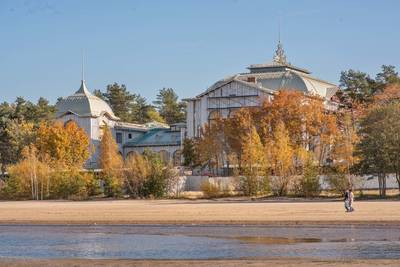
Panoramic view from the Tarkhovka shoreline that looks north-west across the Sestroretsky Razliv (Lake Sestroretsk) toward the city of Sestroretsk. This view captures the dual nature of Sestroretsk: a historic resort town with natural beauty (the lake, reeds, and stones) juxtaposed with modern urban infrastructure (heating plant and high-rise housing). "Three Chimneys" (Center): The most prominent industrial feature is the cluster of three tall red-and-white striped chimneys. These belong to the Sestroretsk District Heating Plant (part of the city s thermal infrastructure). Residential Towers (Left of Chimneys): The tall, beige-and-orange brick apartment buildings are part of the modern residential developments in Sestroretsk, likely along Tokarevskaya Street or the Razliv microdistrict. Church of Peter and Paul (Far Right): On the far right horizon. This is a modern church (consecrated in 2009) built in memory of the Russian submariners. "Pyramid" Building (Far Left): On the far left, there is a distinctive white building with a stepped, pyramid-like shape. This is likely the "Eden" (Edem) residential complex or a similar luxury apartment block, which is known for its terraced architecture. Tarkhovka Park near Sestroretsk, west from Saint Petersburg. Russia, October 3, 2025  Estonian Theatre for Young Audiences (formerly known as the NUKU Theatre), located at the corner of Lai 1 and Nunne streets. This corner building is a fine example of early 20th-century architecture (completed in 1907), originally built for the Nobility Club. It blends Neo-Renaissance elements (like the balcony) with Art Nouveau influences (evident in the curved corner and roofline). The warm uplighting emphasizes its elegant proportions and decorative cornice. The building houses Estonia s only professional puppet theatre, founded in 1952, and the Museum of Puppetry Arts. The museum entrance is typically around the corner or through the main glass doors seen here. The theatre complex has expanded over the years to include modern performance halls while retaining its historic fac,ade. The view looks down Nunne Street towards the Toompea hill area. To the right, you can see the edge of the city wall fortifications. The street is paved with traditional cobblestones, and the scene is quiet, likely captured in the late evening or early morning. Tallinn, Estonia, October 16, 2025  Lai Street in the Old Town. The row of gabled buildings on the right is known as the "Three Brothers". These medieval merchant houses are less famous than the "Three Sisters" on Pikk Street but are equally historically significant. The white facade in the immediate foreground (right) features a neo-Gothic or historicist style, likely dating from a later renovation (potentially 19th or early 20th century) that unified earlier medieval structures. One can clearly see the transition from the plastered, light-colored facade in the foreground to the simpler, pastel-yellow medieval warehouse-style building next to it. These buildings often retain their original "diele-dornse" layout (a large front room for business and living quarters behind). The perspective highlights the massive scale of St. Olaf s Church (Oleviste kirik) at the end of the street (Lai 50). The tower s copper spire, weathered to green, creates a striking contrast with the red tile roofs and the autumn foliage on the left. Tallinn, Estonia, October 16, 2025  Decorative vase, located in the parterre of the park near the Main Building of the Forestry University, a concrete copy of a 19th-century original. The original vase was created in the 1860s by the famous sculptor David Jensen (1816-1902). The original work was carved from unpolished granite. Today s version is a concrete replica installed in the 1970s. The central motif depicts putti (cherubs), which are playful, chubby male children often found in classical art. The putti appear to be engaged in a playful struggle with a goat, a common allegorical theme in baroque and neoclassical art often representing the abundance of nature or Bacchic festivities. This theme fits well with the park s history as a place of botanical study and appreciation of nature. Lesnoy Park (Lesotekhnicheskiy Universitet), Saint Petersburg, Russia, October 14, 2025  Pikk Street (Pikk ta"nav) in Tallinn s Old Town, specifically showing the facades of two notable Art Nouveau buildings at numbers 18 and 16. The building on the right with the dramatic facade featuring dragon sculptures is the famous "Dragon Gallery" (Draakoni galerii). Designed by architect Jacques Rosenbaum and completed in 1910, it is a masterpiece of Art Nouveau architecture. The facade is adorned with fantastical elements, including two large dragons flanking the ground-floor window, Egyptian women, and sphinxes. It currently houses an art gallery managed by the Estonian Artists Association. The building directly next to it on the left (the narrower one with large windows) is Pikk 16. It currently houses the BonVerre shop, visible through the ground-floor window, which specializes in beverages and gourmet products. Further down the street on the left (the grey building with the green flag) is the Kanuti Gildi Saal (St. Canute s Guild Hall), a historic building that now serves as a contemporary performing arts center. Tallinn, Estonia, October 16, 2025  The lower end of Pikk Street, looking back up towards the Town Hall spire. It captures a charming intersection where the street forks. Corner Building (Pikk 12 / Kinga 10): The centerpiece of the image is the distinctive corner building with a mansard roof and red tiles. It houses another branch of the Veta linen and knitwear shop. The building s shape is triangular, adapting to the acute angle where Pikk and Kinga streets meet. Its architecture is a mix of styles, with a portal that hints at older origins but a roofline that suggests 19th or early 20th-century modification. In the distance to the left, you can clearly see the illuminated spire of the Tallinn Town Hall rising above the rooftops, serving as a navigation point for anyone walking up Pikk Street. Tallinn, Estonia, October 16, 2025  Vana Turg (Old Market) square, dominated by the Peppersack restaurant building. The central white building with the high gable and hoist beam is Peppersack (Viru 2 / Vana turg 6). Dating back to 1370, this historic structure was originally a merchant s house and granary. The name "Peppersack" refers to a nickname given to wealthy merchants (who traded in expensive spices like pepper) or possibly a specific owner, Hans Peppersack. Today, it is a popular medieval-themed restaurant known for its sword-fighting shows and hearty Estonian cuisine. To the right of Peppersack is the Art Nouveau building housing Scheeli Restaurant (Vana turg 2). Known for its elegant interior and romantic atmosphere, it offers a contrast to the rustic medieval style of its neighbor, serving refined European cuisine in a setting that recalls the 1920s. The square features a stunning ensemble of Gothic and Art Nouveau architecture. The Peppersack building retains its medieval pulley system (visible on the facade), which was used to hoist goods into the storage floors. The red sack hanging from the facade is a playful nod to the building s name. This spot is a major intersection in the Old Town, where Viru Street meets the Old Market, just steps away from the Town Hall Square. Tallinn, Estonia, October 16, 2025  A striking architectural contrast on Sauna Street (Sauna ta"nav), near the intersection with Va"ike-Karja Street. On the left, a modern glass-and-steel building features large display windows and industrial-style staircases, illuminated by neon lights. This building is part of the Helios Hall complex (formerly the Helios Cinema), which has been repurposed as an event venue and art space. The transparent facade allows a view into the contemporary interior, contrasting sharply with the solid, historic walls of the Old Town. On the right, the corner of an older, plastered building (Sauna 12) is covered in colorful, abstract graffiti. This gritty, urban element acts as a foil to the clean lines and slick surfaces of the modern building opposite it, highlighting the eclectic mix of styles in this part of the city. Tallinn, Estonia, October 16, 2025  Evening view of Lai Street (looking towards St. Olaf s Church). The large grey building on the right (Lai 44/46) stands out with its curved bay windows and decorative facade elements. This is a fine example of Jugendstil (Art Nouveau) architecture, which appeared in Tallinn during the early 20th century. Its smoother lines and larger windows contrast sharply with the smaller medieval merchant houses nearby. On the left, the yellow building (Lai 33) retains a more traditional, modest scale typical of the street s residential past. At the end of the street, the illuminated white tower of St. Olaf s Church (Lai 50) acts as a dramatic focal point. The lighting accentuates the church s massive walls and the green copper spire against the twilight sky. Tallinn, Estonia, October 16, 2025  A building at 5 lit. B Engelsa Prospect which is a surviving historical service corps of the Orlovo-Novosiltsevskaya Almshouse complex. This small brick structure was originally built as one of the auxiliary buildings (likely for staff or utility purposes) for the larger almshouse institution. The main complex, located at Engelsa 1-5, was a major philanthropic center established in the 1830s. The complex was designed by the renowned architect Iosif Charlemagne (Joseph-Maria Charlemagne-Baudet) in the late Classicist style. It was constructed between 1834 and 1841. Lesnoy Park (Lesotekhnicheskiy Universitet), Saint Petersburg, Russia, October 14, 2025  Intersection on Pikk Street (at Pikk 17), looking towards the Town Hall Square area. The view is dominated by two historically significant buildings and a lively restaurant scene. The large, gabled building on the right (Pikk 17) is the Great Guild Hall, built in 1417. For centuries, this was the meeting place for the city s most powerful merchants (the Great Guild), who controlled the town council. The building is a masterpiece of medieval limestone architecture, featuring a prominent Gothic portal and a high saddle roof. Today, it houses the Estonian History Museum. The smaller archway next to it (right foreground) is a historic passage, the "Bo"rsi ka"ik" (Exchange Passage), leading towards the Holy Spirit Church. Though partially obscured, the building further down the street with the stepped gable is connected to the complex of the Church of the Holy Spirit. This church is famous for its 17th-century painted clock, the oldest in Tallinn, which faces Pikk Street (though not clearly visible from this specific angle). This section of Pikk Street is a major pedestrian artery, connecting the northern part of the Old Town (where St. Olaf s is) to the central Town Hall Square. Tallinn, Estonia, October 16, 2025  Example of Art Nouveau architecture in Tallinn, located at Pikk 18. It was designed by the renowned Baltic German architect Jacques Rosenbaum and completed in 1910. The design is celebrated for its flamboyant and fantastical style, which stands in stark contrast to the surrounding medieval architecture. The building is often referred to as the Draakoni Gallery (Dragon Gallery) because of the two large, sculpted dragons flanking the main ground-floor window. These sculptures were created by the famous Riga sculptor August Volz. The fac,ade is uniquely decorated with Egyptian-inspired themes, including reliefs of sphinxes and pharaonic figures at the top of the pilasters, adding to its exotic and eclectic appearance. The building features a distinctive curved corner tower with a slender spire, oval windows, and intricate floral ornaments typical of the late Art Nouveau period. Tallinn, Estonia, October 16, 2025  Va"ike-Karja Street (Va"ike-Karja ta"nav), likely taken near its intersection with Suur-Karja Street. The building on the right with the large grey stone archway and iron gates corresponds to Va"ike-Karja 1 (also known as the Saarinen House), a prominent Art Nouveau building designed by Finnish architect Eliel Saarinen. The street features a mix of architectural styles. The grey stone building on the right is a notable example of early 20th-century national romanticism. Further down the street, you can see pastel-colored facades typical of Tallinn s Old Town. Tallinn, Estonia, October 16, 2025  A perspective of Rataskaevu Street, looking up the gentle slope towards the intersection with Niguliste Street. The building on the right with the striking yellow and grey modern facade and large arched window is home to Casa Alta, an Italian restaurant. The architecture of this building stands out for its postmodern interpretation of the gabled roofline, contrasting with the older structures nearby. The pinkish-red building on the left side of the street (Rataskaevu 6) is a historic property. It currently houses Restoran O~ (or a similar establishment depending on recent changes), known for its fine dining in a medieval setting. Further down on the left, you can see signs for other venues like De 6 and Vana Tallinn. Tallinn, Estonia, October 16, 2025  A wooden double door set within a limestone portal at approximately Pikk 67 in Tallinn s Old Town. The door is framed by a round-arched limestone portal, a common feature in Tallinn s medieval Hanseatic architecture. The rough-hewn stone blocks (voussoirs) forming the arch are clearly visible where the plaster has fallen away, revealing the underlying construction technique. The surrounding wall features peeling stucco in shades of ochre and grey, exposing the limestone masonry beneath. This texture speaks to the building s age and the ongoing challenge of maintaining historic structures in the local climate. The door itself is made of diagonal wooden planks, a traditional style for utility or courtyard entrances in the Old Town. It appears to be a secondary entrance rather than a main portal for a wealthy merchant s house. The juxtaposition of the medieval stone arch with modern urban graffiti creates a stark contrast between the city s protected history and contemporary urban challenges. Tallinn, Estonia, October 16, 2025  View of Pikk Street (Pikk ta"nav), one of the most architecturally diverse streets in Tallinn s Old Town. The spectacular grey Art Nouveau building on the right (with the corner turret) is a masterpiece designed by architect Jacques Rosenbaum in 1910. It is famous for its fantastical facade featuring two large dragons and Egyptian-inspired motifs. Today, the ground floor houses the Draakoni Gallery. On the left side of the street (the red and grey facade), one can see the St. Canute s Guild Hall (Kanuti Gildi Saal). Originally built in the 13th century and remodeled in the 19th century with Tudor-style windows and statues of St. Canute and Martin Luther on the facade. It now serves as a contemporary performing arts center. The yellow building on the immediate right foreground is Pikk 22, which houses the Estonian Handicraft House (Eesti Ka"sito"o" Maja). This shop is a go-to place for authentic Estonian folk art and crafts. Tallinn, Estonia, October 16, 2025  Graffiti series, located on the concrete retaining wall separating the beach from the promenade along the Gulf of Finland (near the Sestroretsk Resort or "Kurort" area) which is a fanciful and nostalgic mural composition featuring whimsical animals and nature motifs. A distinct horizontal band runs across part of the mural, depicting a long, grey commuter train (possibly an elektrichka) traveling through a green landscape. This element likely references the vital railway connection between St. Petersburg and the resort towns of the Kurortny District, a familiar sight for locals and visitors. Saint Petersburg, Russia, October 9, 2025  Small Lamsky Bridge (Maly Lamskoy Bridge), built in the early 20th century (around 1900) to replace an earlier wooden crossing. Aleksandrovsky (Alexander) Park in Pushkin (former Tsarskoe Selo) near Saint Petersburg, Russia, October 10, 2025  This picturesque courtyard is located at Ru"u"tli 28, tucked away near the medieval city wall and the fortifications of Toompea. The site features a charming, small white building with red doors and window frames, nestled directly against the limestone cliff and city wall fortifications. The lush ivy covering the stone walls turns a vibrant red in autumn, creating a "fairytale" aesthetic that contrasts with the defensive nature of the surrounding structures. The wooden walkway visible above the cliff is part of the Kiek in de Ko"k Fortifications Museum complex. This gallery connects the Maiden Tower (Neitsitorn), the Stable Tower (Marstall), and the Kiek in de Ko"k artillery tower, allowing visitors to walk along the old defensive perimeter. The courtyard below sits in the shadow of these massive fortifications, which once protected the city from invaders. Estonia, October 16, 2025  Graffiti series, located on the concrete retaining wall separating the beach from the promenade along the Gulf of Finland (near the Sestroretsk Resort or "Kurort" area) which is a fanciful and nostalgic mural composition featuring whimsical animals and nature motifs. This section features a large bear with a cub, rendered in a sketch-like style with soft shading. The bears are set against a background of rolling green hills and a cloudy sky, evoking a gentle, fairytale forest atmosphere. Saint Petersburg, Russia, October 9, 2025  A weathered stone portal and wooden door at Sauna Street 2 (Sauna 2), in the heart of Tallinn s nightlife district. The arched doorway features a rustic, heavy limestone surround with a prominent keystone. This style is typical of the less ornate, utilitarian medieval architecture found in the Old Town s side streets. The panelled wooden door is heavily distressed, covered in layers of graffiti tags in various colors (silver, red, black). The tags cover nearly every inch, including the panels and the frame, obscuring the original wood finish. The heavy graffiti on this specific door is a hallmark of the area around Sauna Street and Va"ike-Karja, which transforms into a bustling party zone at night. While the historic architecture remains, the street level often bears the marks of the active nightlife scene, creating a gritty contrast between the medieval heritage and modern urban culture. This door is likely a side entrance or utility access for one of the nearby venues like Frank or Sigmund Freud Bar. Tallinn, Estonia, October 16, 2025  Saint Petersburg State Forestry University (often referred to historically as the Forestry Academy or Lesotekhnicheskaya Akademiya). Established in 1803 by decree of Emperor Alexander I as the Practical Forestry School in Tsarskoye Selo. In 1811, it was moved to its current location in the Vyborgsky District of Saint Petersburg, occupying the site of an old English dairy farm. The classical white building shown in the photo is the Main Educational Building. Originally constructed as four separate corps between 1826 and 1833 by architects I.F. Lucchini and A. Nellinger, these were later united into a single complex with a central courtyard in the late 1830s. Lesnoy Park (Lesotekhnicheskiy Universitet), Saint Petersburg, Russia, October 14, 2025  Graffiti series, located on the concrete retaining wall separating the beach from the promenade along the Gulf of Finland (near the Sestroretsk Resort or "Kurort" area) which is a fanciful and nostalgic mural composition featuring whimsical animals and nature motifs. This segment shows a yellow-orange cat perched comfortably on a tree branch. The surrounding trees are depicted with vertical, textured strokes, suggesting a dense birch or pine forest typical of the Karelian Isthmus. Saint Petersburg, Russia, October 9, 2025  Vene Street (Vene ta"nav), one of the most historic and culturally significant streets in Tallinn s Old Town. The creamy yellow building on the right (Vene 17) is the main branch of the Tallinn City Museum (Tallinna Linnamuuseum). It is housed in a medieval merchant s home that dates back to the 14th century, offering visitors a deep dive into the city s history from prehistory to the 20th century. The name Vene means "Russian" in Estonian. The street was historically the center of the Russian merchant community and housed the trade yards and churches of Russian traders, dating back to the 12th century. The streetscape here is an example of Tallinn s Hanseatic architecture. The museum building itself was formed by combining a Gothic merchant house with two granaries, creating the structure seen today. One can also see the distinctive "hoist beam" and cargo hatch on the facade, used for lifting goods into storage. Tallinn, Estonia, October 16, 2025  Neoclassical apartment building located at 108 Bolshoy Sampsonievsky Prospect (corner of Serdobolskaya Street), viewed across Serdobolsky Pond. The dominant structure is a residential complex known locally as the House of Specialists or sometimes nicknamed the "Bastille near Lanskaya". Designed by architects Viktor F. Belov, V.A. Potapov, and M.P. Savkevich. Built between 1953 and 1956, representing the late Stalinist "Empire" style. It was commissioned by the Klimov Plant (Zavod im. Klimova), a major manufacturer of aviation engines, to house its employees. Lesnoy Park (Lesotekhnicheskiy Universitet), Saint Petersburg, Russia, October 14, 2025  View along Mu"ndi Street (Mu"ndi ta"nav), looking towards the Tallinn Town Hall and its iconic spire. This short, cobbled street connects Pikk Street to the Town Hall Square (Raekoja plats). Historically known as "Mu"ndrikute ta"nav" (Street of the Porters), it was a key route for goods moving from the harbor to the market. The large pink building on the right (corner of Mu"ndi and Kinga streets) is a prominent residential and commercial block. Its ground floor houses souvenir shops like Lina, selling traditional linen goods, and the Japarto Crepes & Waffles cafe (visible signage "TURU" further down). The building s mansard roof and regular fenestration are typical of the 19th and early 20th-century renovations in the Old Town. At the end of the street, the Tallinn Town Hall (Tallinna raekoda) rises majestically. It is the oldest surviving Gothic town hall in Northern Europe, completed in 1404. Tallinn, Estonia, October 16, 2025  Rataskaevu Street (Rataskaevu ta"nav) in Tallinn s Old Town. The focal point in the small square is the famous Cat s Well (Rataskaevu), which gave the street its name. According to local legend, a water spirit lived in the well, and the townspeople would sacrifice stray cats into it to prevent the wells from running dry. The yellow building on the left (Rataskaevu 7) houses the St. Petersbourg Hotel. It is the oldest operating hotel in Tallinn, originally opened in 1850 and located in a 15th-century building that was once a Russian merchant s home. Opposite the well (out of frame to the right, but significant to the street s lore) is the building at Rataskaevu 16, famously known as the site of "The Devil s Wedding." Legend says the devil held a party in the upper room of this house, and to this day, there is a painted "false window" on the facade to block the view into that haunted room. The building now houses a very popular restaurant of the same name. Tallinn, Estonia, October 16, 2025  This view from the St. Nicholas Church tower looks south-east, contrasting the medieval Old Town with the modern business district in the background. The large, L-shaped building with the dark gray roof in the center-right is the Writers House (Kirjanike Maja) on Harju Street. Completed in 1963, this Soviet-era modernist building stands out among the older red-roofed structures. It was built on the ruins of buildings destroyed in the 1944 March bombing and remains a cultural hub, housing the Estonian Writers Union and a famous bookstore. In the distance, the sleek glass high-rises of Tallinn s modern city center dominate the horizon. Key skyscrapers include the Swisso^tel Tallinn and the twin towers of the Tornima"e complex, symbolizing the city s rapid economic development since regaining independence. The open area visible to the right, just beyond the dense red roofs, is Freedom Square (Vabaduse va"ljak). Although partially obscured, this major public plaza marks the southern edge of the Old Town and is home to the Victory Column of the War of Independence. Estonia, October 16, 2025  Central plaza of Old Sylvia known as the Twelve Paths. The statue in the center is the Apollo Belvedere, a bronze copy of the famous Vatican original. This figure acts as the "sun" of this layout; he is the leader of the Muses (Apollo Musagetes), orchestrating the ensemble around him. Surrounding Apollo in a perfect circle are bronze statues representing the Nine Muses. Pavlovsk, a suburb of Saint Petersburg, Russia, October 15, 2025  Serene autumn scene at Laskovy Beach (Russian: Laskovyy Plyazh) in the settlement of Solnechnoe, located on the shore of the Gulf of Finland, approximately 40 kilometers northwest of Saint Petersburg. Laskovy Beach is one of the most popular beaches in the Kurortny District of Saint Petersburg. The name "Laskovy" translates to "Affectionate" or "Tender," while the settlement name, Solnechnoe, means "Sunny". This area has a rich history as a summer resort destination; formerly known as the Finnish village of Ollila, it became a hub for St. Petersburg s intelligentsia and dacha owners in the late 19th and early 20th centuries. The image shows a trio of birch trees with vibrant yellow and orange leaves, which is characteristic of the "Golden Autumn" season in the Leningrad Region during early-to-mid October. The golden leaves contrast strikingly with the blue sky and the dark blue waters of the Gulf. The large white concrete sphere on the sand is a landscaping feature. Russia, October 9, 2025  Expansive view looking north-northwest from the southern end of the Sestroretsk coastline towards the Sestroretsk Resort (Kurort) and, further in the distance, the settlement of Solnechnoe (Sunny). The coastline curves gently inward. This specific geography near Sestroretsk causes the eastward littoral drift (sand movement) to weaken, resulting in a very wide, accretional beach (up to 140 meters wide) known for its fine sand and extensive dunes. The foreground shows a sandy spit or sandbar created by the outflow of water. The shallow water here creates the wide, calm pools seen in the foreground, which are popular with birds. Sestroretsk near Saint Petersburg, Russia, October 9, 2025  Wooden building of Train Station Marienburg. South from Saint Petersburg, Russia, June 6, 2014  Upper Bath Pavilion reflected perfectly in the Mirror Pond in Catherine Park. Built in 1777-1779 by the architects Ilya and Vasily Neelov, this pavilion is a fine example of Early Classicism. The building features a modest yet elegant yellow facade with a central arched entrance and circular windows (oculi) adorned with garlands. Pushkin (former Tsarskoe Selo) near Saint Petersburg, Russia, October 10, 2025  A quiet, atmospheric section of Pikk Street (near Pikk 5 and 7), one of the oldest and most important commercial streets in medieval Tallinn. Veta Fashion (Pikk 6/8): On the left, the brightly lit shop window belongs to Veta, a well-known Estonian brand specializing in knitwear and linen clothing. The building itself features a classic stucco fac,ade with large display windows that invite passersby to look in. On the right, the building with the blue-and-red wooden door (Pikk 5) is home to the Noku Klubi, a somewhat "secret" bohemian cultural club and restaurant located on the upper floor. The heavy, colorful door is a distinctive landmark for locals knowing where to find this hidden gem. Further up on the right, the red brick building with Gothic-style pointed arches stands out against the plastered facades, adding texture and historical depth to the streetscape. Tallinn, Estonia, October 16, 2025  Vana turg (Old Market) square, a historic intersection where several streets meet. The white building on the right with the prominent hoist beam and red sack is the Peppersack restaurant (Vana turg 6). It is a well-known medieval-themed venue located in a 14th-century merchant s house. The large, pinkish building on the left (at the corner of Suur-Karja and Kuninga) is the Bishop s House (Piiskopi maja). It stands on the site of the medieval residence of the bishops of Tallinn. The current facade is later, but the core of the building is ancient, and it has historically housed the Consistory of the Estonian Evangelical Lutheran Church. Just out of frame or partially visible (depending on the exact angle, as it is adjacent to Peppersack), this area is also home to Olde Hansa, another famous medieval restaurant housed in a historic warehouse. Tallinn, Estonia, October 16, 2025  This street scene captures the historic Vana Turg (Old Market) area in Tallinn s Old Town, viewed from the intersection near Viru Street. The prominent white building with the stepped gable in the center is the medieval Packinghouse, now home to the famous Olde Hansa restaurant. Dating back to the 15th century and later rebuilt in the 1650s, this structure originally served as a warehouse for foreign merchants and is a key example of Tallinn s Hanseatic architecture. To the left, the tall yellow building is the Peppersack restaurant, another historic merchant house that dates back to the 14th-15th centuries. Estonia, October 16, 2025  Fac,ade of Pikk 18, arguably the most famous Art Nouveau building in Tallinn, known as the Dragon Gallery (Draakoni Galerii). Designed by the renowned Baltic German architect Jacques Rosenbaum and completed in 1910, this building is a prime example of late Art Nouveau (Jugendstil) architecture. The two massive, sculpted dragons flanking the ground-floor window are the building s namesake and most iconic feature. They were created by the sculptor August Volz. Above the dragons, the fac,ade features two stern female figures with Egyptian headdresses projecting from the pilasters. These, along with sphinxes and other exotic ornaments on the upper levels, reflect the eclectic and fantastical influences typical of Rosenbaum s style. The large, horseshoe-shaped window on the ground floor and the undulating gable at the top create a sense of movement and fluidity that contrasts sharply with the rigid lines of the adjacent classical and medieval buildings. Originally built as an apartment house for the merchant Reinhold Reichmann, the ground floor has housed the Draakoni Gallery since 1983, an exhibition space managed by the Estonian Artists Association. The green light visible in the window belongs to a fashion boutique or exhibition currently occupying the space. Tallinn, Estonia, October 16, 2025  Old Passenger Terminal of Tallinn Airport. Built between 1945 and 1954 (opened in 1955), this building is a classic example of Stalinist architecture. Its symmetrical facade, rusticated ground floor, and the distinctive control tower with a viewing gallery reflect the monumental style favored in the Soviet Union during that period. An earlier Art Deco/Functionalist terminal was designed in 1938 by the architect Arthur Ju"rvetson, but construction was halted by World War II. The post-war redesign incorporated the Soviet aesthetic. This building served as the main passenger terminal until 1980, when a new, larger terminal (the current one) was built for the Moscow Olympics sailing regatta held in Tallinn. Today, this historic building has been repurposed for VIP services and administrative offices. It stands separately from the modern glass-and-steel terminal but remains an integral part of the airport s history, visible to passengers taxiing on the runway. View from a window of an airplane from Tallinn to Helsinki. Estonia, October 17, 2025  Petrovsky Bridge in Oranienbaum Park. The bridge is a three-arched stone structure built in 1910 (designed by O. Paulson) to replace an older wooden one. It features rough-hewn stone masonry on the lower arches contrasting with lighter brick detailing and white balustrades along the top. It spans the Karasta River, which flows through a valley currently filled with vibrant orange and golden foliage from the surrounding maple and oak trees. Oranienbaum palace-and-park ensemble in Lomonosov (a suburb of St. Petersburg), Russia, October 13, 2025  Northern end of Vene Street (Vene ta"nav) at the intersection with Olevima"gi and Bremeni ka"ik. The red brick building on the immediate left is located at Vene 28. It is a historic structure that was originally built in 1912 as a residential building and briefly housed the Estonian Provisional Government in 1918. It stands out with its industrial-style red brick facade contrasting with the medieval stone walls nearby. The large limestone wall with the archway on the far left is part of the city s defensive fortifications, specifically near the Bremen Tower (Bremeni torn). The archway leads into Bremen Passage (Bremeni ka"ik), a short, atmospheric walkway that connects Vene Street to Uus Street through the city wall. The tower itself, a 15th-century horseshoe-shaped defensive structure, is located just behind this wall. In the background, at the end of the street, you can see the yellow tower and facade of the Orthodox Church of St. Nicholas (Nikolai kirik) at Vene 24. Designed by architect Luigi Rusca and built between 1820-1827, this Neoclassical church serves a congregation under the Moscow Patriarchate and is known for its valuable iconostasis. It sits on the site of a much older church that served Novgorod merchants in the Middle Ages. Tallinn, Estonia, October 16, 2025  Looking down Mu"u"rivahe Street (Mu"u"rivahe ta"nav), running alongside the medieval city wall of Tallinn. The dominant feature is the massive, 14th-century limestone defensive wall on the right. What stands out in this specific section (near Mu"u"rivahe 52) are the large concrete buttresses supporting the wall. Unlike the original medieval masonry, these are modern reinforcements added during the Soviet era (specifically in the late 1960s or 70s) to stabilize this section of the wall, which was in danger of collapsing. While effective, they are often noted for their distinct, brutalist contrast with the historic stonework. Further down the wall, you can see the red-tiled roof of the defensive walkway (chemin de ronde) and the towers (Hellemann Tower is nearby) that made Tallinn one of the best-fortified cities in Northern Europe. At the base of the wall, the original pointed arches (niches) are illuminated, highlighting the texture of the rough-hewn limestone. These niches historically housed workshops or stalls. The street name "Mu"u"rivahe" literally means "the gap between the walls," referring to the space between the main city wall and the lower defensive earthworks that once existed here. Tallinn, Estonia, October 16, 2025  A view along Lai Street (Lai ta"nav) in the Old Town of Tallinn, Estonia, looking towards the iconic St. Olaf s Church. The dominant spire in the background belongs to St. Olaf s Church. This Gothic church was once the tallest building in the world (from 1549 to 1625), and its 124-meter spire remains a defining feature of the Tallinn skyline. As the name suggests, this is one of the wider medieval thoroughfares in the city, running parallel to the busier Pikk ("Long") Street. Historically, it was a prestigious residential area for wealthy merchants and artisans. The street is lined with well-preserved medieval merchant houses. The buildings on the right likely include or are near the famous "Three Brothers" complex (Lai 38, 40, and 42), a group of medieval gabled houses similar to the "Three Sisters" on Pikk Street. The building with the warm light in the window (foreground right) exemplifies the historic limestone architecture characteristic of the Hanseatic era. Tallinn, Estonia, October 16, 2025  Abandoned wooden building in west side of Stewart Park. Ithaca, New York, December 4, 2005  A cluster of fresh graves from the summer of 2025, including that of Igor Vadimovich Lebedev (1969-2025), a 56-year-old casualty. The scene is densely packed with temporary wooden crosses, massive wreaths in the Russian tricolor, and various unit flags--including the VDV (Airborne Forces) and Motorized Rifle Troops--while a lone mourner in the background tends to a plot, emphasizing the personal grief amidst the mass scale of death. "Alley of Heroes" at Cemetery of the Victims of January 9, St. Petersburg, Russia, October 4, 2025  Turkish Bath, a picturesque pavilion situated on a small peninsula in the Great Pond in Catherine Park. Commissioned by Emperor Nicholas I, this was the last structure built in the imperial park, completed between 1850 and 1852. It was designed by Ippolito Monighetti, who used the appearance of a Turkish mosque as his inspiration. The building features a central gilded dome, a tall minaret crowned with a crescent, and intricate relief ornaments on the white facade. The pavilion serves as a victory monument to the Russo-Turkish War of 1828-1829. Pushkin (former Tsarskoe Selo) near Saint Petersburg, Russia, October 10, 2025  So~prus Cinema (Kino So~prus). The building is a striking example of Stalinist Empire style (Socialist Classicism) architecture, completed in 1955. Its grand fac,ade features a curved colonnade of octagonal columns and decorative reliefs symbolizing various arts and industries. Originally designed by architect Friedrich Wendach, the project was completed by Peeter Tarvas and August Volberg after Wendach was repressed by Soviet authorities. The name "So~prus" means "friendship" in Estonian. Some sources suggest it was named to mark improved relations between the Soviet Union and China at the time. In the 1990s, financial difficulties led to the closure of one hall, which was converted into a nightclub and casino. Today, the building houses both the cinema and the popular Club Hollywood. Tallinn, Estonia, October 16, 2025  A view of Kullassepa Street (Kullassepa ta"nav), a short but lively street that connects Niguliste Street to the Town Hall Square (Raekoja plats). The prominent building on the right (Kullassepa 4) houses Mikkeller Tallinn Old Town. This is a bar and restaurant operated by the famous Danish craft brewery Mikkeller in partnership with a local distributor. It offers 16 taps of craft beer and serves food in collaboration with VLND Burger. The building itself is a historic structure situated just steps away from the Town Hall. Kullassepa translates to "Goldsmith s," hinting at the street s medieval history as a center for jewelry makers and artisans. The street is a bustling pedestrian zone lined with shops, cafes, and restaurants. In the background, you can see the open expanse of the Town Hall Square, making this a prime location for tourists moving between the major sights of the Old Town. Tallinn, Estonia, October 16, 2025  The central alley leading to the Arsenal Pavilion, a red-brick neo-Gothic structure designed by Adam Menelaws. Completed in 1834, the Arsenal resembles a medieval castle with crenellated towers and massive arched windows. It was originally built to house Nicholas I s vast collection of medieval arms and armor. The straight alley is a remnant of the formal layout from the earlier "Monbijou" pavilion that stood here, now framed by the mature trees of the surrounding landscape park. After severe damage in WWII, the building was restored and reopened in 2016 as a museum displaying imperial weaponry. Aleksandrovsky (Alexander) Park in Pushkin (former Tsarskoe Selo) near Saint Petersburg, Russia, October 10, 2025  A wider view of Pikk Street (Pikk ta"nav) in Tallinn s Old Town, focusing on the Russian Embassy at Pikk 19. The elegant pink building on the right with the balcony and the Russian Federation flag is the Russian Embassy. It is a historic structure dating back to the late 19th century, originally built as a private residence before becoming a diplomatic mission. A marked Estonian police van is parked further down the street on the left. Since the start of the full-scale invasion of Ukraine in 2022, there has been a constant police presence here to monitor the protests and ensure security around the embassy. The metal barriers covered in protest art, flags, and posters run along the entire length of the sidewalk in front of the embassy. This installation has become a defining feature of the street, transforming a diplomatic zone into a site of permanent public demonstration. The view looks down Pikk Street towards the north, showing the narrow, cobblestone character of the Old Town. On the left, you can see other historic buildings, including shops and restaurants like the Cantina Texas (just visible in the distance). The contrast between the beautiful medieval architecture and the tense political atmosphere is striking. Tallinn, Estonia, October 16, 2025  A wooden house built at the end of 19th century (?) at 7/59 Morskaya Street near Sestroretskiy Kurort, 15 miles north-west from Sankt Petersburg. Russia, October 2, 2000  Evening Hall (Vecherniy Zal) in Catherine Park. It was built between 1796 and 1810 under the supervision of architect P.V. Neyelov (and possibly Luigi Rusca). This pavilion was intended for evening gatherings, small concerts, and balls. The building is a simple, rectangular Classical structure with a low dome and large arched windows Pushkin (former Tsarskoe Selo) near Saint Petersburg, Russia, October 10, 2025  This perspective of Pikk Street captures one of Tallinn s most historically significant thoroughfares, looking roughly south towards the foot of Toompea Hill. On the left, the large storefront windows belong to Pikk 12 (leftmost edge) and Pikk 10, home to the Oh la la gift and souvenir shop (visible by its red sign). These buildings are part of the continuous row of merchant houses that define the street s character, originally housing the wealthy guilds and traders of the Hanseatic League. While the street is famous for medieval architecture, many facades, including those visible here, show later modifications or complete rebuilds from the 19th and early 20th centuries, blending historicism with Art Nouveau elements. Further up the street, where the road curves uphill past the Swedish flag, the route leads toward the Pikk Jalg (Long Leg) gate tower. This was historically the primary carriage road connecting the Lower Town of merchants to the Upper Town (Toompea) of the nobility. Estonia, October 16, 2025  Large brick building of the Officer s Building (Officers Assembly) of the Fort Shanetz. Kronstadt, Russia, September 27, 2025  Monument of heroes of Great October Socialist Revolution. It is a mass grave monument dedicated to Red Guards who died during the 1917 October Revolution and the subsequent Civil War. The site originated in 1917 as a burial ground for workers and Red Guards from the nearby Novy Lessner Plant (now the Karl Marx Machine-Building Plant). These fighters were killed in battles against the troops of General Pyotr Krasnov near Pulkovo during the defense of Petrograd. In 1953, a wooden structure was replaced by the current grey granite obelisk seen today. It was designed by architect Yuri Wiesenthal. This monument is a solemn reminder of the intense revolutionary history of the Vyborg Side, a district historically populated by industrial workers who were pivotal to the Bolshevik cause. Lesnoy Park (Lesotekhnicheskiy Universitet), Saint Petersburg, Russia, October 14, 2025  Lower Pond (Nizhny Prud) with an island. The pond itself was an integral part of the fortress s original defensive and decorative water system, fed by the Karasta River, which flows down from the Upper Park. Oranienbaum palace-and-park ensemble in Lomonosov (a suburb of St. Petersburg), Russia, October 13, 2025  Intersection of Pikk Street and Pikk jalg (Long Leg) Street, one of the most historically significant spots in Tallinn, marking the boundary between the Lower Town and the Upper Town (Toompea). The massive white tower on the right is the Long Leg Gate Tower, built in the 14th century (c. 1380). It served as the primary fortified gateway connecting the merchant Lower Town to the aristocratic Upper Town. Historically, this gate was locked at night to separate the two distinct social classes. The street rising steeply through the gate arch is Pikk jalg. Its name distinguishes it from the parallel "Short Leg" (Lu"hike jalg), which is a pedestrian-only staircase.:200b The clock attached to the wall on the far right (though partially cut off) is not the famous Holy Spirit Church clock but a decorative element often associated with the Krause Pharmacy building or nearby shops in this tourist-heavy zone. The pink building on the left corner (housing "Krause" and "Eesti Ka"sito"o"" shops) is a classic example of Old Town architecture, with its chamfered corner entrance and large shop windows. Tallinn, Estonia, October 16, 2025  This view is taken from Vanaturu kael ("Old Market Neck"), a short historic street that connects the Old Market (Vana Turg) with the Town Hall Square (Raekoja Plats) in Tallinn s Old Town. The dominant structure in the center is the eastern gable of the Tallinn Town Hall (Tallinna raekoda), the oldest surviving Gothic town hall in Northern Europe and the Baltic region. The building s iconic 64-meter tower rises prominently, topped by the Old Thomas (Vana Toomas) weather vane (visible at the very tip), which has been a symbol of the city since 1530. The limestone facade features a distinct Gothic archway at street level and a small, high window on the gable. To the right, the cream-colored building with the "Hopner House" sign (partially visible) is historically significant, often associated with merchant history. Estonia, October 16, 2025  Debarcader (train shed) of the Vitebsky Railway Station, Russian Art Nouveau (Style Moderne). Massive riveted steel spans were designed by architect Stanislav Brzhozovsky and engineer Sima Minash. It is serving the historic route to Tsarskoye Selo (Pushkin) and Pavlovsk. Saint Petersburg, Russia, October 15, 2025  This view of the installation near the Russian embassy on Pikk Street captures a broader perspective of the protest site, showing how it stretches along the sidewalk in front of the embassy building. The white banner in the foreground originally read "FOR THE VICTIMS OF WARS STARTED BY RUSSIA" (with the Russian translation on the right). However, someone has vandalized the sign by crossing out "RUSSIA" and scrawling "US" and a Star of David (hexagram) over it. This act of vandalism attempts to deflect blame from Russia by invoking anti-American and antisemitic tropes, a tactic often seen in pro-Kremlin disinformation campaigns. On the left side of the street, the building with the distinctive Art Nouveau facade (Pikk 18) houses the Ron Verlin salon, visible through the large arched window. This contrasts the elegant, peaceful commercial life of the street with the raw political conflict playing out just meters away. The fencing extends far down the street, covered in layers of posters, flags, and messages. This indicates the sustained nature of the demonstration, which has become a semi-permanent fixture in the Old Town since the start of the full-scale invasion. Tallinn, Estonia, October 16, 2025  One of the Small Chinese Bridges (Small Iron Bridges) crossing the Krestovy Canal. Originally wooden (1781), they were replaced with cast iron versions forged at the Sestroretsk Arms Factory in 1786. Designed by Charles Cameron, who also planned the nearby Chinese Village. The bridge features intricate iron lattice railings and is framed by distinctive porticoes formed of paired columns with "Chinese-style" curved sheet-iron roofs. The columns are painted to mimic colored marble, and the structure was fully restored in the 21st century. Aleksandrovsky (Alexander) Park in Pushkin (former Tsarskoe Selo) near Saint Petersburg, Russia, October 10, 2025  Saiakang passage where it meets the Town Hall Square (Raekoja plats) in the heart of Old Tallinn. III Draakon: The medieval-style tavern located directly in the town hall building (the large white structure on the left) is III Draakon ("The Third Dragon"). Famous for its elk soup, pies, and theatrical service where the landlady "scolds" customers, it offers an immersive medieval dining experience. The dragon waterspouts on the town hall facade give the tavern its name. The large merchant house with the stepped gable in the background (Raekoja plats 18) is known as Hopner House (Hopneri Maja). It is a prime example of a wealthy merchant s dwelling from the Hanseatic era, now used as a cultural venue. The street leading into the square is Saiakang ("White Bread Passage"). Its name dates back to the 13th century when it was lined with bakeries selling white bread, a luxury item at the time. It is one of the shortest and oldest streets in the city, connecting the square to Pikk Street. Tallinn, Estonia, October 16, 2025  Graffiti series, located on the concrete retaining wall separating the beach from the promenade along the Gulf of Finland (near the Sestroretsk Resort or "Kurort" area) which is a fanciful and nostalgic mural composition featuring whimsical animals and nature motifs. It is a more abstract section, featuring dynamic bursts of color (yellow, orange, and white) that resemble explosions, splashes, or perhaps stylized sunbeams breaking through clouds. These bright, energetic forms add a sense of movement to the otherwise static scenes. Saint Petersburg, Russia, October 9, 2025  Old healing hall of N. A. Semashko Sanatorium in Kuyalnik Liman spa resort. Odessa, Ukraine, July 4, 2009  "The Seated Mourner" of Peters family in Calvert City Cemetery. Surrounding the central monument are individual headstones for family members, including: Elizabeth Peters (visible in the foreground, born 1842, died 1928). Baby Hanna Peters (1888-1890). Ruby Busch Peters (1894-1927). The size and artistry of the monument suggest the Peters family was of significant social and economic standing in Calvert, likely commissioning this work during the town s prosperous cotton era (late 19th/early 20th century). Calvert, Texas, December 13, 2025  This view from the St. Nicholas Church tower looks down into the heart of the lower town, specifically capturing the densely packed historic streets below. Ru"u"tli and Rataskaevu Streets: The view likely centers on the intersection or alignment of Ru"u"tli (Knight) and Rataskaevu streets, which run close to the church. These streets are characterized by their medieval layout and historic merchant houses. The prominent yellow building with the red roof in the foreground (bottom center) stands out with its orderly rows of windows and distinct dormers. This is typical of the 18th and 19th-century residential architecture found in this part of the Old Town, often housing guest apartments today. The image perfectly illustrates the "red roofscape" of Tallinn, with various shades of terracotta tiles covering the gabled roofs. You can see the complex interplay of courtyards, chimneys, and firewalls that define the city s historic urban fabric. St. Olaf s in Distance: In the upper right corner, the spire of St. Olaf s Church pierces the skyline, providing a vertical counterpoint to the horizontal spread of the lower town. The view extends to the gray waters of the bay in the background, reinforcing the city s coastal setting. Estonia, October 16, 2025  A view of Pikk Street (Pikk ta"nav) in Tallinn s Old Town, capturing a section lined with colorful and historically significant buildings. The yellow building on the left with the Estonian flag is Pikk 29. It houses the Meriton Old Town Garden Hotel, which occupies a historic merchant house first mentioned in 1355. The hotel connects through a courtyard to Lai Street, preserving much of its medieval structure and atmosphere. The grand pink building on the right (partially obscured) is Pikk 28, also known as the von Rosen Palace (von Roseni palee). Built in the 1670s, it is considered the finest example of Baroque architecture in Tallinn. It has served as the Embassy of Sweden since the 1990s and is notable for its intricate stucco decorations and portal. The yellow building next to the Swedish Embassy (on the immediate right foreground) is Pikk 27, home to another branch of the Estonian Handicraft House (Eesti Ka"sito"o"). This shop showcases high-quality traditional crafts, knitwear, and folk art, supporting local artisans. This section of Pikk Street is a prime example of the "long street s" historical role as a wealthy merchant avenue, featuring a mix of Gothic, Renaissance, and Baroque facades that now house embassies, hotels, and boutiques. Tallinn, Estonia, October 16, 2025  A lively intersection of Suur-Karja and Vana turg. The central white building with the high, decorated gable (Suur-Karja 1) is a significant medieval structure known as the Bishop s House. Dating back to the 13th-14th centuries, it historically served as the residence for the bishops of Tallinn. Its facade features Gothic niches and a hoist beam, typical of wealthy Hanseatic merchant homes. To the right, the outdoor terrace belongs to Kuldse Notsu Ko~rts (Golden Piglet Inn), located at Dunkri 8 (which intersects here). This restaurant is famous for its authentic Estonian cuisine, serving dishes like sausage feasts and pork knuckle based on traditional recipes. On the far left, the corner of the heavy stone building (Suur-Karja 18) houses residential apartments. The area is a bustling hub, filled with restaurants and cafes that spill out onto the cobblestones, overlooked by the spire of St. Nicholas Church in the background. Tallinn, Estonia, October 16, 2025  This wide-angle view of Pikk Street (Pikk ta"nav) showcases a striking contrast of architectural styles, featuring two of the street s most notable buildings at addresses Pikk 18 and Pikk 20. The Dragon Gallery (Pikk 18): To the right stands one of Tallinn s most eccentric Art Nouveau masterpieces, designed by architect Jacques Rosenbaum and completed in 1910. Its fac,ade is a riot of symbolism, featuring two large dragons flanking the ground-floor window (hence the name "Draakoni Galerii") and Egyptian-inspired sphinxes and female figures on the upper levels. The curved bay window and elaborate curvilinear gable are hallmarks of Rosenbaum s highly decorative style. It currently houses an art gallery run by the Estonian Artists Association. On the left is the St. Canute s Guild Hall (Kanuti Gildi Hoone). This complex facade, with its statues of St. Canute (King of Denmark) and Martin Luther, dates to a major reconstruction in the 1860s in the Tudor Gothic style. Historically, this was the headquarters for the Guild of St. Canute, which organized the city s master artisans (goldsmiths, hatters, bakers, etc.). Today, it functions as the Kanuti Gildi SAAL, a contemporary performing arts center, October 16, 2025  This view from the tower of St. Nicholas Church offers a fascinating contrast between medieval history, post-war reconstruction, and modern urban growth, looking east towards the city center. The most prominent building in the immediate foreground is the large, grey, L-shaped structure known as the Writers House (Kirjanike Maja) on Harju Street. Built in 1963 on the ruins of buildings destroyed during the 1944 Soviet bombing of Tallinn, this modernist structure is a significant cultural landmark. It houses the Estonian Writers Union, a well-known bookstore, and the famous Cafe Pegasus, serving as a hub for the country s literary scene. The street running along the left side of the Writers House is Harju Street, historically one of the city s main commercial arteries. The open green space visible nearby (part of the Harju Street green area) was also created following the wartime destruction, serving as a memorial and recreational space before partial reconstruction debates in recent years. In the background, the view opens up to Tallinn s modern business district. The cluster of high-rise glass buildings, including the distinct wedge-shaped Swisso^tel and the SEB Bank headquarters, illustrates the city s rapid economic development and stands in stark contrast to the red-tiled roofs of the Old Town below. Estonia, October 16, 2025  A section of Uus Street (New Street), a quieter and historically significant lane on the eastern edge of Tallinn s Old Town. The sign on the right marks the entrance to the Haus Gallery (Uus 17). Founded in 1997, it is one of the oldest and most respected private art galleries in Estonia, known for exhibiting both classic and contemporary Estonian art. The gallery is located in a historic building with a large courtyard often used for events. Just beyond the gallery, the flag hanging from the building (Uus 15) is the tricolor of Lithuania, identifying the Embassy of the Republic of Lithuania. This establishes the street as a diplomatic quarter as well. The image starkly contrasts the well-maintained facades of the embassy and gallery on the right with the heavily graffitied and peeling wall of the yellow building on the left (likely the rear or side of a building facing the parallel Sulevima"gi street). This juxtaposition highlights the ongoing struggle with tagging in less-monitored corners of the Old Town. Uus Street runs parallel to the old city wall (parts of which are visible nearby). Historically, it was developed later than the central merchant streets (hence "New Street"), originally serving as a defensive zone before being built up with residential houses for craftsmen and lesser merchants. Tallinn, Estonia, October 16, 2025  Public wooden sculpture in Tarkhovka near Sestroretsk. West from Saint Petersburg, Russia, August 15, 2017  A wooden house at 64 Kommunarov Street in Sestroretsk, suburb of Saint Petersburg. Russia, July 27, 2005  Wooden sculpture in Tarkhovka Park near Sestroretsk, west from Saint Petersburg. Russia, September 22, 2017  Wolf wooden sculpture in Tarkhovka Park near Sestroretsk, west from Saint Petersburg. Russia, September 22, 2017  Fly agaric wooden sculpture in Tarkhovka Park near Sestroretsk, west from Saint Petersburg. Russia, September 22, 2017  A wooden gate in the wall of a building at Uus 16/1. The gate is covered in layers of graffiti. The most prominent feature is the word "TOY" spray-painted in red over a black-and-white heart symbol. In graffiti culture, the term "toy" is a derogatory slur used to describe an inexperienced or unskilled writer, or someone who disrespects the unwritten rules of the scene (e.g., painting over better work). The underlying black-and-white geometric heart appears to be a stencil or a specific artist s tag that has been "crossed out" (dissed) by another writer using the red paint. This layering tells a story of conflict or rivalry within the local street art community. The gate and the yellow stucco wall are covered in various other tags ("PACollege Station, Texas," "ATAS," "NGR"), typical of the tagging that plagues less-surveilled streets in the Old Town like Uus Street. This gate likely leads to a private courtyard or a utility area behind the residential buildings on Uus Street. Tallinn, Estonia, October 16, 2025  Katalnaya Gorka Pavilion (Sliding Hill Pavilion), a masterpiece of 18th-century architecture located in the Upper Park of Oranienbaum. Designed by Antonio Rinaldi, this 33-meter-high pavilion is a striking blend of Baroque and early Classicism. Its festive, light-blue and white facade, tiered "wedding-cake" shape, and crowning bell-shaped dome make it resemble a lighthouse rising above the park s trees. Oranienbaum palace-and-park ensemble in Lomonosov (a suburb of St. Petersburg), Russia, October 13, 2025  This street scene is located on Pikk Street, just north of the Pikk Jalg gate, looking back towards the city center. The baroque spire visible in the distance belongs to St. Nicholas Church (Niguliste kirik). Originally built in the 13th century and dedicated to the patron saint of merchants and seafarers, it is one of the city s most defining landmarks. The tower now features a glass elevator and viewing platform offering 360-degree views of the Old Town. The building at the corner (implied by the location) is part of the historic Kolmjalg ("Tripod") complex, a notable architectural feature at the junction of Pikk and Voorimehe streets, known for its medieval origins. Estonia, October 16, 2025  A vibrant intersection in Tallinn s Old Town where Pikk Street meets Pu"havaimu Street. The white building with the stepped gable and tall, slender spire on the right is the Church of the Holy Spirit (Pu"havaimu kirik). It is a 14th-century church that originally served the common people. A prominent feature on the church s white facade is the magnificent painted clock. Created by the woodcarver Christian Ackermann in 1684, it is the oldest public timepiece in Tallinn and is still in working order. The yellow building on the left (Pikk 16) is the famous Maiasmokk Cafe. Operating since 1864, it is the oldest continuously running cafe in Estonia. The ground floor features a beautifully preserved interior that has remained largely unchanged for nearly a century. Tallinn, Estonia, October 16, 2025  Maple alley near a building of the Forestry Academy. Lesnoy Park (Lesotekhnicheskiy Universitet), Saint Petersburg, Russia, October 14, 2025  Evening view that provides a dramatic, upward-looking perspective of St. Olaf s Church (Oleviste kirik) from the street level (near Lai 48), emphasizing the towering scale of its west facade. The image is dominated by the massive limestone tower of St. Olaf s. The perspective highlights the transition from the square base to the octagonal upper stages, a typical feature of Gothic architecture in the Hanseatic region. The long, narrow window with its pointed arch (lancet window) is a defining Gothic element, allowing light into the nave. To the right, you can see the upper stories of the adjacent building (likely Lai 48 or 50). Its simple, plastered facade and regularly spaced windows provide a domestic scale that contrasts with the monumental church. The distinctive rain gutter (downspout) on the left foreground acts as a framing element, drawing the eye upward. This view underscores why St. Olaf s was once the tallest building in the world (1549-1625). The sheer verticality visible here was originally intended to serve as a landmark for trading ships approaching Tallinn s harbor. Tallinn, Estonia, October 16, 2025  A forgotten military hospital cemetery in the spruce woods on a hillside behind the former Toksovo tuberculosis sanatorium in Syargi, Leningrad Oblast. Simple wooden and welded iron crosses rise above mossy burial mounds scattered with colorful artificial flowers, marking the resting place of Red Army soldiers who succumbed to their wounds during World War II when the facility served as an evacuation hospital, as well as subsequent patients who died of severe bone tuberculosis. Near Saint Petersburg. Russia, August 2, 2005  Muriel s building at a corner of Chartres and Saint Ann streets in French Quarter at early morning. New Orleans, Louisiana, February 22, 2006  A view of Pikk Street (Pikk ta"nav) in Tallinn s Old Town, specifically looking towards the iconic House of the Brotherhood of Blackheads. The yellow building on the right foreground is Pikk 33. It is a historic property, formerly a merchant s house, that has been renovated into apartments and commercial space. In your photo, the ground floor features a shop with a green, white, and red flag display, likely an Italian restaurant or boutique. Further down the street on the right (at Pikk 26, though partially obscured in this angle) is the famous House of the Brotherhood of Blackheads (Mustpeade maja). This building is renowned for its Renaissance fac,ade, the only one of its kind preserved in Tallinn. It historically served as the headquarters for the guild of unmarried merchants and shipowners. Pikk means "Long," and this street is one of the oldest and most significant in the city. In medieval times, it was the main artery connecting the harbor to the Upper Town (Toompea), lined with the homes of wealthy merchants and powerful guild halls. The street showcases a rich mix of architectural styles, including the Gothic gabled houses seen on the left and the later Renaissance and Baroque facades. The building on the left with the stepped gable is a classic example of Hanseatic merchant architecture. Tallinn, Estonia, October 16, 2025  Wooden cross on Architecture Lane in Literatorskie Mostki section of Volkovo Cemetery. Saint Petersburg, Russia, October 17, 2016  Mu"u"rivahe Street (Mu"u"rivahe ta"nav), looking towards the intersection with Viru Street. The image is taken near Mu"u"rivahe 23, which is the location of the Armanda clothing boutique visible on the left. The narrow, cobblestone street retains its medieval charm, winding between historic buildings that date back centuries. In the background, one can see a striking turquoise-colored tower with a weathervane. This is part of the building complex at the corner of Viru and Mu"u"rivahe streets, adding a distinct vertical accent to the streetscape. Tallinn, Estonia, October 16, 2025  Aerial view of Tallinn. The heart of the image is the medieval Old Town, identifiable by its dense cluster of red-tiled roofs, church spires (including the tall St. Olaf s Church), and the fortified Toompea Hill. Surrounding the Old Town are the modern high-rises of the financial district (left foreground), including the Swisso^tel and Tornima"e towers. To the right, the Port of Tallinn (Vanasadam) stretches out into the Baltic Sea, with ferries and cruise ships visible. The sweeping coastline of the Tallinn Bay dominates the background. The clear blue sky and the calm sea suggest a crisp, sunny morning. View from a window of an airplane from Tallinn to Helsinki. Estonia, October 17, 2025  A bronze copy of the famous ancient Greek group "Laocoo"n and His Sons" near the Chinese Palace. The dynamic composition depicts the Trojan priest Laocoo"n and his two sons in their agonizing death struggle against sea serpents sent by the gods (usually attributed to Athena or Poseidon) as punishment for warning the Trojans about the wooden horse. Oranienbaum palace-and-park ensemble in Lomonosov (a suburb of St. Petersburg), Russia, October 13, 2025  This close-up view of the GAZ-51 truck highlights its surreal juxtaposition against the classic architecture of Tallinn s Old Town. The blue cabin is heavily weathered, with rust eating through the paint and missing headlights, emphasizing its status as a ruin or relic. The large green industrial mechanism mounted on the back--resembling a boom or auger--dominates the frame, extending horizontally like a cannon barrel. Distinct graffiti tags (like "WEK") on the door add a layer of contemporary urban decay, contrasting with the historic setting. Directly behind the truck, across the street, is a building housing a Bu"roomaailm (Office World) store. The truck sits on a grassy slope, part of the Harju Street Green Area, which covers the ruins of buildings destroyed in 1944. The contrast between the lush green grass, the rusting Soviet metal, and the maintained city street captures the eclectic spirit of this specific corner of Tallinn. Estonia, October 16, 2025  Leuchtenberg Palace, designed by architect Andrei Stackenschneider and completed in 1842. The facade reflects the Late Classicism style (resembling a Roman villa), characterized by a grand portico with Corinthian columns, symmetrical window arrangements, and a pediment that gives the structure a noble, temple-like appearance. The palace s yellow stucco walls show signs of weathering and peeling paint, contributing to the estate s romantic, slightly melancholic atmosphere of a "forgotten" royal residence. The palace is situated on a terrace overlooking the Gulf of Finland, with its color palette harmonizing with the surrounding golden autumn foliage, reinforcing the seamless blend of architecture and nature intended by its designers. Sergievka Park, Old Peterhof, west from Saint Petersburg, Russia, October 13, 2025  N. A. Semashko Sanatorium in Kuyalnik Liman spa resort. Odessa, Ukraine, July 4, 2009  Forest in dunes of Sestroretsky Kurort, west from Saint Petersburg. Russia, September 5, 2013  Boardwalk of N. A. Semashko Sanatorium in Kuyalnik Liman spa resort. Odessa, Ukraine, July 4, 2009  N. A. Semashko Sanatorium in Kuyalnik Liman (firth) spa resort. Odessa, Ukraine, August 14, 2004  This view from the St. Nicholas Church (Niguliste kirik) viewing platform offers a detailed look at the dense, red-roofed tapestry of Tallinn s Old Town, looking north towards the harbor. Dominating the skyline on the right is the spire of St. Olaf s Church (Oleviste kirik), which historically served as a navigational landmark for ships. Its green copper spire contrasts sharply with the surrounding red clay tiles. Looking directly down into the "canyon" of streets, one can trace Rataskaevu Street winding through the heart of the lower town. The prominent yellow building in the foreground (with the red roof and dormer windows) is likely part of the historic housing blocks near Rataskaevu and Ru"u"tli streets. Its bright facade stands out against the more muted tones of the neighboring structures. The view captures the intricate layers of the city s architecture--chimneys, dormer windows, and varying roof pitches that reveal the organic growth of the medieval city over centuries. Estonia, October 16, 2025  Looking south from the Friendship Bridge, this view captures the recreational and spiritual side of the city, contrasting with the military fortifications seen on the other side. The prominent spire in the distance belongs to the Narva Alexander s Cathedral, an Evangelical Lutheran church built in the late 19th century. Its distinct octagonal tower is a major city landmark that survived severe damage during WWII. Along the riverbank, one see the modern architecture of the Joaorg Beach Building (the low, tiered structure nestled in the trees). This area serves as a popular public space with a swimming beach, gym, and promenade, offering locals a place to relax by the river. Estonia, October 16, 2025  Old filth boardwalks of N. A. Semashko Sanatorium in Kuyalnik Liman spa resort. Odessa, Ukraine, July 4, 2009  This perspective looks further up Pikk Street as it gently curves uphill towards the Pikk Jalg gate and Toompea Hill. On the left, the building housing the Veta knitwear shop is a notable example of Tallinn s layered architecture. The structure itself dates back to the 14th century and survived WWII largely intact, making it one of the city s authentic medieval gems. The bay window with its decorative woodwork on the upper floor adds a touch of elegance to the facade. The right side of the street features handsome brick and plaster facades, typical of the prosperous merchant dwellings that line this historic trade route. The blue sign for Fitness Formula marks a modern business occupying one of these centuries-old spaces. Estonia, October 16, 2025  Empty house opposite to Building No. 1 in north-east corner of Qanat Quartier (Venetian style waterfront village). Pearl Development Project, Doha, Qatar, August 20, 2015 |