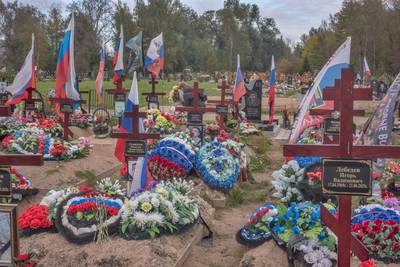
The "initial stage" of memorialization, where fresh earthen graves are densely covered in massive wreaths of artificial flowers and a forest of flags. In the foreground, the wooden cross of Aleksandr Vitalyevich Rogachev (1964-2025) identifies a 61-year-old casualty, representative of the older demographic of mobilized soldiers and volunteers. The scene highlights the diverse composition of the forces, with the flag of Uzbekistan visible in the background--indicating the recruitment of foreign nationals--while a lone mourner tends to a grave amidst the dense rows, adding a human scale to the extensive loss. "Alley of Heroes" at Cemetery of the Victims of January 9, St. Petersburg, Russia, October 4, 2025  The grave of Mikhail Ilyich Svyatkin (1986-2025), a 39-year-old soldier whose death in May 2025 aligns with the surge in casualties during the spring and summer of that year. His wooden cross bears a framed photo of him in combat gear holding a rifle, surrounded by wreaths inscribed "From Mother," highlighting the personal grief embedded in the mass loss. The background is crowded with similar fresh graves, flags, and flowers, reinforcing the density and continuity of the burials at this active military cemetery. "Alley of Heroes" at Cemetery of the Victims of January 9, St. Petersburg, Russia, October 4, 2025  "Section 69 A" marker within the "temporary" burial sector, where fresh earthen mounds stretch toward a forested perimeter, contrasting the ordered numbering system with the raw immediacy of mass death. A solitary mourner in a green coat stands quietly by a cross, tending to flowers amidst a sea of Russian tricolors and unit flags, including the blue and yellow banner of the Aerospace Forces, adding a human scale to the vast, impersonal landscape of casualties. The scene highlights the rapid expansion of the cemetery, with the dense rows of wooden crosses indicating the continuous flow of new burials. "Alley of Heroes" at Cemetery of the Victims of January 9, St. Petersburg, Russia, October 4, 2025  The "initial stage" of memorialization, where fresh earthen graves are crowded with temporary wooden crosses and a profusion of military banners, including the VDV (Airborne Forces) and St. Andrew[CloseCurlyQuote]s Naval flags. The foreground features the grave of Mikhail Ilyich Svyatkin (1986-2025), a 39-year-old casualty, whose cross is adorned with a framed photo of him in uniform, exemplifying the typical profile of recent losses. The scene is saturated with patriotic symbols, including a flag depicting a tank with the slogan "Victory will be ours" and another with the Order of the Great Patriotic War, linking the current conflict to historical narratives of Soviet heroism. "Alley of Heroes" at Cemetery of the Victims of January 9, St. Petersburg, Russia, October 4, 2025  Wide-angle view of the overwhelming scale of the cemetery s "temporary" sector, where row upon row of fresh earthen graves stretch toward the horizon, each topped with a dense carpet of wreaths and a chaotic thicket of flags. The visual field is dominated by the Russian tricolor, but punctuated by Soviet red banners, VDV (Airborne) flags, and Naval ensigns, reflecting the "hybrid" composition of forces. The raw, unpaved ground and the sheer density of the burials underscore the industrial pace of the war s casualties, set against a mundane urban backdrop that integrates this mass death into daily life. "Alley of Heroes" at Cemetery of the Victims of January 9, St. Petersburg, Russia, October 4, 2025  The diverse visual language of mourning in the "Alley of Heroes," showing a mix of permanent granite monuments and temporary graves decorated with flags, including the Russian Imperial black-yellow-white tricolor and a Soviet red banner. In the foreground, the polished black headstone of Ivan Vladimirovich Semenov (1995-2024) features a color portrait of the 28-year-old soldier, while nearby, two women stand amidst the graves, highlighting the cemetery as an active site of personal grief. The scene captures the juxtaposition of varied ideological symbols--imperial, communist, and modern state--united within the shared space of military sacrifice. Cemetery of the Victims of January 9, St. Petersburg, Russia, October 4, 2025  A granite monument bearing the poignant epitaph, "My today is a sacrifice for your tomorrow," framing the soldier[CloseCurlyQuote]s death as a redemptive gift to future generations. The grave is flanked by the black and yellow flags of the Motorized Rifle Troops--Russia s primary ground combat formations--distinguished by the Kalashnikov insignia and the motto "Loyalty". In the background, rows of temporary wooden crosses extend into the distance, contrasting the finished memorial with the raw, fresh graves of recent casualties. "Alley of Heroes" at Cemetery of the Victims of January 9, St. Petersburg, Russia, October 4, 2025  The dense, chaotic stage of recent burial in the "Alley of Heroes," where fresh earthen graves are overwhelmed by a profusion of flags, including the Russian tricolor, the blue flag of the Aerospace Forces (VKS), and banners of various volunteer and assault units. The foreground shows a simple wooden cross with a framed photo of a young soldier, surrounded by vibrant wreaths of artificial flowers, while in the background, a woman walks amongst the rows, emphasizing the cemetery s role as an active site of public mourning. The sheer number of flags and the raw state of the ground visually confirm a continuous, high-volume flow of casualties processed at this site. Cemetery of the Victims of January 9, St. Petersburg, Russia, October 4, 2025  The initial "temporary" stage of burial, showing rows of fresh earthen mounds topped with simple wooden Orthodox crosses and small identification plaques. Despite the lack of permanent monuments, the graves are densely decorated with vibrant artificial flowers and a profusion of flags--including the Russian tricolor, a Soviet hammer-and-sickle banner, and the flag of Uzbekistan--highlighting the diverse origins and ideological affiliations of the recently deceased. The raw, uneven ground and the sheer number of identical crosses extending into the background visually confirm the high volume of recent casualties processed at the site. "Alley of Heroes" at Cemetery of the Victims of January 9, St. Petersburg, Russia, October 4, 2025  The dense visual cacophony of the cemetery s "temporary" section, where rows of wooden crosses are submerged in a sea of Russian tricolors and military intelligence (GRU/Spetsnaz) flags bearing the bat insignia. In the foreground, the grave of Kirill Arkadyevich Sharkov (1975-2025), a 49-year-old casualty, is marked by a simple cross and a photo of him in uniform, surrounded by wreaths in patriotic red, white, and blue colors. The scene conveys the sheer volume of recent losses, with flags fluttering chaotically over uneven mounds of earth, while a tractor in the far left background hints at the ongoing expansion of the burial grounds. "Alley of Heroes" at Cemetery of the Victims of January 9, St. Petersburg, Russia, October 4, 2025  Religious and symbolic narrative of sacrifice, featuring a granite monument with an elaborate engraving of a soldier ascending a staircase toward a welcoming Christ-like figure and a birch tree, blending Christian theology with Russian nationalism. The epitaph laments, "You loved life... But the thread was cut too soon," emphasizing personal loss alongside martial duty. In the background, a chaotic array of VDV (Airborne Forces) and Russian flags flies over rows of fresh, temporary graves, contrasting the permanent serenity of the foreground monument with the raw immediacy of ongoing casualties. "Alley of Heroes" at Cemetery of the Victims of January 9, St. Petersburg, Russia, October 4, 2025  The "initial stage" of mass burial, depicting a dense field of fresh earthen mounds marked only by temporary wooden crosses and overwhelmed by a sea of Russian tricolors, Soviet red banners, and VDV flags. The ground is raw and uneven, with a single permanent black granite curb visible in the foreground as the only sign of the eventual transition to formal memorialization. In the background, industrial infrastructure frames the scene, emphasizing the integration of this expanding military necropolis into the everyday civilian landscape of St. Petersburg "Alley of Heroes" at Cemetery of the Victims of January 9, St. Petersburg, Russia, October 4, 2025  Revealing the multinational and irregular composition of the Russian forces, featuring the flag of Uzbekistan prominently displayed alongside the black "Assault Troops" banner and the Russian tricolor. In the foreground, the grave of Aleksandr Borisovich Vasiliev (1973-2025), a 52-year-old soldier, is marked by a framed photograph of him in combat gear standing in a field, humanizing the older demographic of recent casualties. The scene captures the raw, crowded nature of the "initial stage" of burial, with fresh earthen mounds and a chaotic mix of personal and military symbols extending into the background. "Alley of Heroes" at Cemetery of the Victims of January 9, St. Petersburg, Russia, October 4, 2025  The dense concentration of recent casualties, with fresh earthen mounds tightly packed together and adorned with the ubiquitous Russian tricolor. In the foreground, the grave of Aleksandr Vladimirovich Dementyev (1962-2025) is marked by a wooden cross and a color portrait, identifying a 63-year-old soldier whose age highlights the heavy toll on older reservists and volunteers. The background reveals the integration of the cemetery into the urban fabric, with modern commercial buildings visible just beyond the sea of flags and wreaths, grounding the war[CloseCurlyQuote]s losses in the everyday reality of St. Petersburg. "Alley of Heroes" at Cemetery of the Victims of January 9, St. Petersburg, Russia, October 4, 2025  The expanding scale of the "Alley of Heroes," with construction machinery visible in the left background clearing land for new burial plots, confirming the site s active status. The foreground displays a dense cluster of polished granite monuments flanked by diverse military insignia, including the St. Andrew[CloseCurlyQuote]s flag of the Navy and a unit banner for a Motorized Rifle formation, reflecting the hybrid force structure composed of regular troops, mobilized personnel, and specialized units. Cemetery of the Victims of January 9, St. Petersburg, Russia, October 4, 2025  "Alley of Heroes," a section of the cemetery dedicated to Russian soldiers killed in the war in Ukraine. In the foreground stands a permanent black granite monument featuring a detailed engraving of a soldier in combat gear with the "Z" insignia and a stoic epitaph reading, "Having given everything, I will not rise from the dust... I, having killed the fear within myself, fought". The background reveals rows of additional graves densely adorned with wreaths and flags representing various military branches (including the VDV and Naval Infantry) and private military contractors, illustrating the ongoing scale and diverse composition of the casualties. Cemetery of the Victims of January 9, St. Petersburg, Russia, October 4, 2025  The "permanent stage" of memorialization, featuring a row of polished black granite monuments for soldiers such as Andrey Nikolaevich Atlanov (1977-2024) and Danila Denisovich Shutov (2001-2024), a 23-year-old whose age underscores the ongoing loss of young lives. The monuments display diverse portrait styles--ranging from formal military engravings to casual color photos--and are flanked by flags including the VDV (Airborne Forces) banner with the motto "Nobody, but us," reflecting both individual identity and collective unit pride. The orderly arrangement of these finished graves, complete with granite curbs and gravel, stands in contrast to the chaotic temporary sections seen in other places, illustrating the gradual formalization of the war s toll. "Alley of Heroes" at Cemetery of the Victims of January 9, St. Petersburg, Russia, October 4, 2025  The permanent monument of Denis Alekseevich Mikhailov (1983-2024), a 40-year-old soldier whose polished black granite headstone displays a detailed engraving of him in full combat gear, holding a rifle and wearing a parachute badge, alongside a real blue beret left as a personal tribute. The grave is flanked by the blue and yellow flag of the VDV (Airborne Forces) with the motto "Nobody, but us," underscoring his elite unit affiliation, while surrounding graves show a mix of portrait styles and military banners, reflecting the individualized yet collective nature of the memorialization. "Alley of Heroes" at Cemetery of the Victims of January 9, St. Petersburg, Russia, October 4, 2025  Blending of religious and patriotic symbolism in the "Alley of Heroes". The foreground monument features a poignant epitaph addressing the deceased ("And you stand before our eyes, Alive... We keep you in our hearts") alongside an elaborate engraving of a soldier ascending a staircase toward a Christ-like figure, framing death as a spiritual journey. In the background, a distinctive broken-heart monument depicts a split image of a bridge at night surrounded by flags from various military branches, including the VDV and Russian Naval Infantry. Cemetery of the Victims of January 9, St. Petersburg, Russia, October 4, 2025  The ideological complexity of the war s memorialization, dominated by a large red Soviet flag flying prominently over fresh graves, invoking nostalgia for the USSR s military power alongside Russian tricolors and VDV (Airborne Forces) banners. In the foreground, the grave of Arkady Vasilyevich Kovalchuk (1974-2024), who died at age 50, exemplifies the demographic trend of older men bearing a significant share of casualties. The scene is one of dense, vibrant mourning, with mounds of artificial flowers covering the raw earth, set against a backdrop of modern commercial buildings that anchor the cemetery in the contemporary urban landscape. "Alley of Heroes" at Cemetery of the Victims of January 9, St. Petersburg, Russia, October 4, 2025  The diverse visual languages of mourning in the "Alley of Heroes," contrasting a solemn monochrome engraving of a soldier in full combat gear--distinguished by the Order of Courage medal--with the vibrant, smiling color portrait of Yuri Bogdanov on the adjacent grave. The background is saturated with a chaotic array of flags, including the black-yellow-white Russian Imperial tricolor and red Soviet banners, visually capturing the "hybrid" ideological landscape, where conflicting historical symbols are merged to support the war effort. Cemetery of the Victims of January 9, St. Petersburg, Russia, October 4, 2025  The grave of Alexey Vladimirovich Suslov (1976-2024), a 47-year-old casualty whose age reflects Russia s reliance on older reservists and volunteers rather than just young conscripts. His polished black granite monument features a casual color portrait and the epitaph "We were left without you, You remained with us," asserting a continuing spiritual bond despite death. The background juxtaposes the solemn "Alley of Heroes" with modern commercial buildings, visually grounding the war s toll within the everyday urban landscape of St. Petersburg. Cemetery of the Victims of January 9, St. Petersburg, Russia, October 4, 2025  Family plot of the Volle family in Calvert City Cemetery. This plot is the resting place for other members of the Volle family, including John G. Volle (1843-1908), a prominent merchant or resident of early Calvert. Calvert, Texas, December 13, 2025  Aerial view of Tallinn. The heart of the image is the medieval Old Town, identifiable by its dense cluster of red-tiled roofs, church spires (including the tall St. Olaf s Church), and the fortified Toompea Hill. Surrounding the Old Town are the modern high-rises of the financial district (left foreground), including the Swisso^tel and Tornima"e towers. To the right, the Port of Tallinn (Vanasadam) stretches out into the Baltic Sea, with ferries and cruise ships visible. The sweeping coastline of the Tallinn Bay dominates the background. The clear blue sky and the calm sea suggest a crisp, sunny morning. View from a window of an airplane from Tallinn to Helsinki. Estonia, October 17, 2025  A Kneeling Angel statue on the grave of Mary Drennan by Aristide Maillol (1861-1944)(?) in the Calvert City Cemetery. Mary Drennan (November 20, 1882 - January 8, 1901) was the daughter of John Hill Drennan (1839-1921) and Mary Agnes Garrett Drennan (1846-1929), prominent residents buried nearby in the same family plot. The plot also contains other elaborate statuary, including a larger standing angel leaning against a cross (marking the grave of her sister, Adelaide Drennan Westall, who also died young in 1898). Calvert, Texas, December 13, 2025  Rebuilding of the Forest Building (Russian: Lesnoy Korpus) in a major reconstruction project at the historic Sestroretsk Resort (Sestroretsky Kurort). The original Sestroretsk Resort was a famous health spa complex founded in 1898 by engineer Peter Avenarius. It featured several grand wooden structures, including a massive Kursaal (concert hall), a mud bath facility, and the Forest Building. The resort was a hub for St. Petersburg s elite and intelligentsia in the early 20th century. The original Forest Building was a beautiful wooden hotel and sanatorium building constructed in the early 1900s. It was a key part of the ensemble but was destroyed during World War II. The new structure faithfully replicates the "Northern Art Nouveau" style of the original resort architecture, characterized by its complex roofline, spires, towers, and wooden detailing that harmonizes with the surrounding pine forest and dunes. The exterior appears nearly complete, showing the elaborate wooden facade, the large central dome, and the corner towers with their needle-like spires. The scaffolding indicates that finishing work is still in progress. Saint Petersburg, Russia, October 9, 2025  Tragic graves of the Couter family, likely victims of the devastating 1873 Yellow Fever Epidemic, in the Calvert City Cemetery. George Couter (Left Stone): The headstone is inscribed "In Memory of GEO. COUTER". Dates: Born Dec. 11, 1839 (or 1830) - Died Oct. 16, 1873. Context: He died just days before his wife, a common occurrence during the yellow fever outbreak that claimed hundreds of lives in Calvert between August and November of 1873. Mary Reese Couter (Right Stone): The stone reads "MARY REESE, Wife of G. COUTER". Dates: Born June 20, 1850 - Died Oct. 21, 1873. Tragedy: She died only 5 days after her husband. She was just 23 years old. The proximity of their deaths highlights the swift and deadly impact of the epidemic on local families. Visible in the background is a large, elaborate monument featuring a seated woman (mourner) with her head bowed in grief. Calvert, Texas, December 13, 2025  A view of the installation specifically focuses on the memorial dedicated to Alexei Navalny, the Russian opposition leader who died in a penal colony on February 16, 2024. The central poster explicitly states "PUTIN KILLED NAVALNY" in bold red and black letters, echoing the sentiments of protestors worldwide who hold the Kremlin responsible for his death. Below the text is a large, stylized black-and-white portrait of Navalny, marked with the date of his death, February 16, 2024. The main poster is surrounded by smaller photos, drawings, and messages from supporters, including a quote in Russian: "Everything will be fine. And even if it isn t, we will console ourselves that we were honest people". The memorial is integrated into the broader anti-war protest, with signs like "STOPTHEWAR" and "NETVOYNE" (No to War) visible alongside Ukrainian colors. A yellow poster in the background calls for freedom for political prisoners ("SVOBODU POLITZAKLYUCHONNYM"). Tallinn, Estonia, October 16, 2025  Monument of heroes of Great October Socialist Revolution. It is a mass grave monument dedicated to Red Guards who died during the 1917 October Revolution and the subsequent Civil War. The site originated in 1917 as a burial ground for workers and Red Guards from the nearby Novy Lessner Plant (now the Karl Marx Machine-Building Plant). These fighters were killed in battles against the troops of General Pyotr Krasnov near Pulkovo during the defense of Petrograd. In 1953, a wooden structure was replaced by the current grey granite obelisk seen today. It was designed by architect Yuri Wiesenthal. This monument is a solemn reminder of the intense revolutionary history of the Vyborg Side, a district historically populated by industrial workers who were pivotal to the Bolshevik cause. Lesnoy Park (Lesotekhnicheskiy Universitet), Saint Petersburg, Russia, October 14, 2025  Naturalistic path winding through a dense grove of mature trees, including oaks and maples, which display a vibrant palette of ochre, rust, and lime green. Aleksandrovsky (Alexander) Park in Pushkin (former Tsarskoe Selo) near Saint Petersburg, Russia, October 10, 2025  Linden alley in Oranienbaum Park. Mature linden trees form a dense, golden tunnel overhead. The long, converging lines of the tree trunks draw the eye toward the distant tractor, emphasizing the scale of the park (which covers over 160 hectares) and the ongoing maintenance required to preserve its historic appearance. Oranienbaum palace-and-park ensemble in Lomonosov (a suburb of St. Petersburg), Russia, October 13, 2025  "The Seated Mourner" of Peters family in Calvert City Cemetery. Surrounding the central monument are individual headstones for family members, including: Elizabeth Peters (visible in the foreground, born 1842, died 1928). Baby Hanna Peters (1888-1890). Ruby Busch Peters (1894-1927). The size and artistry of the monument suggest the Peters family was of significant social and economic standing in Calvert, likely commissioning this work during the town s prosperous cotton era (late 19th/early 20th century). Calvert, Texas, December 13, 2025  A wider view of Pikk Street (Pikk ta"nav) in Tallinn s Old Town, focusing on the Russian Embassy at Pikk 19. The elegant pink building on the right with the balcony and the Russian Federation flag is the Russian Embassy. It is a historic structure dating back to the late 19th century, originally built as a private residence before becoming a diplomatic mission. A marked Estonian police van is parked further down the street on the left. Since the start of the full-scale invasion of Ukraine in 2022, there has been a constant police presence here to monitor the protests and ensure security around the embassy. The metal barriers covered in protest art, flags, and posters run along the entire length of the sidewalk in front of the embassy. This installation has become a defining feature of the street, transforming a diplomatic zone into a site of permanent public demonstration. The view looks down Pikk Street towards the north, showing the narrow, cobblestone character of the Old Town. On the left, you can see other historic buildings, including shops and restaurants like the Cantina Texas (just visible in the distance). The contrast between the beautiful medieval architecture and the tense political atmosphere is striking. Tallinn, Estonia, October 16, 2025  Another view of the Friedlander and Klawetter family plot in the Calvert Jewish Cemetery. In the background, a small, corrugated metal shed is visible among the trees. This is likely a maintenance shed for the cemetery groundskeeper, typical in older rural cemeteries. Calvert, Texas, December 13, 2025  Remains of a Finnish hydroelectric power plant on the Volchya River (formerly Saijanjoki), located near the village of Peta"ja"rvi (now Petrovskoye) in the Leningrad Region. The dam structure, including the concrete pillars and spillway, is still standing, creating a scenic waterfall that is a popular tourist stop on the Vyaryamyanselka Ridge eco-trail. Petyayarvi north from Saint Petersburg, Russia, October 5, 2025  Wider view of the Volle family plot in the Calvert City Cemetery. Volle Family Stone (Left): The large, upright granite headstone on the left commemorates the parents of the "Little Robert" statue. J.G. Volle: Born Oct 23, 1843, Died Nov 19, 1908. He was a prominent local merchant. Mary Ellen Volle: Born Dec 8, 1855, Died Apr 14, 1906. She was J.G. s wife. "Little Robert" Statue (Center-Background): The statue of the cherub ("Holly Robert Volle"). Large "VOLLE" Block (Right): A massive granite block with the family name "VOLLE" carved in relief stands in the foreground, serving as the central family plot marker. Calvert, Texas, December 13, 2025  Alley of North Cemetery in Pargolovo, near Saint Petersburg. Russia, October 14, 2025  A temporary protest installation located directly in front of the Russian Embassy at Pikk 19 in Tallinn s Old Town. The barricades and posters are situated along the sidewalk of Pikk Street, facing the embassy building. This narrow, historic street has become a focal point for public demonstrations since the beginning of the full-scale invasion of Ukraine in February 2022. The installation serves as a persistent protest against the Russian invasion of Ukraine. It features Ukrainian flags, anti-war messages, graphic images of war damage (such as destroyed buildings in Ukrainian cities), and tributes to figures like Alexei Navalny. The display transforms a section of the picturesque Old Town into a politically charged space, forcing diplomats and passersby to confront the realities of the conflict. The protest materials are often updated by activists and local residents to reflect ongoing events. The sign "If they decide to kill me, it means we are incredibly strong - Navalny" references the late Russian opposition leader Alexei Navalny, whose death in prison in February 2024 sparked renewed gatherings and memorials at this exact spot. Tallinn, Estonia, October 16, 2025  A politically charged scene on Pikk Street (specifically at Pikk 19) in front of the Russian Embassy in Tallinn. The metal barricades lining the street have become a permanent protest installation since Russia s full-scale invasion of Ukraine in February 2022. The barriers are covered in posters, slogans, and artwork condemning the war and Russian leadership. The large banner in the foreground reads "FOR THE VICTIMS OF WARS STARTED BY RUSSIA". Other signs visible on the fence typically document war crimes or satirize political figures. A police officer in a high-visibility yellow jacket is patrolling the area. A constant police presence has been standard here to maintain order given the high tensions surrounding the embassy. The Russian Embassy occupies a historic Art Nouveau building at Pikk 19. Ironically, this street is one of the most picturesque and tourist-heavy routes in the Old Town, creating a surreal juxtaposition between medieval charm and modern geopolitical conflict. Across the street (visible in the background) is the famous Maiasmokk Cafe, the oldest operating cafe in Tallinn, further highlighting the clash between leisure tourism and serious political activism in this specific location. Tallinn, Estonia, October 16, 2025  Graves belonging to the Foster and Phernetton families (specifically referencing Mattie Phernetton) in the Calvert City Cemetery. These graves are located in the older section of the cemetery, evidenced by the Victorian symbolism and the weathering of the white marble/limestone markers. Calvert, Texas, December 13, 2025  Bright, yellow-green, densely packed tufts of very small, rosette-like shoots of a young growth of Common Bladder-moss (Physcomitrium pyriforme), or potentially a Weissia species, on a lawn in Bee Creek Park. College Station, Texas, February 24, 2025  This view of the installation near the Russian embassy on Pikk Street captures a broader perspective of the protest site, showing how it stretches along the sidewalk in front of the embassy building. The white banner in the foreground originally read "FOR THE VICTIMS OF WARS STARTED BY RUSSIA" (with the Russian translation on the right). However, someone has vandalized the sign by crossing out "RUSSIA" and scrawling "US" and a Star of David (hexagram) over it. This act of vandalism attempts to deflect blame from Russia by invoking anti-American and antisemitic tropes, a tactic often seen in pro-Kremlin disinformation campaigns. On the left side of the street, the building with the distinctive Art Nouveau facade (Pikk 18) houses the Ron Verlin salon, visible through the large arched window. This contrasts the elegant, peaceful commercial life of the street with the raw political conflict playing out just meters away. The fencing extends far down the street, covered in layers of posters, flags, and messages. This indicates the sustained nature of the demonstration, which has become a semi-permanent fixture in the Old Town since the start of the full-scale invasion. Tallinn, Estonia, October 16, 2025  A weathered stone portal and wooden door at Sauna Street 2 (Sauna 2), in the heart of Tallinn s nightlife district. The arched doorway features a rustic, heavy limestone surround with a prominent keystone. This style is typical of the less ornate, utilitarian medieval architecture found in the Old Town s side streets. The panelled wooden door is heavily distressed, covered in layers of graffiti tags in various colors (silver, red, black). The tags cover nearly every inch, including the panels and the frame, obscuring the original wood finish. The heavy graffiti on this specific door is a hallmark of the area around Sauna Street and Va"ike-Karja, which transforms into a bustling party zone at night. While the historic architecture remains, the street level often bears the marks of the active nightlife scene, creating a gritty contrast between the medieval heritage and modern urban culture. This door is likely a side entrance or utility access for one of the nearby venues like Frank or Sigmund Freud Bar. Tallinn, Estonia, October 16, 2025  Spores of white Calocybe-like mushrooms collected earlier 10/9/2025 in Sosnovka Park. Saint Petersburg, Russia, October 19, 2025  A scene of the Karasta River in Upper Park. The shallow, rocky river flows gently towards a rustic, arched stone bridge in the background, which acts as a romantic focal point nestled deep within the foliage. Oranienbaum palace-and-park ensemble in Lomonosov (a suburb of St. Petersburg), Russia, October 13, 2025  Forest scene near the railroad tracks. Sergievka Park near Universitet, Old Peterhof, west from Saint Petersburg, Russia, October 13, 2025  This view across the Friendship Bridge offers a stark look at the Ivangorod Fortress in Russia, directly contrasting with previous Estonian views. The most striking element in this image is the heavy modern fortification in the foreground. The bridge, which once facilitated vehicle traffic, is now blocked by rows of razor wire and concrete "dragon s teeth" anti-tank obstacles. These defensive measures, installed by Estonia, reflect the heightened geopolitical tension and the bridge s current status as a restricted crossing (open only to pedestrians as of 2024-2025). Dominating the background is the formidable Ivangorod Fortress, established in 1492 by Ivan III to counter the Teutonic Order on the opposite bank. A large Russian flag flies prominently atop one of the towers, serving as a deliberate counterpart to the Estonian and NATO flags visible from the other side of the river. Estonia, October 16, 2025  Spores of beefsteak fungus (Fistulina hepatica) collected earlier 10/9/2025 in Dubki Park, Sestroretsk near Saint Petersburg, Russia, October 19, 2025  Spores (in KOH) of mushrooms Psilocybe fuscofulva(?) collected earlier 9/29/2025 near Kavgolovskoe Lake south from Oselki near Saint Petersburg, Russia, October 19, 2025  Debarcader (train shed) of the Vitebsky Railway Station, Russian Art Nouveau (Style Moderne). Massive riveted steel spans were designed by architect Stanislav Brzhozovsky and engineer Sima Minash. It is serving the historic route to Tsarskoye Selo (Pushkin) and Pavlovsk. Saint Petersburg, Russia, October 15, 2025  Spores of Calocybe-like mushrooms collected earlier 10/8/2025 under silvery fir trees behind Lenin s monument in Botanical Garden, Saint Petersburg, Russia, October 19, 2025  Spores of grey tooth mushrooms (Phellodon melaleucus) collected earlier 9/25/2025 near Dibuny, north-west from Saint Petersburg, Russia, October 19, 2025  Spores (in lugol, with x40 objective) of Ascomycete fungus Phaeohelotium monticola(?) collected earlier 10/7/2025 on wood near Lisiy Nos, near Saint Petersburg, Russia, October 19, 2025  Spores (in KOH, with x100 objective) of Ascomycete fungus Phaeohelotium monticola(?) collected earlier 10/7/2025 on wood near Lisiy Nos, near Saint Petersburg, Russia, October 19, 2025  Spores (in lugol, with x100 objective) of Ascomycete fungus Phaeohelotium monticola(?) collected earlier 10/7/2025 on wood near Lisiy Nos, near Saint Petersburg, Russia, October 19, 2025  Spores of Ascomycete mushrooms Pulvinula convexella collected earlier 10/1/2025 on a bonfire site near a lake in Kannelyarvi, north from Saint Petersburg, Russia, October 19, 2025  Alley crossing in Oranienbaum Park. The image captures a quiet intersection of paths lined with mature trees, emphasizing the park s thoughtful layout that encourages leisurely exploration. The placement of multiple benches at this crossing invites visitors to pause and take in the surroundings from different angles. Oranienbaum palace-and-park ensemble in Lomonosov (a suburb of St. Petersburg), Russia, October 13, 2025  Spores of roothole rosette mushrooms (Stereopsis vitellina) collected earlier 10/5/2025 in a burrow near a road under pines in Petyayarvi, north from Saint Petersburg, Russia, October 19, 2025  Spores of coral fungus Lentaria byssiseda collected earlier 10/13/2025 from a tall oak tree in Sergievka Park, Old Peterhof, west from Saint Petersburg, Russia, October 19, 2025  Close-up captures the "successional partners" of the clearing: a Mountain Ash (Rowan) sapling (Sorbus aucuparia) growing amidst the skeletal remains of Fireweed (Chamaenerion angustifolium, Ivan-Chai), both encased in hoarfrost. Kannelyarvi, north from Saint Petersburg, Russia, October 1, 2025  From this more distant perspective, the bridge serves as a gateway through the dense "Golden Autumn" forest, its dark iron silhouette creating a strong focal point amidst the vibrant foliage. Sergievka Park, Old Peterhof, west from Saint Petersburg, Russia, October 13, 2025  Wider view of the Visconti Bridge (Viskontiyev most) emphasizing its role as a "border" or focal point in the vast Slavyanka landscape in Pavlovsk Park. Pavlovsk, a suburb of Saint Petersburg, Russia, October 6, 2025  Spores (in KOH, spore print orange) of spectacular rustgill mushrooms (Gymnopilus junonius) collected earlier 10/9/2025 in Dubki Park, Sestroretsk near Saint Petersburg, Russia, October 19, 2025  Spores (in KOH, spore print black) of brittlestem mushrooms (Psathyrella corrugis) collected earlier 10/6/2025 on a forest trail in Pavlovsk, a suburb of Saint Petersburg, Russia, October 19, 2025  Spores of mushrooms Multiclavula corynoides collected earlier 10/5/2025 in a shallow depression covered by sand, near Petyayarvi train stop, north from Saint Petersburg, Russia, October 19, 2025  Spores (spore print white) of Goblet mushrooms (Pseudoclitocybe cyathiformis) collected earlier 10/12/2025 up from 67 km train stop near Orekhovo, north from Saint Petersburg, Russia, October 19, 2025  Spores (in KOH) of Boletinus/Suillus cavipes mushrooms collected earlier 9/30/2025 near Lindulovskaya Larch Grove, near Roshchino, 30 miles north-west from Saint Petersburg. Russia, October 19, 2025  A bronze copy of the famous ancient Greek group "Laocoo"n and His Sons" near the Chinese Palace. The dynamic composition depicts the Trojan priest Laocoo"n and his two sons in their agonizing death struggle against sea serpents sent by the gods (usually attributed to Athena or Poseidon) as punishment for warning the Trojans about the wooden horse. Oranienbaum palace-and-park ensemble in Lomonosov (a suburb of St. Petersburg), Russia, October 13, 2025  Spores (spore print white) of yellowleg bonnet mushrooms (Mycena epipterygia) collected earlier 10/3/2025 in Tarkhovka Park near Sestroretsk, west from Saint Petersburg, Russia, October 19, 2025  Pore Structure of mature beefsteak fungus (Fistulina hepatica) from a huge old oak in Dubki Park. In the close-up of the underside, one can see that the tubes are separate from one another (like packed straws) rather than fused into a solid sponge. Sestroretsk near Saint Petersburg, Russia, October 9, 2025  Spores (in KOH, spore print dark brown) of common stump brittlestem mushrooms (Psathyrella piluliformis)(?) collected earlier 10/5/2025 on roadside in Petyayarvi, north from Saint Petersburg, Russia, October 19, 2025  Spores (in KOH, spore print brown) of Conocybe(?) mushrooms collected earlier 10/3/2025 on black soil, under spruce trees in Tarkhovka Park near Sestroretsk, west from Saint Petersburg, Russia, October 19, 2025  Spores (in KOH, spore print light brown) of Velvet Shank mushrooms (Flammulina velutipes) collected earlier 10/2/2025 near Kavgolovskoe Lake south from Oselki near Saint Petersburg, Russia, October 19, 2025  This view of the protest installation outside the Russian Embassy on Pikk Street highlights several direct appeals and condemnations aimed at the Russian government. "STOP KILLING PEOPLE": A large, hand-painted sign on the right bluntly demands an end to the violence. This slogan has become a staple of anti-war protests worldwide. "STOP WAR CRIMINALS": The banner on the bottom left features a missile marked with the Russian flag and the demand to stop "war criminals." This reflects the widespread accusation that Russian leadership is committing war crimes in Ukraine. The large white sheet in the center is covered with drawings of cats in blue and yellow bowties, likely representing innocent lives or perhaps a specific children s art project. The text on the right translates from Estonian: "TO THE VICTIMS OF WARS STARTED BY RUSSIA" (Venemaa poolt alustatud so~dade ohvritele). This frames the current conflict as part of a longer history of Russian aggression. The central drawing includes poignant handwritten messages like "NOBODY LOVES YOU!" and "WE DON T WANT WAR!", expressing a mix of personal disdain for the aggressors and a universal plea for peace. Tallinn, Estonia, October 16, 2025  This view from the tower of St. Nicholas Church offers a fascinating contrast between medieval history, post-war reconstruction, and modern urban growth, looking east towards the city center. The most prominent building in the immediate foreground is the large, grey, L-shaped structure known as the Writers House (Kirjanike Maja) on Harju Street. Built in 1963 on the ruins of buildings destroyed during the 1944 Soviet bombing of Tallinn, this modernist structure is a significant cultural landmark. It houses the Estonian Writers Union, a well-known bookstore, and the famous Cafe Pegasus, serving as a hub for the country s literary scene. The street running along the left side of the Writers House is Harju Street, historically one of the city s main commercial arteries. The open green space visible nearby (part of the Harju Street green area) was also created following the wartime destruction, serving as a memorial and recreational space before partial reconstruction debates in recent years. In the background, the view opens up to Tallinn s modern business district. The cluster of high-rise glass buildings, including the distinct wedge-shaped Swisso^tel and the SEB Bank headquarters, illustrates the city s rapid economic development and stands in stark contrast to the red-tiled roofs of the Old Town below. Estonia, October 16, 2025  Spores (in KOH, spore print light brown) of of mushrooms Boletinus asiaticus collected earlier 9/30/2025 in Lindulovskaya Larch Grove, near Roshchino, 30 miles north-west from Saint Petersburg. Russia, October 19, 2025  Spores (in KOH, spore print light brown) of conifer shield mushrooms (Pluteus pouzarianus) collected earlier 10/3/2025 on a forest road under spruce in Tarkhovka Park near Sestroretsk, west from Saint Petersburg, Russia, October 19, 2025  Spores (in KOH, spore print light brown) of Lion shield mushrooms (Pluteus leoninus) collected earlier 10/3/2025 on wood chips of spruce in Tarkhovka Park near Sestroretsk, west from Saint Petersburg, Russia, October 19, 2025  Remains of corrugated metal culvert pipes that collapsed due to hydraulic forces during a flood event in Lick Creek Park. College Station, Texas, January 26, 2025  Evening view that provides a dramatic, upward-looking perspective of St. Olaf s Church (Oleviste kirik) from the street level (near Lai 48), emphasizing the towering scale of its west facade. The image is dominated by the massive limestone tower of St. Olaf s. The perspective highlights the transition from the square base to the octagonal upper stages, a typical feature of Gothic architecture in the Hanseatic region. The long, narrow window with its pointed arch (lancet window) is a defining Gothic element, allowing light into the nave. To the right, you can see the upper stories of the adjacent building (likely Lai 48 or 50). Its simple, plastered facade and regularly spaced windows provide a domestic scale that contrasts with the monumental church. The distinctive rain gutter (downspout) on the left foreground acts as a framing element, drawing the eye upward. This view underscores why St. Olaf s was once the tallest building in the world (1549-1625). The sheer verticality visible here was originally intended to serve as a landmark for trading ships approaching Tallinn s harbor. Tallinn, Estonia, October 16, 2025  Maple alley in Lesnoy Park (Lesotekhnicheskiy Universitet), Saint Petersburg, Russia, October 14, 2025  Akademicheskaya Alley in Lesnoy Park (Lesotekhnicheskiy Universitet), Saint Petersburg, Russia, October 14, 2025  Dense forest scene illustrating the unique "mixed woodland" character of Sergievka Park, where old-growth deciduous trees mingle with younger evergreens. Old Peterhof, west from Saint Petersburg, Russia, October 13, 2025  Classic "Northern Russian" mixed woodland representing a managed semi-natural mixed forest in transition, view from Alley of the Green Woman in Pavlovsk Park. Pavlovsk, a suburb of Saint Petersburg, Russia, October 6, 2025  Dense, fasciculate cluster of clustered domecap mushrooms (Lyophyllum decastes) on a primitive camping site. Kannelyarvi, north from Saint Petersburg, Russia, October 1, 2025  Autumn scene of Karasta River in Oranienbaum Park. Oranienbaum palace-and-park ensemble in Lomonosov (a suburb of St. Petersburg), Russia, October 13, 2025  Alley near Dendrology Garden. Lesnoy Park (Lesotekhnicheskiy Universitet), Saint Petersburg, Russia, October 14, 2025  Cluster of Colchicum flowers in Peter the Great Botanical Garden of Komarov Botanical Institute. Saint Petersburg, Russia, October 8, 2025  Jordan Pond from Kaygorodova Alley. Lesnoy Park (Lesotekhnicheskiy Universitet), Saint Petersburg, Russia, October 14, 2025  Maple alley near the Forestry Academy. Lesnoy Park (Lesotekhnicheskiy Universitet), Saint Petersburg, Russia, October 14, 2025  This view from the Small Chinese Bridge captures the northwestern stretch of the Krestovy Canal. The canal creates a straight, reflective corridor lined with golden maples, emphasizing the transition from the formal "New Garden" to the more naturalistic landscape park areas. Looking northwest, the canal leads toward the Alexander Palace and its kitchen buildings, which are situated to the right of this axis, hidden behind the dense tree line. The scene highlights the park s quiet, wooded character, contrasting with the architectural focus of the opposite view towards the Cross Bridge. Aleksandrovsky (Alexander) Park in Pushkin (former Tsarskoe Selo) near Saint Petersburg, Russia, October 10, 2025  Surreal scene of a discarded couch in the winter wetlands of Lick Creek Greenway, College Station, Texas, January 24, 2025  Yellow Bridge, also known as the Little Lattice Bridge on Gonzaga Road/path in Pavlovsk Park. It crosses a small tributary or drainage channel that feeds into the Slavyanka, rather than the main river itself. Pavlovsk, a suburb of Saint Petersburg, Russia, October 15, 2025  Maple alley near a building of the Forestry Academy. Lesnoy Park (Lesotekhnicheskiy Universitet), Saint Petersburg, Russia, October 14, 2025  SNT "Rodnik" (Garden Non-Commercial Partnership "Rodnik") adjacent to the Kannelyarvi railway station in November, showcasing a quiet, frosty late-autumn scene typical of the Karelian Isthmus. North from Saint Petersburg, Russia, October 1, 2025  Presence of a dead gull on a beach in the Gulf of Finland near Solnechnoe, that is most likely linked to the ongoing highly pathogenic avian influenza (HPAI) outbreak, specifically the H5N1 strain, which has devastated wild bird populations in the Baltic region throughout 2023-2025. Saint Petersburg, Russia, October 9, 2025  Fall colors of maple alley near the Forestry Academy. Lesnoy Park (Lesotekhnicheskiy Universitet), Saint Petersburg, Russia, October 14, 2025  Deer Bridge with the Rose Pavilion in the background in Pavlovsk Park. Pavlovsk, a suburb of Saint Petersburg, Russia, October 15, 2025  Imperial Horse Cemetery at the Pensioner s Stable in Tsarskoe Selo. This cemetery is the final resting place for over 120 favorite horses of the Russian Emperors, from Alexander I to Nicholas II. The neat rows of white tombstones are the result of a major restoration project completed recently. Saint Petersburg, Russia, September 21, 2025 |