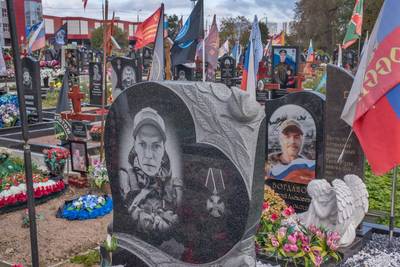
The diverse visual language of mourning in the "Alley of Heroes," showing a mix of permanent granite monuments and temporary graves decorated with flags, including the Russian Imperial black-yellow-white tricolor and a Soviet red banner. In the foreground, the polished black headstone of Ivan Vladimirovich Semenov (1995-2024) features a color portrait of the 28-year-old soldier, while nearby, two women stand amidst the graves, highlighting the cemetery as an active site of personal grief. The scene captures the juxtaposition of varied ideological symbols--imperial, communist, and modern state--united within the shared space of military sacrifice. Cemetery of the Victims of January 9, St. Petersburg, Russia, October 4, 2025  The dense, chaotic stage of recent burial in the "Alley of Heroes," where fresh earthen graves are overwhelmed by a profusion of flags, including the Russian tricolor, the blue flag of the Aerospace Forces (VKS), and banners of various volunteer and assault units. The foreground shows a simple wooden cross with a framed photo of a young soldier, surrounded by vibrant wreaths of artificial flowers, while in the background, a woman walks amongst the rows, emphasizing the cemetery s role as an active site of public mourning. The sheer number of flags and the raw state of the ground visually confirm a continuous, high-volume flow of casualties processed at this site. Cemetery of the Victims of January 9, St. Petersburg, Russia, October 4, 2025  The "initial stage" of memorialization, where fresh earthen graves are crowded with temporary wooden crosses and a profusion of military banners, including the VDV (Airborne Forces) and St. Andrew[CloseCurlyQuote]s Naval flags. The foreground features the grave of Mikhail Ilyich Svyatkin (1986-2025), a 39-year-old casualty, whose cross is adorned with a framed photo of him in uniform, exemplifying the typical profile of recent losses. The scene is saturated with patriotic symbols, including a flag depicting a tank with the slogan "Victory will be ours" and another with the Order of the Great Patriotic War, linking the current conflict to historical narratives of Soviet heroism. "Alley of Heroes" at Cemetery of the Victims of January 9, St. Petersburg, Russia, October 4, 2025  Revealing the multinational and irregular composition of the Russian forces, featuring the flag of Uzbekistan prominently displayed alongside the black "Assault Troops" banner and the Russian tricolor. In the foreground, the grave of Aleksandr Borisovich Vasiliev (1973-2025), a 52-year-old soldier, is marked by a framed photograph of him in combat gear standing in a field, humanizing the older demographic of recent casualties. The scene captures the raw, crowded nature of the "initial stage" of burial, with fresh earthen mounds and a chaotic mix of personal and military symbols extending into the background. "Alley of Heroes" at Cemetery of the Victims of January 9, St. Petersburg, Russia, October 4, 2025  "Alley of Heroes," a section of the cemetery dedicated to Russian soldiers killed in the war in Ukraine. In the foreground stands a permanent black granite monument featuring a detailed engraving of a soldier in combat gear with the "Z" insignia and a stoic epitaph reading, "Having given everything, I will not rise from the dust... I, having killed the fear within myself, fought". The background reveals rows of additional graves densely adorned with wreaths and flags representing various military branches (including the VDV and Naval Infantry) and private military contractors, illustrating the ongoing scale and diverse composition of the casualties. Cemetery of the Victims of January 9, St. Petersburg, Russia, October 4, 2025  The permanent monument of Denis Alekseevich Mikhailov (1983-2024), a 40-year-old soldier whose polished black granite headstone displays a detailed engraving of him in full combat gear, holding a rifle and wearing a parachute badge, alongside a real blue beret left as a personal tribute. The grave is flanked by the blue and yellow flag of the VDV (Airborne Forces) with the motto "Nobody, but us," underscoring his elite unit affiliation, while surrounding graves show a mix of portrait styles and military banners, reflecting the individualized yet collective nature of the memorialization. "Alley of Heroes" at Cemetery of the Victims of January 9, St. Petersburg, Russia, October 4, 2025  The initial "temporary" stage of burial, showing rows of fresh earthen mounds topped with simple wooden Orthodox crosses and small identification plaques. Despite the lack of permanent monuments, the graves are densely decorated with vibrant artificial flowers and a profusion of flags--including the Russian tricolor, a Soviet hammer-and-sickle banner, and the flag of Uzbekistan--highlighting the diverse origins and ideological affiliations of the recently deceased. The raw, uneven ground and the sheer number of identical crosses extending into the background visually confirm the high volume of recent casualties processed at the site. "Alley of Heroes" at Cemetery of the Victims of January 9, St. Petersburg, Russia, October 4, 2025  Wide-angle view of the overwhelming scale of the cemetery s "temporary" sector, where row upon row of fresh earthen graves stretch toward the horizon, each topped with a dense carpet of wreaths and a chaotic thicket of flags. The visual field is dominated by the Russian tricolor, but punctuated by Soviet red banners, VDV (Airborne) flags, and Naval ensigns, reflecting the "hybrid" composition of forces. The raw, unpaved ground and the sheer density of the burials underscore the industrial pace of the war s casualties, set against a mundane urban backdrop that integrates this mass death into daily life. "Alley of Heroes" at Cemetery of the Victims of January 9, St. Petersburg, Russia, October 4, 2025  A granite monument bearing the poignant epitaph, "My today is a sacrifice for your tomorrow," framing the soldier[CloseCurlyQuote]s death as a redemptive gift to future generations. The grave is flanked by the black and yellow flags of the Motorized Rifle Troops--Russia s primary ground combat formations--distinguished by the Kalashnikov insignia and the motto "Loyalty". In the background, rows of temporary wooden crosses extend into the distance, contrasting the finished memorial with the raw, fresh graves of recent casualties. "Alley of Heroes" at Cemetery of the Victims of January 9, St. Petersburg, Russia, October 4, 2025  The grave of Alexey Vladimirovich Suslov (1976-2024), a 47-year-old casualty whose age reflects Russia s reliance on older reservists and volunteers rather than just young conscripts. His polished black granite monument features a casual color portrait and the epitaph "We were left without you, You remained with us," asserting a continuing spiritual bond despite death. The background juxtaposes the solemn "Alley of Heroes" with modern commercial buildings, visually grounding the war s toll within the everyday urban landscape of St. Petersburg. Cemetery of the Victims of January 9, St. Petersburg, Russia, October 4, 2025  Religious and symbolic narrative of sacrifice, featuring a granite monument with an elaborate engraving of a soldier ascending a staircase toward a welcoming Christ-like figure and a birch tree, blending Christian theology with Russian nationalism. The epitaph laments, "You loved life... But the thread was cut too soon," emphasizing personal loss alongside martial duty. In the background, a chaotic array of VDV (Airborne Forces) and Russian flags flies over rows of fresh, temporary graves, contrasting the permanent serenity of the foreground monument with the raw immediacy of ongoing casualties. "Alley of Heroes" at Cemetery of the Victims of January 9, St. Petersburg, Russia, October 4, 2025  The ideological complexity of the war s memorialization, dominated by a large red Soviet flag flying prominently over fresh graves, invoking nostalgia for the USSR s military power alongside Russian tricolors and VDV (Airborne Forces) banners. In the foreground, the grave of Arkady Vasilyevich Kovalchuk (1974-2024), who died at age 50, exemplifies the demographic trend of older men bearing a significant share of casualties. The scene is one of dense, vibrant mourning, with mounds of artificial flowers covering the raw earth, set against a backdrop of modern commercial buildings that anchor the cemetery in the contemporary urban landscape. "Alley of Heroes" at Cemetery of the Victims of January 9, St. Petersburg, Russia, October 4, 2025  The dense concentration of recent casualties, with fresh earthen mounds tightly packed together and adorned with the ubiquitous Russian tricolor. In the foreground, the grave of Aleksandr Vladimirovich Dementyev (1962-2025) is marked by a wooden cross and a color portrait, identifying a 63-year-old soldier whose age highlights the heavy toll on older reservists and volunteers. The background reveals the integration of the cemetery into the urban fabric, with modern commercial buildings visible just beyond the sea of flags and wreaths, grounding the war[CloseCurlyQuote]s losses in the everyday reality of St. Petersburg. "Alley of Heroes" at Cemetery of the Victims of January 9, St. Petersburg, Russia, October 4, 2025  The grave of Mikhail Ilyich Svyatkin (1986-2025), a 39-year-old soldier whose death in May 2025 aligns with the surge in casualties during the spring and summer of that year. His wooden cross bears a framed photo of him in combat gear holding a rifle, surrounded by wreaths inscribed "From Mother," highlighting the personal grief embedded in the mass loss. The background is crowded with similar fresh graves, flags, and flowers, reinforcing the density and continuity of the burials at this active military cemetery. "Alley of Heroes" at Cemetery of the Victims of January 9, St. Petersburg, Russia, October 4, 2025  The "initial stage" of mass burial, depicting a dense field of fresh earthen mounds marked only by temporary wooden crosses and overwhelmed by a sea of Russian tricolors, Soviet red banners, and VDV flags. The ground is raw and uneven, with a single permanent black granite curb visible in the foreground as the only sign of the eventual transition to formal memorialization. In the background, industrial infrastructure frames the scene, emphasizing the integration of this expanding military necropolis into the everyday civilian landscape of St. Petersburg "Alley of Heroes" at Cemetery of the Victims of January 9, St. Petersburg, Russia, October 4, 2025  A cluster of fresh graves from the summer of 2025, including that of Igor Vadimovich Lebedev (1969-2025), a 56-year-old casualty. The scene is densely packed with temporary wooden crosses, massive wreaths in the Russian tricolor, and various unit flags--including the VDV (Airborne Forces) and Motorized Rifle Troops--while a lone mourner in the background tends to a plot, emphasizing the personal grief amidst the mass scale of death. "Alley of Heroes" at Cemetery of the Victims of January 9, St. Petersburg, Russia, October 4, 2025  Blending of religious and patriotic symbolism in the "Alley of Heroes". The foreground monument features a poignant epitaph addressing the deceased ("And you stand before our eyes, Alive... We keep you in our hearts") alongside an elaborate engraving of a soldier ascending a staircase toward a Christ-like figure, framing death as a spiritual journey. In the background, a distinctive broken-heart monument depicts a split image of a bridge at night surrounded by flags from various military branches, including the VDV and Russian Naval Infantry. Cemetery of the Victims of January 9, St. Petersburg, Russia, October 4, 2025  The dense visual cacophony of the cemetery s "temporary" section, where rows of wooden crosses are submerged in a sea of Russian tricolors and military intelligence (GRU/Spetsnaz) flags bearing the bat insignia. In the foreground, the grave of Kirill Arkadyevich Sharkov (1975-2025), a 49-year-old casualty, is marked by a simple cross and a photo of him in uniform, surrounded by wreaths in patriotic red, white, and blue colors. The scene conveys the sheer volume of recent losses, with flags fluttering chaotically over uneven mounds of earth, while a tractor in the far left background hints at the ongoing expansion of the burial grounds. "Alley of Heroes" at Cemetery of the Victims of January 9, St. Petersburg, Russia, October 4, 2025  The "permanent stage" of memorialization, featuring a row of polished black granite monuments for soldiers such as Andrey Nikolaevich Atlanov (1977-2024) and Danila Denisovich Shutov (2001-2024), a 23-year-old whose age underscores the ongoing loss of young lives. The monuments display diverse portrait styles--ranging from formal military engravings to casual color photos--and are flanked by flags including the VDV (Airborne Forces) banner with the motto "Nobody, but us," reflecting both individual identity and collective unit pride. The orderly arrangement of these finished graves, complete with granite curbs and gravel, stands in contrast to the chaotic temporary sections seen in other places, illustrating the gradual formalization of the war s toll. "Alley of Heroes" at Cemetery of the Victims of January 9, St. Petersburg, Russia, October 4, 2025  "Section 69 A" marker within the "temporary" burial sector, where fresh earthen mounds stretch toward a forested perimeter, contrasting the ordered numbering system with the raw immediacy of mass death. A solitary mourner in a green coat stands quietly by a cross, tending to flowers amidst a sea of Russian tricolors and unit flags, including the blue and yellow banner of the Aerospace Forces, adding a human scale to the vast, impersonal landscape of casualties. The scene highlights the rapid expansion of the cemetery, with the dense rows of wooden crosses indicating the continuous flow of new burials. "Alley of Heroes" at Cemetery of the Victims of January 9, St. Petersburg, Russia, October 4, 2025  The expanding scale of the "Alley of Heroes," with construction machinery visible in the left background clearing land for new burial plots, confirming the site s active status. The foreground displays a dense cluster of polished granite monuments flanked by diverse military insignia, including the St. Andrew[CloseCurlyQuote]s flag of the Navy and a unit banner for a Motorized Rifle formation, reflecting the hybrid force structure composed of regular troops, mobilized personnel, and specialized units. Cemetery of the Victims of January 9, St. Petersburg, Russia, October 4, 2025  The "initial stage" of memorialization, where fresh earthen graves are densely covered in massive wreaths of artificial flowers and a forest of flags. In the foreground, the wooden cross of Aleksandr Vitalyevich Rogachev (1964-2025) identifies a 61-year-old casualty, representative of the older demographic of mobilized soldiers and volunteers. The scene highlights the diverse composition of the forces, with the flag of Uzbekistan visible in the background--indicating the recruitment of foreign nationals--while a lone mourner tends to a grave amidst the dense rows, adding a human scale to the extensive loss. "Alley of Heroes" at Cemetery of the Victims of January 9, St. Petersburg, Russia, October 4, 2025  This scene showcases a sophisticated understanding of color layering in landscape design, using native species to create depth. The distinct red-purple haze of the Red-barked dogwood (Cornus alba or Swida alba) in the foreground acts as a grounding base, contrasting sharply with the luminous yellow of the maples and the vertical white lines of the birch trunks behind it. The dogwood s dense, fine twig structure (which turns vibrant blood-red in winter) adds a chaotic, bushy texture that complements the more open, airy canopy of the deciduous forest. This composition highlights the transition of seasons; while the canopy glows with "golden autumn," the understory dogwood is already revealing the red bark that will provide visual interest throughout the snowy Russian winter. Aleksandrovsky (Alexander) Park in Pushkin (former Tsarskoe Selo) near Saint Petersburg, Russia, October 10, 2025  Ancient linden alley near the Feodorovsky Gorodok (Fyodorovsky Town) which is a remnant of the park s imperial landscape design. The gnarled, dark trunks of the linden trees (Tilia) create a solemn, cathedral-like atmosphere. Pushkin (former Tsarskoe Selo) near Saint Petersburg, Russia, October 10, 2025  The wilder, naturalistic aesthetic of Alexander Park s landscape section. The visual appeal lies in the layered textures of the undergrowth--a mix of golden birch leaves and red shrubbery--creating a chaotic but harmonious "tapestry" effect. Unlike the formal alleys, this scene emphasizes density and verticality, with thin birch trunks contrasting against the soft, diffuse background of the forest depth. It evokes the intimacy of a forest interior (uncultivated nature), a deliberate romantic counterpoint to the manicured geometry of the nearby "New Garden". Aleksandrovsky (Alexander) Park in Pushkin (former Tsarskoe Selo) near Saint Petersburg, Russia, October 10, 2025  Monument of heroes of Great October Socialist Revolution. It is a mass grave monument dedicated to Red Guards who died during the 1917 October Revolution and the subsequent Civil War. The site originated in 1917 as a burial ground for workers and Red Guards from the nearby Novy Lessner Plant (now the Karl Marx Machine-Building Plant). These fighters were killed in battles against the troops of General Pyotr Krasnov near Pulkovo during the defense of Petrograd. In 1953, a wooden structure was replaced by the current grey granite obelisk seen today. It was designed by architect Yuri Wiesenthal. This monument is a solemn reminder of the intense revolutionary history of the Vyborg Side, a district historically populated by industrial workers who were pivotal to the Bolshevik cause. Lesnoy Park (Lesotekhnicheskiy Universitet), Saint Petersburg, Russia, October 14, 2025  "Golden Autumn" in Upper Park. The image highlights a mix of deciduous and coniferous trees. Tall spruce trees (dark green) stand in contrast to the vibrant yellow of the maples and lindens, creating a rich texture and color palette typical of the Upper Park s diverse planting design. Oranienbaum palace-and-park ensemble in Lomonosov (a suburb of St. Petersburg), Russia, October 13, 2025  A view of the installation specifically focuses on the memorial dedicated to Alexei Navalny, the Russian opposition leader who died in a penal colony on February 16, 2024. The central poster explicitly states "PUTIN KILLED NAVALNY" in bold red and black letters, echoing the sentiments of protestors worldwide who hold the Kremlin responsible for his death. Below the text is a large, stylized black-and-white portrait of Navalny, marked with the date of his death, February 16, 2024. The main poster is surrounded by smaller photos, drawings, and messages from supporters, including a quote in Russian: "Everything will be fine. And even if it isn t, we will console ourselves that we were honest people". The memorial is integrated into the broader anti-war protest, with signs like "STOPTHEWAR" and "NETVOYNE" (No to War) visible alongside Ukrainian colors. A yellow poster in the background calls for freedom for political prisoners ("SVOBODU POLITZAKLYUCHONNYM"). Tallinn, Estonia, October 16, 2025  Church of the Tikhvin Icon of the Mother of God near the train station in Sestroretsk. The huge icon of Jesus and the rocket models is part of a distinct chapel and memorial complex dedicated to the Royal Martyrs (Tsar Nicholas II and his family) and the spiritual protection of Russia. The Rockets: The models of space rockets (one clearly marked "VOSTOK") are part of a unique, patriotic, and somewhat eclectic display. The local spiritual community, led by Father Gavriil (Gabriel), is known for combining intense Orthodox devotion with Soviet/Russian patriotic symbols, viewing the country s history (including the space age) through a spiritual lens. This particular "installation" links the idea of "spiritual ascent" with the physical ascent of space exploration, a quirky but sincere local expression of faith. The "Clock Tower": The transparent model tower with clocks is a stylized representation of the Spasskaya Tower of the Moscow Kremlin. The Kremlin is often associated with state power, and its inclusion here reinforces the church s focus on the spiritual destiny of the Russian state. This is one of the most idiosyncratic religious sites in the St. Petersburg region--a place where Tsarist martyrdom, Orthodox mysticism, and Soviet space achievements are all visually blended together. Russia, October 9, 2025  This view across the Friendship Bridge offers a stark look at the Ivangorod Fortress in Russia, directly contrasting with previous Estonian views. The most striking element in this image is the heavy modern fortification in the foreground. The bridge, which once facilitated vehicle traffic, is now blocked by rows of razor wire and concrete "dragon s teeth" anti-tank obstacles. These defensive measures, installed by Estonia, reflect the heightened geopolitical tension and the bridge s current status as a restricted crossing (open only to pedestrians as of 2024-2025). Dominating the background is the formidable Ivangorod Fortress, established in 1492 by Ivan III to counter the Teutonic Order on the opposite bank. A large Russian flag flies prominently atop one of the towers, serving as a deliberate counterpart to the Estonian and NATO flags visible from the other side of the river. Estonia, October 16, 2025  A politically charged scene on Pikk Street (specifically at Pikk 19) in front of the Russian Embassy in Tallinn. The metal barricades lining the street have become a permanent protest installation since Russia s full-scale invasion of Ukraine in February 2022. The barriers are covered in posters, slogans, and artwork condemning the war and Russian leadership. The large banner in the foreground reads "FOR THE VICTIMS OF WARS STARTED BY RUSSIA". Other signs visible on the fence typically document war crimes or satirize political figures. A police officer in a high-visibility yellow jacket is patrolling the area. A constant police presence has been standard here to maintain order given the high tensions surrounding the embassy. The Russian Embassy occupies a historic Art Nouveau building at Pikk 19. Ironically, this street is one of the most picturesque and tourist-heavy routes in the Old Town, creating a surreal juxtaposition between medieval charm and modern geopolitical conflict. Across the street (visible in the background) is the famous Maiasmokk Cafe, the oldest operating cafe in Tallinn, further highlighting the clash between leisure tourism and serious political activism in this specific location. Tallinn, Estonia, October 16, 2025  A poetic tribute "Pushkin was here" to the great Russian poet Alexander Pushkin in Catherine Park. The symbols on the bench carry specific meanings related to his time at the Imperial Lyceum (located just nearby), where he studied from 1811 to 1817. The Bicorne Hat (Cocked Hat): This represents the uniform worn by the students of the Imperial Lyceum. The Open Book: A symbol of his literary genius and his constant immersion in reading and writing poetry, often done while wandering this very park. Pushkin (former Tsarskoe Selo) near Saint Petersburg, Russia, October 10, 2025  Majestic, mature trees in the Upper Park that define the landscape s romantic character. The massive, gnarled branches of an old oak tree dominate the foreground, framing the view with their dark bark and patches of green moss. Its remaining leaves are a mix of rusty orange and brown, contrasting with the brighter yellow foliage of the surrounding maples. Beneath the trees, a dense thicket of shrubs (dogwood) creates a vibrant layer of red and pink tones. This rich undergrowth adds warmth and complexity to the autumn palette, which is primarily golden-yellow. Oranienbaum palace-and-park ensemble in Lomonosov (a suburb of St. Petersburg), Russia, October 13, 2025  Imperial Horse Cemetery at the Pensioner s Stable in Tsarskoe Selo. This cemetery is the final resting place for over 120 favorite horses of the Russian Emperors, from Alexander I to Nicholas II. The neat rows of white tombstones are the result of a major restoration project completed recently. Saint Petersburg, Russia, September 21, 2025  A birch grove in Aleksandrovsky (Alexander) Park. The composition is defined by the striking, repeating vertical lines of the white birch trunks. This "bar code" pattern creates a strong visual rhythm that cuts through the soft, chaotic texture of the foliage. Pushkin (former Tsarskoe Selo) near Saint Petersburg, Russia, October 10, 2025  This view of the installation near the Russian embassy on Pikk Street captures a broader perspective of the protest site, showing how it stretches along the sidewalk in front of the embassy building. The white banner in the foreground originally read "FOR THE VICTIMS OF WARS STARTED BY RUSSIA" (with the Russian translation on the right). However, someone has vandalized the sign by crossing out "RUSSIA" and scrawling "US" and a Star of David (hexagram) over it. This act of vandalism attempts to deflect blame from Russia by invoking anti-American and antisemitic tropes, a tactic often seen in pro-Kremlin disinformation campaigns. On the left side of the street, the building with the distinctive Art Nouveau facade (Pikk 18) houses the Ron Verlin salon, visible through the large arched window. This contrasts the elegant, peaceful commercial life of the street with the raw political conflict playing out just meters away. The fencing extends far down the street, covered in layers of posters, flags, and messages. This indicates the sustained nature of the demonstration, which has become a semi-permanent fixture in the Old Town since the start of the full-scale invasion. Tallinn, Estonia, October 16, 2025  Layered complexity of the mixed deciduous forest in Alexander Park. The image is a study in yellow, dominated by the luminous canopy of Norway maples and silver birches. The rough, dark bark of the oaks and maples provides a strong vertical rhythm that cuts through the delicate, hazy texture of the foliage. The white, paper-like bark of the birch trees adds a secondary visual accent typical of the Russian landscape. The composition includes a rich understory of turning shrubs--likely hazel or young rowan--which adds density and depth, grounding the soaring trunks in a thicket of earthy reds and browns. Aleksandrovsky (Alexander) Park in Pushkin (former Tsarskoe Selo) near Saint Petersburg, Russia, October 10, 2025  Naturalistic path winding through a dense grove of mature trees, including oaks and maples, which display a vibrant palette of ochre, rust, and lime green. Aleksandrovsky (Alexander) Park in Pushkin (former Tsarskoe Selo) near Saint Petersburg, Russia, October 10, 2025  Dynamic display of autumn color and texture in Upper Park. The image highlights a grove of white-barked trees--likely birch or aspen--whose bright trunks are textured with patches of green moss and lichen. These vertical lines contrast beautifully with the chaotic, horizontal spread of the crimson undergrowth (likely wild shrubs like dogwood). Oranienbaum palace-and-park ensemble in Lomonosov (a suburb of St. Petersburg), Russia, October 13, 2025  This section of the protest installation outside the Russian Embassy on Pikk Street features striking posters that use language and graphic design to convey urgent anti-war messages. The black banner in the center features stylized white text that mimics the sound or urgency of a warning siren. The Ukrainian text translates to "Air raid alert" (:041f:043e:0432:0456:0442:0440:044f:043d:0430 :0442:0440:0438:0432:043e:0433:0430), followed by the command "KILL" in large red letters. This likely references the constant threat of bombardment facing Ukrainian civilians and calls for defensive action against the aggressors. The poster on the right, designed with yellow and blue text on a white background, carries a message in English: "And you thought that war is simple?" with the word "UKRAINE" stylized in the center. It challenges the viewer to confront the complexities and brutality of the conflict. To the left, there is a collage of photos showing the devastation of Ukrainian cities, including bombed-out residential buildings (likely Mariupol or Kharkiv), serving as visual evidence of war crimes. While partially obscured, other signs in this installation series often include direct messages to Vladimir Putin, such as the famous slogan "Follow your leader" (referencing Hitler s suicide in a bunker), which has been a recurring theme in protests here. Tallinn, Estonia, October 16, 2025  A Kneeling Angel statue on the grave of Mary Drennan by Aristide Maillol (1861-1944)(?) in the Calvert City Cemetery. Mary Drennan (November 20, 1882 - January 8, 1901) was the daughter of John Hill Drennan (1839-1921) and Mary Agnes Garrett Drennan (1846-1929), prominent residents buried nearby in the same family plot. The plot also contains other elaborate statuary, including a larger standing angel leaning against a cross (marking the grave of her sister, Adelaide Drennan Westall, who also died young in 1898). Calvert, Texas, December 13, 2025  Scenery on a slope to Karasta River. A dense mix of oak, maple, and fir trees creates a rich tapestry of color, dominated by vibrant yellows and deep golds that completely cover the canopy. Oranienbaum palace-and-park ensemble in Lomonosov (a suburb of St. Petersburg), Russia, October 13, 2025  A wider view of Pikk Street (Pikk ta"nav) in Tallinn s Old Town, focusing on the Russian Embassy at Pikk 19. The elegant pink building on the right with the balcony and the Russian Federation flag is the Russian Embassy. It is a historic structure dating back to the late 19th century, originally built as a private residence before becoming a diplomatic mission. A marked Estonian police van is parked further down the street on the left. Since the start of the full-scale invasion of Ukraine in 2022, there has been a constant police presence here to monitor the protests and ensure security around the embassy. The metal barriers covered in protest art, flags, and posters run along the entire length of the sidewalk in front of the embassy. This installation has become a defining feature of the street, transforming a diplomatic zone into a site of permanent public demonstration. The view looks down Pikk Street towards the north, showing the narrow, cobblestone character of the Old Town. On the left, you can see other historic buildings, including shops and restaurants like the Cantina Texas (just visible in the distance). The contrast between the beautiful medieval architecture and the tense political atmosphere is striking. Tallinn, Estonia, October 16, 2025  The central alley leading to the Arsenal Pavilion, a red-brick neo-Gothic structure designed by Adam Menelaws. Completed in 1834, the Arsenal resembles a medieval castle with crenellated towers and massive arched windows. It was originally built to house Nicholas I s vast collection of medieval arms and armor. The straight alley is a remnant of the formal layout from the earlier "Monbijou" pavilion that stood here, now framed by the mature trees of the surrounding landscape park. After severe damage in WWII, the building was restored and reopened in 2016 as a museum displaying imperial weaponry. Aleksandrovsky (Alexander) Park in Pushkin (former Tsarskoe Selo) near Saint Petersburg, Russia, October 10, 2025  Upper Park s "Russian Switzerland". A majestic, deep green spruce tree in the foreground provides a striking vertical anchor, contrasting sharply with the soft, hazy backdrop of golden maples and oaks that line the riverbanks. The shallow, rocky riverbed is visible through the clear, dark water, with scattered boulders breaking the surface, enhancing the "mountain stream" illusion intended by the landscape architects. Oranienbaum palace-and-park ensemble in Lomonosov (a suburb of St. Petersburg), Russia, October 13, 2025  Petrovsky Bridge in Oranienbaum Park. The bridge is a three-arched stone structure built in 1910 (designed by O. Paulson) to replace an older wooden one. It features rough-hewn stone masonry on the lower arches contrasting with lighter brick detailing and white balustrades along the top. It spans the Karasta River, which flows through a valley currently filled with vibrant orange and golden foliage from the surrounding maple and oak trees. Oranienbaum palace-and-park ensemble in Lomonosov (a suburb of St. Petersburg), Russia, October 13, 2025  Ramp Alley (Rampovaya Alleya) whic is a historic avenue in Catherine Park, known for its grand canopy of ancient trees and its connection to imperial history. Pushkin (former Tsarskoe Selo) near Saint Petersburg, Russia, October 10, 2025  Wild, impressionistic beauty of Alexander Park s naturalistic sections. The image is dominated by the rough, dark bark of mature oaks (likely Quercus robur) in the foreground, which contrasts sharply with the soft, hazy backdrop of golden maples and underbrush. The dense layering of vegetation--from the grassy forest floor to the tangled mid-story shrubs (like hazel or dogwood) and the towering canopy--creates a sense of enclosure and depth, reminiscent of a Levitan landscape painting. The scene captures the full richness of the "Golden Autumn," where the vibrant yellows and russets of the foliage seem to glow from within the forest, creating a warm, immersive atmosphere despite the overcast sky. Aleksandrovsky (Alexander) Park in Pushkin (former Tsarskoe Selo) near Saint Petersburg, Russia, October 10, 2025  Art installation titled "Portrait of a One-Year-Old Boy with a Sheep" by the artist Artem Filatov as part of the "Crypto/Farm" exhibition held at the Imperial Farm in the Tsarskoe Selo State Museum-Reserve. Saint Petersburg, Russia, September 21, 2025  The installation captures a vivid and direct form of protest directly facing the Russian embassy on Pikk Street. The central panel displays a graphic depiction of Vladimir Putin with a rat s body, lying dead under a Soviet flag with the slogan "Sooner rather than later" and "Putin Zdoh" (a play on words combining the "Z" war symbol with the Russian word for "died" or "croaked"). This reflects the intense anger and desire for regime change among protestors. The red poster on the right translates to "Reveal who gets Kremlin money in Estonia" (Paljastame, kes saavad Kremli raha Eestis), referencing concerns about Russian influence and corruption within Estonian politics and society. A black-and-white photo of Alexei Navalny is pinned to the fence, honoring the Russian opposition leader who died in prison in early 2024. His image serves as a symbol of resistance against the Putin regime. The fence is covered with layers of weather-beaten signs, photos of destroyed Ukrainian apartment blocks (like the one in the top right), and slogans in multiple languages (Estonian, English, Russian, Ukrainian). This accumulation shows that the protest is not a one-time event but a sustained, evolving vigil kept alive by locals and activists. The poster on the far right features a red handprint with names, symbolizing the "blood on the hands" of those complicit in the war or sympathetic to the Kremlin s actions. Tallinn, Estonia, October 16, 2025  Maple tree near the pond by Feodorovsky Gorodok, with juxtaposition of the maple s broad, saturated yellow leaves against the fine, silvery-grey foliage of the willow (Salix species) behind it. Pushkin (former Tsarskoe Selo) near Saint Petersburg, Russia, October 10, 2025  A vibrant intersection in Tallinn s Old Town where Pikk Street meets Pu"havaimu Street. The white building with the stepped gable and tall, slender spire on the right is the Church of the Holy Spirit (Pu"havaimu kirik). It is a 14th-century church that originally served the common people. A prominent feature on the church s white facade is the magnificent painted clock. Created by the woodcarver Christian Ackermann in 1684, it is the oldest public timepiece in Tallinn and is still in working order. The yellow building on the left (Pikk 16) is the famous Maiasmokk Cafe. Operating since 1864, it is the oldest continuously running cafe in Estonia. The ground floor features a beautifully preserved interior that has remained largely unchanged for nearly a century. Tallinn, Estonia, October 16, 2025  Russian Switzerland in Oranienbaum Park. The landscape features rolling, grassy mounds covered in a scattering of fallen yellow leaves, creating a soft, textured carpet that emphasizes the undulating topography of this "Swiss" inspired area. Oranienbaum palace-and-park ensemble in Lomonosov (a suburb of St. Petersburg), Russia, October 13, 2025  Flattened, spoon-shaped or fan-like fruit bodies with a bright egg-yellow to creamy-yellow color of Roothole rosette mushrooms (Stereopsis vitellina) mushrooms extracted from peat walls of a burrow near a road under pines in Petyayarvi, north from Saint Petersburg, Russia, October 5, 2025  A tomb of Egbert Ludwigowitsch Wolf., a distinguished botanist and dendrologist. Egbert Wolf (1860-1931) was a German-born Russian scientist who served as the chief gardener and later a scientific specialist at the Saint Petersburg Forestry Institute. Lesnoy Park (Lesotekhnicheskiy Universitet), Saint Petersburg, Russia, October 14, 2025  Vibrant "Golden Autumn" (Zolotaya Osen) palette of Norway Maple (Acer platanoides) from a house on Svetlanovsky Peospekt. The dominant colors are: Golden-Orange (~32%): A rich, warm amber color (RGB: 138, 98, 28) covers the largest portion of the canopy, particularly on the sunlit tops of the trees. Deep Greenish-Bronze (~19%): Shadowed or transitioning areas (RGB: 94, 74, 13) add depth. Muted Yellow-Ochre (~15%): The mid-tone of the foliage (RGB: 186, 124, 46), creating the classic "golden" look. Green (~15-18%): Visible on the left side (likely a different tree species or a shaded branch), showing that the transition is not yet 100% complete for all vegetation. Saint Petersburg, Russia, October 8, 2025  Close-up of flattened, spoon-shaped or fan-like fruit bodies with a bright egg-yellow to creamy-yellow color of Roothole rosette mushrooms (Stereopsis vitellina) mushrooms extracted from peat walls of a burrow near a road under pines in Petyayarvi, north from Saint Petersburg, Russia, October 5, 2025  The textural complexity of the park s planting, which moves beyond simple color contrast. The towering, evergreen spruces (likely Norway spruce) act as dark, architectural columns that anchor the scene, breaking up the horizontal sweep of the deciduous canopy. Their deep, somber green provides a necessary counterpoint to the "burning" oranges and yellows of the maples and birches, preventing the scene from becoming visually flat. The untouched, grassy banks and fallen logs floating in the water reinforce the "wild forest" illusion (a deliberate design choice known as paysage), evoking the moody, introspective landscapes of Russian Realist painters like Shishkin or Nesterov. Aleksandrovsky (Alexander) Park in Pushkin (former Tsarskoe Selo) near Saint Petersburg, Russia, October 10, 2025  A vibrant and slightly gritty scene in a courtyard or passage off Viru Street (Viru 13), revealing a hidden side of Tallinn s Old Town nightlife. The wall is covered in colorful, chaotic graffiti tags (e.g., "PASR," "OPG," "SRN"), contrasting with the historic surroundings. The abstract blue and white forms at the bottom right resemble stylized waves or bubbles. This heavy tagging is typical of the semi-hidden courtyards in this area that house alternative bars and clubs. Through the window on the right, you can see the warm interior of a bar. Bottles of alcohol are lined up on shelves, and the lighting suggests a cozy, active atmosphere inside. This juxtaposition--the rough, cold exterior wall versus the inviting, warm interior--encapsulates the "hidden bar" culture of Tallinn. While Viru Street itself is a main tourist artery known for flower stalls and souvenir shops, the courtyards behind the facades (like at Viru 13/15) often host rooftop bars like A"rkel or speakeasy-style venues. Tallinn, Estonia, October 16, 2025  This colorful section of the installation outside the Russian Embassy on Pikk Street uses provocative imagery and slogans to confront the Russian leadership. The poster on the bottom left depicts Vladimir Putin lying dead in a coffin with a Soviet flag. The text "Putin Z-dokh" is a pun, combining the pro-war "Z" symbol with the Russian verb for "croaked" or "died like an animal." The English text "Sooner rather than later" expresses a wish for the end of his regime. "Paljastame, kes saavad Kremli raha Eestis": The red poster on the right translates from Estonian as "We reveal who receives Kremlin money in Estonia." It depicts a stylized Kremlin tower with a skull and bundles of cash at the base, addressing concerns about Russian influence operations and corruption within Estonia. A black-and-white photo of Alexei Navalny with yellow and blue ribbons hangs near the top, keeping the memory of the opposition leader alive as a symbol of resistance. "Bloody Hand": The black poster on the far right features a red handprint with names written on it, symbolizing blood guilt. It is titled with a name (partially obscured, possibly "ODANIEL") and includes lists of names, likely implicating individuals or entities considered complicit in the war or sympathetic to the Kremlin. Tallinn, Estonia, October 16, 2025  A carpet of yellow leaves on a lawn. The fallen foliage belongs primarily to Norway maples (Acer platanoides), which, along with linden and oak trees, dominate the Upper Park s romantic landscape. These maples are responsible for the intense yellow and golden hues visible in October. Oranienbaum palace-and-park ensemble in Lomonosov (a suburb of St. Petersburg), Russia, October 13, 2025  Winding gravel path in the Upper Park of Oranienbaum. This area was called "Russian Switzerland" because of its rugged, hilly terrain, steep river banks, and the winding Karasta River valley, which landscape architects designed to resemble a wild, mountainous alpine landscape on a miniature scale. Oranienbaum palace-and-park ensemble in Lomonosov (a suburb of St. Petersburg), Russia, October 13, 2025  Alley of North Cemetery in Pargolovo, near Saint Petersburg. Russia, October 14, 2025  This is the No~elasilma ("Eye of the Needle") Gate, a reconstructed section of the medieval urban fabric located at the end of Niguliste Street. Originally, this area was a densely built-up part of the Old Town, near the historic Harju Gate. However, the neighborhood was largely destroyed during the March 1944 Soviet bombing, which leveled about 20% of Tallinn s buildings, particularly in the Harju and Niguliste street areas. The ruins stood for decades before the area was cleared and later redeveloped as a green space and memorial. The No~elasilma Gate itself was reconstructed in 2006-2007 as part of an effort to restore the medieval street network and mark the historical boundary of the former churchyard. The structure consists of two limestone walls with arched openings, mimicking the narrow passageways typical of the medieval city. Looking through the gate, you see the cobblestones of Niguliste Street. In the background stands a distinct corner tower with a red tiled roof, part of the residential block that survived or was restored after the war. The modern apartment buildings on the left (Harju Street area) are post-war constructions, filling the void left by the bombing. The gate now serves as a poignant reminder of the city s lost layers and its resilience. Estonia, October 16, 2025  This image captures the view from a window of an aircraft taxiing at Dallas-Fort Worth International Airport (DFW), looking out over the wing towards another terminal and active taxiways. JZ -> Z ->" Sign: The yellow and black sign visible on the grass is a taxiway direction sign. It indicates that the aircraft is currently on or approaching taxiway JZ and that taxiway Z ("Zulu") continues to the right. The yellow background with black letters is standard for direction signs, telling pilots where to turn to reach a specific taxiway. While the "Z" symbol has gained political connotations elsewhere, in aviation, it is purely phonetic alphabet usage ("Zulu"). The solid double yellow lines (resembling the St. George Ribbon) mark the edge of the usable taxiway pavement. Based on the "Z" and "JZ" taxiways, this view is likely on the east side of the airport, near Terminal D or the future Terminal F site, looking towards the terminal complex. The flat, sprawling landscape and sunny skies are characteristic of the North Texas region. View from a window of an airplane from Helsinki to Dallas, Texas, October 18, 2025  A museum exhibit inside the historical Coastal Fort "Reef" The scene reconstructs a Soviet-era military office or command post (likely a clerk s or commander s office) located within one of the fort s fortified casemates. Kronstadt, Saint Petersburg, Russia, September 27, 2025  Romantic melancholy of the Russian "Golden Autumn," a recurring theme in both landscape design and literature. The dark, still water acts as a "black mirror," doubling the impact of the golden foliage while adding a somber, contemplative depth to the scene. The contrast between the fading green aquatic grasses, the rusty-red dogwood underbrush, and the bright yellow canopy creates a rich, painterly texture reminiscent of Levitan s landscapes. The framing of the water by dense, encroaching vegetation emphasizes the "wild" nature of this park section, moving away from the formal geometry of the canals toward an intimate, secluded atmosphere. Aleksandrovsky (Alexander) Park in Pushkin (former Tsarskoe Selo) near Saint Petersburg, Russia, October 10, 2025  Picturesque density of Alexander Park s wilder sections. The vertical rhythm of white birch trunks cuts through the heavy, textured masses of yellow maple and brown shrubbery, creating a depth that feels more like a natural forest than a planted garden. The "golden autumn" palette is fully realized here, with the canopy s bright yellow filtering soft light down to the russet-colored undergrowth, unifying the chaotic vegetation into a warm, cohesive scene. This untamed aesthetic offers a sensory retreat, focusing on the enclosure and stillness of the woods rather than open vistas or architectural focal points. in Pushkin (former Tsarskoe Selo) near Saint Petersburg, Russia, October 10, 2025  This view of the protest installation outside the Russian Embassy on Pikk Street highlights several direct appeals and condemnations aimed at the Russian government. "STOP KILLING PEOPLE": A large, hand-painted sign on the right bluntly demands an end to the violence. This slogan has become a staple of anti-war protests worldwide. "STOP WAR CRIMINALS": The banner on the bottom left features a missile marked with the Russian flag and the demand to stop "war criminals." This reflects the widespread accusation that Russian leadership is committing war crimes in Ukraine. The large white sheet in the center is covered with drawings of cats in blue and yellow bowties, likely representing innocent lives or perhaps a specific children s art project. The text on the right translates from Estonian: "TO THE VICTIMS OF WARS STARTED BY RUSSIA" (Venemaa poolt alustatud so~dade ohvritele). This frames the current conflict as part of a longer history of Russian aggression. The central drawing includes poignant handwritten messages like "NOBODY LOVES YOU!" and "WE DON T WANT WAR!", expressing a mix of personal disdain for the aggressors and a universal plea for peace. Tallinn, Estonia, October 16, 2025  Granite and iron bridge in Sergievka Park. The bridge s corners are anchored by sturdy, rough-hewn granite bollards (posts) with rounded tops, which support a decorative black iron railing. The railing features a simple, geometric lattice pattern, typical of the functional yet aesthetic engineering found in the Peterhof estate parks. Old Peterhof, west from Saint Petersburg, Russia, October 13, 2025  Alpine Hill (or Alpinarium). The large tree with vibrant golden-yellow foliage dominating the center of the hill is a Manchurian Walnut (Juglans mandshurica). Peter the Great Botanical Garden of Komarov Botanical Institute. Saint Petersburg, Russia, October 8, 2025  Russian Switzerland in Oranienbaum Park that highlights the serene, painterly quality of the Upper Park s landscape. Oranienbaum palace-and-park ensemble in Lomonosov (a suburb of St. Petersburg), Russia, October 13, 2025  Classical linden alley in the Upper Park, a perfectly straight, tree-lined corridor, a hallmark of the formal garden design elements retained within the landscape park. Oranienbaum palace-and-park ensemble in Lomonosov (a suburb of St. Petersburg), Russia, October 13, 2025  Serene autumn scene at Laskovy Beach (Russian: Laskovyy Plyazh) in the settlement of Solnechnoe, located on the shore of the Gulf of Finland, approximately 40 kilometers northwest of Saint Petersburg. Laskovy Beach is one of the most popular beaches in the Kurortny District of Saint Petersburg. The name "Laskovy" translates to "Affectionate" or "Tender," while the settlement name, Solnechnoe, means "Sunny". This area has a rich history as a summer resort destination; formerly known as the Finnish village of Ollila, it became a hub for St. Petersburg s intelligentsia and dacha owners in the late 19th and early 20th centuries. The image shows a trio of birch trees with vibrant yellow and orange leaves, which is characteristic of the "Golden Autumn" season in the Leningrad Region during early-to-mid October. The golden leaves contrast strikingly with the blue sky and the dark blue waters of the Gulf. The large white concrete sphere on the sand is a landscaping feature. Russia, October 9, 2025  Portrait of an old woman by I. Suvorov in Russian Museum. Saint Petersburg, Russia, January 8, 2016  This sequence of disjointed stone steps, winding up the leaf-covered slope, exemplifies the "landscape surprise" element typical of the Sergievka Park design. Unlike the straight, formal staircases of the nearby Peterhof Grand Palace, these steps are scattered and uneven, inviting visitors to meander through the forest rather than march directly to a destination. The steps are almost camouflaged by a vibrant mosaic of fallen yellow and brown leaves, making them appear as natural rock formations emerging from the hillside. The staircase sequence gently ascends the steep ravine bank, integrating perfectly with the surrounding old-growth trees and emphasizing the park s wild, preserved character. Old Peterhof, west from Saint Petersburg, Russia, October 13, 2025  Vibrant, neon-yellow to chartreuse color and the powdery, granular texture (described as "leprose," meaning it lacks a smooth outer "skin" or cortex) of gold dust lichen (Chrysothrix xanthina) on bark of a tree on Caney Creek Trail (Little Lake Creek Loop Trail) in Sam Houston National Forest north from Montgomery. Texas, January 6, 2026  Graffiti series, located on the concrete retaining wall separating the beach from the promenade along the Gulf of Finland (near the Sestroretsk Resort or "Kurort" area) which is a fanciful and nostalgic mural composition featuring whimsical animals and nature motifs. It is a more abstract section, featuring dynamic bursts of color (yellow, orange, and white) that resemble explosions, splashes, or perhaps stylized sunbeams breaking through clouds. These bright, energetic forms add a sense of movement to the otherwise static scenes. Saint Petersburg, Russia, October 9, 2025  Residential courtyard near Svetlanovsky Prospekt transformed by the vibrant colors of "Golden Autumn". Saint Petersburg, Russia, October 13, 2025  Vase with a portrait of Stalin s aid Sergo Ordzhonikidze by N. Daladugin in Russian Museum. Saint Petersburg, Russia, January 8, 2016  A grave of a soldier Charles S. Darby near Long Point Lighthouse. Provincetown, Massachusetts, March 20, 2004  Chromatic diversity of the understory, where native and introduced species create a vibrant tapestry, with complementary contrast between the brilliant, flat yellow of the maple foliage (likely Acer platanoides) and the deep, rosy-pink to burgundy hues of the Siberian dogwood (Cornus alba). Aleksandrovsky (Alexander) Park in Pushkin (former Tsarskoe Selo) near Saint Petersburg, Russia, October 10, 2025  SNT "Rodnik" (Garden Non-Commercial Partnership "Rodnik") adjacent to the Kannelyarvi railway station in November, showcasing a quiet, frosty late-autumn scene typical of the Karelian Isthmus. North from Saint Petersburg, Russia, October 1, 2025  Memorial of blind victims in Levashovskaya Pustosh Memorial Cemetery. Levashovo near Saint Petersburg, Russia, October 30, 2016  Apartment houses near Svetlanovsky Prospekt from a window of a house. This view presents the "other side" of the Golden Autumn coin: not the crisp, sunny glory, but the damp, reflective, and deeply saturated beauty that follows the city s frequent rains. Saint Petersburg, Russia, October 12, 2025  Aerial view of Tallinn. The heart of the image is the medieval Old Town, identifiable by its dense cluster of red-tiled roofs, church spires (including the tall St. Olaf s Church), and the fortified Toompea Hill. Surrounding the Old Town are the modern high-rises of the financial district (left foreground), including the Swisso^tel and Tornima"e towers. To the right, the Port of Tallinn (Vanasadam) stretches out into the Baltic Sea, with ferries and cruise ships visible. The sweeping coastline of the Tallinn Bay dominates the background. The clear blue sky and the calm sea suggest a crisp, sunny morning. View from a window of an airplane from Tallinn to Helsinki. Estonia, October 17, 2025  The island named after Princess Charlotte Lieven (born Baroness von Gaugreben), a key figure in the imperial court, in Pavlovsk Park. Pavlovsk, a suburb of Saint Petersburg, Russia, October 15, 2025  Galina Starovoitova grave (she was a politician of Perestroika, killed in October 1998) in Alexandro-Nevskaya Lavra (memorial cemetery). Saint Petersburg, Russia, April 7, 1999.  "Framed" perspective looking towards the trees near the Marble Bridge in Catherine Park. The arches create a "picture window" effect, a classic technique in landscape architecture designed to direct the viewer s gaze to specific idealized scenes of nature. The stone ball finials on the balustrade add a rhythmic, formal element that contrasts with the organic chaos of the forest background. Pushkin (former Tsarskoe Selo) near Saint Petersburg, Russia, October 10, 2025  Bright yellow color of an elm tree in Botanic Gardens of Komarov Botanical Institute. Saint Petersburg, Russia, October 26, 2016  A tomb of a Soviet composer I. Shvarts in Literatorskie Mostki section of Volkovo Cemetery. Saint Petersburg, Russia, October 17, 2016  A tomb of a Soviet ballerina A. Shelest in Literatorskie Mostki section of Volkovo Cemetery. Saint Petersburg, Russia, October 17, 2016  A tomb of a Soviet artist P. T. Fomin in Literatorskie Mostki section of Volkovo Cemetery. Saint Petersburg, Russia, October 17, 2016  A tomb of a Soviet sculptor Yu. N. Lokhovinin in Literatorskie Mostki section of Volkovo Cemetery. Saint Petersburg, Russia, October 17, 2016  A temporary protest installation located directly in front of the Russian Embassy at Pikk 19 in Tallinn s Old Town. The barricades and posters are situated along the sidewalk of Pikk Street, facing the embassy building. This narrow, historic street has become a focal point for public demonstrations since the beginning of the full-scale invasion of Ukraine in February 2022. The installation serves as a persistent protest against the Russian invasion of Ukraine. It features Ukrainian flags, anti-war messages, graphic images of war damage (such as destroyed buildings in Ukrainian cities), and tributes to figures like Alexei Navalny. The display transforms a section of the picturesque Old Town into a politically charged space, forcing diplomats and passersby to confront the realities of the conflict. The protest materials are often updated by activists and local residents to reflect ongoing events. The sign "If they decide to kill me, it means we are incredibly strong - Navalny" references the late Russian opposition leader Alexei Navalny, whose death in prison in February 2024 sparked renewed gatherings and memorials at this exact spot. Tallinn, Estonia, October 16, 2025  View of the Slavyanka River showing the "wilder" side of Pavlovsk Park, contrasting with the manicured areas near the palace. Pavlovsk, a suburb of Saint Petersburg, Russia, October 6, 2025  The view through the porticoes of one Small Chinese Bridge (often called the Second Small Chinese Bridge) that frames the Cross Bridge in the distance. The twin porticoes, with their "Chinese" peaked roofs and paired columns, create a natural proscenium that directs the eye straight down the canal. The foreground showcases the bridge s vibrant ironwork--geometric lattices and gilded details--contrasting with the brick arch of the Cross Bridge and the soft autumn foliage beyond. This alignment exemplifies the park s deliberate theatricality, using architectural "wings" (the porticoes) to stage the view of the central pavilion. Aleksandrovsky (Alexander) Park in Pushkin (former Tsarskoe Selo) near Saint Petersburg, Russia, October 10, 2025  This view from the Small Chinese Bridge captures the northwestern stretch of the Krestovy Canal. The canal creates a straight, reflective corridor lined with golden maples, emphasizing the transition from the formal "New Garden" to the more naturalistic landscape park areas. Looking northwest, the canal leads toward the Alexander Palace and its kitchen buildings, which are situated to the right of this axis, hidden behind the dense tree line. The scene highlights the park s quiet, wooded character, contrasting with the architectural focus of the opposite view towards the Cross Bridge. Aleksandrovsky (Alexander) Park in Pushkin (former Tsarskoe Selo) near Saint Petersburg, Russia, October 10, 2025  Forest-like atmosphere and natural landscape in Sergievka Park near Universitet. Old Peterhof, west from Saint Petersburg, Russia, October 13, 2025 |