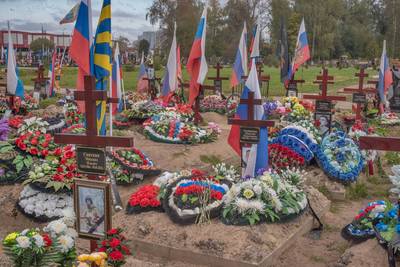
A cluster of fresh graves from the summer of 2025, including that of Igor Vadimovich Lebedev (1969-2025), a 56-year-old casualty. The scene is densely packed with temporary wooden crosses, massive wreaths in the Russian tricolor, and various unit flags--including the VDV (Airborne Forces) and Motorized Rifle Troops--while a lone mourner in the background tends to a plot, emphasizing the personal grief amidst the mass scale of death. "Alley of Heroes" at Cemetery of the Victims of January 9, St. Petersburg, Russia, October 4, 2025  The "initial stage" of memorialization, where fresh earthen graves are crowded with temporary wooden crosses and a profusion of military banners, including the VDV (Airborne Forces) and St. Andrew[CloseCurlyQuote]s Naval flags. The foreground features the grave of Mikhail Ilyich Svyatkin (1986-2025), a 39-year-old casualty, whose cross is adorned with a framed photo of him in uniform, exemplifying the typical profile of recent losses. The scene is saturated with patriotic symbols, including a flag depicting a tank with the slogan "Victory will be ours" and another with the Order of the Great Patriotic War, linking the current conflict to historical narratives of Soviet heroism. "Alley of Heroes" at Cemetery of the Victims of January 9, St. Petersburg, Russia, October 4, 2025  Revealing the multinational and irregular composition of the Russian forces, featuring the flag of Uzbekistan prominently displayed alongside the black "Assault Troops" banner and the Russian tricolor. In the foreground, the grave of Aleksandr Borisovich Vasiliev (1973-2025), a 52-year-old soldier, is marked by a framed photograph of him in combat gear standing in a field, humanizing the older demographic of recent casualties. The scene captures the raw, crowded nature of the "initial stage" of burial, with fresh earthen mounds and a chaotic mix of personal and military symbols extending into the background. "Alley of Heroes" at Cemetery of the Victims of January 9, St. Petersburg, Russia, October 4, 2025  The dense, chaotic stage of recent burial in the "Alley of Heroes," where fresh earthen graves are overwhelmed by a profusion of flags, including the Russian tricolor, the blue flag of the Aerospace Forces (VKS), and banners of various volunteer and assault units. The foreground shows a simple wooden cross with a framed photo of a young soldier, surrounded by vibrant wreaths of artificial flowers, while in the background, a woman walks amongst the rows, emphasizing the cemetery s role as an active site of public mourning. The sheer number of flags and the raw state of the ground visually confirm a continuous, high-volume flow of casualties processed at this site. Cemetery of the Victims of January 9, St. Petersburg, Russia, October 4, 2025  The dense concentration of recent casualties, with fresh earthen mounds tightly packed together and adorned with the ubiquitous Russian tricolor. In the foreground, the grave of Aleksandr Vladimirovich Dementyev (1962-2025) is marked by a wooden cross and a color portrait, identifying a 63-year-old soldier whose age highlights the heavy toll on older reservists and volunteers. The background reveals the integration of the cemetery into the urban fabric, with modern commercial buildings visible just beyond the sea of flags and wreaths, grounding the war[CloseCurlyQuote]s losses in the everyday reality of St. Petersburg. "Alley of Heroes" at Cemetery of the Victims of January 9, St. Petersburg, Russia, October 4, 2025  The dense visual cacophony of the cemetery s "temporary" section, where rows of wooden crosses are submerged in a sea of Russian tricolors and military intelligence (GRU/Spetsnaz) flags bearing the bat insignia. In the foreground, the grave of Kirill Arkadyevich Sharkov (1975-2025), a 49-year-old casualty, is marked by a simple cross and a photo of him in uniform, surrounded by wreaths in patriotic red, white, and blue colors. The scene conveys the sheer volume of recent losses, with flags fluttering chaotically over uneven mounds of earth, while a tractor in the far left background hints at the ongoing expansion of the burial grounds. "Alley of Heroes" at Cemetery of the Victims of January 9, St. Petersburg, Russia, October 4, 2025  A granite monument bearing the poignant epitaph, "My today is a sacrifice for your tomorrow," framing the soldier[CloseCurlyQuote]s death as a redemptive gift to future generations. The grave is flanked by the black and yellow flags of the Motorized Rifle Troops--Russia s primary ground combat formations--distinguished by the Kalashnikov insignia and the motto "Loyalty". In the background, rows of temporary wooden crosses extend into the distance, contrasting the finished memorial with the raw, fresh graves of recent casualties. "Alley of Heroes" at Cemetery of the Victims of January 9, St. Petersburg, Russia, October 4, 2025  The "initial stage" of memorialization, where fresh earthen graves are densely covered in massive wreaths of artificial flowers and a forest of flags. In the foreground, the wooden cross of Aleksandr Vitalyevich Rogachev (1964-2025) identifies a 61-year-old casualty, representative of the older demographic of mobilized soldiers and volunteers. The scene highlights the diverse composition of the forces, with the flag of Uzbekistan visible in the background--indicating the recruitment of foreign nationals--while a lone mourner tends to a grave amidst the dense rows, adding a human scale to the extensive loss. "Alley of Heroes" at Cemetery of the Victims of January 9, St. Petersburg, Russia, October 4, 2025  The permanent monument of Denis Alekseevich Mikhailov (1983-2024), a 40-year-old soldier whose polished black granite headstone displays a detailed engraving of him in full combat gear, holding a rifle and wearing a parachute badge, alongside a real blue beret left as a personal tribute. The grave is flanked by the blue and yellow flag of the VDV (Airborne Forces) with the motto "Nobody, but us," underscoring his elite unit affiliation, while surrounding graves show a mix of portrait styles and military banners, reflecting the individualized yet collective nature of the memorialization. "Alley of Heroes" at Cemetery of the Victims of January 9, St. Petersburg, Russia, October 4, 2025  Wide-angle view of the overwhelming scale of the cemetery s "temporary" sector, where row upon row of fresh earthen graves stretch toward the horizon, each topped with a dense carpet of wreaths and a chaotic thicket of flags. The visual field is dominated by the Russian tricolor, but punctuated by Soviet red banners, VDV (Airborne) flags, and Naval ensigns, reflecting the "hybrid" composition of forces. The raw, unpaved ground and the sheer density of the burials underscore the industrial pace of the war s casualties, set against a mundane urban backdrop that integrates this mass death into daily life. "Alley of Heroes" at Cemetery of the Victims of January 9, St. Petersburg, Russia, October 4, 2025  The diverse visual language of mourning in the "Alley of Heroes," showing a mix of permanent granite monuments and temporary graves decorated with flags, including the Russian Imperial black-yellow-white tricolor and a Soviet red banner. In the foreground, the polished black headstone of Ivan Vladimirovich Semenov (1995-2024) features a color portrait of the 28-year-old soldier, while nearby, two women stand amidst the graves, highlighting the cemetery as an active site of personal grief. The scene captures the juxtaposition of varied ideological symbols--imperial, communist, and modern state--united within the shared space of military sacrifice. Cemetery of the Victims of January 9, St. Petersburg, Russia, October 4, 2025  "Alley of Heroes," a section of the cemetery dedicated to Russian soldiers killed in the war in Ukraine. In the foreground stands a permanent black granite monument featuring a detailed engraving of a soldier in combat gear with the "Z" insignia and a stoic epitaph reading, "Having given everything, I will not rise from the dust... I, having killed the fear within myself, fought". The background reveals rows of additional graves densely adorned with wreaths and flags representing various military branches (including the VDV and Naval Infantry) and private military contractors, illustrating the ongoing scale and diverse composition of the casualties. Cemetery of the Victims of January 9, St. Petersburg, Russia, October 4, 2025  "Section 69 A" marker within the "temporary" burial sector, where fresh earthen mounds stretch toward a forested perimeter, contrasting the ordered numbering system with the raw immediacy of mass death. A solitary mourner in a green coat stands quietly by a cross, tending to flowers amidst a sea of Russian tricolors and unit flags, including the blue and yellow banner of the Aerospace Forces, adding a human scale to the vast, impersonal landscape of casualties. The scene highlights the rapid expansion of the cemetery, with the dense rows of wooden crosses indicating the continuous flow of new burials. "Alley of Heroes" at Cemetery of the Victims of January 9, St. Petersburg, Russia, October 4, 2025  Religious and symbolic narrative of sacrifice, featuring a granite monument with an elaborate engraving of a soldier ascending a staircase toward a welcoming Christ-like figure and a birch tree, blending Christian theology with Russian nationalism. The epitaph laments, "You loved life... But the thread was cut too soon," emphasizing personal loss alongside martial duty. In the background, a chaotic array of VDV (Airborne Forces) and Russian flags flies over rows of fresh, temporary graves, contrasting the permanent serenity of the foreground monument with the raw immediacy of ongoing casualties. "Alley of Heroes" at Cemetery of the Victims of January 9, St. Petersburg, Russia, October 4, 2025  The diverse visual languages of mourning in the "Alley of Heroes," contrasting a solemn monochrome engraving of a soldier in full combat gear--distinguished by the Order of Courage medal--with the vibrant, smiling color portrait of Yuri Bogdanov on the adjacent grave. The background is saturated with a chaotic array of flags, including the black-yellow-white Russian Imperial tricolor and red Soviet banners, visually capturing the "hybrid" ideological landscape, where conflicting historical symbols are merged to support the war effort. Cemetery of the Victims of January 9, St. Petersburg, Russia, October 4, 2025  The initial "temporary" stage of burial, showing rows of fresh earthen mounds topped with simple wooden Orthodox crosses and small identification plaques. Despite the lack of permanent monuments, the graves are densely decorated with vibrant artificial flowers and a profusion of flags--including the Russian tricolor, a Soviet hammer-and-sickle banner, and the flag of Uzbekistan--highlighting the diverse origins and ideological affiliations of the recently deceased. The raw, uneven ground and the sheer number of identical crosses extending into the background visually confirm the high volume of recent casualties processed at the site. "Alley of Heroes" at Cemetery of the Victims of January 9, St. Petersburg, Russia, October 4, 2025  Blending of religious and patriotic symbolism in the "Alley of Heroes". The foreground monument features a poignant epitaph addressing the deceased ("And you stand before our eyes, Alive... We keep you in our hearts") alongside an elaborate engraving of a soldier ascending a staircase toward a Christ-like figure, framing death as a spiritual journey. In the background, a distinctive broken-heart monument depicts a split image of a bridge at night surrounded by flags from various military branches, including the VDV and Russian Naval Infantry. Cemetery of the Victims of January 9, St. Petersburg, Russia, October 4, 2025  The ideological complexity of the war s memorialization, dominated by a large red Soviet flag flying prominently over fresh graves, invoking nostalgia for the USSR s military power alongside Russian tricolors and VDV (Airborne Forces) banners. In the foreground, the grave of Arkady Vasilyevich Kovalchuk (1974-2024), who died at age 50, exemplifies the demographic trend of older men bearing a significant share of casualties. The scene is one of dense, vibrant mourning, with mounds of artificial flowers covering the raw earth, set against a backdrop of modern commercial buildings that anchor the cemetery in the contemporary urban landscape. "Alley of Heroes" at Cemetery of the Victims of January 9, St. Petersburg, Russia, October 4, 2025  The "initial stage" of mass burial, depicting a dense field of fresh earthen mounds marked only by temporary wooden crosses and overwhelmed by a sea of Russian tricolors, Soviet red banners, and VDV flags. The ground is raw and uneven, with a single permanent black granite curb visible in the foreground as the only sign of the eventual transition to formal memorialization. In the background, industrial infrastructure frames the scene, emphasizing the integration of this expanding military necropolis into the everyday civilian landscape of St. Petersburg "Alley of Heroes" at Cemetery of the Victims of January 9, St. Petersburg, Russia, October 4, 2025  The grave of Alexey Vladimirovich Suslov (1976-2024), a 47-year-old casualty whose age reflects Russia s reliance on older reservists and volunteers rather than just young conscripts. His polished black granite monument features a casual color portrait and the epitaph "We were left without you, You remained with us," asserting a continuing spiritual bond despite death. The background juxtaposes the solemn "Alley of Heroes" with modern commercial buildings, visually grounding the war s toll within the everyday urban landscape of St. Petersburg. Cemetery of the Victims of January 9, St. Petersburg, Russia, October 4, 2025  The "permanent stage" of memorialization, featuring a row of polished black granite monuments for soldiers such as Andrey Nikolaevich Atlanov (1977-2024) and Danila Denisovich Shutov (2001-2024), a 23-year-old whose age underscores the ongoing loss of young lives. The monuments display diverse portrait styles--ranging from formal military engravings to casual color photos--and are flanked by flags including the VDV (Airborne Forces) banner with the motto "Nobody, but us," reflecting both individual identity and collective unit pride. The orderly arrangement of these finished graves, complete with granite curbs and gravel, stands in contrast to the chaotic temporary sections seen in other places, illustrating the gradual formalization of the war s toll. "Alley of Heroes" at Cemetery of the Victims of January 9, St. Petersburg, Russia, October 4, 2025  The expanding scale of the "Alley of Heroes," with construction machinery visible in the left background clearing land for new burial plots, confirming the site s active status. The foreground displays a dense cluster of polished granite monuments flanked by diverse military insignia, including the St. Andrew[CloseCurlyQuote]s flag of the Navy and a unit banner for a Motorized Rifle formation, reflecting the hybrid force structure composed of regular troops, mobilized personnel, and specialized units. Cemetery of the Victims of January 9, St. Petersburg, Russia, October 4, 2025  Tragic graves of the Couter family, likely victims of the devastating 1873 Yellow Fever Epidemic, in the Calvert City Cemetery. George Couter (Left Stone): The headstone is inscribed "In Memory of GEO. COUTER". Dates: Born Dec. 11, 1839 (or 1830) - Died Oct. 16, 1873. Context: He died just days before his wife, a common occurrence during the yellow fever outbreak that claimed hundreds of lives in Calvert between August and November of 1873. Mary Reese Couter (Right Stone): The stone reads "MARY REESE, Wife of G. COUTER". Dates: Born June 20, 1850 - Died Oct. 21, 1873. Tragedy: She died only 5 days after her husband. She was just 23 years old. The proximity of their deaths highlights the swift and deadly impact of the epidemic on local families. Visible in the background is a large, elaborate monument featuring a seated woman (mourner) with her head bowed in grief. Calvert, Texas, December 13, 2025  Graves belonging to the Foster and Phernetton families (specifically referencing Mattie Phernetton) in the Calvert City Cemetery. These graves are located in the older section of the cemetery, evidenced by the Victorian symbolism and the weathering of the white marble/limestone markers. Calvert, Texas, December 13, 2025  Alley of North Cemetery in Pargolovo, near Saint Petersburg. Russia, October 14, 2025  Early spring growth of Berchemia scandens, commonly known as Alabama supplejack or rattan vine. The backlit perspective isolates the young foliage against a dark background, highlighting the bright, translucent green of the newly emerged leaves. At this time of year, these native vines are actively putting out fresh growth as they begin their seasonal climb through the local understory. Lick Creek Park. College Station, Texas, March 25, 2026  Monument of heroes of Great October Socialist Revolution. It is a mass grave monument dedicated to Red Guards who died during the 1917 October Revolution and the subsequent Civil War. The site originated in 1917 as a burial ground for workers and Red Guards from the nearby Novy Lessner Plant (now the Karl Marx Machine-Building Plant). These fighters were killed in battles against the troops of General Pyotr Krasnov near Pulkovo during the defense of Petrograd. In 1953, a wooden structure was replaced by the current grey granite obelisk seen today. It was designed by architect Yuri Wiesenthal. This monument is a solemn reminder of the intense revolutionary history of the Vyborg Side, a district historically populated by industrial workers who were pivotal to the Bolshevik cause. Lesnoy Park (Lesotekhnicheskiy Universitet), Saint Petersburg, Russia, October 14, 2025  A Kneeling Angel statue on the grave of Mary Drennan by Aristide Maillol (1861-1944)(?) in the Calvert City Cemetery. Mary Drennan (November 20, 1882 - January 8, 1901) was the daughter of John Hill Drennan (1839-1921) and Mary Agnes Garrett Drennan (1846-1929), prominent residents buried nearby in the same family plot. The plot also contains other elaborate statuary, including a larger standing angel leaning against a cross (marking the grave of her sister, Adelaide Drennan Westall, who also died young in 1898). Calvert, Texas, December 13, 2025  Another view of the Friedlander and Klawetter family plot in the Calvert Jewish Cemetery. In the background, a small, corrugated metal shed is visible among the trees. This is likely a maintenance shed for the cemetery groundskeeper, typical in older rural cemeteries. Calvert, Texas, December 13, 2025  Art installation titled "Portrait of a One-Year-Old Boy with a Sheep" by the artist Artem Filatov as part of the "Crypto/Farm" exhibition held at the Imperial Farm in the Tsarskoe Selo State Museum-Reserve. Saint Petersburg, Russia, September 21, 2025  Tunnel-like quality of the linden alley, a hallmark of 19th-century Russian park design. The interlocking branches of the mature linden trees (Tilia) form a "gothic arch" overhead, completely enclosing the path. This creates a sense of protection and separation from the outside world, which aligns with the secluded, monastic theme of the nearby Feodorovsky Gorodok. Pushkin (former Tsarskoe Selo) near Saint Petersburg, Russia, October 10, 2025  Mixed forest texture, highlighting the interplay between deciduous and coniferous species. Aleksandrovsky (Alexander) Park in Pushkin (former Tsarskoe Selo) near Saint Petersburg, Russia, October 10, 2025  Eastern gates of the Feodorovsky Cathedral (Fedorovsky Sobor), framed by a magnificent display of autumn foliage. Pushkin (former Tsarskoe Selo) near Saint Petersburg, Russia, October 10, 2025  Spores of white Calocybe-like mushrooms collected earlier 10/9/2025 in Sosnovka Park. Saint Petersburg, Russia, October 19, 2025  Angel statue on the grave of Louis Browning in the Calvert Cemetery. It is a praying angel with curly hair flowing down its back, hands clasped near the chest, and a serene, upward-gazing expression. Calvert, Texas, December 13, 2025  Spores of beefsteak fungus (Fistulina hepatica) collected earlier 10/9/2025 in Dubki Park, Sestroretsk near Saint Petersburg, Russia, October 19, 2025  Spores (in KOH) of mushrooms Psilocybe fuscofulva(?) collected earlier 9/29/2025 near Kavgolovskoe Lake south from Oselki near Saint Petersburg, Russia, October 19, 2025  "Framed" perspective looking towards the trees near the Marble Bridge in Catherine Park. The arches create a "picture window" effect, a classic technique in landscape architecture designed to direct the viewer s gaze to specific idealized scenes of nature. The stone ball finials on the balustrade add a rhythmic, formal element that contrasts with the organic chaos of the forest background. Pushkin (former Tsarskoe Selo) near Saint Petersburg, Russia, October 10, 2025  Spores of grey tooth mushrooms (Phellodon melaleucus) collected earlier 9/25/2025 near Dibuny, north-west from Saint Petersburg, Russia, October 19, 2025  Spores of Calocybe-like mushrooms collected earlier 10/8/2025 under silvery fir trees behind Lenin s monument in Botanical Garden, Saint Petersburg, Russia, October 19, 2025  Spores (in lugol, with x40 objective) of Ascomycete fungus Phaeohelotium monticola(?) collected earlier 10/7/2025 on wood near Lisiy Nos, near Saint Petersburg, Russia, October 19, 2025  Spores (in KOH, with x100 objective) of Ascomycete fungus Phaeohelotium monticola(?) collected earlier 10/7/2025 on wood near Lisiy Nos, near Saint Petersburg, Russia, October 19, 2025  Wooden cross on Architecture Lane in Literatorskie Mostki section of Volkovo Cemetery. Saint Petersburg, Russia, October 17, 2016  Graffiti series, located on the concrete retaining wall separating the beach from the promenade along the Gulf of Finland (near the Sestroretsk Resort or "Kurort" area) which is a fanciful and nostalgic mural composition featuring whimsical animals and nature motifs. This section features a large bear with a cub, rendered in a sketch-like style with soft shading. The bears are set against a background of rolling green hills and a cloudy sky, evoking a gentle, fairytale forest atmosphere. Saint Petersburg, Russia, October 9, 2025  Spores of Ascomycete mushrooms Pulvinula convexella collected earlier 10/1/2025 on a bonfire site near a lake in Kannelyarvi, north from Saint Petersburg, Russia, October 19, 2025  Spores (in lugol, with x100 objective) of Ascomycete fungus Phaeohelotium monticola(?) collected earlier 10/7/2025 on wood near Lisiy Nos, near Saint Petersburg, Russia, October 19, 2025  Imperial Horse Cemetery at the Pensioner s Stable in Tsarskoe Selo. This cemetery is the final resting place for over 120 favorite horses of the Russian Emperors, from Alexander I to Nicholas II. The neat rows of white tombstones are the result of a major restoration project completed recently. Saint Petersburg, Russia, September 21, 2025  Spores of roothole rosette mushrooms (Stereopsis vitellina) collected earlier 10/5/2025 in a burrow near a road under pines in Petyayarvi, north from Saint Petersburg, Russia, October 19, 2025  Spores of coral fungus Lentaria byssiseda collected earlier 10/13/2025 from a tall oak tree in Sergievka Park, Old Peterhof, west from Saint Petersburg, Russia, October 19, 2025  Spores (in KOH, spore print black) of brittlestem mushrooms (Psathyrella corrugis) collected earlier 10/6/2025 on a forest trail in Pavlovsk, a suburb of Saint Petersburg, Russia, October 19, 2025  Spores of mushrooms Multiclavula corynoides collected earlier 10/5/2025 in a shallow depression covered by sand, near Petyayarvi train stop, north from Saint Petersburg, Russia, October 19, 2025  Spores (in KOH, spore print orange) of spectacular rustgill mushrooms (Gymnopilus junonius) collected earlier 10/9/2025 in Dubki Park, Sestroretsk near Saint Petersburg, Russia, October 19, 2025  Spores (in KOH) of Boletinus/Suillus cavipes mushrooms collected earlier 9/30/2025 near Lindulovskaya Larch Grove, near Roshchino, 30 miles north-west from Saint Petersburg. Russia, October 19, 2025  Spores (spore print white) of Goblet mushrooms (Pseudoclitocybe cyathiformis) collected earlier 10/12/2025 up from 67 km train stop near Orekhovo, north from Saint Petersburg, Russia, October 19, 2025  A bronze copy of the famous ancient Greek group "Laocoo"n and His Sons" near the Chinese Palace. The dynamic composition depicts the Trojan priest Laocoo"n and his two sons in their agonizing death struggle against sea serpents sent by the gods (usually attributed to Athena or Poseidon) as punishment for warning the Trojans about the wooden horse. Oranienbaum palace-and-park ensemble in Lomonosov (a suburb of St. Petersburg), Russia, October 13, 2025  Spores (spore print white) of yellowleg bonnet mushrooms (Mycena epipterygia) collected earlier 10/3/2025 in Tarkhovka Park near Sestroretsk, west from Saint Petersburg, Russia, October 19, 2025  Mary E. Friedlander Klawetter and Richard Friedlander stones in Calvert Jewish Cemetery at FM 1644. Mary (or "Mamie") was a member of the prominent Friedlander family, early Jewish settlers in Calvert. Her marriage to A.W. Klawetter (likely a member of the Christian community or a non-observant Jew, given the Klawetter family s later presence in the general cemetery) illustrates the integration of Jewish families into the broader social fabric of the town. The presence of Masonic symbols on the Friedlander stone is common in this cemetery, as many of Calvert s Jewish male citizens were active Freemasons. Mary s marriage to A.W. Klawetter connects these two prominent local families. Calvert, Texas, December 13, 2025  Spores (in KOH, spore print brown) of Conocybe(?) mushrooms collected earlier 10/3/2025 on black soil, under spruce trees in Tarkhovka Park near Sestroretsk, west from Saint Petersburg, Russia, October 19, 2025  Spores (in KOH, spore print light brown) of Velvet Shank mushrooms (Flammulina velutipes) collected earlier 10/2/2025 near Kavgolovskoe Lake south from Oselki near Saint Petersburg, Russia, October 19, 2025  Spores (in KOH, spore print dark brown) of common stump brittlestem mushrooms (Psathyrella piluliformis)(?) collected earlier 10/5/2025 on roadside in Petyayarvi, north from Saint Petersburg, Russia, October 19, 2025  A weathered stone portal and wooden door at Sauna Street 2 (Sauna 2), in the heart of Tallinn s nightlife district. The arched doorway features a rustic, heavy limestone surround with a prominent keystone. This style is typical of the less ornate, utilitarian medieval architecture found in the Old Town s side streets. The panelled wooden door is heavily distressed, covered in layers of graffiti tags in various colors (silver, red, black). The tags cover nearly every inch, including the panels and the frame, obscuring the original wood finish. The heavy graffiti on this specific door is a hallmark of the area around Sauna Street and Va"ike-Karja, which transforms into a bustling party zone at night. While the historic architecture remains, the street level often bears the marks of the active nightlife scene, creating a gritty contrast between the medieval heritage and modern urban culture. This door is likely a side entrance or utility access for one of the nearby venues like Frank or Sigmund Freud Bar. Tallinn, Estonia, October 16, 2025  Spores (in KOH, spore print light brown) of of mushrooms Boletinus asiaticus collected earlier 9/30/2025 in Lindulovskaya Larch Grove, near Roshchino, 30 miles north-west from Saint Petersburg. Russia, October 19, 2025  A view of the installation specifically focuses on the memorial dedicated to Alexei Navalny, the Russian opposition leader who died in a penal colony on February 16, 2024. The central poster explicitly states "PUTIN KILLED NAVALNY" in bold red and black letters, echoing the sentiments of protestors worldwide who hold the Kremlin responsible for his death. Below the text is a large, stylized black-and-white portrait of Navalny, marked with the date of his death, February 16, 2024. The main poster is surrounded by smaller photos, drawings, and messages from supporters, including a quote in Russian: "Everything will be fine. And even if it isn t, we will console ourselves that we were honest people". The memorial is integrated into the broader anti-war protest, with signs like "STOPTHEWAR" and "NETVOYNE" (No to War) visible alongside Ukrainian colors. A yellow poster in the background calls for freedom for political prisoners ("SVOBODU POLITZAKLYUCHONNYM"). Tallinn, Estonia, October 16, 2025  The stall labeled "Moskva" that honors a favorite horse of Emperor Nicholas I in Pensioner Stable (Pensionnaya Konyushnya) in Alexander Park, Tsarskoe Selo. This horse, a veteran of military reviews like the one in Elisavetgrad, spent its retirement in the stable built by the Emperor for his own and his predecessor s faithful steeds. The nameplate was reinstated during the 2024-2025 restoration of the pavilion. Saint Petersburg, Russia, September 21, 2025  Spores (in KOH, spore print light brown) of conifer shield mushrooms (Pluteus pouzarianus) collected earlier 10/3/2025 on a forest road under spruce in Tarkhovka Park near Sestroretsk, west from Saint Petersburg, Russia, October 19, 2025  Spores (in KOH, spore print light brown) of Lion shield mushrooms (Pluteus leoninus) collected earlier 10/3/2025 on wood chips of spruce in Tarkhovka Park near Sestroretsk, west from Saint Petersburg, Russia, October 19, 2025  Maple alley in Lesnoy Park (Lesotekhnicheskiy Universitet), Saint Petersburg, Russia, October 14, 2025  Akademicheskaya Alley in Lesnoy Park (Lesotekhnicheskiy Universitet), Saint Petersburg, Russia, October 14, 2025  Bog habitat (boloto) along the shore of Lake Istok. The single bright red leaf belongs to Golubika (Bog Blueberry/Bilberry). The entire background is a carpet of Sphagnum moss (peat moss), likely Sphagnum magellanicum (Magellan s Peat Moss) or a similar red-pigmented species common in Karelian bogs. Scattered across the moss are long, paired needles of Scots Pine (Pinus sylvestris). Kannelyarvi, north from Saint Petersburg, Russia, October 1, 2025  Alley near Dendrology Garden. Lesnoy Park (Lesotekhnicheskiy Universitet), Saint Petersburg, Russia, October 14, 2025  "Grotto" spring (istochnik) or a ruined water feature near the Old Sylvia district, often referred to as the "Ruined Cascade" or simply a natural spring reinforced with stone in Pavlovsk Park. Pavlovsk, a suburb of Saint Petersburg, Russia, October 6, 2025  Marble statue of a cherub or young boy standing on the grave of Holly Robert Volle (February 15, 1882 - February 20, 1894) in Calvert City Cemetery. The statue depicts a curly-haired child with wings, standing on a globe or orb, with a finger pressed to his lips in a gesture of silence or hush. Calvert, Texas, December 13, 2025  A small tomb with a wooden cross in Holt Cemetery. New Orleans, Louisiana, October 15, 2006  Maple alley near the Forestry Academy. Lesnoy Park (Lesotekhnicheskiy Universitet), Saint Petersburg, Russia, October 14, 2025  Jordan Pond from Kaygorodova Alley. Lesnoy Park (Lesotekhnicheskiy Universitet), Saint Petersburg, Russia, October 14, 2025  This view across the Friendship Bridge offers a stark look at the Ivangorod Fortress in Russia, directly contrasting with previous Estonian views. The most striking element in this image is the heavy modern fortification in the foreground. The bridge, which once facilitated vehicle traffic, is now blocked by rows of razor wire and concrete "dragon s teeth" anti-tank obstacles. These defensive measures, installed by Estonia, reflect the heightened geopolitical tension and the bridge s current status as a restricted crossing (open only to pedestrians as of 2024-2025). Dominating the background is the formidable Ivangorod Fortress, established in 1492 by Ivan III to counter the Teutonic Order on the opposite bank. A large Russian flag flies prominently atop one of the towers, serving as a deliberate counterpart to the Estonian and NATO flags visible from the other side of the river. Estonia, October 16, 2025  Cross section of slimy spike mushrooms (Gomphidius glutinosus) Kannelyarvi, north from Saint Petersburg, Russia, October 1, 2025  Maple alley near a building of the Forestry Academy. Lesnoy Park (Lesotekhnicheskiy Universitet), Saint Petersburg, Russia, October 14, 2025  An old transformer substation (or similar utility building) in Lanskoy Garden on Sampsonievsky Prospekt near Lanskaya train Station. Its brick walls have effectively become an unofficial community billboard, covered in layers of concert posters (e.g., for the singer Linda). Saint Petersburg, Russia, October 9, 2025  A woman holding a cross on a tomb in a corner of Metairie Cemetery. New Orleans, Louisiana, May 7, 2006  Presence of a dead gull on a beach in the Gulf of Finland near Solnechnoe, that is most likely linked to the ongoing highly pathogenic avian influenza (HPAI) outbreak, specifically the H5N1 strain, which has devastated wild bird populations in the Baltic region throughout 2023-2025. Saint Petersburg, Russia, October 9, 2025  Fall colors of maple alley near the Forestry Academy. Lesnoy Park (Lesotekhnicheskiy Universitet), Saint Petersburg, Russia, October 14, 2025  Deer Bridge with the Rose Pavilion in the background in Pavlovsk Park. Pavlovsk, a suburb of Saint Petersburg, Russia, October 15, 2025  The central alley leading to the Arsenal Pavilion, a red-brick neo-Gothic structure designed by Adam Menelaws. Completed in 1834, the Arsenal resembles a medieval castle with crenellated towers and massive arched windows. It was originally built to house Nicholas I s vast collection of medieval arms and armor. The straight alley is a remnant of the formal layout from the earlier "Monbijou" pavilion that stood here, now framed by the mature trees of the surrounding landscape park. After severe damage in WWII, the building was restored and reopened in 2016 as a museum displaying imperial weaponry. Aleksandrovsky (Alexander) Park in Pushkin (former Tsarskoe Selo) near Saint Petersburg, Russia, October 10, 2025  A man holding a cross and a ball on a tomb of Saint Louis Cemetery No. 3. New Orleans, Louisiana, August 6, 2006  Iron gate of a city cemetery in fog. Calvert, Texas, December 13, 2025  Main path of a city cemetery in fog. Calvert, Texas, December 13, 2025  White Ibis (juvenile) water bird (Eudocimus albus) from Spillway Trail. As this bird matures over the next year or so, it will molt these brown feathers and become the all-white adult bird commonly seen probing for crayfish in the park s shallow waters. Brazos Bend State Park, Needville, Texas, December 25, 2025  Vokzalnaya Alley in Pavlovsk Park. Pavlovsk, a suburb of Saint Petersburg, Russia, October 15, 2025  The wilder, naturalistic aesthetic of Alexander Park s landscape section. The visual appeal lies in the layered textures of the undergrowth--a mix of golden birch leaves and red shrubbery--creating a chaotic but harmonious "tapestry" effect. Unlike the formal alleys, this scene emphasizes density and verticality, with thin birch trunks contrasting against the soft, diffuse background of the forest depth. It evokes the intimacy of a forest interior (uncultivated nature), a deliberate romantic counterpoint to the manicured geometry of the nearby "New Garden". Aleksandrovsky (Alexander) Park in Pushkin (former Tsarskoe Selo) near Saint Petersburg, Russia, October 10, 2025  Maple alley near Chinese Bridges of Krestovy Canal in Aleksandrovsky (Alexander) Park. Pushkin (former Tsarskoe Selo) near Saint Petersburg, Russia, October 10, 2025  Area of Teatralnaya Alley in Pavlovsk Park. Pavlovsk, a suburb of Saint Petersburg, Russia, October 15, 2025  Alley of Green Woman in Pavlovsk Park. Pavlovsk, a suburb of Saint Petersburg, Russia, October 15, 2025  Oaks of alley of Green Woman in Pavlovsk Park. Pavlovsk, a suburb of Saint Petersburg, Russia, October 15, 2025  Memorial of blind victims in Levashovskaya Pustosh Memorial Cemetery. Levashovo near Saint Petersburg, Russia, October 30, 2016  One of the Small Chinese Bridges (Small Iron Bridges) crossing the Krestovy Canal. Originally wooden (1781), they were replaced with cast iron versions forged at the Sestroretsk Arms Factory in 1786. Designed by Charles Cameron, who also planned the nearby Chinese Village. The bridge features intricate iron lattice railings and is framed by distinctive porticoes formed of paired columns with "Chinese-style" curved sheet-iron roofs. The columns are painted to mimic colored marble, and the structure was fully restored in the 21st century. Aleksandrovsky (Alexander) Park in Pushkin (former Tsarskoe Selo) near Saint Petersburg, Russia, October 10, 2025  A classic alley in Upper Park during the height of autumn. Oranienbaum palace-and-park ensemble in Lomonosov (a suburb of St. Petersburg), Russia, October 13, 2025  Small Lamsky Bridge (Maly Lamskoy Bridge), built in the early 20th century (around 1900) to replace an earlier wooden crossing. Aleksandrovsky (Alexander) Park in Pushkin (former Tsarskoe Selo) near Saint Petersburg, Russia, October 10, 2025  Galina Starovoitova grave (she was a politician of Perestroika, killed in October 1998) in Alexandro-Nevskaya Lavra (memorial cemetery). Saint Petersburg, Russia, April 7, 1999. |