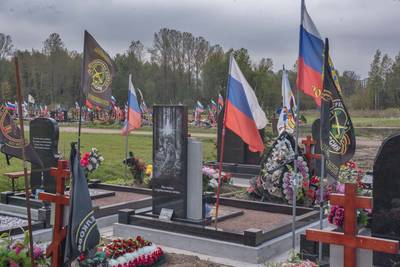
Religious and symbolic narrative of sacrifice, featuring a granite monument with an elaborate engraving of a soldier ascending a staircase toward a welcoming Christ-like figure and a birch tree, blending Christian theology with Russian nationalism. The epitaph laments, "You loved life... But the thread was cut too soon," emphasizing personal loss alongside martial duty. In the background, a chaotic array of VDV (Airborne Forces) and Russian flags flies over rows of fresh, temporary graves, contrasting the permanent serenity of the foreground monument with the raw immediacy of ongoing casualties. "Alley of Heroes" at Cemetery of the Victims of January 9, St. Petersburg, Russia, October 4, 2025  A cluster of fresh graves from the summer of 2025, including that of Igor Vadimovich Lebedev (1969-2025), a 56-year-old casualty. The scene is densely packed with temporary wooden crosses, massive wreaths in the Russian tricolor, and various unit flags--including the VDV (Airborne Forces) and Motorized Rifle Troops--while a lone mourner in the background tends to a plot, emphasizing the personal grief amidst the mass scale of death. "Alley of Heroes" at Cemetery of the Victims of January 9, St. Petersburg, Russia, October 4, 2025  "Alley of Heroes," a section of the cemetery dedicated to Russian soldiers killed in the war in Ukraine. In the foreground stands a permanent black granite monument featuring a detailed engraving of a soldier in combat gear with the "Z" insignia and a stoic epitaph reading, "Having given everything, I will not rise from the dust... I, having killed the fear within myself, fought". The background reveals rows of additional graves densely adorned with wreaths and flags representing various military branches (including the VDV and Naval Infantry) and private military contractors, illustrating the ongoing scale and diverse composition of the casualties. Cemetery of the Victims of January 9, St. Petersburg, Russia, October 4, 2025  The grave of Mikhail Ilyich Svyatkin (1986-2025), a 39-year-old soldier whose death in May 2025 aligns with the surge in casualties during the spring and summer of that year. His wooden cross bears a framed photo of him in combat gear holding a rifle, surrounded by wreaths inscribed "From Mother," highlighting the personal grief embedded in the mass loss. The background is crowded with similar fresh graves, flags, and flowers, reinforcing the density and continuity of the burials at this active military cemetery. "Alley of Heroes" at Cemetery of the Victims of January 9, St. Petersburg, Russia, October 4, 2025  The dense visual cacophony of the cemetery s "temporary" section, where rows of wooden crosses are submerged in a sea of Russian tricolors and military intelligence (GRU/Spetsnaz) flags bearing the bat insignia. In the foreground, the grave of Kirill Arkadyevich Sharkov (1975-2025), a 49-year-old casualty, is marked by a simple cross and a photo of him in uniform, surrounded by wreaths in patriotic red, white, and blue colors. The scene conveys the sheer volume of recent losses, with flags fluttering chaotically over uneven mounds of earth, while a tractor in the far left background hints at the ongoing expansion of the burial grounds. "Alley of Heroes" at Cemetery of the Victims of January 9, St. Petersburg, Russia, October 4, 2025  The permanent monument of Denis Alekseevich Mikhailov (1983-2024), a 40-year-old soldier whose polished black granite headstone displays a detailed engraving of him in full combat gear, holding a rifle and wearing a parachute badge, alongside a real blue beret left as a personal tribute. The grave is flanked by the blue and yellow flag of the VDV (Airborne Forces) with the motto "Nobody, but us," underscoring his elite unit affiliation, while surrounding graves show a mix of portrait styles and military banners, reflecting the individualized yet collective nature of the memorialization. "Alley of Heroes" at Cemetery of the Victims of January 9, St. Petersburg, Russia, October 4, 2025  The initial "temporary" stage of burial, showing rows of fresh earthen mounds topped with simple wooden Orthodox crosses and small identification plaques. Despite the lack of permanent monuments, the graves are densely decorated with vibrant artificial flowers and a profusion of flags--including the Russian tricolor, a Soviet hammer-and-sickle banner, and the flag of Uzbekistan--highlighting the diverse origins and ideological affiliations of the recently deceased. The raw, uneven ground and the sheer number of identical crosses extending into the background visually confirm the high volume of recent casualties processed at the site. "Alley of Heroes" at Cemetery of the Victims of January 9, St. Petersburg, Russia, October 4, 2025  Blending of religious and patriotic symbolism in the "Alley of Heroes". The foreground monument features a poignant epitaph addressing the deceased ("And you stand before our eyes, Alive... We keep you in our hearts") alongside an elaborate engraving of a soldier ascending a staircase toward a Christ-like figure, framing death as a spiritual journey. In the background, a distinctive broken-heart monument depicts a split image of a bridge at night surrounded by flags from various military branches, including the VDV and Russian Naval Infantry. Cemetery of the Victims of January 9, St. Petersburg, Russia, October 4, 2025  The expanding scale of the "Alley of Heroes," with construction machinery visible in the left background clearing land for new burial plots, confirming the site s active status. The foreground displays a dense cluster of polished granite monuments flanked by diverse military insignia, including the St. Andrew[CloseCurlyQuote]s flag of the Navy and a unit banner for a Motorized Rifle formation, reflecting the hybrid force structure composed of regular troops, mobilized personnel, and specialized units. Cemetery of the Victims of January 9, St. Petersburg, Russia, October 4, 2025  The dense concentration of recent casualties, with fresh earthen mounds tightly packed together and adorned with the ubiquitous Russian tricolor. In the foreground, the grave of Aleksandr Vladimirovich Dementyev (1962-2025) is marked by a wooden cross and a color portrait, identifying a 63-year-old soldier whose age highlights the heavy toll on older reservists and volunteers. The background reveals the integration of the cemetery into the urban fabric, with modern commercial buildings visible just beyond the sea of flags and wreaths, grounding the war[CloseCurlyQuote]s losses in the everyday reality of St. Petersburg. "Alley of Heroes" at Cemetery of the Victims of January 9, St. Petersburg, Russia, October 4, 2025  The dense, chaotic stage of recent burial in the "Alley of Heroes," where fresh earthen graves are overwhelmed by a profusion of flags, including the Russian tricolor, the blue flag of the Aerospace Forces (VKS), and banners of various volunteer and assault units. The foreground shows a simple wooden cross with a framed photo of a young soldier, surrounded by vibrant wreaths of artificial flowers, while in the background, a woman walks amongst the rows, emphasizing the cemetery s role as an active site of public mourning. The sheer number of flags and the raw state of the ground visually confirm a continuous, high-volume flow of casualties processed at this site. Cemetery of the Victims of January 9, St. Petersburg, Russia, October 4, 2025  "Section 69 A" marker within the "temporary" burial sector, where fresh earthen mounds stretch toward a forested perimeter, contrasting the ordered numbering system with the raw immediacy of mass death. A solitary mourner in a green coat stands quietly by a cross, tending to flowers amidst a sea of Russian tricolors and unit flags, including the blue and yellow banner of the Aerospace Forces, adding a human scale to the vast, impersonal landscape of casualties. The scene highlights the rapid expansion of the cemetery, with the dense rows of wooden crosses indicating the continuous flow of new burials. "Alley of Heroes" at Cemetery of the Victims of January 9, St. Petersburg, Russia, October 4, 2025  The diverse visual languages of mourning in the "Alley of Heroes," contrasting a solemn monochrome engraving of a soldier in full combat gear--distinguished by the Order of Courage medal--with the vibrant, smiling color portrait of Yuri Bogdanov on the adjacent grave. The background is saturated with a chaotic array of flags, including the black-yellow-white Russian Imperial tricolor and red Soviet banners, visually capturing the "hybrid" ideological landscape, where conflicting historical symbols are merged to support the war effort. Cemetery of the Victims of January 9, St. Petersburg, Russia, October 4, 2025  Revealing the multinational and irregular composition of the Russian forces, featuring the flag of Uzbekistan prominently displayed alongside the black "Assault Troops" banner and the Russian tricolor. In the foreground, the grave of Aleksandr Borisovich Vasiliev (1973-2025), a 52-year-old soldier, is marked by a framed photograph of him in combat gear standing in a field, humanizing the older demographic of recent casualties. The scene captures the raw, crowded nature of the "initial stage" of burial, with fresh earthen mounds and a chaotic mix of personal and military symbols extending into the background. "Alley of Heroes" at Cemetery of the Victims of January 9, St. Petersburg, Russia, October 4, 2025  The "initial stage" of memorialization, where fresh earthen graves are crowded with temporary wooden crosses and a profusion of military banners, including the VDV (Airborne Forces) and St. Andrew[CloseCurlyQuote]s Naval flags. The foreground features the grave of Mikhail Ilyich Svyatkin (1986-2025), a 39-year-old casualty, whose cross is adorned with a framed photo of him in uniform, exemplifying the typical profile of recent losses. The scene is saturated with patriotic symbols, including a flag depicting a tank with the slogan "Victory will be ours" and another with the Order of the Great Patriotic War, linking the current conflict to historical narratives of Soviet heroism. "Alley of Heroes" at Cemetery of the Victims of January 9, St. Petersburg, Russia, October 4, 2025  The diverse visual language of mourning in the "Alley of Heroes," showing a mix of permanent granite monuments and temporary graves decorated with flags, including the Russian Imperial black-yellow-white tricolor and a Soviet red banner. In the foreground, the polished black headstone of Ivan Vladimirovich Semenov (1995-2024) features a color portrait of the 28-year-old soldier, while nearby, two women stand amidst the graves, highlighting the cemetery as an active site of personal grief. The scene captures the juxtaposition of varied ideological symbols--imperial, communist, and modern state--united within the shared space of military sacrifice. Cemetery of the Victims of January 9, St. Petersburg, Russia, October 4, 2025  The "initial stage" of mass burial, depicting a dense field of fresh earthen mounds marked only by temporary wooden crosses and overwhelmed by a sea of Russian tricolors, Soviet red banners, and VDV flags. The ground is raw and uneven, with a single permanent black granite curb visible in the foreground as the only sign of the eventual transition to formal memorialization. In the background, industrial infrastructure frames the scene, emphasizing the integration of this expanding military necropolis into the everyday civilian landscape of St. Petersburg "Alley of Heroes" at Cemetery of the Victims of January 9, St. Petersburg, Russia, October 4, 2025  Wide-angle view of the overwhelming scale of the cemetery s "temporary" sector, where row upon row of fresh earthen graves stretch toward the horizon, each topped with a dense carpet of wreaths and a chaotic thicket of flags. The visual field is dominated by the Russian tricolor, but punctuated by Soviet red banners, VDV (Airborne) flags, and Naval ensigns, reflecting the "hybrid" composition of forces. The raw, unpaved ground and the sheer density of the burials underscore the industrial pace of the war s casualties, set against a mundane urban backdrop that integrates this mass death into daily life. "Alley of Heroes" at Cemetery of the Victims of January 9, St. Petersburg, Russia, October 4, 2025  The "permanent stage" of memorialization, featuring a row of polished black granite monuments for soldiers such as Andrey Nikolaevich Atlanov (1977-2024) and Danila Denisovich Shutov (2001-2024), a 23-year-old whose age underscores the ongoing loss of young lives. The monuments display diverse portrait styles--ranging from formal military engravings to casual color photos--and are flanked by flags including the VDV (Airborne Forces) banner with the motto "Nobody, but us," reflecting both individual identity and collective unit pride. The orderly arrangement of these finished graves, complete with granite curbs and gravel, stands in contrast to the chaotic temporary sections seen in other places, illustrating the gradual formalization of the war s toll. "Alley of Heroes" at Cemetery of the Victims of January 9, St. Petersburg, Russia, October 4, 2025  The grave of Alexey Vladimirovich Suslov (1976-2024), a 47-year-old casualty whose age reflects Russia s reliance on older reservists and volunteers rather than just young conscripts. His polished black granite monument features a casual color portrait and the epitaph "We were left without you, You remained with us," asserting a continuing spiritual bond despite death. The background juxtaposes the solemn "Alley of Heroes" with modern commercial buildings, visually grounding the war s toll within the everyday urban landscape of St. Petersburg. Cemetery of the Victims of January 9, St. Petersburg, Russia, October 4, 2025  The "initial stage" of memorialization, where fresh earthen graves are densely covered in massive wreaths of artificial flowers and a forest of flags. In the foreground, the wooden cross of Aleksandr Vitalyevich Rogachev (1964-2025) identifies a 61-year-old casualty, representative of the older demographic of mobilized soldiers and volunteers. The scene highlights the diverse composition of the forces, with the flag of Uzbekistan visible in the background--indicating the recruitment of foreign nationals--while a lone mourner tends to a grave amidst the dense rows, adding a human scale to the extensive loss. "Alley of Heroes" at Cemetery of the Victims of January 9, St. Petersburg, Russia, October 4, 2025  The ideological complexity of the war s memorialization, dominated by a large red Soviet flag flying prominently over fresh graves, invoking nostalgia for the USSR s military power alongside Russian tricolors and VDV (Airborne Forces) banners. In the foreground, the grave of Arkady Vasilyevich Kovalchuk (1974-2024), who died at age 50, exemplifies the demographic trend of older men bearing a significant share of casualties. The scene is one of dense, vibrant mourning, with mounds of artificial flowers covering the raw earth, set against a backdrop of modern commercial buildings that anchor the cemetery in the contemporary urban landscape. "Alley of Heroes" at Cemetery of the Victims of January 9, St. Petersburg, Russia, October 4, 2025  Monument of heroes of Great October Socialist Revolution. It is a mass grave monument dedicated to Red Guards who died during the 1917 October Revolution and the subsequent Civil War. The site originated in 1917 as a burial ground for workers and Red Guards from the nearby Novy Lessner Plant (now the Karl Marx Machine-Building Plant). These fighters were killed in battles against the troops of General Pyotr Krasnov near Pulkovo during the defense of Petrograd. In 1953, a wooden structure was replaced by the current grey granite obelisk seen today. It was designed by architect Yuri Wiesenthal. This monument is a solemn reminder of the intense revolutionary history of the Vyborg Side, a district historically populated by industrial workers who were pivotal to the Bolshevik cause. Lesnoy Park (Lesotekhnicheskiy Universitet), Saint Petersburg, Russia, October 14, 2025  Memorial of blind victims in Levashovskaya Pustosh Memorial Cemetery. Levashovo near Saint Petersburg, Russia, October 30, 2016  Rows of unidentified graves without headstones marked with temporary markers in Oak Hill Cemetery in Camp Swift north from Bastrop. Texas, September 15, 2012  A view of the installation specifically focuses on the memorial dedicated to Alexei Navalny, the Russian opposition leader who died in a penal colony on February 16, 2024. The central poster explicitly states "PUTIN KILLED NAVALNY" in bold red and black letters, echoing the sentiments of protestors worldwide who hold the Kremlin responsible for his death. Below the text is a large, stylized black-and-white portrait of Navalny, marked with the date of his death, February 16, 2024. The main poster is surrounded by smaller photos, drawings, and messages from supporters, including a quote in Russian: "Everything will be fine. And even if it isn t, we will console ourselves that we were honest people". The memorial is integrated into the broader anti-war protest, with signs like "STOPTHEWAR" and "NETVOYNE" (No to War) visible alongside Ukrainian colors. A yellow poster in the background calls for freedom for political prisoners ("SVOBODU POLITZAKLYUCHONNYM"). Tallinn, Estonia, October 16, 2025  Close view of the stone marker at the base of Daniel J. Laird[CloseCurlyQuote]s forest memorial, showing the weathered [OpenCurlyQuote]Tahoe Helitack 514 - White Cloud - Est. 2001[CloseCurlyQuote] insignia surrounded by pine needles and rocks near Sand Branch Loop Trail in Sam Houston National Forest near Montgomery. Texas, February 15, 2026  Soykinskaya Alley (or Road) in Oranienbaum Park. This is a major thoroughfare in the Upper Park, notable for its impressive width and the straight, long perspective it creates, reminiscent of the "prospekts" designed in the 18th century. The alley is flanked by mature, stately trees--predominantly oaks and lindens--whose canopies form a "golden tunnel" overhead. The fallen leaves completely cover the ground, creating a continuous carpet of orange and yellow that mirrors the canopy above. Oranienbaum palace-and-park ensemble in Lomonosov (a suburb of St. Petersburg), Russia, October 13, 2025  The "Adam s Head" (or Golova-valun:feff) sculpture presents a striking profile view, revealing its deep-set eye and prominent nose emerging from the earth. Bright yellow maple leaves carpeting the ground and contrasting with the grey granite. A small spring flows near the base of the sculpture (visible in the foreground as a trickle), adding to the mystical atmosphere that reportedly inspired Lewis Carroll during his visit in 1867. This angle emphasizes the massive scale of the boulder relative to the path, showing how the face was carved directly into the natural granite contours. Sergievka Park, Old Peterhof, west from Saint Petersburg, Russia, October 13, 2025  This view across the Friendship Bridge offers a stark look at the Ivangorod Fortress in Russia, directly contrasting with previous Estonian views. The most striking element in this image is the heavy modern fortification in the foreground. The bridge, which once facilitated vehicle traffic, is now blocked by rows of razor wire and concrete "dragon s teeth" anti-tank obstacles. These defensive measures, installed by Estonia, reflect the heightened geopolitical tension and the bridge s current status as a restricted crossing (open only to pedestrians as of 2024-2025). Dominating the background is the formidable Ivangorod Fortress, established in 1492 by Ivan III to counter the Teutonic Order on the opposite bank. A large Russian flag flies prominently atop one of the towers, serving as a deliberate counterpart to the Estonian and NATO flags visible from the other side of the river. Estonia, October 16, 2025  Grave of Sam Houston at west entrance of Oakwood Cemetery showing Sam Houston carved from grey granite on his horse flanked by allegorical figures of Victory and History, view from Avenue I. Huntsville, Texas, December 18, 2008  Galina Starovoitova grave (she was a politician of Perestroika, killed in October 1998) in Alexandro-Nevskaya Lavra (memorial cemetery). Saint Petersburg, Russia, April 7, 1999.  Tragic graves of the Couter family, likely victims of the devastating 1873 Yellow Fever Epidemic, in the Calvert City Cemetery. George Couter (Left Stone): The headstone is inscribed "In Memory of GEO. COUTER". Dates: Born Dec. 11, 1839 (or 1830) - Died Oct. 16, 1873. Context: He died just days before his wife, a common occurrence during the yellow fever outbreak that claimed hundreds of lives in Calvert between August and November of 1873. Mary Reese Couter (Right Stone): The stone reads "MARY REESE, Wife of G. COUTER". Dates: Born June 20, 1850 - Died Oct. 21, 1873. Tragedy: She died only 5 days after her husband. She was just 23 years old. The proximity of their deaths highlights the swift and deadly impact of the epidemic on local families. Visible in the background is a large, elaborate monument featuring a seated woman (mourner) with her head bowed in grief. Calvert, Texas, December 13, 2025  Majestic, mature trees in the Upper Park that define the landscape s romantic character. The massive, gnarled branches of an old oak tree dominate the foreground, framing the view with their dark bark and patches of green moss. Its remaining leaves are a mix of rusty orange and brown, contrasting with the brighter yellow foliage of the surrounding maples. Beneath the trees, a dense thicket of shrubs (dogwood) creates a vibrant layer of red and pink tones. This rich undergrowth adds warmth and complexity to the autumn palette, which is primarily golden-yellow. Oranienbaum palace-and-park ensemble in Lomonosov (a suburb of St. Petersburg), Russia, October 13, 2025  Totalitarianism monument in Levashovskaya Pustosh Memorial Cemetery. Levashovo near Saint Petersburg, Russia, October 30, 2016  Rows of crosses of TDCJ Captain Joe Byrd (Peckerwood Hill) Cemetery. Huntsville, Texas, October 31, 2009  Purple flower of Yesterday-Today-and-Tomorrow (Brunfelsia australis(?)) in greenhouses of Botanic Gardens of Komarov Botanical Institute. Saint Petersburg, Russia, June 27, 2009  Memorial of heroes of Great October Socialist Revolution in Lesnoy Park. Saint Petersburg, Russia, October 8, 2016  Memorial Gates "To My Dear Fellow Servants", a historical monument located on the boundary of the Catherine Park in Pushkin (Tsarskoye Selo). Saint Petersburg, Russia, October 10, 2025  This view from the St. Nicholas Church tower looks down into the heart of the lower town, specifically capturing the densely packed historic streets below. Ru"u"tli and Rataskaevu Streets: The view likely centers on the intersection or alignment of Ru"u"tli (Knight) and Rataskaevu streets, which run close to the church. These streets are characterized by their medieval layout and historic merchant houses. The prominent yellow building with the red roof in the foreground (bottom center) stands out with its orderly rows of windows and distinct dormers. This is typical of the 18th and 19th-century residential architecture found in this part of the Old Town, often housing guest apartments today. The image perfectly illustrates the "red roofscape" of Tallinn, with various shades of terracotta tiles covering the gabled roofs. You can see the complex interplay of courtyards, chimneys, and firewalls that define the city s historic urban fabric. St. Olaf s in Distance: In the upper right corner, the spire of St. Olaf s Church pierces the skyline, providing a vertical counterpoint to the horizontal spread of the lower town. The view extends to the gray waters of the bay in the background, reinforcing the city s coastal setting. Estonia, October 16, 2025  Temple of Friendship in Pavlovsk Park. Built by Charles Cameron between 1780 and 1784, it was the very first building constructed in the park. It was officially dedicated to Empress Catherine the Great by her son Paul (the future Emperor) and his wife Maria Feodorovna as a gesture of thanks for gifting them the Pavlovsk lands. However, it was also a politically savvy move to rename it the "Temple of Friendship" to honor the visit of Joseph II, the Holy Roman Emperor, framing it as a symbol of enlightened European alliance. Pavlovsk, a suburb of Saint Petersburg, Russia, October 15, 2025  Memorial of Heroes of Great October Socialist Revolution in Lesnoy Park. Saint Petersburg, Russia, September 22, 2016  Alley of North Cemetery in Pargolovo, near Saint Petersburg. Russia, October 14, 2025  Rows of crosses in TDCJ Captain Joe Byrd (Peckerwood Hill) Cemetery in fog. Huntsville, Texas, February 21, 2008  Rows of crosses of TDCJ Captain Joe Byrd (Peckerwood Hill) Cemetery in fog. Huntsville, Texas, December 29, 2011  Monument of heroes of Great October Socialist Revolution in Alexander Park. Pushkin (former Tsarskoe Selo), south from Saint Petersburg, Russia, September 24, 2015  Graves belonging to the Foster and Phernetton families (specifically referencing Mattie Phernetton) in the Calvert City Cemetery. These graves are located in the older section of the cemetery, evidenced by the Victorian symbolism and the weathering of the white marble/limestone markers. Calvert, Texas, December 13, 2025  Crosses in Negro Section of Oakwood Cemetery on a strip of land where many slaves were buried in unmarked graves. Huntsville, Texas, December 18, 2008  Monument of glory to fallen heroes fought for Great October Socialist Revolution in Alexander Park in Pushkin (former Tsarskoe Selo) near Saint Petersburg. Russia, May 18, 2021  This image captures the view from a window of an aircraft taxiing at Dallas-Fort Worth International Airport (DFW), looking out over the wing towards another terminal and active taxiways. JZ -> Z ->" Sign: The yellow and black sign visible on the grass is a taxiway direction sign. It indicates that the aircraft is currently on or approaching taxiway JZ and that taxiway Z ("Zulu") continues to the right. The yellow background with black letters is standard for direction signs, telling pilots where to turn to reach a specific taxiway. While the "Z" symbol has gained political connotations elsewhere, in aviation, it is purely phonetic alphabet usage ("Zulu"). The solid double yellow lines (resembling the St. George Ribbon) mark the edge of the usable taxiway pavement. Based on the "Z" and "JZ" taxiways, this view is likely on the east side of the airport, near Terminal D or the future Terminal F site, looking towards the terminal complex. The flat, sprawling landscape and sunny skies are characteristic of the North Texas region. View from a window of an airplane from Helsinki to Dallas, Texas, October 18, 2025  The base of the cross of a memorial for U.S. Forest Service helitack captain Daniel J. Laird with flowers and a painted stone bearing his Tahoe Helitack 514 [OpenCurlyQuote]White Cloud[CloseCurlyQuote] unit emblem on Richards Loop Trail in Sam Houston National Forest. Montgomery County, Texas, April 11, 2026  This view from the Friendship Bridge captures the imposing Hermann Castle (also known as Narva Castle) standing guard on the banks of the Narva River. The dominant structure is the medieval fortress itself, distinguished by its 51-meter-tall Tall Hermann tower. This specific vantage point is historically and geopolitically significant. The river below serves as the border between Estonia (European Union/NATO) and Russia. The view is famous for being one of the only places in the world where two hostile fortresses--Hermann Castle and Russia s Ivangorod Fortress--stand directly opposite each other within musket shot distance. Estonia, October 16, 2025  Yellow Bridge, also known as the Little Lattice Bridge on Gonzaga Road/path in Pavlovsk Park. It crosses a small tributary or drainage channel that feeds into the Slavyanka, rather than the main river itself. Pavlovsk, a suburb of Saint Petersburg, Russia, October 15, 2025  Iron crosses in Novodevichye Cemetery at Moskovskiy Prospect. Saint Petersburg, Russia, October 18, 2016  Tombs with crosses in Novodevichye Cemetery at Moskovskiy Prospect. Saint Petersburg, Russia, October 18, 2016  Imperial Horse Cemetery at the Pensioner s Stable in Tsarskoe Selo. This cemetery is the final resting place for over 120 favorite horses of the Russian Emperors, from Alexander I to Nicholas II. The neat rows of white tombstones are the result of a major restoration project completed recently. Saint Petersburg, Russia, September 21, 2025  Collection of crosses on Serovskaya Lane in Smolenskoe Cemetery of Vasilievsliy Island. Saint Petersburg, Russia, October 27, 2016  Crosses near Volkovka River in Literatorskie Mostki section of Volkovo Cemetery. Saint Petersburg, Russia, October 17, 2016  Granite and iron bridge in Sergievka Park. The bridge s corners are anchored by sturdy, rough-hewn granite bollards (posts) with rounded tops, which support a decorative black iron railing. The railing features a simple, geometric lattice pattern, typical of the functional yet aesthetic engineering found in the Peterhof estate parks. Old Peterhof, west from Saint Petersburg, Russia, October 13, 2025  Crosses near Obukhovskoy Oborony Prospect in Nikolskoe Cemetery of Alexander Nevsky Lavra. Saint Petersburg, Russia, October 18, 2016  A bronze copy of the famous ancient Greek group "Laocoo"n and His Sons" near the Chinese Palace. The dynamic composition depicts the Trojan priest Laocoo"n and his two sons in their agonizing death struggle against sea serpents sent by the gods (usually attributed to Athena or Poseidon) as punishment for warning the Trojans about the wooden horse. Oranienbaum palace-and-park ensemble in Lomonosov (a suburb of St. Petersburg), Russia, October 13, 2025  Accumulation of stone crosses on Krymskaya Lane near Smolenka River in Smolenskoe Cemetery of Vasilievsliy Island. Saint Petersburg, Russia, October 27, 2016  Spores of Calocybe-like mushrooms collected earlier 10/8/2025 under silvery fir trees behind Lenin s monument in Botanical Garden, Saint Petersburg, Russia, October 19, 2025  Romantic melancholy of the Russian "Golden Autumn," a recurring theme in both landscape design and literature. The dark, still water acts as a "black mirror," doubling the impact of the golden foliage while adding a somber, contemplative depth to the scene. The contrast between the fading green aquatic grasses, the rusty-red dogwood underbrush, and the bright yellow canopy creates a rich, painterly texture reminiscent of Levitan s landscapes. The framing of the water by dense, encroaching vegetation emphasizes the "wild" nature of this park section, moving away from the formal geometry of the canals toward an intimate, secluded atmosphere. Aleksandrovsky (Alexander) Park in Pushkin (former Tsarskoe Selo) near Saint Petersburg, Russia, October 10, 2025  Septarian nodule-like texture of back of a black granite tomb in Smolenskoe Lutheran Cemetery on Dekabristov Island. Saint Petersburg, Russia, August 12, 2024  Petrovsky Bridge in Oranienbaum Park. The bridge is a three-arched stone structure built in 1910 (designed by O. Paulson) to replace an older wooden one. It features rough-hewn stone masonry on the lower arches contrasting with lighter brick detailing and white balustrades along the top. It spans the Karasta River, which flows through a valley currently filled with vibrant orange and golden foliage from the surrounding maple and oak trees. Oranienbaum palace-and-park ensemble in Lomonosov (a suburb of St. Petersburg), Russia, October 13, 2025  Classic "Golden Autumn" above the Karasta River in Oranienbaum[CloseCurlyQuote]s Upper Park. Oranienbaum palace-and-park ensemble in Lomonosov (a suburb of St. Petersburg), Russia, October 13, 2025  Memorial cross for U.S. Forest Service helitack captain Daniel J. Laird in Sam Houston National Forest, marking the site of the March 27, 2019 helicopter crash following a prescribed burn operation. At the base of the cross are flowers and a painted stone bearing his Tahoe Helitack 514 [OpenCurlyQuote]White Cloud[CloseCurlyQuote] unit emblem. Area of Sand Branch Loop Trail near Montgomery, Texas, February 15, 2026  Death cap mushroom (Amanita phalloides) among yellow leaves in Lisiy Nos, west from Saint Petersburg. Russia, October 9, 2016  View of the Slavyanka River showing the "wilder" side of Pavlovsk Park, contrasting with the manicured areas near the palace. Pavlovsk, a suburb of Saint Petersburg, Russia, October 6, 2025  The view through the porticoes of one Small Chinese Bridge (often called the Second Small Chinese Bridge) that frames the Cross Bridge in the distance. The twin porticoes, with their "Chinese" peaked roofs and paired columns, create a natural proscenium that directs the eye straight down the canal. The foreground showcases the bridge s vibrant ironwork--geometric lattices and gilded details--contrasting with the brick arch of the Cross Bridge and the soft autumn foliage beyond. This alignment exemplifies the park s deliberate theatricality, using architectural "wings" (the porticoes) to stage the view of the central pavilion. Aleksandrovsky (Alexander) Park in Pushkin (former Tsarskoe Selo) near Saint Petersburg, Russia, October 10, 2025  Alley of Heroes in Sosnovka Park. Saint Petersburg, Russia, September 3, 2018  Alley of Heroes in mist in Sosnovka Park. Saint Petersburg, Russia, September 3, 2018  A tomb of Egbert Ludwigowitsch Wolf., a distinguished botanist and dendrologist. Egbert Wolf (1860-1931) was a German-born Russian scientist who served as the chief gardener and later a scientific specialist at the Saint Petersburg Forestry Institute. Lesnoy Park (Lesotekhnicheskiy Universitet), Saint Petersburg, Russia, October 14, 2025  Crosses on Volkovo Cemetery. Saint Petersburg, Russia, May 28, 2011  A tomb of E. Freeman, A. Armstead, R. Becco, and Armsteads, with temporary housing (FEMA trailers) in background, in Holt Cemetery. New Orleans, Louisiana, April 30, 2006  Granite tomb in Novodevichye Cemetery at Moskovskiy Prospect. Saint Petersburg, Russia, October 18, 2016  Granite tomb in Novodevichye Cemetery at Moskovskiy Prospect. Saint Petersburg, Russia, October 18, 2016  A grave of a soldier Charles S. Darby near Long Point Lighthouse. Provincetown, Massachusetts, March 20, 2004  Forest floor with a dense carpet of fallen leaves. The ground is thickly blanketed in thousands of yellow maple leaves, intermixed with brown oak and linden litter. Sergievka Park, Old Peterhof, west from Saint Petersburg, Russia, October 13, 2025  Black headed goats for Feast of the Sacrifice (Eid al-Adha) in Musheirib area. Doha, Qatar, October 4, 2014  Monument of heroes partisans at a road stop north from Luga, Leningrad Region. Russia, September 8, 2013  German memorial in Levashovskaya Pustosh Cemetery. Levashovo near Saint Petersburg, Russia, October 30, 2016  Memorial stones in Levashovskaya Pustosh Cemetery. Levashovo near Saint Petersburg, Russia, October 30, 2016  Jewish memorial in Levashovskaya Pustosh Cemetery. Levashovo near Saint Petersburg, Russia, October 30, 2016  Pink granite pillars in Novodevichye Cemetery at Moskovskiy Prospect. Saint Petersburg, Russia, October 18, 2016  This view of Pikk Street highlights the blend of commerce and history that has defined the area for centuries. The foreground features the large display windows of Pikk 12 and the red sign for Oh la la, a well-known gift shop at Pikk 10. These buildings continue the street s medieval legacy as the primary commercial artery connecting the harbor to the upper town. On the right, the prominent "LIVONIA" sign marks a shop specializing in traditional Estonian linen and wool products, housed in a building that respects the historic streetscape. Further down at Pikk 12 (corner), the "Veta" sign indicates a brand store known for knitwear, located in a building with a distinctive rounded corner bay window. The blue and yellow flag flying further down the street marks the location of the Swedish Embassy at Pikk 28. Housed in the magnificent von Rosen Palace (dating from the 1670s), it stands as a reminder of the Swedish era in Estonia s history. Estonia, October 16, 2025  Wooden cross on Architecture Lane in Literatorskie Mostki section of Volkovo Cemetery. Saint Petersburg, Russia, October 17, 2016  Evangelist stone memorial in Levashovskaya Pustosh Cemetery. Levashovo near Saint Petersburg, Russia, October 30, 2016  Poland stone in Levashovskaya Pustosh Memorial Cemetery. Levashovo near Saint Petersburg, Russia, October 30, 2016  Catholic stone in Levashovskaya Pustosh Memorial Cemetery. Levashovo near Saint Petersburg, Russia, October 30, 2016  Finland stone in Levashovskaya Pustosh Memorial Cemetery. Levashovo near Saint Petersburg, Russia, October 30, 2016  Estonian stone in Levashovskaya Pustosh Memorial Cemetery. Levashovo near Saint Petersburg, Russia, October 30, 2016  Syria stone in Levashovskaya Pustosh Memorial Cemetery. Levashovo near Saint Petersburg, Russia, October 30, 2016  Ukrainian stone in Levashovskaya Pustosh Memorial Cemetery. Levashovo near Saint Petersburg, Russia, October 30, 2016  Granite tombstones on Krymskaya Lane in Smolenskoe Cemetery of Vasilievsliy Island. Saint Petersburg, Russia, October 27, 2016  Granite obelisk on Mikhailovskaya Lane in Smolenskoe Cemetery of Vasilievsliy Island. Saint Petersburg, Russia, October 27, 2016  Granite sculpture on Kozhevnikova Lane in Smolenskoe Cemetery of Vasilievsliy Island. Saint Petersburg, Russia, October 27, 2016  Oak rows on Angliyskaya Alley in Upper Garden. Oranienbaum (Lomonosov), a suburb of Saint Petersburg, Russia, May 11, 2016 |