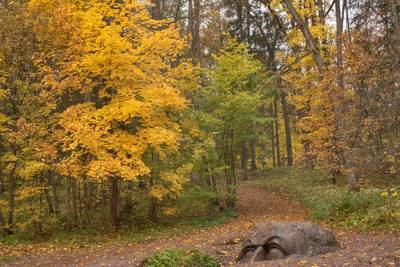
Close-up of the "Adam s Head" (or "The Old Man") revealing the intricate craftsmanship carved directly into the granite boulder, highlighting its weathered texture and mysterious expression. The close view emphasizes the deeply carved eyes with distinct eyelids and pupils, gazing upward in a look of eternal surprise or contemplation. The nose is prominent and well-defined. The sculpture s rough granite surface is speckled with wet, yellow maple leaves, which contrast with the dark grey stone and emphasize its seamless, "sunken" placement within the forest floor. Sergievka Park, Old Peterhof, west from Saint Petersburg, Russia, October 13, 2025  The "Stone Head" (also known as "The Old Man" or "Adam s Head") which is Sergievka Park s most famous and mysterious landmark. Carved from a massive granite boulder in situ, its origins are unclear. Most researchers date it to around 1800, attributing it to an unknown master, possibly based on a design by Franz Brouer. The sculpture appears to be sinking into the earth, with its eyes wide open, gazing up from the bottom of a ravine near the manor house, surrounded by fallen autumn leaves. Sergievka Park, Old Peterhof, west from Saint Petersburg, Russia, October 13, 2025  A stone arch bridge of the Kristatelka River situated downstream from the "Adam s Head" sculpture. The bridge features a solid, polished masonry arch topped with a simple, functional black iron railing. Spanning a cascade of moss-covered boulders and small waterfalls, the bridge sits deep within the ravine, creating a secluded atmosphere amplified by the dense canopy of trees. Sergievka Park, Old Peterhof, west from Saint Petersburg, Russia, October 13, 2025  Sturdy stone bridge, crossing the Kristatelka River just downstream from the famous "Adam s Head" sculpture. Sergievka Park, Old Peterhof, west from Saint Petersburg, Russia, October 13, 2025  This stone bridge serves as a picturesque crossing over the Kristatelka River ravine, situated at the foot of the slope directly beneath the Leuchtenberg Palace. As part of the 19th-century Sergievka ensemble, this bridge links the wilder, lower ravine paths (near the "Adam s Head" boulder) with the landscaped grounds surrounding the palace on the upper terrace. It features a solid masonry arch topped with simple iron railings, designed to provide a functional yet scenic vantage point for viewing the deep ravine that defines the estate s geography. Sergievka Park, Old Peterhof, west from Saint Petersburg, Russia, October 13, 2025  A wide, panoramic view of the "Three Graces" sculpture within its autumn context. The dark bronze sculpture of the three women acts as a vertical anchor in a landscape dominated by towering trees. The wider angle emphasizes the scale of the forest compared to the artwork, placing human creativity within the embrace of nature. Oranienbaum palace-and-park ensemble in Lomonosov (a suburb of St. Petersburg), Russia, October 13, 2025  Weathered stone steps, covered in moss and fallen leaves, are a charming example of the "romantic ruin" aesthetic that defines Sergievka Park. The granite blocks are softened by thick green moss and scattered with yellow maple leaves, emphasizing the passage of time and the park s intentionally wild, "abandoned" atmosphere. Set within a dense grove of maples and hardwoods, the steps are illuminated by the soft, filtered light of the "Golden Autumn" canopy, creating a quiet, contemplative spot for visitors. Old Peterhof, west from Saint Petersburg, Russia, October 13, 2025  Rustic stone arch bridge, nestled deep within the Sergievka Park ravine. Built from rough-hewn granite blocks, the bridge was designed to look ancient and weather-beaten even when new, fitting the 19th-century romantic preference for melding architecture with wild nature. The bridge spans a small cascade of the Kristatelka River, where water tumbles over mossy stone steps, creating a soothing auditory backdrop to the visual serenity. The scene is framed by golden maples and fallen leaves that carpet the banks and settle into the stream s rocky bed, enhancing the secluded, fairy-tale atmosphere. Sergievka Park, Old Peterhof, west from Saint Petersburg, Russia, October 13, 2025  Forest floor with a dense carpet of fallen leaves. The ground is thickly blanketed in thousands of yellow maple leaves, intermixed with brown oak and linden litter. Sergievka Park, Old Peterhof, west from Saint Petersburg, Russia, October 13, 2025  Graceful, humpbacked silhouette of the bridge, designed to arch elegantly over the narrow waterway connecting the ponds. The bridge s single, shallow arch is constructed from dark iron, supported by massive granite abutments on either bank. Delicate lattice pattern of the wrought-iron railing is clearly visible against the backdrop of the forest. Sergievka Park, Old Peterhof, west from Saint Petersburg, Russia, October 13, 2025  Forest-like atmosphere and natural landscape in Sergievka Park near Universitet. Old Peterhof, west from Saint Petersburg, Russia, October 13, 2025  Rugged stone steps covered by yellow maple leaves. Sergievka Park, Old Peterhof, west from Saint Petersburg, Russia, October 13, 2025  This view emphasizes the imposing nature of Hermann Castle while revealing the stark reality of the modern frontier. From this angle, the Tall Hermann Tower looms directly overhead, showcasing its 51-meter height and white-washed stone upper sections. The massive limestone walls of the fortress rise steeply from the riverbank, illustrating why this stronghold was the northernmost defensive point of Livonia. In the foreground, the Friendship Bridge is heavily fortified, contrasting sharply with the medieval architecture. Rows of concrete "dragon s teeth" (pyramidal anti-tank obstacles) and coils of razor wire block the roadway. These fortifications, installed by Estonia around 2024-2025, serve as a physical barrier against potential military threats and unauthorized vehicle crossings, marking the bridge s transformation from a trade route into a secure defensive line. A blue, black, and white flag flies from the castle wall, asserting Estonian sovereignty. Modern security cameras are mounted on the utility pole in the foreground, highlighting the intense monitoring of this border zone. Estonia, October 16, 2025  Stone head made from a boulder with a spring in Sergievka Park. Old Peterhof, west from Saint Petersburg, Russia, April 10, 2017  Granite and iron bridge in Sergievka Park. The bridge s corners are anchored by sturdy, rough-hewn granite bollards (posts) with rounded tops, which support a decorative black iron railing. The railing features a simple, geometric lattice pattern, typical of the functional yet aesthetic engineering found in the Peterhof estate parks. Old Peterhof, west from Saint Petersburg, Russia, October 13, 2025  This sequence of disjointed stone steps, winding up the leaf-covered slope, exemplifies the "landscape surprise" element typical of the Sergievka Park design. Unlike the straight, formal staircases of the nearby Peterhof Grand Palace, these steps are scattered and uneven, inviting visitors to meander through the forest rather than march directly to a destination. The steps are almost camouflaged by a vibrant mosaic of fallen yellow and brown leaves, making them appear as natural rock formations emerging from the hillside. The staircase sequence gently ascends the steep ravine bank, integrating perfectly with the surrounding old-growth trees and emphasizing the park s wild, preserved character. Old Peterhof, west from Saint Petersburg, Russia, October 13, 2025  Low angle view of the stone head in Sergievka Park. Old Peterhof, west from Saint Petersburg, Russia, April 10, 2017  Upper Park s "Russian Switzerland". A majestic, deep green spruce tree in the foreground provides a striking vertical anchor, contrasting sharply with the soft, hazy backdrop of golden maples and oaks that line the riverbanks. The shallow, rocky riverbed is visible through the clear, dark water, with scattered boulders breaking the surface, enhancing the "mountain stream" illusion intended by the landscape architects. Oranienbaum palace-and-park ensemble in Lomonosov (a suburb of St. Petersburg), Russia, October 13, 2025  Wider view of the Volle family plot in the Calvert City Cemetery. Volle Family Stone (Left): The large, upright granite headstone on the left commemorates the parents of the "Little Robert" statue. J.G. Volle: Born Oct 23, 1843, Died Nov 19, 1908. He was a prominent local merchant. Mary Ellen Volle: Born Dec 8, 1855, Died Apr 14, 1906. She was J.G. s wife. "Little Robert" Statue (Center-Background): The statue of the cherub ("Holly Robert Volle"). Large "VOLLE" Block (Right): A massive granite block with the family name "VOLLE" carved in relief stands in the foreground, serving as the central family plot marker. Calvert, Texas, December 13, 2025  Stone head made from a boulder in Sergievka Park. Old Peterhof, west from Saint Petersburg, Russia, October 11, 2016  Marble Bridge (also known as the Palladian Bridge) in Catherine Park, Pushkin, enveloped in the vibrant colors of a Russian autumn. Built in the 1770s, it features a graceful colonnade of Ionic columns carved from blue-grey Ural marble, resting on a sturdy granite base. The bridge spans a narrow channel connecting the Great Pond to smaller neighboring ponds and the "Swan Islands." In the foreground, several mallard ducks glide peacefully across the water. Pushkin (former Tsarskoe Selo) near Saint Petersburg, Russia, October 10, 2025  A narrow dirt path, cresting a small hill in Sergievka Park. Old Peterhof, west from Saint Petersburg, Russia, October 13, 2025  Aerial view of the Schweizerland Alps in East Greenland, likely near the Sermilik Fjord region. The jagged, snow-covered peaks visible in the foreground are part of the Schweizerland mountain range (also known as the Schweizerland Alps). This is one of the highest and most alpine regions in Greenland, located just west of the town of Tasiilaq. The image shows deep valleys filled with snow and ice, with massive glaciers flowing down from the high peaks towards the fjords. The interplay of sharp ridges (are^tes) and ice-filled basins (cirques) creates a classic, high-alpine landscape that rivals the European Alps in ruggedness but on a much wilder scale. The large body of water visible in the background (center-right) is likely Sermilik Fjord, a major fjord known for being choked with icebergs calved from the Helheim and other glaciers. The water reflects the sunlight, creating a bright contrast against the darker mountains. View from a window of an airplane from Helsinki to Dallas, Greenland, October 17, 2025  Mixed forest path, where the untamed woodland creates a natural tunnel of "Golden Autumn" foliage. Sergievka Park near Universitet, Old Peterhof, west from Saint Petersburg, Russia, October 13, 2025  This winding dirt path ascends a steep slope covered in an old-growth maple forest, showcasing the serene and untamed beauty of Sergievka Park. Old Peterhof, west from Saint Petersburg, Russia, October 13, 2025  Grave of Sam Houston at west entrance of Oakwood Cemetery showing Sam Houston carved from grey granite on his horse flanked by allegorical figures of Victory and History, view from Avenue I. Huntsville, Texas, December 18, 2008  The "initial stage" of memorialization, where fresh earthen graves are densely covered in massive wreaths of artificial flowers and a forest of flags. In the foreground, the wooden cross of Aleksandr Vitalyevich Rogachev (1964-2025) identifies a 61-year-old casualty, representative of the older demographic of mobilized soldiers and volunteers. The scene highlights the diverse composition of the forces, with the flag of Uzbekistan visible in the background--indicating the recruitment of foreign nationals--while a lone mourner tends to a grave amidst the dense rows, adding a human scale to the extensive loss. "Alley of Heroes" at Cemetery of the Victims of January 9, St. Petersburg, Russia, October 4, 2025 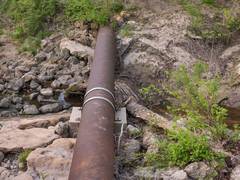 A large, heavily rusted metal pipe spanning horizontally across a ravine. The thick cylindrical pipe, completely oxidized from long-term exposure to the elements, serves as a stark piece of man-made infrastructure cutting directly through the natural landscape. Its dark, weathered surface stretches across the frame, contrasting sharply with the lighter earthy tones of the surrounding environment. In the near foreground, the engineering used to secure the pipeline is clearly visible. The heavy steel pipe rests securely on a square, poured-concrete abutment built directly into the creek bank. Two bright, unweathered metal retaining straps wrap over the top of the pipe, firmly bolted into the solid concrete base. These shiny galvanized brackets anchor the structure to the ground, designed to prevent the heavy cylinder from shifting under internal pressure or environmental stress. Lick Creek Park. College Station, Texas, March 25, 2026  From the elevated terrace of the Leuchtenberg Palace, a thoughtfully designed "prospect" (vista) opens up towards the Gulf of Finland, offering a serene coastal panorama framed by autumn foliage. This clearing was intentionally cut through the forest in the 19th century to create a direct visual link between the palace and the sea, a common feature in romantic landscape architecture. The busy road visible in the middle ground is the Oranienbaum Highway, which separates the upper park from the lower coastal meadows. In the distance, the grey-blue waters of the Gulf of Finland merge with the overcast sky, creating a vast, moody backdrop that emphasizes the estate s prime coastal location. Sergievka Park, Old Peterhof, west from Saint Petersburg, Russia, October 13, 2025  Golden Autumn scene along a winding path in the Upper Park, showing a gravel or dirt path curving gently uphill, completely covered in a carpet of fallen yellow maple leaves. Oranienbaum palace-and-park ensemble in Lomonosov (a suburb of St. Petersburg), Russia, October 13, 2025  Scenery near Bolshoy Prud (Big Pond). The landscape is a rich tapestry of deciduous hardwoods like maple, linden, and birch turning brilliant shades of gold and ochre, contrasted by the deep green of spruce and other evergreens. Sergievka Park near Universitet, Old Peterhof, west from Saint Petersburg, Russia, October 13, 2025  Stone head with a spring in Sergievka Park. Old Peterhof, west from Saint Petersburg, Russia, October 5, 2017  Face of the stone head in Sergievka Park. Old Peterhof, west from Saint Petersburg, Russia, April 10, 2017  Yellow leaves of maple carpeting ground in Botanic Gardens of Komarov Botanical Institute. Saint Petersburg, Russia, October 26, 2016  Stone head made from a boulder in Sergievka Park. Old Peterhof, west from Saint Petersburg, Russia, April 10, 2017  This view from Rataskaevu Street looks directly towards the imposing St. Nicholas Church (Niguliste kirik), creating one of the most picturesque and architecturally significant scenes in Tallinn s Old Town. The dominant feature is the massive tower of St. Nicholas Church, dedicated to the patron saint of merchants and sailors. The church, originally built in the 13th century as a fortress-church, showcases a mix of Gothic and Baroque elements. The current Baroque spire (added in the late 17th century) rises high above the street, while the lower sections reveal the heavy limestone walls typical of medieval defense structures. At the base of the tower, one can see the Small Chapel (Va"ike kabel) and the Clodt Chapel. The smaller, yellow-and-white structure with the arched entrance (left foreground) is the Chapel of St. Matthew (later St. George), adding a touch of color and intricate detail to the otherwise austere stone facade. Estonia, October 16, 2025  Romantic melancholy of the Russian "Golden Autumn," a recurring theme in both landscape design and literature. The dark, still water acts as a "black mirror," doubling the impact of the golden foliage while adding a somber, contemplative depth to the scene. The contrast between the fading green aquatic grasses, the rusty-red dogwood underbrush, and the bright yellow canopy creates a rich, painterly texture reminiscent of Levitan s landscapes. The framing of the water by dense, encroaching vegetation emphasizes the "wild" nature of this park section, moving away from the formal geometry of the canals toward an intimate, secluded atmosphere. Aleksandrovsky (Alexander) Park in Pushkin (former Tsarskoe Selo) near Saint Petersburg, Russia, October 10, 2025  Majestic, mature trees in the Upper Park that define the landscape s romantic character. The massive, gnarled branches of an old oak tree dominate the foreground, framing the view with their dark bark and patches of green moss. Its remaining leaves are a mix of rusty orange and brown, contrasting with the brighter yellow foliage of the surrounding maples. Beneath the trees, a dense thicket of shrubs (dogwood) creates a vibrant layer of red and pink tones. This rich undergrowth adds warmth and complexity to the autumn palette, which is primarily golden-yellow. Oranienbaum palace-and-park ensemble in Lomonosov (a suburb of St. Petersburg), Russia, October 13, 2025  This view across the Friendship Bridge offers a stark look at the Ivangorod Fortress in Russia, directly contrasting with previous Estonian views. The most striking element in this image is the heavy modern fortification in the foreground. The bridge, which once facilitated vehicle traffic, is now blocked by rows of razor wire and concrete "dragon s teeth" anti-tank obstacles. These defensive measures, installed by Estonia, reflect the heightened geopolitical tension and the bridge s current status as a restricted crossing (open only to pedestrians as of 2024-2025). Dominating the background is the formidable Ivangorod Fortress, established in 1492 by Ivan III to counter the Teutonic Order on the opposite bank. A large Russian flag flies prominently atop one of the towers, serving as a deliberate counterpart to the Estonian and NATO flags visible from the other side of the river. Estonia, October 16, 2025  Stone head and a spring in Sergievka Park. Old Peterhof, west from Saint Petersburg, Russia, May 17, 2019  Bronze sculpture of Marcus Cocceius Nerva (reigned 96-98 AD), the first of the "Five Good Emperors" of Rome on the "Great Lawn" (Parterre) of the Landscape Park, directly in front of the Granite Terrace in Catherine Park. He is depicted seated, draped in a toga that exposes his muscular torso, holding a scroll (a symbol of law or wisdom) in his right hand. Catherine the Great and her successors viewed their own reign through the lens of Enlightened Absolutism, often drawing parallels between the Russian Empire and the Pax Romana. Pushkin (former Tsarskoe Selo) near Saint Petersburg, Russia, October 10, 2025  Stone head and a spring in Sergievka Park. Old Peterhof, west from Saint Petersburg, Russia, April 10, 2017  A path covered by yellow maple leaves. Lesnoy Park (Lesotekhnicheskiy Universitet), Saint Petersburg, Russia, October 14, 2025  Russian Switzerland in Oranienbaum Park. The landscape features rolling, grassy mounds covered in a scattering of fallen yellow leaves, creating a soft, textured carpet that emphasizes the undulating topography of this "Swiss" inspired area. Oranienbaum palace-and-park ensemble in Lomonosov (a suburb of St. Petersburg), Russia, October 13, 2025  Grey folios lichen on a granite stone near the gulf in Sobstvennaya Dacha Park. Old Peterhof, west from Saint Petersburg, Russia, May 17, 2019  Sugar-frosted leaves of the bog blueberry or bog bilberry (Vaccinium uliginosum), locally known in Russia as golubika. The ice crystals have nucleated along the leaf margins, outlining each small oval leaf in white. This creates a striking contrast with the deep crimson tissue. The deep red pigmentation is due to anthocyanins.This is a classic sign of the "pre-winter" season (predzimye) in the taiga ecosystem. Kannelyarvi, north from Saint Petersburg, Russia, October 1, 2025  The expanding scale of the "Alley of Heroes," with construction machinery visible in the left background clearing land for new burial plots, confirming the site s active status. The foreground displays a dense cluster of polished granite monuments flanked by diverse military insignia, including the St. Andrew[CloseCurlyQuote]s flag of the Navy and a unit banner for a Motorized Rifle formation, reflecting the hybrid force structure composed of regular troops, mobilized personnel, and specialized units. Cemetery of the Victims of January 9, St. Petersburg, Russia, October 4, 2025  Close up of grey folios lichen on a granite stone near the gulf in Sobstvennaya Dacha Park. Old Peterhof, west from Saint Petersburg, Russia, May 17, 2019  Small coral fungus Lentaria byssiseda at the base of ash tree in lower Sergievka Park. Old Peterhof, west from Saint Petersburg, Russia, October 5, 2017  View towards Repino from the Laskovy Beach area in Solnechnoe highlighting a transition in the coastal landscape of the Gulf of Finland, marked by rugged natural textures and distinct geological features typical of the Karelian Isthmus shoreline. Unlike the wide, smooth sandy expanses of the main Laskovy Beach, the stretch towards Repino is characterized by a "stony belt" of glacial boulders and pebbles. The rocks visible in the shallow water and on the sand--primarily rapakivi granite and gneiss--are glacial erratics left behind by retreating ice sheets. Their reddish and grey hues (wet from the waves) contrast sharply with the rust-colored sand. Several hooded crows (Corvus cornix) are visible foraging along the shoreline. Saint Petersburg, Russia, October 9, 2025  Maple tree near the pond by Feodorovsky Gorodok, with juxtaposition of the maple s broad, saturated yellow leaves against the fine, silvery-grey foliage of the willow (Salix species) behind it. Pushkin (former Tsarskoe Selo) near Saint Petersburg, Russia, October 10, 2025  Granite sculpture on Kozhevnikova Lane in Smolenskoe Cemetery of Vasilievsliy Island. Saint Petersburg, Russia, October 27, 2016  Maple leaves carpeting ground in Smolenskoe Lutheran Cemetery on Dekabristov Island. Saint Petersburg, Russia, October 28, 2016  The "initial stage" of mass burial, depicting a dense field of fresh earthen mounds marked only by temporary wooden crosses and overwhelmed by a sea of Russian tricolors, Soviet red banners, and VDV flags. The ground is raw and uneven, with a single permanent black granite curb visible in the foreground as the only sign of the eventual transition to formal memorialization. In the background, industrial infrastructure frames the scene, emphasizing the integration of this expanding military necropolis into the everyday civilian landscape of St. Petersburg "Alley of Heroes" at Cemetery of the Victims of January 9, St. Petersburg, Russia, October 4, 2025  The view through the porticoes of one Small Chinese Bridge (often called the Second Small Chinese Bridge) that frames the Cross Bridge in the distance. The twin porticoes, with their "Chinese" peaked roofs and paired columns, create a natural proscenium that directs the eye straight down the canal. The foreground showcases the bridge s vibrant ironwork--geometric lattices and gilded details--contrasting with the brick arch of the Cross Bridge and the soft autumn foliage beyond. This alignment exemplifies the park s deliberate theatricality, using architectural "wings" (the porticoes) to stage the view of the central pavilion. Aleksandrovsky (Alexander) Park in Pushkin (former Tsarskoe Selo) near Saint Petersburg, Russia, October 10, 2025  Vibrant "Golden Autumn" (Zolotaya Osen) palette of Norway Maple (Acer platanoides) from a house on Svetlanovsky Peospekt. The dominant colors are: Golden-Orange (~32%): A rich, warm amber color (RGB: 138, 98, 28) covers the largest portion of the canopy, particularly on the sunlit tops of the trees. Deep Greenish-Bronze (~19%): Shadowed or transitioning areas (RGB: 94, 74, 13) add depth. Muted Yellow-Ochre (~15%): The mid-tone of the foliage (RGB: 186, 124, 46), creating the classic "golden" look. Green (~15-18%): Visible on the left side (likely a different tree species or a shaded branch), showing that the transition is not yet 100% complete for all vegetation. Saint Petersburg, Russia, October 8, 2025  A rustic stone bridge of Sergievka Park s hydraulic system, spanning the small creek that connects the Bolshoy Prud (Big Pond) and the Ogorodny Prud (Kitchen Garden Pond). Sergievka Park, Old Peterhof, west from Saint Petersburg, Russia, October 13, 2025  Narrow, leaf-strewn path winding through the heart old-growth forest, exemplifying the serene, immersive quality of the "Golden Autumn" season. Sergievka Park, Old Peterhof, west from Saint Petersburg, Russia, October 13, 2025  This panoramic view from the tower of St. Nicholas Church looks south-west towards Toompea Hill, capturing the dense layering of Tallinn s medieval and religious history. The striking structure with black onion domes is the Alexander Nevsky Cathedral, an Orthodox cathedral built in 1900 in the Russian Revival style. Its imposing presence on Toompea Hill contrasts sharply with the surrounding red-tiled roofs, symbolizing the complex history of the Russian era in Estonia. In the foreground and middle distance, you can see key parts of the city s defensive network: The square tower with the tall red roof in the foreground is the Maiden Tower, a 14th-century defensive structure that now houses a cafe. Just behind and slightly to the left of the Maiden Tower (partially obscured) is the massive Kiek in de Ko"k artillery tower, whose Low German name ("Peep into the Kitchen") referred to the guards ability to see into nearby homes. Connective sections of the medieval city wall run between these towers, marking the boundary between the lower town and the upper citadel. The green space visible near the base of the wall is the Danish King s Garden (Taani kuninga aed). According to legend, this is where the Danish flag (Dannebrog) fell from the sky during a battle in 1219, turning the tide in favor of the Danes. The garden sits on the slope directly facing St. Nicholas Church. Estonia, October 16, 2025  Front view of the bridge acting as a gateway into the deeper, leaf-strewn forest. Sergievka Park, Old Peterhof, west from Saint Petersburg, Russia, October 13, 2025  Evening view that provides a dramatic, upward-looking perspective of St. Olaf s Church (Oleviste kirik) from the street level (near Lai 48), emphasizing the towering scale of its west facade. The image is dominated by the massive limestone tower of St. Olaf s. The perspective highlights the transition from the square base to the octagonal upper stages, a typical feature of Gothic architecture in the Hanseatic region. The long, narrow window with its pointed arch (lancet window) is a defining Gothic element, allowing light into the nave. To the right, you can see the upper stories of the adjacent building (likely Lai 48 or 50). Its simple, plastered facade and regularly spaced windows provide a domestic scale that contrasts with the monumental church. The distinctive rain gutter (downspout) on the left foreground acts as a framing element, drawing the eye upward. This view underscores why St. Olaf s was once the tallest building in the world (1549-1625). The sheer verticality visible here was originally intended to serve as a landmark for trading ships approaching Tallinn s harbor. Tallinn, Estonia, October 16, 2025  View of the Slavyanka River showing the "wilder" side of Pavlovsk Park, contrasting with the manicured areas near the palace. Pavlovsk, a suburb of Saint Petersburg, Russia, October 6, 2025  An old transformer substation in Lanskoy Garden on Sampsonievsky Prospekt near Lanskaya train Station. This corner can be described as a striking example of urban decay juxtaposed with natural harmony. The scene captures a raw, "wabi-sabi" beauty--an appreciation for things that are imperfect, impermanent, and incomplete. The Wall: The brickwork is rough, weathered, and tactile. The peeling paint and chipped bricks tell a story of age and neglect. The layers of torn posters add a "trash collage" effect (reminiscent of decollage art), creating a chaotic, man-made texture that feels gritty and transient. The Ground: In stark contrast, the ground is covered in a soft, organic carpet of fallen maple leaves. This natural texture is random but harmonious, softening the harsh lines of the brick building. Saint Petersburg, Russia, October 9, 2025  Stone head in Sergievka Park. Old Peterhof, west from Saint Petersburg, Russia, October 11, 2016  A granite monument bearing the poignant epitaph, "My today is a sacrifice for your tomorrow," framing the soldier[CloseCurlyQuote]s death as a redemptive gift to future generations. The grave is flanked by the black and yellow flags of the Motorized Rifle Troops--Russia s primary ground combat formations--distinguished by the Kalashnikov insignia and the motto "Loyalty". In the background, rows of temporary wooden crosses extend into the distance, contrasting the finished memorial with the raw, fresh graves of recent casualties. "Alley of Heroes" at Cemetery of the Victims of January 9, St. Petersburg, Russia, October 4, 2025  View from an apartment window showing lived-in atmosphere of a residential block near Svetlanovsky Prospekt, characterized by 1970s brick architecture softened by mature greenery. Saint Petersburg, Russia, October 13, 2025  Deer sculpture with maple leaves in Botanic Gardens of Komarov Botanical Institute. Saint Petersburg, Russia, October 20, 2016  This evening view is likely a side street or courtyard just off the bustling Viru Street, possibly near the intersection with Vene Street or Sauna Street given the architectural style and proximity to nightlife areas. The most striking feature is the graffiti-covered wooden doors on the right. The words KID3:feff, PINTSEL:feff (meaning "paintbrush" in Estonian), and other tags cover the chevron-patterned double doors. This type of street art is common in the "alternative" or less-polished corners of the Old Town, often near bars and clubs. To the left, a brightly lit shop window with modern art prints or posters suggests this is a commercial area that remains active into the evening. The purple and blue lighting effects contribute to a club-like atmosphere, consistent with the nearby Viru Street and Sauna Street nightlife districts. The narrow cobblestone street slopes gently upward, flanked by tall, plastered buildings in pastel colors (pink, yellow, purple). The building on the right features a distinctive green downspout and a small blue diamond-shaped sign (likely a utility marker). Tallinn, Estonia, October 16, 2025  This perspective on Harju Street captures a striking mix of Soviet-era modernism and medieval heritage in the heart of Tallinn s Old Town. The prominent grey building on the right is the Writers House (Kirjanike Maja), located at Harju 1. Designed by architects August Volberg and Heili Volberg and completed in 1963, it is a prime example of post-war modernist architecture in Estonia. The foreground reveals traces of the area s turbulent history. The open green space on the left (Harju Street Park) occupies the site of buildings destroyed during the March 1944 Soviet bombing. For decades, these ruins were a painful scar, but the area has since been redeveloped into a recreational space that memorializes the lost urban fabric while providing a breathing room in the dense Old Town. The blue truck cabin visible in the foreground of the Harju Street photo is a GAZ-51, a legendary Soviet-era truck that was a common sight in Estonia for decades. Estonia, October 16, 2025  Grey crustose lichen Aspicilia on a granite boulder on shore of Gvardeysky Island. Vyborg, Russia, July 20, 2024  Yellow leaves on a maple in Alexandria Park in Peterhof, west from Saint Petersburg. Russia, September 28, 2015  This scene showcases a sophisticated understanding of color layering in landscape design, using native species to create depth. The distinct red-purple haze of the Red-barked dogwood (Cornus alba or Swida alba) in the foreground acts as a grounding base, contrasting sharply with the luminous yellow of the maples and the vertical white lines of the birch trunks behind it. The dogwood s dense, fine twig structure (which turns vibrant blood-red in winter) adds a chaotic, bushy texture that complements the more open, airy canopy of the deciduous forest. This composition highlights the transition of seasons; while the canopy glows with "golden autumn," the understory dogwood is already revealing the red bark that will provide visual interest throughout the snowy Russian winter. Aleksandrovsky (Alexander) Park in Pushkin (former Tsarskoe Selo) near Saint Petersburg, Russia, October 10, 2025  Spores of coral fungus Lentaria byssiseda collected earlier 10/13/2025 from a tall oak tree in Sergievka Park, Old Peterhof, west from Saint Petersburg, Russia, October 19, 2025  Coral fungus Lentaria byssiseda at the base of ash tree in lower Sergievka Park. Old Peterhof, west from Saint Petersburg, Russia, October 5, 2017  Tiny cup mushrooms Hymenoscyphus serotinus(?) at the base of ash tree in lower Sergievka Park. Old Peterhof, west from Saint Petersburg, Russia, October 5, 2017  Deeper inland over the East Greenland coast, likely near the major glacial systems feeding into the Sermilik Fjord complex. The massive, heavily crevassed glacier visible in the lower center (flowing from left to right) is characteristic of the major outlet glaciers in this region, such as Helheim Glacier or Midgard Glacier. These are some of the largest and fastest-flowing glaciers in Greenland, draining huge volumes of ice from the interior ice sheet into the fjords.:200b The intensely wrinkled texture of the glacier surface is caused by deep crevasses (cracks) that form as the ice flows over uneven bedrock and bends around mountains. The chaotic, shattered appearance indicates rapid movement and significant stress within the ice. The dark, jagged peaks rising above the ice are part of the coastal mountain ranges (likely the Schweizerland Alps mentioned previously). In this view, you can see how the ice sheet wraps around and flows between these mountains, essentially burying the valleys in ice. In the bottom right corner, a turquoise-colored lake is visible. This is a proglacial lake, formed by meltwater trapped between the glacier and the mountains. The distinctive color comes from "glacial flour" (fine rock particles) suspended in the water. This transition from the rugged coastal peaks (in the previous image) to the massive, flowing rivers of ice marks the boundary between the coastal mountains and the vast Greenland Ice Sheet proper. It is the dynamic edge where the ice sheet discharges into the ocean, a critical zone for understanding global sea-level rise. View from a window of an airplane from Helsinki to Dallas, Greenland, October 17, 2025  Stones scattered on a granite base on a beach of Vyborg Bay on Storozhok Peninsula near granite quarry near Stony Trail (Kamenistaya Tropa) in Kivi Park south from Chulkovo, west from Vyborg. Russia, July 27, 2024  scenery near the Chinese Palace in the Upper Park. The foreground features a massive, aged oak tree with a prominent hollow in its trunk. This "veteran tree" adds a sense of history and wildness, characteristic of 19th-century English landscape gardens that prized such picturesque imperfections. Oranienbaum palace-and-park ensemble in Lomonosov (a suburb of St. Petersburg), Russia, October 13, 2025  Lai Street in the Old Town. The row of gabled buildings on the right is known as the "Three Brothers". These medieval merchant houses are less famous than the "Three Sisters" on Pikk Street but are equally historically significant. The white facade in the immediate foreground (right) features a neo-Gothic or historicist style, likely dating from a later renovation (potentially 19th or early 20th century) that unified earlier medieval structures. One can clearly see the transition from the plastered, light-colored facade in the foreground to the simpler, pastel-yellow medieval warehouse-style building next to it. These buildings often retain their original "diele-dornse" layout (a large front room for business and living quarters behind). The perspective highlights the massive scale of St. Olaf s Church (Oleviste kirik) at the end of the street (Lai 50). The tower s copper spire, weathered to green, creates a striking contrast with the red tile roofs and the autumn foliage on the left. Tallinn, Estonia, October 16, 2025  Song of Vainamoinen sculpture below granite cliffs in Monrepos Park in Vyborg. Russia, May 24, 2019  Oak mazegill mushrooms (Daedalea quercina) on a rotting log. Sergievka Park, Old Peterhof, west from Saint Petersburg, Russia, October 13, 2025  Forest scene near the railroad tracks. Sergievka Park near Universitet, Old Peterhof, west from Saint Petersburg, Russia, October 13, 2025  "Golden Autumn" forest near Leuchtenberg Palace. Sergievka Park, Old Peterhof, west from Saint Petersburg, Russia, October 13, 2025  Granite sculpture in Peter the Great Botanical Garden of Komarov Botanical Institute. Saint Petersburg, Russia, May 7, 2019  A wider view of Pikk Street (Pikk ta"nav) in Tallinn s Old Town, focusing on the Russian Embassy at Pikk 19. The elegant pink building on the right with the balcony and the Russian Federation flag is the Russian Embassy. It is a historic structure dating back to the late 19th century, originally built as a private residence before becoming a diplomatic mission. A marked Estonian police van is parked further down the street on the left. Since the start of the full-scale invasion of Ukraine in 2022, there has been a constant police presence here to monitor the protests and ensure security around the embassy. The metal barriers covered in protest art, flags, and posters run along the entire length of the sidewalk in front of the embassy. This installation has become a defining feature of the street, transforming a diplomatic zone into a site of permanent public demonstration. The view looks down Pikk Street towards the north, showing the narrow, cobblestone character of the Old Town. On the left, you can see other historic buildings, including shops and restaurants like the Cantina Texas (just visible in the distance). The contrast between the beautiful medieval architecture and the tense political atmosphere is striking. Tallinn, Estonia, October 16, 2025  Orange leaves near Leykhtenbergsky Palace in Sergievka Park. Old Peterhof, west from Saint Petersburg, Russia, October 5, 2017  Fallen ash leaves in lower area in Sergievka Park. Old Peterhof, west from Saint Petersburg, Russia, October 5, 2017  Leaves of ash in a creek in lower area in Sergievka Park. Old Peterhof, west from Saint Petersburg, Russia, October 5, 2017  This view from the St. Nicholas Church (Niguliste kirik) viewing platform offers a detailed look at the dense, red-roofed tapestry of Tallinn s Old Town, looking north towards the harbor. Dominating the skyline on the right is the spire of St. Olaf s Church (Oleviste kirik), which historically served as a navigational landmark for ships. Its green copper spire contrasts sharply with the surrounding red clay tiles. Looking directly down into the "canyon" of streets, one can trace Rataskaevu Street winding through the heart of the lower town. The prominent yellow building in the foreground (with the red roof and dormer windows) is likely part of the historic housing blocks near Rataskaevu and Ru"u"tli streets. Its bright facade stands out against the more muted tones of the neighboring structures. The view captures the intricate layers of the city s architecture--chimneys, dormer windows, and varying roof pitches that reveal the organic growth of the medieval city over centuries. Estonia, October 16, 2025  Coral fungus Lentaria byssiseda on a tall oak tree. Sergievka Park, Old Peterhof, west from Saint Petersburg, Russia, October 13, 2025  Coral fungus Lentaria byssiseda on bark of a tall oak. Sergievka Park, Old Peterhof, west from Saint Petersburg, Russia, October 13, 2025  Aspen leaves carpeting ground near Razliv Lake, in Sestroretsk area west from Saint Petersburg. Russia, October 2, 2017  Yellow maple leaves in Lesnoy Park (Lesotekhnicheskiy Universitet), Saint Petersburg, Russia, October 14, 2025  Stone head in Sergievka Park. Old Peterhof, west from Saint Petersburg, Russia, May 17, 2019  Stone head in Sergievka Park. Old Peterhof, west from Saint Petersburg, Russia, May 17, 2019  Stone head in Sergievka Park. Old Peterhof, west from Saint Petersburg, Russia, May 23, 2017  Rustic stone crossing of Kristatelka River situated below the dam and pond. Sergievka Park, Old Peterhof, west from Saint Petersburg, Russia, October 13, 2025  Fallen yellow maple leaves. Lesnoy Park (Lesotekhnicheskiy Universitet), Saint Petersburg, Russia, October 14, 2025  Granite boulders on a beach in Alexandria Park in Peterhof, west from Saint Petersburg. Russia, September 28, 2015 |