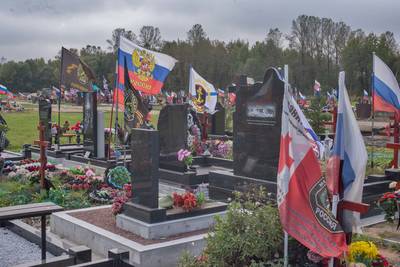
The "permanent stage" of memorialization, featuring a row of polished black granite monuments for soldiers such as Andrey Nikolaevich Atlanov (1977-2024) and Danila Denisovich Shutov (2001-2024), a 23-year-old whose age underscores the ongoing loss of young lives. The monuments display diverse portrait styles--ranging from formal military engravings to casual color photos--and are flanked by flags including the VDV (Airborne Forces) banner with the motto "Nobody, but us," reflecting both individual identity and collective unit pride. The orderly arrangement of these finished graves, complete with granite curbs and gravel, stands in contrast to the chaotic temporary sections seen in other places, illustrating the gradual formalization of the war s toll. "Alley of Heroes" at Cemetery of the Victims of January 9, St. Petersburg, Russia, October 4, 2025  A cluster of fresh graves from the summer of 2025, including that of Igor Vadimovich Lebedev (1969-2025), a 56-year-old casualty. The scene is densely packed with temporary wooden crosses, massive wreaths in the Russian tricolor, and various unit flags--including the VDV (Airborne Forces) and Motorized Rifle Troops--while a lone mourner in the background tends to a plot, emphasizing the personal grief amidst the mass scale of death. "Alley of Heroes" at Cemetery of the Victims of January 9, St. Petersburg, Russia, October 4, 2025  The permanent monument of Denis Alekseevich Mikhailov (1983-2024), a 40-year-old soldier whose polished black granite headstone displays a detailed engraving of him in full combat gear, holding a rifle and wearing a parachute badge, alongside a real blue beret left as a personal tribute. The grave is flanked by the blue and yellow flag of the VDV (Airborne Forces) with the motto "Nobody, but us," underscoring his elite unit affiliation, while surrounding graves show a mix of portrait styles and military banners, reflecting the individualized yet collective nature of the memorialization. "Alley of Heroes" at Cemetery of the Victims of January 9, St. Petersburg, Russia, October 4, 2025  A granite monument bearing the poignant epitaph, "My today is a sacrifice for your tomorrow," framing the soldier[CloseCurlyQuote]s death as a redemptive gift to future generations. The grave is flanked by the black and yellow flags of the Motorized Rifle Troops--Russia s primary ground combat formations--distinguished by the Kalashnikov insignia and the motto "Loyalty". In the background, rows of temporary wooden crosses extend into the distance, contrasting the finished memorial with the raw, fresh graves of recent casualties. "Alley of Heroes" at Cemetery of the Victims of January 9, St. Petersburg, Russia, October 4, 2025  The diverse visual language of mourning in the "Alley of Heroes," showing a mix of permanent granite monuments and temporary graves decorated with flags, including the Russian Imperial black-yellow-white tricolor and a Soviet red banner. In the foreground, the polished black headstone of Ivan Vladimirovich Semenov (1995-2024) features a color portrait of the 28-year-old soldier, while nearby, two women stand amidst the graves, highlighting the cemetery as an active site of personal grief. The scene captures the juxtaposition of varied ideological symbols--imperial, communist, and modern state--united within the shared space of military sacrifice. Cemetery of the Victims of January 9, St. Petersburg, Russia, October 4, 2025  "Alley of Heroes," a section of the cemetery dedicated to Russian soldiers killed in the war in Ukraine. In the foreground stands a permanent black granite monument featuring a detailed engraving of a soldier in combat gear with the "Z" insignia and a stoic epitaph reading, "Having given everything, I will not rise from the dust... I, having killed the fear within myself, fought". The background reveals rows of additional graves densely adorned with wreaths and flags representing various military branches (including the VDV and Naval Infantry) and private military contractors, illustrating the ongoing scale and diverse composition of the casualties. Cemetery of the Victims of January 9, St. Petersburg, Russia, October 4, 2025  The dense, chaotic stage of recent burial in the "Alley of Heroes," where fresh earthen graves are overwhelmed by a profusion of flags, including the Russian tricolor, the blue flag of the Aerospace Forces (VKS), and banners of various volunteer and assault units. The foreground shows a simple wooden cross with a framed photo of a young soldier, surrounded by vibrant wreaths of artificial flowers, while in the background, a woman walks amongst the rows, emphasizing the cemetery s role as an active site of public mourning. The sheer number of flags and the raw state of the ground visually confirm a continuous, high-volume flow of casualties processed at this site. Cemetery of the Victims of January 9, St. Petersburg, Russia, October 4, 2025  The "initial stage" of mass burial, depicting a dense field of fresh earthen mounds marked only by temporary wooden crosses and overwhelmed by a sea of Russian tricolors, Soviet red banners, and VDV flags. The ground is raw and uneven, with a single permanent black granite curb visible in the foreground as the only sign of the eventual transition to formal memorialization. In the background, industrial infrastructure frames the scene, emphasizing the integration of this expanding military necropolis into the everyday civilian landscape of St. Petersburg "Alley of Heroes" at Cemetery of the Victims of January 9, St. Petersburg, Russia, October 4, 2025  The "initial stage" of memorialization, where fresh earthen graves are densely covered in massive wreaths of artificial flowers and a forest of flags. In the foreground, the wooden cross of Aleksandr Vitalyevich Rogachev (1964-2025) identifies a 61-year-old casualty, representative of the older demographic of mobilized soldiers and volunteers. The scene highlights the diverse composition of the forces, with the flag of Uzbekistan visible in the background--indicating the recruitment of foreign nationals--while a lone mourner tends to a grave amidst the dense rows, adding a human scale to the extensive loss. "Alley of Heroes" at Cemetery of the Victims of January 9, St. Petersburg, Russia, October 4, 2025  The initial "temporary" stage of burial, showing rows of fresh earthen mounds topped with simple wooden Orthodox crosses and small identification plaques. Despite the lack of permanent monuments, the graves are densely decorated with vibrant artificial flowers and a profusion of flags--including the Russian tricolor, a Soviet hammer-and-sickle banner, and the flag of Uzbekistan--highlighting the diverse origins and ideological affiliations of the recently deceased. The raw, uneven ground and the sheer number of identical crosses extending into the background visually confirm the high volume of recent casualties processed at the site. "Alley of Heroes" at Cemetery of the Victims of January 9, St. Petersburg, Russia, October 4, 2025  Revealing the multinational and irregular composition of the Russian forces, featuring the flag of Uzbekistan prominently displayed alongside the black "Assault Troops" banner and the Russian tricolor. In the foreground, the grave of Aleksandr Borisovich Vasiliev (1973-2025), a 52-year-old soldier, is marked by a framed photograph of him in combat gear standing in a field, humanizing the older demographic of recent casualties. The scene captures the raw, crowded nature of the "initial stage" of burial, with fresh earthen mounds and a chaotic mix of personal and military symbols extending into the background. "Alley of Heroes" at Cemetery of the Victims of January 9, St. Petersburg, Russia, October 4, 2025  The dense visual cacophony of the cemetery s "temporary" section, where rows of wooden crosses are submerged in a sea of Russian tricolors and military intelligence (GRU/Spetsnaz) flags bearing the bat insignia. In the foreground, the grave of Kirill Arkadyevich Sharkov (1975-2025), a 49-year-old casualty, is marked by a simple cross and a photo of him in uniform, surrounded by wreaths in patriotic red, white, and blue colors. The scene conveys the sheer volume of recent losses, with flags fluttering chaotically over uneven mounds of earth, while a tractor in the far left background hints at the ongoing expansion of the burial grounds. "Alley of Heroes" at Cemetery of the Victims of January 9, St. Petersburg, Russia, October 4, 2025  The "initial stage" of memorialization, where fresh earthen graves are crowded with temporary wooden crosses and a profusion of military banners, including the VDV (Airborne Forces) and St. Andrew[CloseCurlyQuote]s Naval flags. The foreground features the grave of Mikhail Ilyich Svyatkin (1986-2025), a 39-year-old casualty, whose cross is adorned with a framed photo of him in uniform, exemplifying the typical profile of recent losses. The scene is saturated with patriotic symbols, including a flag depicting a tank with the slogan "Victory will be ours" and another with the Order of the Great Patriotic War, linking the current conflict to historical narratives of Soviet heroism. "Alley of Heroes" at Cemetery of the Victims of January 9, St. Petersburg, Russia, October 4, 2025  "Section 69 A" marker within the "temporary" burial sector, where fresh earthen mounds stretch toward a forested perimeter, contrasting the ordered numbering system with the raw immediacy of mass death. A solitary mourner in a green coat stands quietly by a cross, tending to flowers amidst a sea of Russian tricolors and unit flags, including the blue and yellow banner of the Aerospace Forces, adding a human scale to the vast, impersonal landscape of casualties. The scene highlights the rapid expansion of the cemetery, with the dense rows of wooden crosses indicating the continuous flow of new burials. "Alley of Heroes" at Cemetery of the Victims of January 9, St. Petersburg, Russia, October 4, 2025  The dense concentration of recent casualties, with fresh earthen mounds tightly packed together and adorned with the ubiquitous Russian tricolor. In the foreground, the grave of Aleksandr Vladimirovich Dementyev (1962-2025) is marked by a wooden cross and a color portrait, identifying a 63-year-old soldier whose age highlights the heavy toll on older reservists and volunteers. The background reveals the integration of the cemetery into the urban fabric, with modern commercial buildings visible just beyond the sea of flags and wreaths, grounding the war[CloseCurlyQuote]s losses in the everyday reality of St. Petersburg. "Alley of Heroes" at Cemetery of the Victims of January 9, St. Petersburg, Russia, October 4, 2025  The grave of Mikhail Ilyich Svyatkin (1986-2025), a 39-year-old soldier whose death in May 2025 aligns with the surge in casualties during the spring and summer of that year. His wooden cross bears a framed photo of him in combat gear holding a rifle, surrounded by wreaths inscribed "From Mother," highlighting the personal grief embedded in the mass loss. The background is crowded with similar fresh graves, flags, and flowers, reinforcing the density and continuity of the burials at this active military cemetery. "Alley of Heroes" at Cemetery of the Victims of January 9, St. Petersburg, Russia, October 4, 2025  Wide-angle view of the overwhelming scale of the cemetery s "temporary" sector, where row upon row of fresh earthen graves stretch toward the horizon, each topped with a dense carpet of wreaths and a chaotic thicket of flags. The visual field is dominated by the Russian tricolor, but punctuated by Soviet red banners, VDV (Airborne) flags, and Naval ensigns, reflecting the "hybrid" composition of forces. The raw, unpaved ground and the sheer density of the burials underscore the industrial pace of the war s casualties, set against a mundane urban backdrop that integrates this mass death into daily life. "Alley of Heroes" at Cemetery of the Victims of January 9, St. Petersburg, Russia, October 4, 2025  The diverse visual languages of mourning in the "Alley of Heroes," contrasting a solemn monochrome engraving of a soldier in full combat gear--distinguished by the Order of Courage medal--with the vibrant, smiling color portrait of Yuri Bogdanov on the adjacent grave. The background is saturated with a chaotic array of flags, including the black-yellow-white Russian Imperial tricolor and red Soviet banners, visually capturing the "hybrid" ideological landscape, where conflicting historical symbols are merged to support the war effort. Cemetery of the Victims of January 9, St. Petersburg, Russia, October 4, 2025  The grave of Alexey Vladimirovich Suslov (1976-2024), a 47-year-old casualty whose age reflects Russia s reliance on older reservists and volunteers rather than just young conscripts. His polished black granite monument features a casual color portrait and the epitaph "We were left without you, You remained with us," asserting a continuing spiritual bond despite death. The background juxtaposes the solemn "Alley of Heroes" with modern commercial buildings, visually grounding the war s toll within the everyday urban landscape of St. Petersburg. Cemetery of the Victims of January 9, St. Petersburg, Russia, October 4, 2025  Blending of religious and patriotic symbolism in the "Alley of Heroes". The foreground monument features a poignant epitaph addressing the deceased ("And you stand before our eyes, Alive... We keep you in our hearts") alongside an elaborate engraving of a soldier ascending a staircase toward a Christ-like figure, framing death as a spiritual journey. In the background, a distinctive broken-heart monument depicts a split image of a bridge at night surrounded by flags from various military branches, including the VDV and Russian Naval Infantry. Cemetery of the Victims of January 9, St. Petersburg, Russia, October 4, 2025  The ideological complexity of the war s memorialization, dominated by a large red Soviet flag flying prominently over fresh graves, invoking nostalgia for the USSR s military power alongside Russian tricolors and VDV (Airborne Forces) banners. In the foreground, the grave of Arkady Vasilyevich Kovalchuk (1974-2024), who died at age 50, exemplifies the demographic trend of older men bearing a significant share of casualties. The scene is one of dense, vibrant mourning, with mounds of artificial flowers covering the raw earth, set against a backdrop of modern commercial buildings that anchor the cemetery in the contemporary urban landscape. "Alley of Heroes" at Cemetery of the Victims of January 9, St. Petersburg, Russia, October 4, 2025  Aerial view of Tallinn. The heart of the image is the medieval Old Town, identifiable by its dense cluster of red-tiled roofs, church spires (including the tall St. Olaf s Church), and the fortified Toompea Hill. Surrounding the Old Town are the modern high-rises of the financial district (left foreground), including the Swisso^tel and Tornima"e towers. To the right, the Port of Tallinn (Vanasadam) stretches out into the Baltic Sea, with ferries and cruise ships visible. The sweeping coastline of the Tallinn Bay dominates the background. The clear blue sky and the calm sea suggest a crisp, sunny morning. View from a window of an airplane from Tallinn to Helsinki. Estonia, October 17, 2025  Religious and symbolic narrative of sacrifice, featuring a granite monument with an elaborate engraving of a soldier ascending a staircase toward a welcoming Christ-like figure and a birch tree, blending Christian theology with Russian nationalism. The epitaph laments, "You loved life... But the thread was cut too soon," emphasizing personal loss alongside martial duty. In the background, a chaotic array of VDV (Airborne Forces) and Russian flags flies over rows of fresh, temporary graves, contrasting the permanent serenity of the foreground monument with the raw immediacy of ongoing casualties. "Alley of Heroes" at Cemetery of the Victims of January 9, St. Petersburg, Russia, October 4, 2025  Monument of heroes of Great October Socialist Revolution. It is a mass grave monument dedicated to Red Guards who died during the 1917 October Revolution and the subsequent Civil War. The site originated in 1917 as a burial ground for workers and Red Guards from the nearby Novy Lessner Plant (now the Karl Marx Machine-Building Plant). These fighters were killed in battles against the troops of General Pyotr Krasnov near Pulkovo during the defense of Petrograd. In 1953, a wooden structure was replaced by the current grey granite obelisk seen today. It was designed by architect Yuri Wiesenthal. This monument is a solemn reminder of the intense revolutionary history of the Vyborg Side, a district historically populated by industrial workers who were pivotal to the Bolshevik cause. Lesnoy Park (Lesotekhnicheskiy Universitet), Saint Petersburg, Russia, October 14, 2025  This view of the installation near the Russian embassy on Pikk Street captures a broader perspective of the protest site, showing how it stretches along the sidewalk in front of the embassy building. The white banner in the foreground originally read "FOR THE VICTIMS OF WARS STARTED BY RUSSIA" (with the Russian translation on the right). However, someone has vandalized the sign by crossing out "RUSSIA" and scrawling "US" and a Star of David (hexagram) over it. This act of vandalism attempts to deflect blame from Russia by invoking anti-American and antisemitic tropes, a tactic often seen in pro-Kremlin disinformation campaigns. On the left side of the street, the building with the distinctive Art Nouveau facade (Pikk 18) houses the Ron Verlin salon, visible through the large arched window. This contrasts the elegant, peaceful commercial life of the street with the raw political conflict playing out just meters away. The fencing extends far down the street, covered in layers of posters, flags, and messages. This indicates the sustained nature of the demonstration, which has become a semi-permanent fixture in the Old Town since the start of the full-scale invasion. Tallinn, Estonia, October 16, 2025  A wider view of Pikk Street (Pikk ta"nav) in Tallinn s Old Town, focusing on the Russian Embassy at Pikk 19. The elegant pink building on the right with the balcony and the Russian Federation flag is the Russian Embassy. It is a historic structure dating back to the late 19th century, originally built as a private residence before becoming a diplomatic mission. A marked Estonian police van is parked further down the street on the left. Since the start of the full-scale invasion of Ukraine in 2022, there has been a constant police presence here to monitor the protests and ensure security around the embassy. The metal barriers covered in protest art, flags, and posters run along the entire length of the sidewalk in front of the embassy. This installation has become a defining feature of the street, transforming a diplomatic zone into a site of permanent public demonstration. The view looks down Pikk Street towards the north, showing the narrow, cobblestone character of the Old Town. On the left, you can see other historic buildings, including shops and restaurants like the Cantina Texas (just visible in the distance). The contrast between the beautiful medieval architecture and the tense political atmosphere is striking. Tallinn, Estonia, October 16, 2025  A politically charged scene on Pikk Street (specifically at Pikk 19) in front of the Russian Embassy in Tallinn. The metal barricades lining the street have become a permanent protest installation since Russia s full-scale invasion of Ukraine in February 2022. The barriers are covered in posters, slogans, and artwork condemning the war and Russian leadership. The large banner in the foreground reads "FOR THE VICTIMS OF WARS STARTED BY RUSSIA". Other signs visible on the fence typically document war crimes or satirize political figures. A police officer in a high-visibility yellow jacket is patrolling the area. A constant police presence has been standard here to maintain order given the high tensions surrounding the embassy. The Russian Embassy occupies a historic Art Nouveau building at Pikk 19. Ironically, this street is one of the most picturesque and tourist-heavy routes in the Old Town, creating a surreal juxtaposition between medieval charm and modern geopolitical conflict. Across the street (visible in the background) is the famous Maiasmokk Cafe, the oldest operating cafe in Tallinn, further highlighting the clash between leisure tourism and serious political activism in this specific location. Tallinn, Estonia, October 16, 2025  This view from the tower of St. Nicholas Church offers a fascinating contrast between medieval history, post-war reconstruction, and modern urban growth, looking east towards the city center. The most prominent building in the immediate foreground is the large, grey, L-shaped structure known as the Writers House (Kirjanike Maja) on Harju Street. Built in 1963 on the ruins of buildings destroyed during the 1944 Soviet bombing of Tallinn, this modernist structure is a significant cultural landmark. It houses the Estonian Writers Union, a well-known bookstore, and the famous Cafe Pegasus, serving as a hub for the country s literary scene. The street running along the left side of the Writers House is Harju Street, historically one of the city s main commercial arteries. The open green space visible nearby (part of the Harju Street green area) was also created following the wartime destruction, serving as a memorial and recreational space before partial reconstruction debates in recent years. In the background, the view opens up to Tallinn s modern business district. The cluster of high-rise glass buildings, including the distinct wedge-shaped Swisso^tel and the SEB Bank headquarters, illustrates the city s rapid economic development and stands in stark contrast to the red-tiled roofs of the Old Town below. Estonia, October 16, 2025  This view across the Friendship Bridge offers a stark look at the Ivangorod Fortress in Russia, directly contrasting with previous Estonian views. The most striking element in this image is the heavy modern fortification in the foreground. The bridge, which once facilitated vehicle traffic, is now blocked by rows of razor wire and concrete "dragon s teeth" anti-tank obstacles. These defensive measures, installed by Estonia, reflect the heightened geopolitical tension and the bridge s current status as a restricted crossing (open only to pedestrians as of 2024-2025). Dominating the background is the formidable Ivangorod Fortress, established in 1492 by Ivan III to counter the Teutonic Order on the opposite bank. A large Russian flag flies prominently atop one of the towers, serving as a deliberate counterpart to the Estonian and NATO flags visible from the other side of the river. Estonia, October 16, 2025  The "Adam s Head" (or Golova-valun:feff) sculpture presents a striking profile view, revealing its deep-set eye and prominent nose emerging from the earth. Bright yellow maple leaves carpeting the ground and contrasting with the grey granite. A small spring flows near the base of the sculpture (visible in the foreground as a trickle), adding to the mystical atmosphere that reportedly inspired Lewis Carroll during his visit in 1867. This angle emphasizes the massive scale of the boulder relative to the path, showing how the face was carved directly into the natural granite contours. Sergievka Park, Old Peterhof, west from Saint Petersburg, Russia, October 13, 2025  This panoramic view from the tower of St. Nicholas Church looks south-west towards Toompea Hill, capturing the dense layering of Tallinn s medieval and religious history. The striking structure with black onion domes is the Alexander Nevsky Cathedral, an Orthodox cathedral built in 1900 in the Russian Revival style. Its imposing presence on Toompea Hill contrasts sharply with the surrounding red-tiled roofs, symbolizing the complex history of the Russian era in Estonia. In the foreground and middle distance, you can see key parts of the city s defensive network: The square tower with the tall red roof in the foreground is the Maiden Tower, a 14th-century defensive structure that now houses a cafe. Just behind and slightly to the left of the Maiden Tower (partially obscured) is the massive Kiek in de Ko"k artillery tower, whose Low German name ("Peep into the Kitchen") referred to the guards ability to see into nearby homes. Connective sections of the medieval city wall run between these towers, marking the boundary between the lower town and the upper citadel. The green space visible near the base of the wall is the Danish King s Garden (Taani kuninga aed). According to legend, this is where the Danish flag (Dannebrog) fell from the sky during a battle in 1219, turning the tide in favor of the Danes. The garden sits on the slope directly facing St. Nicholas Church. Estonia, October 16, 2025  Wider view of the Volle family plot in the Calvert City Cemetery. Volle Family Stone (Left): The large, upright granite headstone on the left commemorates the parents of the "Little Robert" statue. J.G. Volle: Born Oct 23, 1843, Died Nov 19, 1908. He was a prominent local merchant. Mary Ellen Volle: Born Dec 8, 1855, Died Apr 14, 1906. She was J.G. s wife. "Little Robert" Statue (Center-Background): The statue of the cherub ("Holly Robert Volle"). Large "VOLLE" Block (Right): A massive granite block with the family name "VOLLE" carved in relief stands in the foreground, serving as the central family plot marker. Calvert, Texas, December 13, 2025  Dense, fasciculate cluster of clustered domecap mushrooms (Lyophyllum decastes) on a primitive camping site. Kannelyarvi, north from Saint Petersburg, Russia, October 1, 2025  Hydraulic engineering and bank reinforcement works at Upper Ponds in Catherine Park. The piles of large fieldstones (boulders) and gravel, along with the heavy machinery (an excavator is visible in the background), indicate major landscaping and structural repairs. The area near the Upper Ponds has historically required maintenance to its complex system of dams, sluices, and cascades. Pushkin (former Tsarskoe Selo) near Saint Petersburg, Russia, October 10, 2025  This perspective on Harju Street captures a striking mix of Soviet-era modernism and medieval heritage in the heart of Tallinn s Old Town. The prominent grey building on the right is the Writers House (Kirjanike Maja), located at Harju 1. Designed by architects August Volberg and Heili Volberg and completed in 1963, it is a prime example of post-war modernist architecture in Estonia. The foreground reveals traces of the area s turbulent history. The open green space on the left (Harju Street Park) occupies the site of buildings destroyed during the March 1944 Soviet bombing. For decades, these ruins were a painful scar, but the area has since been redeveloped into a recreational space that memorializes the lost urban fabric while providing a breathing room in the dense Old Town. The blue truck cabin visible in the foreground of the Harju Street photo is a GAZ-51, a legendary Soviet-era truck that was a common sight in Estonia for decades. Estonia, October 16, 2025  This broader aerial shot, taken from an aircraft heading north towards Helsinki, captures the expansive geography of Tallinn s coastline. The large landmass stretching into the sea on the left is the Kopli Peninsula. Once an industrial zone, it is now a rapidly developing area with trendy neighborhoods like Kalamaja (closer to the center) and burgeoning cultural hubs. The calm, blue waters of Tallinn Bay dominate the background, illustrating the city s intimate connection with the Baltic Sea. Further in the distance, beyond Kopli, one can see the tip of the Paljassaare Peninsula, known for its bird conservation area and beaches. The area in the foreground, characterized by a regular grid of streets and lower-rise buildings (many of them historic wooden houses), is the Kalamaja district. On the coastline to the right, the massive concrete hangars of the Seaplane Harbour museum are visible, a key maritime landmark. Near the Seaplane Harbour, the curved, defensive walls of the Patarei Sea Fortress (a former prison) stand on the water s edge, marking a grim but significant historical site. View from a window of an airplane from Tallinn to Helsinki, Estonia, October 17, 2025  This perspective of Pikk Street captures one of Tallinn s most historically significant thoroughfares, looking roughly south towards the foot of Toompea Hill. On the left, the large storefront windows belong to Pikk 12 (leftmost edge) and Pikk 10, home to the Oh la la gift and souvenir shop (visible by its red sign). These buildings are part of the continuous row of merchant houses that define the street s character, originally housing the wealthy guilds and traders of the Hanseatic League. While the street is famous for medieval architecture, many facades, including those visible here, show later modifications or complete rebuilds from the 19th and early 20th centuries, blending historicism with Art Nouveau elements. Further up the street, where the road curves uphill past the Swedish flag, the route leads toward the Pikk Jalg (Long Leg) gate tower. This was historically the primary carriage road connecting the Lower Town of merchants to the Upper Town (Toompea) of the nobility. Estonia, October 16, 2025  Dark patterns on a beach in shallow waters that are a classic example of heavy mineral sorting (often called a "placer" formation). Heavy Mineral Patterns: Dark, flame-like streaks of black and purplish sand (magnetite, ilmenite, and garnet) sorted by wave action. Quartz-Feldspar Base: A background of lighter golden-brown sand composed of quartz and feldspar grains. Hydrodynamic Sorting: Intricate shapes created by the "swash and backwash" of waves, which wash away lighter grains and leave heavier minerals behind. Sestroretsk near Saint Petersburg, Russia, October 9, 2025  This evening view is likely a side street or courtyard just off the bustling Viru Street, possibly near the intersection with Vene Street or Sauna Street given the architectural style and proximity to nightlife areas. The most striking feature is the graffiti-covered wooden doors on the right. The words KID3:feff, PINTSEL:feff (meaning "paintbrush" in Estonian), and other tags cover the chevron-patterned double doors. This type of street art is common in the "alternative" or less-polished corners of the Old Town, often near bars and clubs. To the left, a brightly lit shop window with modern art prints or posters suggests this is a commercial area that remains active into the evening. The purple and blue lighting effects contribute to a club-like atmosphere, consistent with the nearby Viru Street and Sauna Street nightlife districts. The narrow cobblestone street slopes gently upward, flanked by tall, plastered buildings in pastel colors (pink, yellow, purple). The building on the right features a distinctive green downspout and a small blue diamond-shaped sign (likely a utility marker). Tallinn, Estonia, October 16, 2025  Pikk Street (Pikk ta"nav) in Tallinn s Old Town, specifically showing the facades of two notable Art Nouveau buildings at numbers 18 and 16. The building on the right with the dramatic facade featuring dragon sculptures is the famous "Dragon Gallery" (Draakoni galerii). Designed by architect Jacques Rosenbaum and completed in 1910, it is a masterpiece of Art Nouveau architecture. The facade is adorned with fantastical elements, including two large dragons flanking the ground-floor window, Egyptian women, and sphinxes. It currently houses an art gallery managed by the Estonian Artists Association. The building directly next to it on the left (the narrower one with large windows) is Pikk 16. It currently houses the BonVerre shop, visible through the ground-floor window, which specializes in beverages and gourmet products. Further down the street on the left (the grey building with the green flag) is the Kanuti Gildi Saal (St. Canute s Guild Hall), a historic building that now serves as a contemporary performing arts center. Tallinn, Estonia, October 16, 2025  Aerial view of the Schweizerland Alps in East Greenland, likely near the Sermilik Fjord region. The jagged, snow-covered peaks visible in the foreground are part of the Schweizerland mountain range (also known as the Schweizerland Alps). This is one of the highest and most alpine regions in Greenland, located just west of the town of Tasiilaq. The image shows deep valleys filled with snow and ice, with massive glaciers flowing down from the high peaks towards the fjords. The interplay of sharp ridges (are^tes) and ice-filled basins (cirques) creates a classic, high-alpine landscape that rivals the European Alps in ruggedness but on a much wilder scale. The large body of water visible in the background (center-right) is likely Sermilik Fjord, a major fjord known for being choked with icebergs calved from the Helheim and other glaciers. The water reflects the sunlight, creating a bright contrast against the darker mountains. View from a window of an airplane from Helsinki to Dallas, Greenland, October 17, 2025  Linden alley in Oranienbaum Park. Mature linden trees form a dense, golden tunnel overhead. The long, converging lines of the tree trunks draw the eye toward the distant tractor, emphasizing the scale of the park (which covers over 160 hectares) and the ongoing maintenance required to preserve its historic appearance. Oranienbaum palace-and-park ensemble in Lomonosov (a suburb of St. Petersburg), Russia, October 13, 2025  Naturalistic path winding through a dense grove of mature trees, including oaks and maples, which display a vibrant palette of ochre, rust, and lime green. Aleksandrovsky (Alexander) Park in Pushkin (former Tsarskoe Selo) near Saint Petersburg, Russia, October 10, 2025  Close view of the stone marker at the base of Daniel J. Laird[CloseCurlyQuote]s forest memorial, showing the weathered [OpenCurlyQuote]Tahoe Helitack 514 - White Cloud - Est. 2001[CloseCurlyQuote] insignia surrounded by pine needles and rocks near Sand Branch Loop Trail in Sam Houston National Forest near Montgomery. Texas, February 15, 2026  View from the Small Chinese Bridge looks down the Krestovy Canal in the opposite direction from the Cross Bridge. The photo captures the linear vista of the canal, flanked by an avenue of mature maple trees displaying vibrant autumn colors. The foreground highlights the Small Chinese Bridge s decorative iron railing, featuring a geometric lattice pattern with gilded rosettes, cast in 1786. This section of the canal borders the regular "New Garden" area, leading toward the Chinese Village. Aleksandrovsky (Alexander) Park in Pushkin (former Tsarskoe Selo) near Saint Petersburg, Russia, October 10, 2025  Evening view that provides a dramatic, upward-looking perspective of St. Olaf s Church (Oleviste kirik) from the street level (near Lai 48), emphasizing the towering scale of its west facade. The image is dominated by the massive limestone tower of St. Olaf s. The perspective highlights the transition from the square base to the octagonal upper stages, a typical feature of Gothic architecture in the Hanseatic region. The long, narrow window with its pointed arch (lancet window) is a defining Gothic element, allowing light into the nave. To the right, you can see the upper stories of the adjacent building (likely Lai 48 or 50). Its simple, plastered facade and regularly spaced windows provide a domestic scale that contrasts with the monumental church. The distinctive rain gutter (downspout) on the left foreground acts as a framing element, drawing the eye upward. This view underscores why St. Olaf s was once the tallest building in the world (1549-1625). The sheer verticality visible here was originally intended to serve as a landmark for trading ships approaching Tallinn s harbor. Tallinn, Estonia, October 16, 2025  "The Seated Mourner" of Peters family in Calvert City Cemetery. Surrounding the central monument are individual headstones for family members, including: Elizabeth Peters (visible in the foreground, born 1842, died 1928). Baby Hanna Peters (1888-1890). Ruby Busch Peters (1894-1927). The size and artistry of the monument suggest the Peters family was of significant social and economic standing in Calvert, likely commissioning this work during the town s prosperous cotton era (late 19th/early 20th century). Calvert, Texas, December 13, 2025  View towards Repino from the Laskovy Beach area in Solnechnoe highlighting a transition in the coastal landscape of the Gulf of Finland, marked by rugged natural textures and distinct geological features typical of the Karelian Isthmus shoreline. Unlike the wide, smooth sandy expanses of the main Laskovy Beach, the stretch towards Repino is characterized by a "stony belt" of glacial boulders and pebbles. The rocks visible in the shallow water and on the sand--primarily rapakivi granite and gneiss--are glacial erratics left behind by retreating ice sheets. Their reddish and grey hues (wet from the waves) contrast sharply with the rust-colored sand. Several hooded crows (Corvus cornix) are visible foraging along the shoreline. Saint Petersburg, Russia, October 9, 2025  Confederate flag and a rifle on a tombstone in Odd Fellow Cemetery. Anderson, Texas, December 31, 2018  Old Town at the foot of Toompea Hill, specifically near Nunne Street 5. The illuminated stone staircase on the left is the start of the Patkuli Stairs. Built in 1903, these 157 steps connect the Lower Town (from Nunne Street) to the Patkuli viewing platform on the upper limestone plateau of Toompea. The striking street art on the wall to the right is titled "Okay, Queen...". Created by the artist Marie Soosaar in 2022, this stencil graffiti depicts a queen-like figure holding a lamb, flanked by a knight and a castle tower. It adds a modern, whimsical touch to the medieval surroundings and has quickly become a popular photo spot. The massive limestone wall in the background supports the Toompea hill. The buildings visible at the top (with the pink facade) are part of the complex of government and noble residences that historically occupied the Upper Town. The large trees on the left are part of the green belt (Snelli Park area) that surrounds the Old Town fortifications, providing a lush contrast to the stone architecture. Tallinn, Estonia, October 16, 2025  Dense, mature mixed conifer-deciduous stand with a complex vertical structure from a forest trail In Valley of Ponds in Pavlovsk Park. Pavlovsk, a suburb of Saint Petersburg, Russia, October 6, 2025  A view of Pikk Street (Pikk ta"nav) in Tallinn s Old Town, specifically looking towards the iconic House of the Brotherhood of Blackheads. The yellow building on the right foreground is Pikk 33. It is a historic property, formerly a merchant s house, that has been renovated into apartments and commercial space. In your photo, the ground floor features a shop with a green, white, and red flag display, likely an Italian restaurant or boutique. Further down the street on the right (at Pikk 26, though partially obscured in this angle) is the famous House of the Brotherhood of Blackheads (Mustpeade maja). This building is renowned for its Renaissance fac,ade, the only one of its kind preserved in Tallinn. It historically served as the headquarters for the guild of unmarried merchants and shipowners. Pikk means "Long," and this street is one of the oldest and most significant in the city. In medieval times, it was the main artery connecting the harbor to the Upper Town (Toompea), lined with the homes of wealthy merchants and powerful guild halls. The street showcases a rich mix of architectural styles, including the Gothic gabled houses seen on the left and the later Renaissance and Baroque facades. The building on the left with the stepped gable is a classic example of Hanseatic merchant architecture. Tallinn, Estonia, October 16, 2025  This view of the protest installation outside the Russian Embassy on Pikk Street highlights several direct appeals and condemnations aimed at the Russian government. "STOP KILLING PEOPLE": A large, hand-painted sign on the right bluntly demands an end to the violence. This slogan has become a staple of anti-war protests worldwide. "STOP WAR CRIMINALS": The banner on the bottom left features a missile marked with the Russian flag and the demand to stop "war criminals." This reflects the widespread accusation that Russian leadership is committing war crimes in Ukraine. The large white sheet in the center is covered with drawings of cats in blue and yellow bowties, likely representing innocent lives or perhaps a specific children s art project. The text on the right translates from Estonian: "TO THE VICTIMS OF WARS STARTED BY RUSSIA" (Venemaa poolt alustatud so~dade ohvritele). This frames the current conflict as part of a longer history of Russian aggression. The central drawing includes poignant handwritten messages like "NOBODY LOVES YOU!" and "WE DON T WANT WAR!", expressing a mix of personal disdain for the aggressors and a universal plea for peace. Tallinn, Estonia, October 16, 2025  Remains of a Finnish hydroelectric power plant on the Volchya River (formerly Saijanjoki), located near the village of Peta"ja"rvi (now Petrovskoye) in the Leningrad Region. The dam structure, including the concrete pillars and spillway, is still standing, creating a scenic waterfall that is a popular tourist stop on the Vyaryamyanselka Ridge eco-trail. Petyayarvi north from Saint Petersburg, Russia, October 5, 2025  This aerial view, captured on the approach to Helsinki (arriving from the west/southwest towards Helsinki-Vantaa Airport), showcases the stunningly fragmented coastline of the Finnish capital. The Archipelago: The image perfectly illustrates why Helsinki is known as the "Daughter of the Baltic." The coastline is a complex maze of peninsulas, bays, and islands. Western Suburbs: The dense urban areas visible are likely the western districts of Espoo (Finland s second-largest city, part of the capital region) and western Helsinki. Specifically, the large island connected by bridges in the center-left is likely Lauttasaari (Drumso), a major residential island district. To its left, the distinctive curved coastline of Keilaniemi and West Harbour (La"nsisatama) areas might be visible. The landscape is dotted with significant green spaces and forested islands, characteristic of the Helsinki metropolitan area where nature is never far from the urban core. View from a window of an airplane from Tallinn to Helsinki, Finland, October 17, 2025  Another view of the Friedlander and Klawetter family plot in the Calvert Jewish Cemetery. In the background, a small, corrugated metal shed is visible among the trees. This is likely a maintenance shed for the cemetery groundskeeper, typical in older rural cemeteries. Calvert, Texas, December 13, 2025  Tragic graves of the Couter family, likely victims of the devastating 1873 Yellow Fever Epidemic, in the Calvert City Cemetery. George Couter (Left Stone): The headstone is inscribed "In Memory of GEO. COUTER". Dates: Born Dec. 11, 1839 (or 1830) - Died Oct. 16, 1873. Context: He died just days before his wife, a common occurrence during the yellow fever outbreak that claimed hundreds of lives in Calvert between August and November of 1873. Mary Reese Couter (Right Stone): The stone reads "MARY REESE, Wife of G. COUTER". Dates: Born June 20, 1850 - Died Oct. 21, 1873. Tragedy: She died only 5 days after her husband. She was just 23 years old. The proximity of their deaths highlights the swift and deadly impact of the epidemic on local families. Visible in the background is a large, elaborate monument featuring a seated woman (mourner) with her head bowed in grief. Calvert, Texas, December 13, 2025  Button lichen (Buellia) on a polished granite surface of Bible on a tomb in Odd Fellow Cemetery. Anderson, Texas, December 31, 2018  Close up of button lichen (Buellia) on a polished granite surface of Bible on a tomb in Odd Fellow Cemetery. Anderson, Texas, December 31, 2018  Alley of North Cemetery in Pargolovo, near Saint Petersburg. Russia, October 14, 2025  This aerial view captures the "horseshoe" terminal design characteristic of Dallas-Fort Worth International Airport (DFW), taken just after takeoff. The large, semi-circular terminal in the foreground is Terminal C. This is American Airlines primary domestic hub terminal. The distinctive curved parking garages nestled inside the "U" shape are a signature feature of DFW s original design, minimizing walking distance from car to gate. The extension visible on the left side of the terminal arc is known as the "High C" gates (gates C35-C39). This area was renovated earlier than the rest of the terminal and serves many American Eagle regional flights. In the background (top right), across the highway spine, is Terminal E. One can identify it by the Spirit Airlines aircraft (yellow livery) parked at the gates, as Spirit operates primarily from Terminal E. The elevated guideway running above the terminal roof and connecting the different arms of the horseshoe is the Skylink automated people mover system. This bi-directional train connects all five terminals inside the secure area, allowing passengers to transfer without re-clearing security. The multi-lane highway running through the center of the image (between the terminals) is International Parkway, the main spine road that bisects the airport north-to-south. View from a window of an airplane from Dallas to College Station, Texas, October 18, 2025  Narrow, cobblestone alley is Va"ike-Karja Street (Va"ike-Karja ta"nav) at the intersection with Sauna Street, a spot known for its vibrant nightlife. The black sign reading "FRANK" visible down the street on the right marks the entrance to FRANK Bistro & Cocktail Bar. This popular venue, located on the corner, is known for its New York-style interior and a hidden underground cocktail lounge ("Frank Underground"). The wall on the immediate right is heavily tagged with graffiti (visible tags include "FRANK" and other abstract designs), reflecting the street s gritty, urban character typical of the "Bermuda Triangle" nightlife district. The view looks down the narrow passage towards the intersection where Va"ike-Karja meets Sauna Street. The cobblestones are well-worn, and the narrowness of the street amplifies the intimate, medieval feel, despite the modern graffiti and bar signs. Tallinn, Estonia, October 16, 2025  Lai Street in the Old Town. The row of gabled buildings on the right is known as the "Three Brothers". These medieval merchant houses are less famous than the "Three Sisters" on Pikk Street but are equally historically significant. The white facade in the immediate foreground (right) features a neo-Gothic or historicist style, likely dating from a later renovation (potentially 19th or early 20th century) that unified earlier medieval structures. One can clearly see the transition from the plastered, light-colored facade in the foreground to the simpler, pastel-yellow medieval warehouse-style building next to it. These buildings often retain their original "diele-dornse" layout (a large front room for business and living quarters behind). The perspective highlights the massive scale of St. Olaf s Church (Oleviste kirik) at the end of the street (Lai 50). The tower s copper spire, weathered to green, creates a striking contrast with the red tile roofs and the autumn foliage on the left. Tallinn, Estonia, October 16, 2025  Northern end of Vene Street (Vene ta"nav) at the intersection with Olevima"gi and Bremeni ka"ik. The red brick building on the immediate left is located at Vene 28. It is a historic structure that was originally built in 1912 as a residential building and briefly housed the Estonian Provisional Government in 1918. It stands out with its industrial-style red brick facade contrasting with the medieval stone walls nearby. The large limestone wall with the archway on the far left is part of the city s defensive fortifications, specifically near the Bremen Tower (Bremeni torn). The archway leads into Bremen Passage (Bremeni ka"ik), a short, atmospheric walkway that connects Vene Street to Uus Street through the city wall. The tower itself, a 15th-century horseshoe-shaped defensive structure, is located just behind this wall. In the background, at the end of the street, you can see the yellow tower and facade of the Orthodox Church of St. Nicholas (Nikolai kirik) at Vene 24. Designed by architect Luigi Rusca and built between 1820-1827, this Neoclassical church serves a congregation under the Moscow Patriarchate and is known for its valuable iconostasis. It sits on the site of a much older church that served Novgorod merchants in the Middle Ages. Tallinn, Estonia, October 16, 2025  "Bulldozing" trails left by a freshwater mussel of the family Unionidae, most probably the Duck Mussel (Anodonta anatina) or the Painter s Mussel (Unio pictorum) on a beach near Kurort. The shell partially visible at the end of the trail is large, oval, and relatively smooth with a dark, brownish-yellow periostracum (outer skin). Saint Petersburg, Russia, October 9, 2025  Mu"u"rivahe Street (Mu"u"rivahe ta"nav), looking towards the intersection with Viru Street. The image is taken near Mu"u"rivahe 23, which is the location of the Armanda clothing boutique visible on the left. The narrow, cobblestone street retains its medieval charm, winding between historic buildings that date back centuries. In the background, one can see a striking turquoise-colored tower with a weathervane. This is part of the building complex at the corner of Viru and Mu"u"rivahe streets, adding a distinct vertical accent to the streetscape. Tallinn, Estonia, October 16, 2025  Central axis of the "Old Garden" (Regular Park), known as Hermitage Alley (Ermitazhnaya alleya) in Catherine Park. In the 18th century, this alley was the promenade for courtiers moving between the formal receptions at the Palace and the intimate, private parties at the Hermitage. Pushkin (former Tsarskoe Selo) near Saint Petersburg, Russia, October 10, 2025  Devil s Bridge (Chertov Most), also known as the Cascade, located near the Upper Ponds in Catherine Park. It is constructed from rough-hewn limestone and granite blocks (tufa) to resemble a natural rock formation or an ancient grotto. The "bridge" actually functions as a decorative cascade or dam between the ponds. Pushkin (former Tsarskoe Selo) near Saint Petersburg, Russia, October 10, 2025  A stone arch bridge of the Kristatelka River situated downstream from the "Adam s Head" sculpture. The bridge features a solid, polished masonry arch topped with a simple, functional black iron railing. Spanning a cascade of moss-covered boulders and small waterfalls, the bridge sits deep within the ravine, creating a secluded atmosphere amplified by the dense canopy of trees. Sergievka Park, Old Peterhof, west from Saint Petersburg, Russia, October 13, 2025  Soykinskaya Alley (or Road) in Oranienbaum Park. This is a major thoroughfare in the Upper Park, notable for its impressive width and the straight, long perspective it creates, reminiscent of the "prospekts" designed in the 18th century. The alley is flanked by mature, stately trees--predominantly oaks and lindens--whose canopies form a "golden tunnel" overhead. The fallen leaves completely cover the ground, creating a continuous carpet of orange and yellow that mirrors the canopy above. Oranienbaum palace-and-park ensemble in Lomonosov (a suburb of St. Petersburg), Russia, October 13, 2025  Pil Tower Bridge (Pil-bashnyy most), with the iconic Pil Tower (Pil-bashnya) visible in the background. The tower is one of the most charming "follies" in the park. Originally built in 1797 by Vincenzo Brenna, it was designed to look like a rustic water mill, complete with a thatched roof and stairs. Pavlovsk, a suburb of Saint Petersburg, Russia, October 6, 2025  Navy ship Indigirka in Yuzhnaya Stenka Harbor in military base V/Ch 20862. Oranienbaum (Lomonosov), 20 miles west from Saint Petersburg, Russia, August 2, 2012  Tracks of land snails, or zigzag marks left by mouthparts (radula) on bark of crape myrtle tree in Fanthorp Cemetery. Anderson, Texas, December 31, 2018  A view from the gun deck of the Moncrieff gun pit, with the "shaft" construction visible as a two-level system: the Gun Deck (Top), the Crew Floor (Bottom), Mechanism Traces. Coastal Fort "Reef", Kronstadt, Russia, September 27, 2025  Dense cluster of cup fungus Sphaerosporella brunnea among charcoal on a site of old campfire in area of Lembolovo - Orekhovo, 35 miles north from Saint Petersburg. Russia, August 8, 2017  Dense cluster of cup fungus Sphaerosporella brunnea among charcoal on a bonfire site in a coastal forest between Lisiy Nos and Olgino, west from Saint Petersburg. Russia, September 6, 2018  The surviving granite base of the 1917 railway water tower on Station Square in Toksovo, Leningrad Oblast. Designed in the Nordic National Romantic style by Finnish architect Urho Pa"llia" for the Saint Petersburg-Hiitola railway line, the structure features rusticated Karelian stone quoins, a segmental arched portal, and a date plaque; its upper half-timbered wooden reservoir reservoir tier had burned down in the 1990s, leaving the masonry plinth derelict prior to receiving regional cultural heritage status. 8 miles north from Saint Petersburg. Russia, August 1, 2012  This view emphasizes the imposing nature of Hermann Castle while revealing the stark reality of the modern frontier. From this angle, the Tall Hermann Tower looms directly overhead, showcasing its 51-meter height and white-washed stone upper sections. The massive limestone walls of the fortress rise steeply from the riverbank, illustrating why this stronghold was the northernmost defensive point of Livonia. In the foreground, the Friendship Bridge is heavily fortified, contrasting sharply with the medieval architecture. Rows of concrete "dragon s teeth" (pyramidal anti-tank obstacles) and coils of razor wire block the roadway. These fortifications, installed by Estonia around 2024-2025, serve as a physical barrier against potential military threats and unauthorized vehicle crossings, marking the bridge s transformation from a trade route into a secure defensive line. A blue, black, and white flag flies from the castle wall, asserting Estonian sovereignty. Modern security cameras are mounted on the utility pole in the foreground, highlighting the intense monitoring of this border zone. Estonia, October 16, 2025  Caloplaca and Xanthoparmelia lichens on a granite tombstone when exposed to regular daylight as well as when illuminated by a 365 nm ultraviolet (UV-A) blacklight in City Cemetery. Bryan, Texas, October 24, 2024  This scene showcases a sophisticated understanding of color layering in landscape design, using native species to create depth. The distinct red-purple haze of the Red-barked dogwood (Cornus alba or Swida alba) in the foreground acts as a grounding base, contrasting sharply with the luminous yellow of the maples and the vertical white lines of the birch trunks behind it. The dogwood s dense, fine twig structure (which turns vibrant blood-red in winter) adds a chaotic, bushy texture that complements the more open, airy canopy of the deciduous forest. This composition highlights the transition of seasons; while the canopy glows with "golden autumn," the understory dogwood is already revealing the red bark that will provide visual interest throughout the snowy Russian winter. Aleksandrovsky (Alexander) Park in Pushkin (former Tsarskoe Selo) near Saint Petersburg, Russia, October 10, 2025  Firedot lichen Caloplaca on a granite tombstone of Herne when exposed to regular daylight as well as when illuminated by a 365 nm ultraviolet (UV-A) blacklight in City Cemetery. Bryan, Texas, October 24, 2024  Pyramid Pavilion, located in a quiet, shady corner of Catherine Park in Tsarskoe Selo (Pushkin). It was originally built in 1770-1772 by the architect Vasily Neyelov and later reconstructed by Charles Cameron in 1782-1783. The pavilion was designed to resemble an ancient Egyptian mausoleum, reflecting the Romantic era s fascination with antiquity and melancholy ruins. It is constructed of brick and faced with trimmed granite. Buried behind the pyramid are three of the Empress s favorite Italian greyhounds: Tom Anderson, Zemira, and Duchesse. Saint Petersburg, Russia, October 10, 2025  Graceful, humpbacked silhouette of the bridge, designed to arch elegantly over the narrow waterway connecting the ponds. The bridge s single, shallow arch is constructed from dark iron, supported by massive granite abutments on either bank. Delicate lattice pattern of the wrought-iron railing is clearly visible against the backdrop of the forest. Sergievka Park, Old Peterhof, west from Saint Petersburg, Russia, October 13, 2025  Grave of Sam Houston at west entrance of Oakwood Cemetery showing Sam Houston carved from grey granite on his horse flanked by allegorical figures of Victory and History, view from Avenue I. Huntsville, Texas, December 18, 2008  Upper Park s "Russian Switzerland". A majestic, deep green spruce tree in the foreground provides a striking vertical anchor, contrasting sharply with the soft, hazy backdrop of golden maples and oaks that line the riverbanks. The shallow, rocky riverbed is visible through the clear, dark water, with scattered boulders breaking the surface, enhancing the "mountain stream" illusion intended by the landscape architects. Oranienbaum palace-and-park ensemble in Lomonosov (a suburb of St. Petersburg), Russia, October 13, 2025  Memorial of blind victims in Levashovskaya Pustosh Memorial Cemetery. Levashovo near Saint Petersburg, Russia, October 30, 2016  This image captures the view from a window of an aircraft taxiing at Dallas-Fort Worth International Airport (DFW), looking out over the wing towards another terminal and active taxiways. JZ -> Z ->" Sign: The yellow and black sign visible on the grass is a taxiway direction sign. It indicates that the aircraft is currently on or approaching taxiway JZ and that taxiway Z ("Zulu") continues to the right. The yellow background with black letters is standard for direction signs, telling pilots where to turn to reach a specific taxiway. While the "Z" symbol has gained political connotations elsewhere, in aviation, it is purely phonetic alphabet usage ("Zulu"). The solid double yellow lines (resembling the St. George Ribbon) mark the edge of the usable taxiway pavement. Based on the "Z" and "JZ" taxiways, this view is likely on the east side of the airport, near Terminal D or the future Terminal F site, looking towards the terminal complex. The flat, sprawling landscape and sunny skies are characteristic of the North Texas region. View from a window of an airplane from Helsinki to Dallas, Texas, October 18, 2025  Classic "Golden Autumn" above the Karasta River in Oranienbaum[CloseCurlyQuote]s Upper Park. Oranienbaum palace-and-park ensemble in Lomonosov (a suburb of St. Petersburg), Russia, October 13, 2025  Italian Pergola located in the Private Garden (Sobstvenny Sadik) of Catherine Park. This pergola frames the view of the Kagul Obelisk (Kagulsky Obelisk), which is visible in the background This simple marble needle was erected much earlier, in 1771-1772, by Antonio Rinaldi to commemorate the Russian victory over the Turks at the Battle of Kagul. Pushkin (former Tsarskoe Selo) near Saint Petersburg, Russia, October 10, 2025  View of Pikk Street (Pikk ta"nav), one of the most architecturally diverse streets in Tallinn s Old Town. The spectacular grey Art Nouveau building on the right (with the corner turret) is a masterpiece designed by architect Jacques Rosenbaum in 1910. It is famous for its fantastical facade featuring two large dragons and Egyptian-inspired motifs. Today, the ground floor houses the Draakoni Gallery. On the left side of the street (the red and grey facade), one can see the St. Canute s Guild Hall (Kanuti Gildi Saal). Originally built in the 13th century and remodeled in the 19th century with Tudor-style windows and statues of St. Canute and Martin Luther on the facade. It now serves as a contemporary performing arts center. The yellow building on the immediate right foreground is Pikk 22, which houses the Estonian Handicraft House (Eesti Ka"sito"o" Maja). This shop is a go-to place for authentic Estonian folk art and crafts. Tallinn, Estonia, October 16, 2025  A view of Pikk Street (Pikk ta"nav) in Tallinn s Old Town, capturing a section lined with colorful and historically significant buildings. The yellow building on the left with the Estonian flag is Pikk 29. It houses the Meriton Old Town Garden Hotel, which occupies a historic merchant house first mentioned in 1355. The hotel connects through a courtyard to Lai Street, preserving much of its medieval structure and atmosphere. The grand pink building on the right (partially obscured) is Pikk 28, also known as the von Rosen Palace (von Roseni palee). Built in the 1670s, it is considered the finest example of Baroque architecture in Tallinn. It has served as the Embassy of Sweden since the 1990s and is notable for its intricate stucco decorations and portal. The yellow building next to the Swedish Embassy (on the immediate right foreground) is Pikk 27, home to another branch of the Estonian Handicraft House (Eesti Ka"sito"o"). This shop showcases high-quality traditional crafts, knitwear, and folk art, supporting local artisans. This section of Pikk Street is a prime example of the "long street s" historical role as a wealthy merchant avenue, featuring a mix of Gothic, Renaissance, and Baroque facades that now house embassies, hotels, and boutiques. Tallinn, Estonia, October 16, 2025  Enclosed pedestrian overpass at the Kannelyarvi railway station, located on the Karelian Isthmus roughly 75 km northwest of St. Petersburg. This overpass is a modular steel structure clad in translucent polycarbonate panels. The structure is a characteristic example of the standardized "blue tube" pedestrian bridges installed by Russian Railways (RZD) during the widespread modernization of the St. Petersburg-Vyborg line in the late 2000s. Russia, October 1, 2025  This cross-section of a Tomatillo (Mexican husk tomato, Physalis philadelphica) reveals its internal structure under two different lighting conditions. Top Image (Visible Light): The fruit is a two-carpellate berry, which means it is divided into two main internal chambers (locules) filled with seeds. One can see the fleshy placenta in the center where the small, flat, yellowish seeds are attached. The entire fruit is enclosed in a papery, green husk (calyx) that has expanded to cover the berry as it matured. Bottom Image (UV Fluorescence): Under ultraviolet light, the tomatillo displays a striking fluorescence. The bluish-white glow in the center is likely due to phenolic compounds or other metabolites common in plant tissues that fluoresce under UV. The outer ring glows a distinct orange-red. This is characteristic of chlorophyll fluorescence. College Station, Texas, November 6, 2025  This comparative photo contrasts a salad in natural light (top) with its hidden chemical fluorescence under 365 nm ultraviolet light (bottom). The glowing blue-white haze on the seemingly empty ceramic plate exposes microscopic traces of organic residue and fats left over from previous meals. The brightest glow comes from the cottage cheese, which emits a brilliant yellow-green light due to its high riboflavin and protein content. The plant ingredients show a more subtle, tissue-specific response: green olives shift to a pale salmon hue from chlorophyll and phenols, while the red pepper[CloseCurlyQuote]s thin cuticles light up in blue-purple tones. In contrast, the water-dense cucumber and tomato slices absorb most of the UV light and remain dark against the glowing background. College Station, Texas, May 2, 2026  This section of the protest installation outside the Russian Embassy on Pikk Street features striking posters that use language and graphic design to convey urgent anti-war messages. The black banner in the center features stylized white text that mimics the sound or urgency of a warning siren. The Ukrainian text translates to "Air raid alert" (:041f:043e:0432:0456:0442:0440:044f:043d:0430 :0442:0440:0438:0432:043e:0433:0430), followed by the command "KILL" in large red letters. This likely references the constant threat of bombardment facing Ukrainian civilians and calls for defensive action against the aggressors. The poster on the right, designed with yellow and blue text on a white background, carries a message in English: "And you thought that war is simple?" with the word "UKRAINE" stylized in the center. It challenges the viewer to confront the complexities and brutality of the conflict. To the left, there is a collage of photos showing the devastation of Ukrainian cities, including bombed-out residential buildings (likely Mariupol or Kharkiv), serving as visual evidence of war crimes. While partially obscured, other signs in this installation series often include direct messages to Vladimir Putin, such as the famous slogan "Follow your leader" (referencing Hitler s suicide in a bunker), which has been a recurring theme in protests here. Tallinn, Estonia, October 16, 2025  Military memorial on Bogoyavlenskaya Lane in Smolenskoe Cemetery of Vasilievsliy Island. Saint Petersburg, Russia, October 27, 2016  A forgotten military hospital cemetery in the spruce woods on a hillside behind the former Toksovo tuberculosis sanatorium in Syargi, Leningrad Oblast. Simple wooden and welded iron crosses rise above mossy burial mounds scattered with colorful artificial flowers, marking the resting place of Red Army soldiers who succumbed to their wounds during World War II when the facility served as an evacuation hospital, as well as subsequent patients who died of severe bone tuberculosis. Near Saint Petersburg. Russia, August 2, 2005  Alley of Heroes in Sosnovka Park. Saint Petersburg, Russia, September 3, 2018  This aerial view captures the Tapiola district in Espoo, Finland, just west of Helsinki. Known as a "garden city," Tapiola is famous for its unique urban planning that blends modern architecture with extensive green spaces. Central Basin (Keskusallas): The large body of water in the left-center is the artificial pool or basin at the heart of Tapiola s center. It is surrounded by key landmarks like the Espoo Cultural Centre and the iconic Tapiola Garden Hotel. The image clearly shows the "garden city" concept in action: high-rise apartment blocks (typically white) are scattered amongst dense patches of forest and parks, rather than being packed into tight grids. In the foreground (bottom left), the coastline features marinas and residential areas, likely parts of the affluent Westend or Haukilahti neighborhoods, known for their seaside location. The major road running horizontally through the upper middle is likely La"nsiva"yla" (Western Highway), the main artery connecting Espoo to Helsinki city center (which would be to the right/east). View from a window of an airplane from Tallinn to Helsinki, Finland, October 17, 2025 |