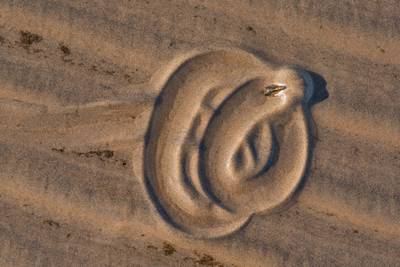
"Bulldozing" trails left by a freshwater mussel of the family Unionidae, most probably the Duck Mussel (Anodonta anatina) or the Painter s Mussel (Unio pictorum) on a beach near Kurort. The deep, meandering furrow left in the sand is a classic "ploughing" trace (known as repichnia). These mussels use a large, muscular foot to drag themselves slowly through the upper layer of sediment, leaving behind the U-shaped groove. Saint Petersburg, Russia, October 9, 2025  Spiral trail left by a freshwater mussel on a beach near Kurort which is a specific behavioral trace often associated with disorientation or stress. When these simple organisms lack a strong environmental cue (like a clear water current to guide them), their movement becomes less directional. Without a "current signal" to orient against (rheotaxis), their left/right muscular asymmetry can cause them to drift continually to one side, resulting in a tightening spiral. This behavior is sometimes colloquially called a "death spiral," though that is a dramatic term. It often occurs when a mussel is stranded in shallow water or exposed sediment and is desperately trying to find deeper water or a suitable substrate to burrow into. The spiral indicates the mussel has been moving for a sustained period without success, expending significant energy. Saint Petersburg, Russia, October 9, 2025 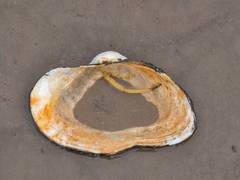 Shell of a Giant Floater (Pyganodon grandis) freshwater mussel on a lake shore at Lake Somerville Trailway near Birch Creek Unit of Somerville Lake State Park. The oxidation of iron deposits on the shell s nacre (the inner pearly layer) turns them into this characteristic rusty-orange or copper color. Texas, December 14, 2025 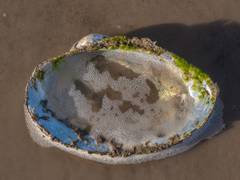 Shell of a freshwater mussel on a lake shore near Birch Creek Unit of Somerville Lake State Park. Texas, January 2, 2026 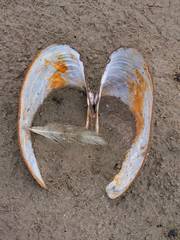 Shell of a Giant Floater (Pyganodon grandis) freshwater mussel on a lake shore at Lake Somerville Trailway near Birch Creek Unit of Somerville Lake State Park. Texas, December 22, 2025 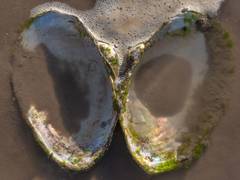 Shells of a freshwater mussel on a lake shore near Birch Creek Unit of Somerville Lake State Park. Texas, January 2, 2026 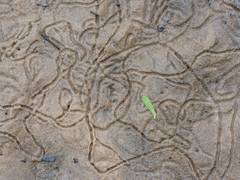 Meandering furrows (continuous, squiggly grooves in the sand) commonly referred to as "clam tracks" or "mussel trails" made by Asian Clam (Corbicula fluminea) on a sandy bottom of Caney Creek on Caney Creek Trail (Little Lake Creek Loop Trail) in Sam Houston National Forest north from Montgomery. Texas, July 4, 2026  Freshwater mussels Anodonta cygnea(?) (Bezzubka in Russian) on a beach in Solnechnoe, west from Saint Petersburg. Russia, October 2, 2016  Mussel shells on shores of the lake near Birch Creek Unit of Somerville Lake State Park. Texas, October 12, 2022  Flat caked mud and mussel shells on bottom of the lake near Birch Creek Unit of Somerville Lake State Park. Texas, October 12, 2022  View towards Repino from the Laskovy Beach area in Solnechnoe highlighting a transition in the coastal landscape of the Gulf of Finland, marked by rugged natural textures and distinct geological features typical of the Karelian Isthmus shoreline. Unlike the wide, smooth sandy expanses of the main Laskovy Beach, the stretch towards Repino is characterized by a "stony belt" of glacial boulders and pebbles. The rocks visible in the shallow water and on the sand--primarily rapakivi granite and gneiss--are glacial erratics left behind by retreating ice sheets. Their reddish and grey hues (wet from the waves) contrast sharply with the rust-colored sand. Several hooded crows (Corvus cornix) are visible foraging along the shoreline. Saint Petersburg, Russia, October 9, 2025  Ostrich Fern (Matteuccia struthiopteris) on Alpine Hill (or Alpinarium). Sterile Fronds (The "Feathers"): The large, outer leaves have turned from green to a golden-bronze color. These are the "ostrich feathers" that give the plant its name. They are withering now and will soon collapse for the winter. Fertile Fronds (The Dark Spikes): In the very center, there are the dark brown, stiff, upright spikes. These are the spore-bearing fronds (sporophylls). Unlike the leafy outer fronds, these become woody and persist standing upright through the entire winter, often poking out through the snow. Peter the Great Botanical Garden of Komarov Botanical Institute. Saint Petersburg, Russia, October 8, 2025  Vibrant, neon-yellow to chartreuse color and the powdery, granular texture (described as "leprose," meaning it lacks a smooth outer "skin" or cortex) of gold dust lichen (Chrysothrix xanthina) on bark of a tree on Caney Creek Trail (Little Lake Creek Loop Trail) in Sam Houston National Forest north from Montgomery. Texas, January 6, 2026  Wider view of the Volle family plot in the Calvert City Cemetery. Volle Family Stone (Left): The large, upright granite headstone on the left commemorates the parents of the "Little Robert" statue. J.G. Volle: Born Oct 23, 1843, Died Nov 19, 1908. He was a prominent local merchant. Mary Ellen Volle: Born Dec 8, 1855, Died Apr 14, 1906. She was J.G. s wife. "Little Robert" Statue (Center-Background): The statue of the cherub ("Holly Robert Volle"). Large "VOLLE" Block (Right): A massive granite block with the family name "VOLLE" carved in relief stands in the foreground, serving as the central family plot marker. Calvert, Texas, December 13, 2025  Graffiti series, located on the concrete retaining wall separating the beach from the promenade along the Gulf of Finland (near the Sestroretsk Resort or "Kurort" area) which is a fanciful and nostalgic mural composition featuring whimsical animals and nature motifs. This section features a large bear with a cub, rendered in a sketch-like style with soft shading. The bears are set against a background of rolling green hills and a cloudy sky, evoking a gentle, fairytale forest atmosphere. Saint Petersburg, Russia, October 9, 2025  Shells of freshwater mussels on a beach near guard station in Sestroretsk, west from Saint Petersburg. Russia, October 2, 2016  Shells of freshwater mussels and snails on a beach near guard station in Sestroretsk, west from Saint Petersburg. Russia, October 2, 2016  Graffiti series, located on the concrete retaining wall separating the beach from the promenade along the Gulf of Finland (near the Sestroretsk Resort or "Kurort" area) which is a fanciful and nostalgic mural composition featuring whimsical animals and nature motifs. This segment shows a yellow-orange cat perched comfortably on a tree branch. The surrounding trees are depicted with vertical, textured strokes, suggesting a dense birch or pine forest typical of the Karelian Isthmus. Saint Petersburg, Russia, October 9, 2025  Serene autumn scene at Laskovy Beach (Russian: Laskovyy Plyazh) in the settlement of Solnechnoe, located on the shore of the Gulf of Finland, approximately 40 kilometers northwest of Saint Petersburg. Laskovy Beach is one of the most popular beaches in the Kurortny District of Saint Petersburg. The name "Laskovy" translates to "Affectionate" or "Tender," while the settlement name, Solnechnoe, means "Sunny". This area has a rich history as a summer resort destination; formerly known as the Finnish village of Ollila, it became a hub for St. Petersburg s intelligentsia and dacha owners in the late 19th and early 20th centuries. The image shows a trio of birch trees with vibrant yellow and orange leaves, which is characteristic of the "Golden Autumn" season in the Leningrad Region during early-to-mid October. The golden leaves contrast strikingly with the blue sky and the dark blue waters of the Gulf. The large white concrete sphere on the sand is a landscaping feature. Russia, October 9, 2025  Graffiti series, located on the concrete retaining wall separating the beach from the promenade along the Gulf of Finland (near the Sestroretsk Resort or "Kurort" area) which is a fanciful and nostalgic mural composition featuring whimsical animals and nature motifs. It is a more abstract section, featuring dynamic bursts of color (yellow, orange, and white) that resemble explosions, splashes, or perhaps stylized sunbeams breaking through clouds. These bright, energetic forms add a sense of movement to the otherwise static scenes. Saint Petersburg, Russia, October 9, 2025  Purple pleat-leaf (Pinewood lily, Alophia drummondii, Eustylis purpurea) on Little Lake Creek Loop Trail in Sam Houston National Forest, with 3 large rounded dark purple outer petal segments and 3 boat-like inner petals with a yellow spot at central pithed-in area. Richards, Texas, June 22, 2008  Vibrant "Golden Autumn" (Zolotaya Osen) palette of Norway Maple (Acer platanoides) from a house on Svetlanovsky Peospekt. The dominant colors are: Golden-Orange (~32%): A rich, warm amber color (RGB: 138, 98, 28) covers the largest portion of the canopy, particularly on the sunlit tops of the trees. Deep Greenish-Bronze (~19%): Shadowed or transitioning areas (RGB: 94, 74, 13) add depth. Muted Yellow-Ochre (~15%): The mid-tone of the foliage (RGB: 186, 124, 46), creating the classic "golden" look. Green (~15-18%): Visible on the left side (likely a different tree species or a shaded branch), showing that the transition is not yet 100% complete for all vegetation. Saint Petersburg, Russia, October 8, 2025  A carpet of yellow leaves on a lawn. The fallen foliage belongs primarily to Norway maples (Acer platanoides), which, along with linden and oak trees, dominate the Upper Park s romantic landscape. These maples are responsible for the intense yellow and golden hues visible in October. Oranienbaum palace-and-park ensemble in Lomonosov (a suburb of St. Petersburg), Russia, October 13, 2025  Tragic graves of the Couter family, likely victims of the devastating 1873 Yellow Fever Epidemic, in the Calvert City Cemetery. George Couter (Left Stone): The headstone is inscribed "In Memory of GEO. COUTER". Dates: Born Dec. 11, 1839 (or 1830) - Died Oct. 16, 1873. Context: He died just days before his wife, a common occurrence during the yellow fever outbreak that claimed hundreds of lives in Calvert between August and November of 1873. Mary Reese Couter (Right Stone): The stone reads "MARY REESE, Wife of G. COUTER". Dates: Born June 20, 1850 - Died Oct. 21, 1873. Tragedy: She died only 5 days after her husband. She was just 23 years old. The proximity of their deaths highlights the swift and deadly impact of the epidemic on local families. Visible in the background is a large, elaborate monument featuring a seated woman (mourner) with her head bowed in grief. Calvert, Texas, December 13, 2025  This aerial view, captured on the approach to Helsinki (arriving from the west/southwest towards Helsinki-Vantaa Airport), showcases the stunningly fragmented coastline of the Finnish capital. The Archipelago: The image perfectly illustrates why Helsinki is known as the "Daughter of the Baltic." The coastline is a complex maze of peninsulas, bays, and islands. Western Suburbs: The dense urban areas visible are likely the western districts of Espoo (Finland s second-largest city, part of the capital region) and western Helsinki. Specifically, the large island connected by bridges in the center-left is likely Lauttasaari (Drumso), a major residential island district. To its left, the distinctive curved coastline of Keilaniemi and West Harbour (La"nsisatama) areas might be visible. The landscape is dotted with significant green spaces and forested islands, characteristic of the Helsinki metropolitan area where nature is never far from the urban core. View from a window of an airplane from Tallinn to Helsinki, Finland, October 17, 2025  Vana turg (Old Market) square, a historic intersection where several streets meet. The white building on the right with the prominent hoist beam and red sack is the Peppersack restaurant (Vana turg 6). It is a well-known medieval-themed venue located in a 14th-century merchant s house. The large, pinkish building on the left (at the corner of Suur-Karja and Kuninga) is the Bishop s House (Piiskopi maja). It stands on the site of the medieval residence of the bishops of Tallinn. The current facade is later, but the core of the building is ancient, and it has historically housed the Consistory of the Estonian Evangelical Lutheran Church. Just out of frame or partially visible (depending on the exact angle, as it is adjacent to Peppersack), this area is also home to Olde Hansa, another famous medieval restaurant housed in a historic warehouse. Tallinn, Estonia, October 16, 2025  Yellow flowers of sunflower family on a beach in Solnechnoe, west from Saint Petersburg. Russia, June 30, 2011  Sand ripples on a beach. Kurort, west from Saint Petersburg, Russia, May 31, 2014  Greenish-yellow to rusty brown underside of Dyer s Mazegill mushrooms (Phaeolus schweinitzii) from a large pine in Dubki Park. Sestroretsk near Saint Petersburg, Russia, October 9, 2025  Shells of swan mussels (Anodonta cygnea, Russian name Bezzubka) on a beach near coast guard station in Sestroretsk, north-west from Saint Petersburg. Russia, July 8, 2016  Graceful, humpbacked silhouette of the bridge, designed to arch elegantly over the narrow waterway connecting the ponds. The bridge s single, shallow arch is constructed from dark iron, supported by massive granite abutments on either bank. Delicate lattice pattern of the wrought-iron railing is clearly visible against the backdrop of the forest. Sergievka Park, Old Peterhof, west from Saint Petersburg, Russia, October 13, 2025  Graffiti on a beach wall near Kurort, north-west from Saint Petersburg. Russia, July 8, 2016  Orange graffiti on a beach wall near Kurort, north-west from Saint Petersburg. Russia, July 8, 2016  Pikk Street (Pikk ta"nav) in Tallinn s Old Town, specifically showing the facades of two notable Art Nouveau buildings at numbers 18 and 16. The building on the right with the dramatic facade featuring dragon sculptures is the famous "Dragon Gallery" (Draakoni galerii). Designed by architect Jacques Rosenbaum and completed in 1910, it is a masterpiece of Art Nouveau architecture. The facade is adorned with fantastical elements, including two large dragons flanking the ground-floor window, Egyptian women, and sphinxes. It currently houses an art gallery managed by the Estonian Artists Association. The building directly next to it on the left (the narrower one with large windows) is Pikk 16. It currently houses the BonVerre shop, visible through the ground-floor window, which specializes in beverages and gourmet products. Further down the street on the left (the grey building with the green flag) is the Kanuti Gildi Saal (St. Canute s Guild Hall), a historic building that now serves as a contemporary performing arts center. Tallinn, Estonia, October 16, 2025  Sand ripples covered by iron oxide film on a beach. Kurort, west from Saint Petersburg, Russia, May 31, 2014  Geometrical patterns on graffiti on a beach wall near Kurort, north-west from Saint Petersburg. Russia, July 8, 2016  A perspective of Rataskaevu Street, looking up the gentle slope towards the intersection with Niguliste Street. The building on the right with the striking yellow and grey modern facade and large arched window is home to Casa Alta, an Italian restaurant. The architecture of this building stands out for its postmodern interpretation of the gabled roofline, contrasting with the older structures nearby. The pinkish-red building on the left side of the street (Rataskaevu 6) is a historic property. It currently houses Restoran O~ (or a similar establishment depending on recent changes), known for its fine dining in a medieval setting. Further down on the left, you can see signs for other venues like De 6 and Vana Tallinn. Tallinn, Estonia, October 16, 2025  Hydraulic engineering and bank reinforcement works at Upper Ponds in Catherine Park. The piles of large fieldstones (boulders) and gravel, along with the heavy machinery (an excavator is visible in the background), indicate major landscaping and structural repairs. The area near the Upper Ponds has historically required maintenance to its complex system of dams, sluices, and cascades. Pushkin (former Tsarskoe Selo) near Saint Petersburg, Russia, October 10, 2025  Spores (in KOH, spore print dark brown) of common stump brittlestem mushrooms (Psathyrella piluliformis)(?) collected earlier 10/5/2025 on roadside in Petyayarvi, north from Saint Petersburg, Russia, October 19, 2025  Hyphae under a microscope of outer skin of a giant mature mushroom Scleroderma polyrhizum(?) collected on Stubblefield section of Lone Star hiking trail in Sam Houston National Forest. Texas, February 4, 2024  Brownish canopy of English oaks (Quercus robur) of Alley of the Green Woman (Alleya Zelionoy Zhenshchiny) in Pavlovsk Park. Pavlovsk, a suburb of Saint Petersburg, Russia, October 6, 2025  Bittersweet nightshade (Solanum dulcamara, Russian name Paslion) on a beach near Kurort, north-west from Saint Petersburg. Russia, July 8, 2016  Remains of 5 mm thick outer skin of a giant mature mushroom Scleroderma polyrhizum(?) on Stubblefield section of Lone Star hiking trail north from Trailhead No. 6 in Sam Houston National Forest. Texas, February 4, 2024  Tissues under a microscope at low magnification of outer skin of a giant mature mushroom Scleroderma polyrhizum(?) collected on Stubblefield section of Lone Star hiking trail in Sam Houston National Forest. Texas, February 4, 2024  Graffiti series, located on the concrete retaining wall separating the beach from the promenade along the Gulf of Finland (near the Sestroretsk Resort or "Kurort" area) which is a fanciful and nostalgic mural composition featuring whimsical animals and nature motifs. A distinct horizontal band runs across part of the mural, depicting a long, grey commuter train (possibly an elektrichka) traveling through a green landscape. This element likely references the vital railway connection between St. Petersburg and the resort towns of the Kurortny District, a familiar sight for locals and visitors. Saint Petersburg, Russia, October 9, 2025  Large, overlapping brackets of Dyer s Mazegill mushrooms (Phaeolus schweinitzii) one meter above ground on a large pine in Dubki Park. Sestroretsk near Saint Petersburg, Russia, October 9, 2025  Water crowfoot (Batrachium circinatum, Russian name Shelkovnik) thrown by waves on a beach near Kurort, north-west from Saint Petersburg. Russia, July 8, 2016  Yellow sphagnum moss at Eco Trail Sestroretskoye Swamp near Saint Petersburg. Russia, October 2, 2025  This perspective of Pikk Street captures one of Tallinn s most historically significant thoroughfares, looking roughly south towards the foot of Toompea Hill. On the left, the large storefront windows belong to Pikk 12 (leftmost edge) and Pikk 10, home to the Oh la la gift and souvenir shop (visible by its red sign). These buildings are part of the continuous row of merchant houses that define the street s character, originally housing the wealthy guilds and traders of the Hanseatic League. While the street is famous for medieval architecture, many facades, including those visible here, show later modifications or complete rebuilds from the 19th and early 20th centuries, blending historicism with Art Nouveau elements. Further up the street, where the road curves uphill past the Swedish flag, the route leads toward the Pikk Jalg (Long Leg) gate tower. This was historically the primary carriage road connecting the Lower Town of merchants to the Upper Town (Toompea) of the nobility. Estonia, October 16, 2025  A quiet, historic section of Rataskaevu Street, just up from the well-known Cat s Well. The large bronze relief on the yellow wall to the left (Rataskaevu 10) is a memorial to Voldemar Panso (1920-1977), a legendary Estonian actor, director, and drama teacher. The building houses the Drama School of the Estonian Academy of Music and Theatre, which Panso founded. The relief, created by sculptor Jaak Soans in 1979, depicts Panso s profile emerging from the "stage curtain" of the wall. The building at Rataskaevu 22 (just beyond the Panso relief) is historically significant as the former home of the renowned Renaissance painter Michel Sittow (c. 1469-1525). He was born in Tallinn (then Reval) and became a court portraitist for European royalty, including Isabella of Castile and Henry VII of England. The street features well-preserved medieval merchant houses with their characteristic high gables and hoist beams (used for lifting goods into storage lofts). The narrow, cobblestone path winds gently uphill, creating an intimate atmosphere distinct from the wider commercial streets below. Tallinn, Estonia, October 16, 2025  Dark patterns on a beach in shallow waters that are a classic example of heavy mineral sorting (often called a "placer" formation). Heavy Mineral Streaks: The dark purplish-black areas are concentrated deposits of heavy minerals (magnetite, ilmenite, garnet). Light Mineral Patches: The beige/tan areas are the lighter quartz and feldspar sands. Flow Patterns: The sand is sculpted into fluid, wavy shapes ("swash marks"), showing exactly where water flowed and separated the grains based on density. Sestroretsk near Saint Petersburg, Russia, October 9, 2025  The expanding scale of the "Alley of Heroes," with construction machinery visible in the left background clearing land for new burial plots, confirming the site s active status. The foreground displays a dense cluster of polished granite monuments flanked by diverse military insignia, including the St. Andrew[CloseCurlyQuote]s flag of the Navy and a unit banner for a Motorized Rifle formation, reflecting the hybrid force structure composed of regular troops, mobilized personnel, and specialized units. Cemetery of the Victims of January 9, St. Petersburg, Russia, October 4, 2025  Church of the Tikhvin Icon of the Mother of God near the train station in Sestroretsk. The huge icon of Jesus and the rocket models is part of a distinct chapel and memorial complex dedicated to the Royal Martyrs (Tsar Nicholas II and his family) and the spiritual protection of Russia. The "Face" Facade: The large face is a giant icon of the Savior Not Made by Hands (Spas Nerukotvorny). Below it, the red banner reads "Holy Royal Martyrs, Pray to God for Us", referring to the canonized Romanov family. Community: This church is known for its "Cossack" guard and a very distinct, staunchly monarchist and patriotic atmosphere that differs from typical Russian Orthodox parishes. Saint Petersburg. Russia, October 9, 2025  Alpine Hill (or Alpinarium). The large tree with vibrant golden-yellow foliage dominating the center of the hill is a Manchurian Walnut (Juglans mandshurica). Peter the Great Botanical Garden of Komarov Botanical Institute. Saint Petersburg, Russia, October 8, 2025  View of the Karasta River near the stone bridge in Oranienbaum Park. The stone bridge, with its rustic, unpolished arches, is partially obscured by the golden leaves of a large tree, enhancing the sense of depth and discovery typical of romantic English-style gardens. Oranienbaum palace-and-park ensemble in Lomonosov (a suburb of St. Petersburg), Russia, October 13, 2025  This view from the St. Nicholas Church tower looks south-east, contrasting the medieval Old Town with the modern business district in the background. The large, L-shaped building with the dark gray roof in the center-right is the Writers House (Kirjanike Maja) on Harju Street. Completed in 1963, this Soviet-era modernist building stands out among the older red-roofed structures. It was built on the ruins of buildings destroyed in the 1944 March bombing and remains a cultural hub, housing the Estonian Writers Union and a famous bookstore. In the distance, the sleek glass high-rises of Tallinn s modern city center dominate the horizon. Key skyscrapers include the Swisso^tel Tallinn and the twin towers of the Tornima"e complex, symbolizing the city s rapid economic development since regaining independence. The open area visible to the right, just beyond the dense red roofs, is Freedom Square (Vabaduse va"ljak). Although partially obscured, this major public plaza marks the southern edge of the Old Town and is home to the Victory Column of the War of Independence. Estonia, October 16, 2025  Dark-brown webcap (Cortinarius) mushrooms under spruce in moss in Petyayarvi, north from Saint Petersburg, Russia, October 5, 2025  Expansive view looking north-northwest from the southern end of the Sestroretsk coastline towards the Sestroretsk Resort (Kurort) and, further in the distance, the settlement of Solnechnoe (Sunny). The coastline curves gently inward. This specific geography near Sestroretsk causes the eastward littoral drift (sand movement) to weaken, resulting in a very wide, accretional beach (up to 140 meters wide) known for its fine sand and extensive dunes. The foreground shows a sandy spit or sandbar created by the outflow of water. The shallow water here creates the wide, calm pools seen in the foreground, which are popular with birds. Sestroretsk near Saint Petersburg, Russia, October 9, 2025  Upper Park s "Russian Switzerland". A majestic, deep green spruce tree in the foreground provides a striking vertical anchor, contrasting sharply with the soft, hazy backdrop of golden maples and oaks that line the riverbanks. The shallow, rocky riverbed is visible through the clear, dark water, with scattered boulders breaking the surface, enhancing the "mountain stream" illusion intended by the landscape architects. Oranienbaum palace-and-park ensemble in Lomonosov (a suburb of St. Petersburg), Russia, October 13, 2025  Dark patterns on a beach in shallow waters that are a classic example of heavy mineral sorting (often called a "placer" formation). Heavy Mineral Patterns: Dark, flame-like streaks of black and purplish sand (magnetite, ilmenite, and garnet) sorted by wave action. Quartz-Feldspar Base: A background of lighter golden-brown sand composed of quartz and feldspar grains. Hydrodynamic Sorting: Intricate shapes created by the "swash and backwash" of waves, which wash away lighter grains and leave heavier minerals behind. Sestroretsk near Saint Petersburg, Russia, October 9, 2025  Small dark brown webcap (Cortinarius) mushrooms together with Clitocybe(?) on moss in Tarkhovka Park near Sestroretsk, west from Saint Petersburg. Russia, October 3, 2025  Rocky riverbed of Karasta River, with moss-covered boulders visible in the shallow water. Oranienbaum palace-and-park ensemble in Lomonosov (a suburb of St. Petersburg), Russia, October 13, 2025  Slime mold Trichia decipiens in its immature (developing) stage. The vibrant bright orange to salmon-pink "beads" visible are the developing fruiting bodies (sporangia). Tarkhovka Park near Sestroretsk, west from Saint Petersburg. Russia, October 3, 2025  "The Seated Mourner" of Peters family in Calvert City Cemetery. Surrounding the central monument are individual headstones for family members, including: Elizabeth Peters (visible in the foreground, born 1842, died 1928). Baby Hanna Peters (1888-1890). Ruby Busch Peters (1894-1927). The size and artistry of the monument suggest the Peters family was of significant social and economic standing in Calvert, likely commissioning this work during the town s prosperous cotton era (late 19th/early 20th century). Calvert, Texas, December 13, 2025  Close-up of small dark brown webcap (Cortinarius) mushrooms and Clitocybe(?) on moss in Tarkhovka Park near Sestroretsk, west from Saint Petersburg. Russia, October 3, 2025  Deeply funnel-shaped dark brown caps of the Goblet mushrooms (Pseudoclitocybe cyathiformis) collected near Orekhovo, north from Saint Petersburg. Russia, October 12, 2025  Old Town at the foot of Toompea Hill, specifically near Nunne Street 5. The illuminated stone staircase on the left is the start of the Patkuli Stairs. Built in 1903, these 157 steps connect the Lower Town (from Nunne Street) to the Patkuli viewing platform on the upper limestone plateau of Toompea. The striking street art on the wall to the right is titled "Okay, Queen...". Created by the artist Marie Soosaar in 2022, this stencil graffiti depicts a queen-like figure holding a lamb, flanked by a knight and a castle tower. It adds a modern, whimsical touch to the medieval surroundings and has quickly become a popular photo spot. The massive limestone wall in the background supports the Toompea hill. The buildings visible at the top (with the pink facade) are part of the complex of government and noble residences that historically occupied the Upper Town. The large trees on the left are part of the green belt (Snelli Park area) that surrounds the Old Town fortifications, providing a lush contrast to the stone architecture. Tallinn, Estonia, October 16, 2025  Sleeping shaved camel with smooth skin in livestock market, Abu Hamour area. Doha, Qatar, May 1, 2013  Shaved camel with smooth skin in Livestock Market, Abu Hamour area. Doha, Qatar, June 11, 2013  Presence of a dead gull on a beach in the Gulf of Finland near Solnechnoe, that is most likely linked to the ongoing highly pathogenic avian influenza (HPAI) outbreak, specifically the H5N1 strain, which has devastated wild bird populations in the Baltic region throughout 2023-2025. Saint Petersburg, Russia, October 9, 2025  A view of Suur-Karja Street (Suur-Karja ta"nav), one of the main arteries in Tallinn s Old Town. This street is famously (or infamously) known as the "Bermuda Triangle" of Tallinn s nightlife. The intersection of Suur-Karja and Va"ike-Karja streets is packed with bars, pubs, and clubs, making it the busiest party spot in the city on weekends. The street is lined with historic buildings that date back centuries. For instance, the building at Suur-Karja 12 (partially visible on the left) is a late-Gothic merchant house with roots in the 15th century. It has recently undergone extensive renovation to modernize its interiors while preserving its medieval stone fac,ade and window details. The street name "Suur-Karja" translates to "Great Cattle Street," referencing its medieval function as the route used to drive cattle from the city center out to pastures through the Karja Gate. Today, it connects the heart of the Old Town with Pa"rnu Road and the modern city center. Tallinn, Estonia, October 16, 2025  Close-up view of the Karasta River cascade in Oranienbaum Park. The water tumbles over tiered, man-made steps (part of the Lower Bridge dam system), transforming into a silky, smooth sheet of water that suggests a long-exposure photograph. Moss-covered boulders at the base add a rugged, naturalistic touch, breaking the uniform flow into frothy white streams that contrast with the dark, wet stone walls. Oranienbaum palace-and-park ensemble in Lomonosov (a suburb of St. Petersburg), Russia, October 13, 2025  Some smooth white corticioid fungus on a stick in a state nature reserve "North Shore of Neva Gulf" (Zakaznik Severnoe Poberezhye Nevskoy Guby) on the northern coast of the Gulf of Finland, near Lisiy Nos. Saint Petersburg, Russia, October 7, 2025  Some smooth white crust fungus on a stick in a state nature reserve "North Shore of Neva Gulf" (Zakaznik Severnoe Poberezhye Nevskoy Guby) on the northern coast of the Gulf of Finland, near Lisiy Nos. Saint Petersburg, Russia, October 7, 2025  Mace blades (lacy-looking scarlet-colored outer shell of nutmeg fruit) in spice section in Souq Waqif (Old Market). Doha, Qatar, September 11, 2015  Spectacular rustgill mushrooms (Gymnopilus junonius) at the base of a large oak in Dubki Park. Sestroretsk near Saint Petersburg, Russia, October 9, 2025  Some smooth grey-white corticioid mushroom on a stick in a state nature reserve "North Shore of Neva Gulf" (Zakaznik Severnoe Poberezhye Nevskoy Guby) on the northern coast of the Gulf of Finland, near Lisiy Nos. Saint Petersburg, Russia, October 7, 2025  This view is taken from Vanaturu kael ("Old Market Neck"), a short historic street that connects the Old Market (Vana Turg) with the Town Hall Square (Raekoja Plats) in Tallinn s Old Town. The dominant structure in the center is the eastern gable of the Tallinn Town Hall (Tallinna raekoda), the oldest surviving Gothic town hall in Northern Europe and the Baltic region. The building s iconic 64-meter tower rises prominently, topped by the Old Thomas (Vana Toomas) weather vane (visible at the very tip), which has been a symbol of the city since 1530. The limestone facade features a distinct Gothic archway at street level and a small, high window on the gable. To the right, the cream-colored building with the "Hopner House" sign (partially visible) is historically significant, often associated with merchant history. Estonia, October 16, 2025  Yellow maple leaves in Lesnoy Park (Lesotekhnicheskiy Universitet), Saint Petersburg, Russia, October 14, 2025  Yellow maple trees Lesnoy Park (Lesotekhnicheskiy Universitet), Saint Petersburg, Russia, October 14, 2025  Cypress-leaved Plait-moss (Hypnum cupressiforme) on bark of a large oak in Dubki Park. Sestroretsk near Saint Petersburg, Russia, October 9, 2025  Section of spectacular rustgill mushrooms (Gymnopilus junonius) at the base of a large oak in Dubki Park. Sestroretsk near Saint Petersburg, Russia, October 9, 2025  Underside of spectacular rustgill mushrooms (Gymnopilus junonius) at the base of a large oak in Dubki Park. Sestroretsk near Saint Petersburg, Russia, October 9, 2025  A section of Uus Street (New Street), a quieter and historically significant lane on the eastern edge of Tallinn s Old Town. The sign on the right marks the entrance to the Haus Gallery (Uus 17). Founded in 1997, it is one of the oldest and most respected private art galleries in Estonia, known for exhibiting both classic and contemporary Estonian art. The gallery is located in a historic building with a large courtyard often used for events. Just beyond the gallery, the flag hanging from the building (Uus 15) is the tricolor of Lithuania, identifying the Embassy of the Republic of Lithuania. This establishes the street as a diplomatic quarter as well. The image starkly contrasts the well-maintained facades of the embassy and gallery on the right with the heavily graffitied and peeling wall of the yellow building on the left (likely the rear or side of a building facing the parallel Sulevima"gi street). This juxtaposition highlights the ongoing struggle with tagging in less-monitored corners of the Old Town. Uus Street runs parallel to the old city wall (parts of which are visible nearby). Historically, it was developed later than the central merchant streets (hence "New Street"), originally serving as a defensive zone before being built up with residential houses for craftsmen and lesser merchants. Tallinn, Estonia, October 16, 2025  This view of the installation near the Russian embassy on Pikk Street captures a broader perspective of the protest site, showing how it stretches along the sidewalk in front of the embassy building. The white banner in the foreground originally read "FOR THE VICTIMS OF WARS STARTED BY RUSSIA" (with the Russian translation on the right). However, someone has vandalized the sign by crossing out "RUSSIA" and scrawling "US" and a Star of David (hexagram) over it. This act of vandalism attempts to deflect blame from Russia by invoking anti-American and antisemitic tropes, a tactic often seen in pro-Kremlin disinformation campaigns. On the left side of the street, the building with the distinctive Art Nouveau facade (Pikk 18) houses the Ron Verlin salon, visible through the large arched window. This contrasts the elegant, peaceful commercial life of the street with the raw political conflict playing out just meters away. The fencing extends far down the street, covered in layers of posters, flags, and messages. This indicates the sustained nature of the demonstration, which has become a semi-permanent fixture in the Old Town since the start of the full-scale invasion. Tallinn, Estonia, October 16, 2025  Pil Tower Bridge (Pil-bashnyy most), with the iconic Pil Tower (Pil-bashnya) visible in the background. The tower is one of the most charming "follies" in the park. Originally built in 1797 by Vincenzo Brenna, it was designed to look like a rustic water mill, complete with a thatched roof and stairs. Pavlovsk, a suburb of Saint Petersburg, Russia, October 6, 2025  Sugar-frosted leaves of the bog blueberry or bog bilberry (Vaccinium uliginosum), locally known in Russia as golubika. The ice crystals have nucleated along the leaf margins, outlining each small oval leaf in white. This creates a striking contrast with the deep crimson tissue. The deep red pigmentation is due to anthocyanins.This is a classic sign of the "pre-winter" season (predzimye) in the taiga ecosystem. Kannelyarvi, north from Saint Petersburg, Russia, October 1, 2025  Yellow brittlegill mushrooms (Russula claroflava(?)) partially lit by ultraviolet light in Sosnovka Park. Saint Petersburg, Russia, July 30, 2024  Fallen yellow maple leaves. Lesnoy Park (Lesotekhnicheskiy Universitet), Saint Petersburg, Russia, October 14, 2025  Yellow maple foliage in a yard at 13 Gavrskaya Street in area of Udelnaya. Saint Petersburg, Russia, October 9, 2025  Yellow knight mushrooms (Tricholoma equestre) in Posiolok near Vyritsa, south from Saint Petersburg, Russia, October 11, 2025  Tall yellow sandstone tomb of a merchant Andreas Konrad Nissen (1812-1895) and twin family tombs in Smolenskoe Lutheran Cemetery on Dekabristov Island. Saint Petersburg, Russia, October 28, 2016  Underside of Artist s conk mushrooms (Ganoderma applanatum) with a parasitic fungus Sporophagomyces chrysostomus visible to the right in Sosnovka Park. Saint Petersburg, Russia, September 20, 2025  Mu"u"rivahe Street (Mu"u"rivahe ta"nav), looking towards the intersection with Viru Street. The image is taken near Mu"u"rivahe 23, which is the location of the Armanda clothing boutique visible on the left. The narrow, cobblestone street retains its medieval charm, winding between historic buildings that date back centuries. In the background, one can see a striking turquoise-colored tower with a weathervane. This is part of the building complex at the corner of Viru and Mu"u"rivahe streets, adding a distinct vertical accent to the streetscape. Tallinn, Estonia, October 16, 2025  A politically charged scene on Pikk Street (specifically at Pikk 19) in front of the Russian Embassy in Tallinn. The metal barricades lining the street have become a permanent protest installation since Russia s full-scale invasion of Ukraine in February 2022. The barriers are covered in posters, slogans, and artwork condemning the war and Russian leadership. The large banner in the foreground reads "FOR THE VICTIMS OF WARS STARTED BY RUSSIA". Other signs visible on the fence typically document war crimes or satirize political figures. A police officer in a high-visibility yellow jacket is patrolling the area. A constant police presence has been standard here to maintain order given the high tensions surrounding the embassy. The Russian Embassy occupies a historic Art Nouveau building at Pikk 19. Ironically, this street is one of the most picturesque and tourist-heavy routes in the Old Town, creating a surreal juxtaposition between medieval charm and modern geopolitical conflict. Across the street (visible in the background) is the famous Maiasmokk Cafe, the oldest operating cafe in Tallinn, further highlighting the clash between leisure tourism and serious political activism in this specific location. Tallinn, Estonia, October 16, 2025  Large roll-rim mushrooms Paxillus ammoniavirescens(?)(?) together with Melanophyllum haematospermum (in left upper corner) near Lisiy Nos, west from Saint Petersburg. Russia, September 1, 2018  Underside of yellow knight mushrooms (Tricholoma equestre) in Posiolok near Vyritsa, south from Saint Petersburg, Russia, October 11, 2025  A path covered by yellow maple leaves. Lesnoy Park (Lesotekhnicheskiy Universitet), Saint Petersburg, Russia, October 14, 2025  Large area covered by corticioid fungus Plicatura nivea on a log in Aleksandrovsky (Alexander) Park in Pushkin (former Tsarskoe Selo) near Saint Petersburg, Russia, October 10, 2025 |