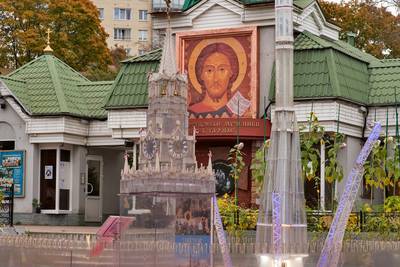
Church of the Tikhvin Icon of the Mother of God near the train station in Sestroretsk. The huge icon of Jesus and the rocket models is part of a distinct chapel and memorial complex dedicated to the Royal Martyrs (Tsar Nicholas II and his family) and the spiritual protection of Russia. The Rockets: The models of space rockets (one clearly marked "VOSTOK") are part of a unique, patriotic, and somewhat eclectic display. The local spiritual community, led by Father Gavriil (Gabriel), is known for combining intense Orthodox devotion with Soviet/Russian patriotic symbols, viewing the country s history (including the space age) through a spiritual lens. This particular "installation" links the idea of "spiritual ascent" with the physical ascent of space exploration, a quirky but sincere local expression of faith. The "Clock Tower": The transparent model tower with clocks is a stylized representation of the Spasskaya Tower of the Moscow Kremlin. The Kremlin is often associated with state power, and its inclusion here reinforces the church s focus on the spiritual destiny of the Russian state. This is one of the most idiosyncratic religious sites in the St. Petersburg region--a place where Tsarist martyrdom, Orthodox mysticism, and Soviet space achievements are all visually blended together. Russia, October 9, 2025  Firing squad executing a group of orthodox priests for political reasons on a wall icon "Novomucheniki Petrogradskiye" (Petrograd martyrs) in Kazanskaya Church in Novodevichiy Cathedral. Saint Petersburg, Russia, June 26, 2010  Church of an icon of Tikhvin god s mother in Syas Pogost near Novaya Ladoga. Leningrad Region, Russia, August 6, 2016  Interior of church of an icon of Tikhvin god s mother in Syas Pogost near Novaya Ladoga. Leningrad Region, Russia, August 6, 2016  Church of Icon of God s Mother (1858) in Cemetery No. 1 in Kingisepp. Russia, May 5, 2019  Chapel of Iverskaya Icon of a god s mother on Tsaritsynsky Proezd. Saint Petersburg, Russia, January 2, 2017  This view from Rataskaevu Street looks directly towards the imposing St. Nicholas Church (Niguliste kirik), creating one of the most picturesque and architecturally significant scenes in Tallinn s Old Town. The dominant feature is the massive tower of St. Nicholas Church, dedicated to the patron saint of merchants and sailors. The church, originally built in the 13th century as a fortress-church, showcases a mix of Gothic and Baroque elements. The current Baroque spire (added in the late 17th century) rises high above the street, while the lower sections reveal the heavy limestone walls typical of medieval defense structures. At the base of the tower, one can see the Small Chapel (Va"ike kabel) and the Clodt Chapel. The smaller, yellow-and-white structure with the arched entrance (left foreground) is the Chapel of St. Matthew (later St. George), adding a touch of color and intricate detail to the otherwise austere stone facade. Estonia, October 16, 2025  This perspective from the St. Nicholas Church tower looks south-west towards Toompea Hill, highlighting the architectural contrast between the medieval fortifications and the 19th-century Russian influence. The dominant feature is the Alexander Nevsky Cathedral, a grand Russian Orthodox church built between 1894 and 1900. Its distinctive black onion domes and Russian Revival style stand out vividly against the red-tiled roofs of the Old Town. This location on Toompea Hill was chosen symbolically to face the governor s palace, representing the power of the Russian Empire at the time. In the foreground, you can see part of the city s defensive wall system. The limestone wall connecting the Maiden Tower to the other fortifications (like the Kiek in de Ko"k, just out of frame to the left) marks the historic boundary between the lower town and the upper citadel of Toompea. Estonia, October 16, 2025  This view from the St. Nicholas Church tower looks down into the heart of the lower town, specifically capturing the densely packed historic streets below. Ru"u"tli and Rataskaevu Streets: The view likely centers on the intersection or alignment of Ru"u"tli (Knight) and Rataskaevu streets, which run close to the church. These streets are characterized by their medieval layout and historic merchant houses. The prominent yellow building with the red roof in the foreground (bottom center) stands out with its orderly rows of windows and distinct dormers. This is typical of the 18th and 19th-century residential architecture found in this part of the Old Town, often housing guest apartments today. The image perfectly illustrates the "red roofscape" of Tallinn, with various shades of terracotta tiles covering the gabled roofs. You can see the complex interplay of courtyards, chimneys, and firewalls that define the city s historic urban fabric. St. Olaf s in Distance: In the upper right corner, the spire of St. Olaf s Church pierces the skyline, providing a vertical counterpoint to the horizontal spread of the lower town. The view extends to the gray waters of the bay in the background, reinforcing the city s coastal setting. Estonia, October 16, 2025  Gilded icon of Saint Isaac Cathedral. Saint Petersburg, Russia, June 26, 2009  St. Nicholas Church (Niguliste kirik), located at Niguliste 3 in Tallinn s Old Town. Although originally built as a fortress church in the 13th century dedicated to Saint Nicholas (patron of sailors and merchants), it is no longer a functioning place of worship. Today, it houses the Niguliste Museum, a branch of the Art Museum of Estonia, dedicated to medieval ecclesiastical art. The church was founded by Westphalian merchants in the 1230s and was one of the wealthiest in the city. It was heavily damaged during the Soviet bombing of Tallinn in March 1944, losing its roof and most of its interior, but was meticulously restored in the following decades. The tower, rebuilt with a Baroque spire, now features a glass elevator and a viewing platform offering panoramic views of the city. The church sits on a rise just south of the Town Hall Square, surrounded by a green area that was once a cemetery. The street in the foreground is Niguliste Street, leading up from the lower town. Tallinn, Estonia, October 16, 2025  Northern end of Vene Street (Vene ta"nav) at the intersection with Olevima"gi and Bremeni ka"ik. The red brick building on the immediate left is located at Vene 28. It is a historic structure that was originally built in 1912 as a residential building and briefly housed the Estonian Provisional Government in 1918. It stands out with its industrial-style red brick facade contrasting with the medieval stone walls nearby. The large limestone wall with the archway on the far left is part of the city s defensive fortifications, specifically near the Bremen Tower (Bremeni torn). The archway leads into Bremen Passage (Bremeni ka"ik), a short, atmospheric walkway that connects Vene Street to Uus Street through the city wall. The tower itself, a 15th-century horseshoe-shaped defensive structure, is located just behind this wall. In the background, at the end of the street, you can see the yellow tower and facade of the Orthodox Church of St. Nicholas (Nikolai kirik) at Vene 24. Designed by architect Luigi Rusca and built between 1820-1827, this Neoclassical church serves a congregation under the Moscow Patriarchate and is known for its valuable iconostasis. It sits on the site of a much older church that served Novgorod merchants in the Middle Ages. Tallinn, Estonia, October 16, 2025  This image details the predella (the base section) of the High Altar retable in St. Nicholas Church. The central theme of this section is the Holy Kinship (Sancta Proles), depicting the extended family of the Virgin Mary, a subject that was extremely popular in Northern Europe during the late 15th century. The figures are carved from wood, painted, and gilded, showcasing the exquisite craftsmanship of Hermen Rode s workshop. Estonia, October 16, 2025  Panoramic view from the Tarkhovka shoreline that looks north-west across the Sestroretsky Razliv (Lake Sestroretsk) toward the city of Sestroretsk. This view captures the dual nature of Sestroretsk: a historic resort town with natural beauty (the lake, reeds, and stones) juxtaposed with modern urban infrastructure (heating plant and high-rise housing). "Three Chimneys" (Center): The most prominent industrial feature is the cluster of three tall red-and-white striped chimneys. These belong to the Sestroretsk District Heating Plant (part of the city s thermal infrastructure). Residential Towers (Left of Chimneys): The tall, beige-and-orange brick apartment buildings are part of the modern residential developments in Sestroretsk, likely along Tokarevskaya Street or the Razliv microdistrict. Church of Peter and Paul (Far Right): On the far right horizon. This is a modern church (consecrated in 2009) built in memory of the Russian submariners. "Pyramid" Building (Far Left): On the far left, there is a distinctive white building with a stepped, pyramid-like shape. This is likely the "Eden" (Edem) residential complex or a similar luxury apartment block, which is known for its terraced architecture. Tarkhovka Park near Sestroretsk, west from Saint Petersburg. Russia, October 3, 2025  Graffiti series, located on the concrete retaining wall separating the beach from the promenade along the Gulf of Finland (near the Sestroretsk Resort or "Kurort" area) which is a fanciful and nostalgic mural composition featuring whimsical animals and nature motifs. A distinct horizontal band runs across part of the mural, depicting a long, grey commuter train (possibly an elektrichka) traveling through a green landscape. This element likely references the vital railway connection between St. Petersburg and the resort towns of the Kurortny District, a familiar sight for locals and visitors. Saint Petersburg, Russia, October 9, 2025  This street scene is located on Pikk Street, just north of the Pikk Jalg gate, looking back towards the city center. The baroque spire visible in the distance belongs to St. Nicholas Church (Niguliste kirik). Originally built in the 13th century and dedicated to the patron saint of merchants and seafarers, it is one of the city s most defining landmarks. The tower now features a glass elevator and viewing platform offering 360-degree views of the Old Town. The building at the corner (implied by the location) is part of the historic Kolmjalg ("Tripod") complex, a notable architectural feature at the junction of Pikk and Voorimehe streets, known for its medieval origins. Estonia, October 16, 2025  Evening view of Lai Street (looking towards St. Olaf s Church). The large grey building on the right (Lai 44/46) stands out with its curved bay windows and decorative facade elements. This is a fine example of Jugendstil (Art Nouveau) architecture, which appeared in Tallinn during the early 20th century. Its smoother lines and larger windows contrast sharply with the smaller medieval merchant houses nearby. On the left, the yellow building (Lai 33) retains a more traditional, modest scale typical of the street s residential past. At the end of the street, the illuminated white tower of St. Olaf s Church (Lai 50) acts as a dramatic focal point. The lighting accentuates the church s massive walls and the green copper spire against the twilight sky. Tallinn, Estonia, October 16, 2025  This is the interior of St. Nicholas Church (Niguliste kirik), now a museum of medieval art, looking towards the east end of the nave. The centerpiece is the magnificent High Altar retable (visible in the distance), a masterpiece of late medieval art created by the workshop of Lu"beck master Hermen Rode between 1478 and 1481. It is one of the largest and best-preserved altarpieces of its kind in Europe, measuring over six meters wide when fully open. The artwork depicts the lives of St. Nicholas and St. Victor, alongside more than thirty sculptures of saints. Coat-of-Arms Epitaphs: The white limestone walls of the nave are adorned with a unique collection of large, colorful coat-of-arms epitaphs (seen on the right wall). These were dedicated to wealthy local merchants and nobility from the 17th and 18th centuries, serving as memorials for those buried within the church. Estonia, October 16, 2025  Intersection on Pikk Street (at Pikk 17), looking towards the Town Hall Square area. The view is dominated by two historically significant buildings and a lively restaurant scene. The large, gabled building on the right (Pikk 17) is the Great Guild Hall, built in 1417. For centuries, this was the meeting place for the city s most powerful merchants (the Great Guild), who controlled the town council. The building is a masterpiece of medieval limestone architecture, featuring a prominent Gothic portal and a high saddle roof. Today, it houses the Estonian History Museum. The smaller archway next to it (right foreground) is a historic passage, the "Bo"rsi ka"ik" (Exchange Passage), leading towards the Holy Spirit Church. Though partially obscured, the building further down the street with the stepped gable is connected to the complex of the Church of the Holy Spirit. This church is famous for its 17th-century painted clock, the oldest in Tallinn, which faces Pikk Street (though not clearly visible from this specific angle). This section of Pikk Street is a major pedestrian artery, connecting the northern part of the Old Town (where St. Olaf s is) to the central Town Hall Square. Tallinn, Estonia, October 16, 2025  Rebuilding of the Forest Building (Russian: Lesnoy Korpus) in a major reconstruction project at the historic Sestroretsk Resort (Sestroretsky Kurort). The original Sestroretsk Resort was a famous health spa complex founded in 1898 by engineer Peter Avenarius. It featured several grand wooden structures, including a massive Kursaal (concert hall), a mud bath facility, and the Forest Building. The resort was a hub for St. Petersburg s elite and intelligentsia in the early 20th century. The original Forest Building was a beautiful wooden hotel and sanatorium building constructed in the early 1900s. It was a key part of the ensemble but was destroyed during World War II. The new structure faithfully replicates the "Northern Art Nouveau" style of the original resort architecture, characterized by its complex roofline, spires, towers, and wooden detailing that harmonizes with the surrounding pine forest and dunes. The exterior appears nearly complete, showing the elaborate wooden facade, the large central dome, and the corner towers with their needle-like spires. The scaffolding indicates that finishing work is still in progress. Saint Petersburg, Russia, October 9, 2025  A double gallery house at 2709 Royal Street (Marie D Aunoy - Miltenberger - Nott - Maurice Garvey) and two towers of Holy Trinity Church in Faubourg Marigny. New Orleans, Louisiana, May 14, 2005.  Typical shotgun houses near Royal Street in Holy Cross neighborhood. New Orleans, Louisiana, January 21, 2006  Looking south from the Friendship Bridge, this view captures the recreational and spiritual side of the city, contrasting with the military fortifications seen on the other side. The prominent spire in the distance belongs to the Narva Alexander s Cathedral, an Evangelical Lutheran church built in the late 19th century. Its distinct octagonal tower is a major city landmark that survived severe damage during WWII. Along the riverbank, one see the modern architecture of the Joaorg Beach Building (the low, tiered structure nestled in the trees). This area serves as a popular public space with a swimming beach, gym, and promenade, offering locals a place to relax by the river. Estonia, October 16, 2025  Interior of Vladimir Cathedral (orthodox church) at 9A Lenina Street. Kronstadt, part of Saint Petersburg, Russia, August 28, 2013  Fourcade Hall (Holy Family Church) near Road 57 (Grand Caillou), Terrebonne Parish. Dulac, Louisiana, June 25, 2005  Church Spas Na Vodakh on Angliyskaya Embankment. Saint Petersburg, Russia, March 11, 2017  Russian Orthodox church of Peter and Paul in Siverskaya, 45 miles south from Saint Petersburg. Russia, July 6, 2003  Holy Name of Jesus Church of Loyola University at 6363 Saint Charles Avenue. New Orleans, Louisiana, February 3, 2006  Holy Name of Jesus Church and a palm in Loyola University on Saint Charles Avenue. New Orleans, Louisiana, February 3, 2006  View of the Slavyanka River showing the "picturesque meadow" aesthetic, distinct from the wooded ravine views seen earlier. Pavlovsk, a suburb of Saint Petersburg, Russia, October 6, 2025  Holy Name of Jesus Church of Loyola University at 6363 Saint Charles Avenue at evening. New Orleans, Louisiana, April 6, 2006  Plaster replications of hands in a niche dedicated to the healed in Chapel of Saint Roch Cemetery. New Orleans, Louisiana, May 26, 2006  This panoramic view from the tower of St. Nicholas Church looks south-west towards Toompea Hill, capturing the dense layering of Tallinn s medieval and religious history. The striking structure with black onion domes is the Alexander Nevsky Cathedral, an Orthodox cathedral built in 1900 in the Russian Revival style. Its imposing presence on Toompea Hill contrasts sharply with the surrounding red-tiled roofs, symbolizing the complex history of the Russian era in Estonia. In the foreground and middle distance, you can see key parts of the city s defensive network: The square tower with the tall red roof in the foreground is the Maiden Tower, a 14th-century defensive structure that now houses a cafe. Just behind and slightly to the left of the Maiden Tower (partially obscured) is the massive Kiek in de Ko"k artillery tower, whose Low German name ("Peep into the Kitchen") referred to the guards ability to see into nearby homes. Connective sections of the medieval city wall run between these towers, marking the boundary between the lower town and the upper citadel. The green space visible near the base of the wall is the Danish King s Garden (Taani kuninga aed). According to legend, this is where the Danish flag (Dannebrog) fell from the sky during a battle in 1219, turning the tide in favor of the Danes. The garden sits on the slope directly facing St. Nicholas Church. Estonia, October 16, 2025  Holy Sepulchre (where the body of Jesus was laid after crucifixion) in Rotunda of the Church of the Holy Sepulchre in the Old City. Now, it faces frequent clashes between tourist groups keeping each other from entering out of turn. Jerusalem, the Middle East, June 17, 2000  Shrine of Saint Jude in the chapel of Our Lady of Guadalupe Church at 411 North Rampart Street, a corner of Conti Street (Mortuary Chapel, "the Church of the Dead"). New Orleans, Louisiana, August 5, 2006  A statue of Saint Jude in the chapel of Our Lady of Guadalupe Church at 411 North Rampart Street, a corner of Conti Street (Mortuary Chapel, "the Church of the Dead"). New Orleans, Louisiana, December 9, 2006  Shrine of Saint Jude in the chapel of Our Lady of Guadalupe Church at 411 North Rampart Street, a corner of Conti Street (Mortuary Chapel, "the Church of the Dead"). New Orleans, Louisiana, December 21, 2006  This view from the St. Nicholas Church tower focuses on the southwestern edge of the Old Town, dominated by medieval fortifications and the lush greenery of Toompea s slopes. The massive round tower on the right is Kiek in de Ko"k ("Peep into the Kitchen"), a 15th-century artillery tower. Its formidable stone walls, over 4 meters thick, were designed to withstand cannon fire, making it the most powerful defensive tower in the Baltic region during its time. Today, it houses a fortification museum. Below the tower, the cobblestone street running vertically is Ru"u"tli Street, historically home to the city s executioner and later a quiet residential area. To the left of Ru"u"tli Street, the large building with the expansive red-tiled roof is the Swedish St. Michael s Church (Rootsi-Mihkli kirik). Originally a medieval hospital and poorhouse, it was converted into a church for the Swedish garrison and community. Its simple, robust architecture contrasts with the more ornate merchant houses found elsewhere in the Old Town. Estonia, October 16, 2025  This view from the tower of St. Nicholas Church offers a fascinating contrast between medieval history, post-war reconstruction, and modern urban growth, looking east towards the city center. The most prominent building in the immediate foreground is the large, grey, L-shaped structure known as the Writers House (Kirjanike Maja) on Harju Street. Built in 1963 on the ruins of buildings destroyed during the 1944 Soviet bombing of Tallinn, this modernist structure is a significant cultural landmark. It houses the Estonian Writers Union, a well-known bookstore, and the famous Cafe Pegasus, serving as a hub for the country s literary scene. The street running along the left side of the Writers House is Harju Street, historically one of the city s main commercial arteries. The open green space visible nearby (part of the Harju Street green area) was also created following the wartime destruction, serving as a memorial and recreational space before partial reconstruction debates in recent years. In the background, the view opens up to Tallinn s modern business district. The cluster of high-rise glass buildings, including the distinct wedge-shaped Swisso^tel and the SEB Bank headquarters, illustrates the city s rapid economic development and stands in stark contrast to the red-tiled roofs of the Old Town below. Estonia, October 16, 2025  Beefsteak mushrooms (Fistulina hepatica) growing a huge old oak in Dubki Park. Sestroretsk near Saint Petersburg, Russia, October 9, 2025  Church models in Museum of Orthodox Christian Odessa in Archangel Michael Monastery for women. Odessa, Ukraine, July 2, 2009  This view from the St. Nicholas Church (Niguliste) tower looks down towards the dense medieval streets of the lower town, offering a detailed perspective of the residential architecture and rooftops. The narrow, curved street cutting through the scene is Rataskaevu Street, one of the most picturesque lanes in the Old Town. Yellow Building: The prominent, multi-story yellow building in the foreground (with the large red-tiled roof and dormer windows) is likely situated on or near Rataskaevu Street. Buildings in this area often date from the 18th or 19th centuries and now frequently house guest apartments, such as the Rataskaevu Boutique Apartments or Rataskaevu Guest Apartment. Its bright facade and orderly fenestration are typical of the later updates to the medieval fabric. The image showcases the iconic "sea of red roofs" that defines Tallinn s aerial aesthetic. The jumble of gables, chimneys, and varying roof pitches reveals the organic development of the city over centuries. In the background, the spire of St. Olaf s Church (Oleviste kirik) rises above the horizon, providing a vertical anchor to the cityscape and connecting the view to the harbor beyond. Estonia, October 16, 2025  Pores of mature beefsteak fungus (Fistulina hepatica) from a huge old oak in Dubki Park. Sestroretsk near Saint Petersburg, Russia, October 9, 2025  Broken mature beefsteak fungus (Fistulina hepatica) on a huge old oak in Dubki Park. Sestroretsk near Saint Petersburg, Russia, October 9, 2025  Istok Lake at "Golden Hour". The sunrise reveals distinct layers in the forest structure: birch curtain, pine canopy, spruce backdrop. Kannelyarvi, north from Saint Petersburg, Russia, October 1, 2025  Leuchtenberg Palace, designed by architect Andrei Stackenschneider and completed in 1842. The facade reflects the Late Classicism style (resembling a Roman villa), characterized by a grand portico with Corinthian columns, symmetrical window arrangements, and a pediment that gives the structure a noble, temple-like appearance. The palace s yellow stucco walls show signs of weathering and peeling paint, contributing to the estate s romantic, slightly melancholic atmosphere of a "forgotten" royal residence. The palace is situated on a terrace overlooking the Gulf of Finland, with its color palette harmonizing with the surrounding golden autumn foliage, reinforcing the seamless blend of architecture and nature intended by its designers. Sergievka Park, Old Peterhof, west from Saint Petersburg, Russia, October 13, 2025  Some chapel of Church of Holy Sepulchre. Jerusalem, the Middle East, December 13, 2002.  Colorful moss which is a mix of Sphagnum species, with the distinct red one likely being Red Bog-moss (Sphagnum rubellum) at Eco Trail Sestroretskoye Swamp near Saint Petersburg. Russia, October 2, 2025  Entrance to Holy Sepulchre (Angels Chapel is seen just behind the entrance) of the Church of the Holy Sepulchre in the Old City. Jerusalem, the Middle East, June 17, 2000  Mu"u"rivahe Street (Mu"u"rivahe ta"nav), looking towards the intersection with Viru Street. The image is taken near Mu"u"rivahe 23, which is the location of the Armanda clothing boutique visible on the left. The narrow, cobblestone street retains its medieval charm, winding between historic buildings that date back centuries. In the background, one can see a striking turquoise-colored tower with a weathervane. This is part of the building complex at the corner of Viru and Mu"u"rivahe streets, adding a distinct vertical accent to the streetscape. Tallinn, Estonia, October 16, 2025  Coptic chapel of the Church of Holy Sepulchre. Jerusalem, the Middle East, December 13, 2002.  Syrian chapel of the Church of Holy Sepulchre. Jerusalem, the Middle East, December 13, 2002.  A vibrant intersection in Tallinn s Old Town where Pikk Street meets Pu"havaimu Street. The white building with the stepped gable and tall, slender spire on the right is the Church of the Holy Spirit (Pu"havaimu kirik). It is a 14th-century church that originally served the common people. A prominent feature on the church s white facade is the magnificent painted clock. Created by the woodcarver Christian Ackermann in 1684, it is the oldest public timepiece in Tallinn and is still in working order. The yellow building on the left (Pikk 16) is the famous Maiasmokk Cafe. Operating since 1864, it is the oldest continuously running cafe in Estonia. The ground floor features a beautifully preserved interior that has remained largely unchanged for nearly a century. Tallinn, Estonia, October 16, 2025  Fibrous, rusty-brown section of mature beefsteak fungus (Fistulina hepatica) from a huge old oak in Dubki Park. Sestroretsk near Saint Petersburg, Russia, October 9, 2025  Stone of Unction (upon which the body of Jesus was anointed) behind the entrance to the Church of the Holy Sepulchre in the Old City. Jerusalem, the Middle East, June 17, 2000  This image provides a closer view of the High Altar retable in St. Nicholas Church, showcasing its impressive scale and detail. Commissioned by the Great Guild and the Brotherhood of the Black Heads, this masterpiece was created between 1478 and 1481 in the Lu"beck workshop of Hermen Rode. It is a double-winged altarpiece, meaning it has two sets of wings that can be opened to reveal different scenes. In this "half-open" view, the panels display painted scenes from the legends of St. Nicholas (patron of the church and merchants) and St. Victor (patron of Tallinn). Estonia, October 16, 2025  A corner of Saint Peter and Royal streets in French Quarter. LaBranche House at 700 Royal Street is on the left, and Pedesclaux - Lemonnier House at 640 Royal Street is on the right. New Orleans, Louisiana, May 1, 2006  A niche dedicated to the healed in Chapel of Saint Roch Cemetery. Relics include casts of hands, feet, legs, head, brain, heart, ear, even a tooth. New Orleans, Louisiana, May 26, 2006  Old monument of Russian communist revolutionary Vladimir Ilyich Ulyanov (Lenin) together with Orthodox Church of St. Peter Afonsky and Dutchess Olga at Military Base No. 28287 in Morye, west from Saint Petersburg. Russia, May 13, 2021  This view from the St. Nicholas Church (Niguliste kirik) viewing platform offers a detailed look at the dense, red-roofed tapestry of Tallinn s Old Town, looking north towards the harbor. Dominating the skyline on the right is the spire of St. Olaf s Church (Oleviste kirik), which historically served as a navigational landmark for ships. Its green copper spire contrasts sharply with the surrounding red clay tiles. Looking directly down into the "canyon" of streets, one can trace Rataskaevu Street winding through the heart of the lower town. The prominent yellow building in the foreground (with the red roof and dormer windows) is likely part of the historic housing blocks near Rataskaevu and Ru"u"tli streets. Its bright facade stands out against the more muted tones of the neighboring structures. The view captures the intricate layers of the city s architecture--chimneys, dormer windows, and varying roof pitches that reveal the organic growth of the medieval city over centuries. Estonia, October 16, 2025  Church of Savior on Blood. Saint Petersburg, Russia, May 30, 2009  Small, delicate brown mushrooms with a distinct ring on the stem that are likely Conocybe rugosa (Pholiotina rugosa) found on a lawn in Peter the Great Botanical Garden of Komarov Botanical Institute. Saint Petersburg, Russia, October 8, 2025  Interior of Archangel Cathedral in Kremlin (Arkhangelsky sobor of Russian Orthodox church). Moscow, Russia, July 3, 2011  This close-up reveals the intricate half-open view of the Rode Altarpiece, one of the most significant medieval artworks in Northern Europe. In this position, the altarpiece functions as a visual storybook, displaying painted panels that narrate the lives of two key saints: Left Wings (St. Nicholas): The panels on the left depict scenes from the life and miracles of St. Nicholas, the patron saint of the church and protector of merchants and sailors. Right Wings (St. Victor): The panels on the right illustrate the martyrdom and legend of St. Victor of Marseilles, the patron saint of Tallinn. Notably, one of these scenes features a detailed cityscape in the background that is believed to be a depiction of medieval Lu"beck, the city where the altar was made. Estonia, October 16, 2025  Russian orthodox church of Mary Magdalene on a slope of Mount of Olives. Jerusalem, the Middle East, October 31, 2002  This is the No~elasilma ("Eye of the Needle") Gate, a reconstructed section of the medieval urban fabric located at the end of Niguliste Street. Originally, this area was a densely built-up part of the Old Town, near the historic Harju Gate. However, the neighborhood was largely destroyed during the March 1944 Soviet bombing, which leveled about 20% of Tallinn s buildings, particularly in the Harju and Niguliste street areas. The ruins stood for decades before the area was cleared and later redeveloped as a green space and memorial. The No~elasilma Gate itself was reconstructed in 2006-2007 as part of an effort to restore the medieval street network and mark the historical boundary of the former churchyard. The structure consists of two limestone walls with arched openings, mimicking the narrow passageways typical of the medieval city. Looking through the gate, you see the cobblestones of Niguliste Street. In the background stands a distinct corner tower with a red tiled roof, part of the residential block that survived or was restored after the war. The modern apartment buildings on the left (Harju Street area) are post-war constructions, filling the void left by the bombing. The gate now serves as a poignant reminder of the city s lost layers and its resilience. Estonia, October 16, 2025  Albrecht family crypt near a church in Kotly Villae. Kingisepp Region of Leningrad District, Russia, January 4, 2016  Looking down Mu"u"rivahe Street (Mu"u"rivahe ta"nav), running alongside the medieval city wall of Tallinn. The dominant feature is the massive, 14th-century limestone defensive wall on the right. What stands out in this specific section (near Mu"u"rivahe 52) are the large concrete buttresses supporting the wall. Unlike the original medieval masonry, these are modern reinforcements added during the Soviet era (specifically in the late 1960s or 70s) to stabilize this section of the wall, which was in danger of collapsing. While effective, they are often noted for their distinct, brutalist contrast with the historic stonework. Further down the wall, you can see the red-tiled roof of the defensive walkway (chemin de ronde) and the towers (Hellemann Tower is nearby) that made Tallinn one of the best-fortified cities in Northern Europe. At the base of the wall, the original pointed arches (niches) are illuminated, highlighting the texture of the rough-hewn limestone. These niches historically housed workshops or stalls. The street name "Mu"u"rivahe" literally means "the gap between the walls," referring to the space between the main city wall and the lower defensive earthworks that once existed here. Tallinn, Estonia, October 16, 2025  Church of Savior on Blood. Saint Petersburg, Russia, July 3, 2003  Medusa face on Kozhevnikova Lane in Smolenskoe Cemetery of Vasilievsliy Island. Saint Petersburg, Russia, October 27, 2016  The "Adam s Head" (or Golova-valun:feff) sculpture presents a striking profile view, revealing its deep-set eye and prominent nose emerging from the earth. Bright yellow maple leaves carpeting the ground and contrasting with the grey granite. A small spring flows near the base of the sculpture (visible in the foreground as a trickle), adding to the mystical atmosphere that reportedly inspired Lewis Carroll during his visit in 1867. This angle emphasizes the massive scale of the boulder relative to the path, showing how the face was carved directly into the natural granite contours. Sergievka Park, Old Peterhof, west from Saint Petersburg, Russia, October 13, 2025  White flowers of mustard family near train station of Komarovo, 25 miles north-west from Saint Petersburg. Russia, May 9, 2016  White inflorescence of mustard family near train station of Komarovo, 25 miles north-west from Saint Petersburg. Russia, May 9, 2016  Ceiling of Church of Savior on Blood. Saint Petersburg, Russia, June 25, 2009  Domes of Church of Savior on Blood. Saint Petersburg, Russia, June 10, 2014  Arches of Church of Savior on Blood. Saint Petersburg, Russia, June 25, 2009  Altar of Church of Savior on Blood. Saint Petersburg, Russia, December 20, 2005  Arches of Church of Savior on Blood. Saint Petersburg, Russia, February 2, 2013  Church of Savior on Blood in downtown Saint Petersburg. Russia, February 1, 2000  Vaults of Church of Savior on Blood. Saint Petersburg, Russia, June 25, 2009  Mosaics of Church of Savior on Blood. Saint Petersburg, Russia, June 25, 2009  Vaults of Church of Savior on Blood. Saint Petersburg, Russia, February 2, 2013  Decorations of Church of Savior on Blood. Saint Petersburg, Russia, February 2, 2013  Mosaic of Church of Savior on Blood. Saint Petersburg, Russia, February 2, 2013  Columns of Church of Savior on Blood. Saint Petersburg, Russia, February 2, 2013  Ceiling of Church of Savior on Blood. Saint Petersburg, Russia, June 2, 2014  Ceiling of Church of Savior on Blood. Saint Petersburg, Russia, February 2, 2013  Paintings of Church of Savior on Blood. Saint Petersburg, Russia, February 2, 2013  Ceiling of Church of Savior on Blood. Saint Petersburg, Russia, June 2, 2014  Altar of Church of Savior on Blood. Saint Petersburg, Russia, June 2, 2014  Interior of Church of Savior on Blood. Saint Petersburg, Russia, June 2, 2014  Ceiling of Church of Savior on Blood. Saint Petersburg, Russia, December 20, 2005  Altar of Church of Savior on Blood. Saint Petersburg, Russia, February 2, 2013  Domes of Church of Savior on Blood. Saint Petersburg, Russia, December 23, 2016  Interior of Church of Savior on Blood. Saint Petersburg, Russia, June 25, 2009  Althar(?) of Church of Savior on Blood. Saint Petersburg, Russia, June 25, 2009  An old transformer substation (or similar utility building) in Lanskoy Garden on Sampsonievsky Prospekt near Lanskaya train Station. Its brick walls have effectively become an unofficial community billboard, covered in layers of concert posters (e.g., for the singer Linda). Saint Petersburg, Russia, October 9, 2025  An Orthodox church in Gornensky Convent for women (the Russian Orthodox Mission of Moscow Patriarchate in Jerusalem). Ein Kerem (western Jerusalem). The Middle East, August 15, 2002  An Orthodox church in Gornensky Convent for women (the Russian Orthodox Mission of Moscow Patriarchate in Jerusalem). Ein Kerem (western Jerusalem), the Middle East, December 30, 2000 |