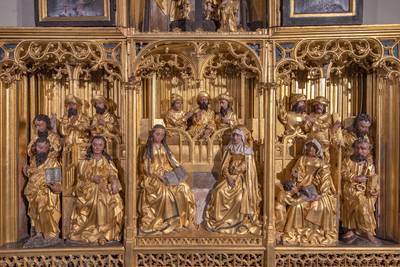
This image provides a closer view of the High Altar retable in St. Nicholas Church, showcasing its impressive scale and detail. Commissioned by the Great Guild and the Brotherhood of the Black Heads, this masterpiece was created between 1478 and 1481 in the Lu"beck workshop of Hermen Rode. It is a double-winged altarpiece, meaning it has two sets of wings that can be opened to reveal different scenes. In this "half-open" view, the panels display painted scenes from the legends of St. Nicholas (patron of the church and merchants) and St. Victor (patron of Tallinn). Estonia, October 16, 2025  This is the interior of St. Nicholas Church (Niguliste kirik), now a museum of medieval art, looking towards the east end of the nave. The centerpiece is the magnificent High Altar retable (visible in the distance), a masterpiece of late medieval art created by the workshop of Lu"beck master Hermen Rode between 1478 and 1481. It is one of the largest and best-preserved altarpieces of its kind in Europe, measuring over six meters wide when fully open. The artwork depicts the lives of St. Nicholas and St. Victor, alongside more than thirty sculptures of saints. Coat-of-Arms Epitaphs: The white limestone walls of the nave are adorned with a unique collection of large, colorful coat-of-arms epitaphs (seen on the right wall). These were dedicated to wealthy local merchants and nobility from the 17th and 18th centuries, serving as memorials for those buried within the church. Estonia, October 16, 2025  This close-up reveals the intricate half-open view of the Rode Altarpiece, one of the most significant medieval artworks in Northern Europe. In this position, the altarpiece functions as a visual storybook, displaying painted panels that narrate the lives of two key saints: Left Wings (St. Nicholas): The panels on the left depict scenes from the life and miracles of St. Nicholas, the patron saint of the church and protector of merchants and sailors. Right Wings (St. Victor): The panels on the right illustrate the martyrdom and legend of St. Victor of Marseilles, the patron saint of Tallinn. Notably, one of these scenes features a detailed cityscape in the background that is believed to be a depiction of medieval Lu"beck, the city where the altar was made. Estonia, October 16, 2025  This view from Rataskaevu Street looks directly towards the imposing St. Nicholas Church (Niguliste kirik), creating one of the most picturesque and architecturally significant scenes in Tallinn s Old Town. The dominant feature is the massive tower of St. Nicholas Church, dedicated to the patron saint of merchants and sailors. The church, originally built in the 13th century as a fortress-church, showcases a mix of Gothic and Baroque elements. The current Baroque spire (added in the late 17th century) rises high above the street, while the lower sections reveal the heavy limestone walls typical of medieval defense structures. At the base of the tower, one can see the Small Chapel (Va"ike kabel) and the Clodt Chapel. The smaller, yellow-and-white structure with the arched entrance (left foreground) is the Chapel of St. Matthew (later St. George), adding a touch of color and intricate detail to the otherwise austere stone facade. Estonia, October 16, 2025  Intersection on Pikk Street (at Pikk 17), looking towards the Town Hall Square area. The view is dominated by two historically significant buildings and a lively restaurant scene. The large, gabled building on the right (Pikk 17) is the Great Guild Hall, built in 1417. For centuries, this was the meeting place for the city s most powerful merchants (the Great Guild), who controlled the town council. The building is a masterpiece of medieval limestone architecture, featuring a prominent Gothic portal and a high saddle roof. Today, it houses the Estonian History Museum. The smaller archway next to it (right foreground) is a historic passage, the "Bo"rsi ka"ik" (Exchange Passage), leading towards the Holy Spirit Church. Though partially obscured, the building further down the street with the stepped gable is connected to the complex of the Church of the Holy Spirit. This church is famous for its 17th-century painted clock, the oldest in Tallinn, which faces Pikk Street (though not clearly visible from this specific angle). This section of Pikk Street is a major pedestrian artery, connecting the northern part of the Old Town (where St. Olaf s is) to the central Town Hall Square. Tallinn, Estonia, October 16, 2025  A vibrant intersection in Tallinn s Old Town where Pikk Street meets Pu"havaimu Street. The white building with the stepped gable and tall, slender spire on the right is the Church of the Holy Spirit (Pu"havaimu kirik). It is a 14th-century church that originally served the common people. A prominent feature on the church s white facade is the magnificent painted clock. Created by the woodcarver Christian Ackermann in 1684, it is the oldest public timepiece in Tallinn and is still in working order. The yellow building on the left (Pikk 16) is the famous Maiasmokk Cafe. Operating since 1864, it is the oldest continuously running cafe in Estonia. The ground floor features a beautifully preserved interior that has remained largely unchanged for nearly a century. Tallinn, Estonia, October 16, 2025  Looking down Mu"u"rivahe Street (Mu"u"rivahe ta"nav), running alongside the medieval city wall of Tallinn. The dominant feature is the massive, 14th-century limestone defensive wall on the right. What stands out in this specific section (near Mu"u"rivahe 52) are the large concrete buttresses supporting the wall. Unlike the original medieval masonry, these are modern reinforcements added during the Soviet era (specifically in the late 1960s or 70s) to stabilize this section of the wall, which was in danger of collapsing. While effective, they are often noted for their distinct, brutalist contrast with the historic stonework. Further down the wall, you can see the red-tiled roof of the defensive walkway (chemin de ronde) and the towers (Hellemann Tower is nearby) that made Tallinn one of the best-fortified cities in Northern Europe. At the base of the wall, the original pointed arches (niches) are illuminated, highlighting the texture of the rough-hewn limestone. These niches historically housed workshops or stalls. The street name "Mu"u"rivahe" literally means "the gap between the walls," referring to the space between the main city wall and the lower defensive earthworks that once existed here. Tallinn, Estonia, October 16, 2025  St. Nicholas Church (Niguliste kirik), located at Niguliste 3 in Tallinn s Old Town. Although originally built as a fortress church in the 13th century dedicated to Saint Nicholas (patron of sailors and merchants), it is no longer a functioning place of worship. Today, it houses the Niguliste Museum, a branch of the Art Museum of Estonia, dedicated to medieval ecclesiastical art. The church was founded by Westphalian merchants in the 1230s and was one of the wealthiest in the city. It was heavily damaged during the Soviet bombing of Tallinn in March 1944, losing its roof and most of its interior, but was meticulously restored in the following decades. The tower, rebuilt with a Baroque spire, now features a glass elevator and a viewing platform offering panoramic views of the city. The church sits on a rise just south of the Town Hall Square, surrounded by a green area that was once a cemetery. The street in the foreground is Niguliste Street, leading up from the lower town. Tallinn, Estonia, October 16, 2025  Looking south from the Friendship Bridge, this view captures the recreational and spiritual side of the city, contrasting with the military fortifications seen on the other side. The prominent spire in the distance belongs to the Narva Alexander s Cathedral, an Evangelical Lutheran church built in the late 19th century. Its distinct octagonal tower is a major city landmark that survived severe damage during WWII. Along the riverbank, one see the modern architecture of the Joaorg Beach Building (the low, tiered structure nestled in the trees). This area serves as a popular public space with a swimming beach, gym, and promenade, offering locals a place to relax by the river. Estonia, October 16, 2025  Rataskaevu Street (Rataskaevu ta"nav) in Tallinn s Old Town. The focal point in the small square is the famous Cat s Well (Rataskaevu), which gave the street its name. According to local legend, a water spirit lived in the well, and the townspeople would sacrifice stray cats into it to prevent the wells from running dry. The yellow building on the left (Rataskaevu 7) houses the St. Petersbourg Hotel. It is the oldest operating hotel in Tallinn, originally opened in 1850 and located in a 15th-century building that was once a Russian merchant s home. Opposite the well (out of frame to the right, but significant to the street s lore) is the building at Rataskaevu 16, famously known as the site of "The Devil s Wedding." Legend says the devil held a party in the upper room of this house, and to this day, there is a painted "false window" on the facade to block the view into that haunted room. The building now houses a very popular restaurant of the same name. Tallinn, Estonia, October 16, 2025  This view from the St. Nicholas Church tower focuses on the southwestern edge of the Old Town, dominated by medieval fortifications and the lush greenery of Toompea s slopes. The massive round tower on the right is Kiek in de Ko"k ("Peep into the Kitchen"), a 15th-century artillery tower. Its formidable stone walls, over 4 meters thick, were designed to withstand cannon fire, making it the most powerful defensive tower in the Baltic region during its time. Today, it houses a fortification museum. Below the tower, the cobblestone street running vertically is Ru"u"tli Street, historically home to the city s executioner and later a quiet residential area. To the left of Ru"u"tli Street, the large building with the expansive red-tiled roof is the Swedish St. Michael s Church (Rootsi-Mihkli kirik). Originally a medieval hospital and poorhouse, it was converted into a church for the Swedish garrison and community. Its simple, robust architecture contrasts with the more ornate merchant houses found elsewhere in the Old Town. Estonia, October 16, 2025  Decorative vase, located in the parterre of the park near the Main Building of the Forestry University, a concrete copy of a 19th-century original. The original vase was created in the 1860s by the famous sculptor David Jensen (1816-1902). The original work was carved from unpolished granite. Today s version is a concrete replica installed in the 1970s. The central motif depicts putti (cherubs), which are playful, chubby male children often found in classical art. The putti appear to be engaged in a playful struggle with a goat, a common allegorical theme in baroque and neoclassical art often representing the abundance of nature or Bacchic festivities. This theme fits well with the park s history as a place of botanical study and appreciation of nature. Lesnoy Park (Lesotekhnicheskiy Universitet), Saint Petersburg, Russia, October 14, 2025  Northern end of Vene Street (Vene ta"nav) at the intersection with Olevima"gi and Bremeni ka"ik. The red brick building on the immediate left is located at Vene 28. It is a historic structure that was originally built in 1912 as a residential building and briefly housed the Estonian Provisional Government in 1918. It stands out with its industrial-style red brick facade contrasting with the medieval stone walls nearby. The large limestone wall with the archway on the far left is part of the city s defensive fortifications, specifically near the Bremen Tower (Bremeni torn). The archway leads into Bremen Passage (Bremeni ka"ik), a short, atmospheric walkway that connects Vene Street to Uus Street through the city wall. The tower itself, a 15th-century horseshoe-shaped defensive structure, is located just behind this wall. In the background, at the end of the street, you can see the yellow tower and facade of the Orthodox Church of St. Nicholas (Nikolai kirik) at Vene 24. Designed by architect Luigi Rusca and built between 1820-1827, this Neoclassical church serves a congregation under the Moscow Patriarchate and is known for its valuable iconostasis. It sits on the site of a much older church that served Novgorod merchants in the Middle Ages. Tallinn, Estonia, October 16, 2025  Church of the Tikhvin Icon of the Mother of God near the train station in Sestroretsk. The huge icon of Jesus and the rocket models is part of a distinct chapel and memorial complex dedicated to the Royal Martyrs (Tsar Nicholas II and his family) and the spiritual protection of Russia. The "Face" Facade: The large face is a giant icon of the Savior Not Made by Hands (Spas Nerukotvorny). Below it, the red banner reads "Holy Royal Martyrs, Pray to God for Us", referring to the canonized Romanov family. Community: This church is known for its "Cossack" guard and a very distinct, staunchly monarchist and patriotic atmosphere that differs from typical Russian Orthodox parishes. Saint Petersburg. Russia, October 9, 2025  Aerial view of Tallinn. The heart of the image is the medieval Old Town, identifiable by its dense cluster of red-tiled roofs, church spires (including the tall St. Olaf s Church), and the fortified Toompea Hill. Surrounding the Old Town are the modern high-rises of the financial district (left foreground), including the Swisso^tel and Tornima"e towers. To the right, the Port of Tallinn (Vanasadam) stretches out into the Baltic Sea, with ferries and cruise ships visible. The sweeping coastline of the Tallinn Bay dominates the background. The clear blue sky and the calm sea suggest a crisp, sunny morning. View from a window of an airplane from Tallinn to Helsinki. Estonia, October 17, 2025  "The Seated Mourner" of Peters family in Calvert City Cemetery. Surrounding the central monument are individual headstones for family members, including: Elizabeth Peters (visible in the foreground, born 1842, died 1928). Baby Hanna Peters (1888-1890). Ruby Busch Peters (1894-1927). The size and artistry of the monument suggest the Peters family was of significant social and economic standing in Calvert, likely commissioning this work during the town s prosperous cotton era (late 19th/early 20th century). Calvert, Texas, December 13, 2025  Narrow, cobblestone street is Sauna Street (Sauna ta"nav), located in a lively section of the Old Town known for its nightlife and history. As the name implies, this street was historically the location of public bathhouses (saunas) dating back to the medieval period. The "Sauna Tower" of the city wall is also nearby, named for a women s sauna that once stood there. Today, Sauna Street and its immediate surroundings (connecting to Viru Street) are a popular destination for nightlife. The street is lined with well-known bars and clubs like Club Baila and Frank. The image shows the street in a relatively quiet moment, emphasizing the contrast between the historic architecture and the gritty urban texture. Tallinn, Estonia, October 16, 2025  This panoramic view from the tower of St. Nicholas Church looks south-west towards Toompea Hill, capturing the dense layering of Tallinn s medieval and religious history. The striking structure with black onion domes is the Alexander Nevsky Cathedral, an Orthodox cathedral built in 1900 in the Russian Revival style. Its imposing presence on Toompea Hill contrasts sharply with the surrounding red-tiled roofs, symbolizing the complex history of the Russian era in Estonia. In the foreground and middle distance, you can see key parts of the city s defensive network: The square tower with the tall red roof in the foreground is the Maiden Tower, a 14th-century defensive structure that now houses a cafe. Just behind and slightly to the left of the Maiden Tower (partially obscured) is the massive Kiek in de Ko"k artillery tower, whose Low German name ("Peep into the Kitchen") referred to the guards ability to see into nearby homes. Connective sections of the medieval city wall run between these towers, marking the boundary between the lower town and the upper citadel. The green space visible near the base of the wall is the Danish King s Garden (Taani kuninga aed). According to legend, this is where the Danish flag (Dannebrog) fell from the sky during a battle in 1219, turning the tide in favor of the Danes. The garden sits on the slope directly facing St. Nicholas Church. Estonia, October 16, 2025  This view from the St. Nicholas Church tower looks down into the heart of the lower town, specifically capturing the densely packed historic streets below. Ru"u"tli and Rataskaevu Streets: The view likely centers on the intersection or alignment of Ru"u"tli (Knight) and Rataskaevu streets, which run close to the church. These streets are characterized by their medieval layout and historic merchant houses. The prominent yellow building with the red roof in the foreground (bottom center) stands out with its orderly rows of windows and distinct dormers. This is typical of the 18th and 19th-century residential architecture found in this part of the Old Town, often housing guest apartments today. The image perfectly illustrates the "red roofscape" of Tallinn, with various shades of terracotta tiles covering the gabled roofs. You can see the complex interplay of courtyards, chimneys, and firewalls that define the city s historic urban fabric. St. Olaf s in Distance: In the upper right corner, the spire of St. Olaf s Church pierces the skyline, providing a vertical counterpoint to the horizontal spread of the lower town. The view extends to the gray waters of the bay in the background, reinforcing the city s coastal setting. Estonia, October 16, 2025  A view of Suur-Karja Street (Suur-Karja ta"nav), one of the main arteries in Tallinn s Old Town. This street is famously (or infamously) known as the "Bermuda Triangle" of Tallinn s nightlife. The intersection of Suur-Karja and Va"ike-Karja streets is packed with bars, pubs, and clubs, making it the busiest party spot in the city on weekends. The street is lined with historic buildings that date back centuries. For instance, the building at Suur-Karja 12 (partially visible on the left) is a late-Gothic merchant house with roots in the 15th century. It has recently undergone extensive renovation to modernize its interiors while preserving its medieval stone fac,ade and window details. The street name "Suur-Karja" translates to "Great Cattle Street," referencing its medieval function as the route used to drive cattle from the city center out to pastures through the Karja Gate. Today, it connects the heart of the Old Town with Pa"rnu Road and the modern city center. Tallinn, Estonia, October 16, 2025  Wider view of the Volle family plot in the Calvert City Cemetery. Volle Family Stone (Left): The large, upright granite headstone on the left commemorates the parents of the "Little Robert" statue. J.G. Volle: Born Oct 23, 1843, Died Nov 19, 1908. He was a prominent local merchant. Mary Ellen Volle: Born Dec 8, 1855, Died Apr 14, 1906. She was J.G. s wife. "Little Robert" Statue (Center-Background): The statue of the cherub ("Holly Robert Volle"). Large "VOLLE" Block (Right): A massive granite block with the family name "VOLLE" carved in relief stands in the foreground, serving as the central family plot marker. Calvert, Texas, December 13, 2025  This street scene captures the historic Vana Turg (Old Market) area in Tallinn s Old Town, viewed from the intersection near Viru Street. The prominent white building with the stepped gable in the center is the medieval Packinghouse, now home to the famous Olde Hansa restaurant. Dating back to the 15th century and later rebuilt in the 1650s, this structure originally served as a warehouse for foreign merchants and is a key example of Tallinn s Hanseatic architecture. To the left, the tall yellow building is the Peppersack restaurant, another historic merchant house that dates back to the 14th-15th centuries. Estonia, October 16, 2025  A lively intersection of Suur-Karja and Vana turg. The central white building with the high, decorated gable (Suur-Karja 1) is a significant medieval structure known as the Bishop s House. Dating back to the 13th-14th centuries, it historically served as the residence for the bishops of Tallinn. Its facade features Gothic niches and a hoist beam, typical of wealthy Hanseatic merchant homes. To the right, the outdoor terrace belongs to Kuldse Notsu Ko~rts (Golden Piglet Inn), located at Dunkri 8 (which intersects here). This restaurant is famous for its authentic Estonian cuisine, serving dishes like sausage feasts and pork knuckle based on traditional recipes. On the far left, the corner of the heavy stone building (Suur-Karja 18) houses residential apartments. The area is a bustling hub, filled with restaurants and cafes that spill out onto the cobblestones, overlooked by the spire of St. Nicholas Church in the background. Tallinn, Estonia, October 16, 2025  Statues near an altar of Saint Mary s Assumption Church. New Orleans, Louisiana, May 8, 2005.  This street scene is located on Pikk Street, just north of the Pikk Jalg gate, looking back towards the city center. The baroque spire visible in the distance belongs to St. Nicholas Church (Niguliste kirik). Originally built in the 13th century and dedicated to the patron saint of merchants and seafarers, it is one of the city s most defining landmarks. The tower now features a glass elevator and viewing platform offering 360-degree views of the Old Town. The building at the corner (implied by the location) is part of the historic Kolmjalg ("Tripod") complex, a notable architectural feature at the junction of Pikk and Voorimehe streets, known for its medieval origins. Estonia, October 16, 2025  Close-up of the "Adam s Head" (or "The Old Man") revealing the intricate craftsmanship carved directly into the granite boulder, highlighting its weathered texture and mysterious expression. The close view emphasizes the deeply carved eyes with distinct eyelids and pupils, gazing upward in a look of eternal surprise or contemplation. The nose is prominent and well-defined. The sculpture s rough granite surface is speckled with wet, yellow maple leaves, which contrast with the dark grey stone and emphasize its seamless, "sunken" placement within the forest floor. Sergievka Park, Old Peterhof, west from Saint Petersburg, Russia, October 13, 2025  This perspective from the St. Nicholas Church tower looks south-west towards Toompea Hill, highlighting the architectural contrast between the medieval fortifications and the 19th-century Russian influence. The dominant feature is the Alexander Nevsky Cathedral, a grand Russian Orthodox church built between 1894 and 1900. Its distinctive black onion domes and Russian Revival style stand out vividly against the red-tiled roofs of the Old Town. This location on Toompea Hill was chosen symbolically to face the governor s palace, representing the power of the Russian Empire at the time. In the foreground, you can see part of the city s defensive wall system. The limestone wall connecting the Maiden Tower to the other fortifications (like the Kiek in de Ko"k, just out of frame to the left) marks the historic boundary between the lower town and the upper citadel of Toompea. Estonia, October 16, 2025  An altar (?) of the Church of the Holy Sepulchre in the Old City. Jerusalem, the Middle East, June 17, 2000  An altar (?) of the Church of the Holy Sepulchre in the Old City. Jerusalem, the Middle East, June 17, 2000  SNT "Rodnik" (Garden Non-Commercial Partnership "Rodnik") adjacent to the Kannelyarvi railway station in November, showcasing a quiet, frosty late-autumn scene typical of the Karelian Isthmus. North from Saint Petersburg, Russia, October 1, 2025  A modest stone bridge with simple iron railings crossings a quiet, reflective section of the Kristatelka River, showcasing the "Golden Autumn". Sergievka Park, Old Peterhof, west from Saint Petersburg, Russia, October 13, 2025  Altar of Saint Mary s Assumption (German) Church at 2030 Constance Street, Lower Garden District. New Orleans, Louisiana, April 29, 2006  View of St. Nicholas Church from Ruutli 9 in Tallinn old town. Estonia, August 14, 2024  Stone bridge in Oranienbaum Park in the "Russian Switzerland" section of the Upper Park. The bridge is built from rough, unpolished granite boulders, giving it a deliberately archaic, "ruin-like" appearance that blends seamlessly into the natural landscape, typical of the romantic style popular in the 19th century. It spans a bend in the Karasta River, connecting a gravel path that winds through rolling green hills, which were artificially shaped to mimic an alpine valley. Oranienbaum palace-and-park ensemble in Lomonosov (a suburb of St. Petersburg), Russia, October 13, 2025  Evening view of Lai Street (looking towards St. Olaf s Church). The large grey building on the right (Lai 44/46) stands out with its curved bay windows and decorative facade elements. This is a fine example of Jugendstil (Art Nouveau) architecture, which appeared in Tallinn during the early 20th century. Its smoother lines and larger windows contrast sharply with the smaller medieval merchant houses nearby. On the left, the yellow building (Lai 33) retains a more traditional, modest scale typical of the street s residential past. At the end of the street, the illuminated white tower of St. Olaf s Church (Lai 50) acts as a dramatic focal point. The lighting accentuates the church s massive walls and the green copper spire against the twilight sky. Tallinn, Estonia, October 16, 2025  This view is taken from Vanaturu kael ("Old Market Neck"), a short historic street that connects the Old Market (Vana Turg) with the Town Hall Square (Raekoja Plats) in Tallinn s Old Town. The dominant structure in the center is the eastern gable of the Tallinn Town Hall (Tallinna raekoda), the oldest surviving Gothic town hall in Northern Europe and the Baltic region. The building s iconic 64-meter tower rises prominently, topped by the Old Thomas (Vana Toomas) weather vane (visible at the very tip), which has been a symbol of the city since 1530. The limestone facade features a distinct Gothic archway at street level and a small, high window on the gable. To the right, the cream-colored building with the "Hopner House" sign (partially visible) is historically significant, often associated with merchant history. Estonia, October 16, 2025  A section of Uus Street (New Street), a quieter and historically significant lane on the eastern edge of Tallinn s Old Town. The sign on the right marks the entrance to the Haus Gallery (Uus 17). Founded in 1997, it is one of the oldest and most respected private art galleries in Estonia, known for exhibiting both classic and contemporary Estonian art. The gallery is located in a historic building with a large courtyard often used for events. Just beyond the gallery, the flag hanging from the building (Uus 15) is the tricolor of Lithuania, identifying the Embassy of the Republic of Lithuania. This establishes the street as a diplomatic quarter as well. The image starkly contrasts the well-maintained facades of the embassy and gallery on the right with the heavily graffitied and peeling wall of the yellow building on the left (likely the rear or side of a building facing the parallel Sulevima"gi street). This juxtaposition highlights the ongoing struggle with tagging in less-monitored corners of the Old Town. Uus Street runs parallel to the old city wall (parts of which are visible nearby). Historically, it was developed later than the central merchant streets (hence "New Street"), originally serving as a defensive zone before being built up with residential houses for craftsmen and lesser merchants. Tallinn, Estonia, October 16, 2025  View along Mu"ndi Street (Mu"ndi ta"nav), looking towards the Tallinn Town Hall and its iconic spire. This short, cobbled street connects Pikk Street to the Town Hall Square (Raekoja plats). Historically known as "Mu"ndrikute ta"nav" (Street of the Porters), it was a key route for goods moving from the harbor to the market. The large pink building on the right (corner of Mu"ndi and Kinga streets) is a prominent residential and commercial block. Its ground floor houses souvenir shops like Lina, selling traditional linen goods, and the Japarto Crepes & Waffles cafe (visible signage "TURU" further down). The building s mansard roof and regular fenestration are typical of the 19th and early 20th-century renovations in the Old Town. At the end of the street, the Tallinn Town Hall (Tallinna raekoda) rises majestically. It is the oldest surviving Gothic town hall in Northern Europe, completed in 1404. Tallinn, Estonia, October 16, 2025  This quiet cobblestone street is Mu"ndi ("Mint Street"), a short but historically rich passageway in Tallinn s Old Town. Despite being only about 45 meters long, Mu"ndi is one of the oldest streets in the city, with origins dating back to the 13th century when it was a pathway known as "the short one, close to the market". The narrow, curving layout framed by tall pastel-colored buildings creates a classic "canyon" effect typical of medieval urban design. The view looks towards Pikk Street, with the high gable of a merchant house visible in the background. Estonia, October 16, 2025  Central altar of Church of Savior on Blood. Saint Petersburg, Russia, February 2, 2013  This view from the St. Nicholas Church (Niguliste) tower looks down towards the dense medieval streets of the lower town, offering a detailed perspective of the residential architecture and rooftops. The narrow, curved street cutting through the scene is Rataskaevu Street, one of the most picturesque lanes in the Old Town. Yellow Building: The prominent, multi-story yellow building in the foreground (with the large red-tiled roof and dormer windows) is likely situated on or near Rataskaevu Street. Buildings in this area often date from the 18th or 19th centuries and now frequently house guest apartments, such as the Rataskaevu Boutique Apartments or Rataskaevu Guest Apartment. Its bright facade and orderly fenestration are typical of the later updates to the medieval fabric. The image showcases the iconic "sea of red roofs" that defines Tallinn s aerial aesthetic. The jumble of gables, chimneys, and varying roof pitches reveals the organic development of the city over centuries. In the background, the spire of St. Olaf s Church (Oleviste kirik) rises above the horizon, providing a vertical anchor to the cityscape and connecting the view to the harbor beyond. Estonia, October 16, 2025  Turkish Bath, a picturesque pavilion situated on a small peninsula in the Great Pond in Catherine Park. Commissioned by Emperor Nicholas I, this was the last structure built in the imperial park, completed between 1850 and 1852. It was designed by Ippolito Monighetti, who used the appearance of a Turkish mosque as his inspiration. The building features a central gilded dome, a tall minaret crowned with a crescent, and intricate relief ornaments on the white facade. The pavilion serves as a victory monument to the Russo-Turkish War of 1828-1829. Pushkin (former Tsarskoe Selo) near Saint Petersburg, Russia, October 10, 2025  Vault over a central altar of Church of Savior on Blood. Saint Petersburg, Russia, February 2, 2013  Looking down the Krestovy Canal from the deck of one of the Small Chinese Bridges. The cast-iron railing belongs to the Small Chinese Bridge, characterized by its geometric lattice and gilded ball details, cast at the Sestroretsk Arms Factory. The structure in the distance is the Krestovy Bridge (Cross Bridge), positioned centrally over the canal axis. This perspective illustrates the linear layout of the "New Garden" section of Alexander Park, visually connecting the two Chinoiserie-style crossings. Aleksandrovsky (Alexander) Park in Pushkin (former Tsarskoe Selo) near Saint Petersburg, Russia, October 10, 2025  Evening view that provides a dramatic, upward-looking perspective of St. Olaf s Church (Oleviste kirik) from the street level (near Lai 48), emphasizing the towering scale of its west facade. The image is dominated by the massive limestone tower of St. Olaf s. The perspective highlights the transition from the square base to the octagonal upper stages, a typical feature of Gothic architecture in the Hanseatic region. The long, narrow window with its pointed arch (lancet window) is a defining Gothic element, allowing light into the nave. To the right, you can see the upper stories of the adjacent building (likely Lai 48 or 50). Its simple, plastered facade and regularly spaced windows provide a domestic scale that contrasts with the monumental church. The distinctive rain gutter (downspout) on the left foreground acts as a framing element, drawing the eye upward. This view underscores why St. Olaf s was once the tallest building in the world (1549-1625). The sheer verticality visible here was originally intended to serve as a landmark for trading ships approaching Tallinn s harbor. Tallinn, Estonia, October 16, 2025  The view from Ru"u"tli Street (Knight Street) offers a quintessential glimpse into Tallinn s medieval past, framed by the looming presence of St. Nicholas Church (Niguliste kirik). Ru"u"tli Street itself is steeped in darker history. In the medieval period, it was home to the town s prison and the executioner s house, leading to it being avoided by respectable citizens. The executioner, a figure of fear and superstition, lived here because his profession made him a social pariah, and the street was even fenced off at night to prevent vandalism and "fouling" by locals who despised him. Estonia, October 16, 2025  Devil s Bridge (Chertov Most), also known as the Cascade, located near the Upper Ponds in Catherine Park. Built in the 1770s, likely designed by the architect Vasily Neyelov or possibly Antonio Rinaldi, this structure is a classic example of the romantic "ruin" aesthetic popular in 18th-century landscape gardening. Pushkin (former Tsarskoe Selo) near Saint Petersburg, Russia, October 10, 2025  Section of spectacular rustgill mushrooms (Gymnopilus junonius) at the base of a large oak in Dubki Park. Sestroretsk near Saint Petersburg, Russia, October 9, 2025  Fourcade Hall (Holy Family Church) near Road 57 (Grand Caillou), Terrebonne Parish. Dulac, Louisiana, June 25, 2005  Interior of St. Peter and St. Paul s Cathedral (Peeter-Pauli katedraal), located at Vene 18. This is the main cathedral for the Roman Catholic Diocese of Tallinn and one of the few Catholic churches in a predominantly Protestant and secular country. The church was built between 1841 and 1844 on the walls of the former refectory (dining hall) of the medieval St. Catherine s Monastery. The Neoclassical fac,ade and twin towers were added later in the 1920s by architects Erich Jacoby and Franz de Vries. The space is characterized by its high vaulted ceilings and light, airy atmosphere. Tallinn, Estonia, October 16, 2025  The image shows Suur-Karja Street (Suur-Karja ta"nav) in the Old Town of Tallinn, a well-known nightlife destination often referred to as the "Bermuda Triangle" of Tallinn bars. Tallinn, Estonia, October 16, 2025  Mary E. Friedlander Klawetter and Richard Friedlander stones in Calvert Jewish Cemetery at FM 1644. Mary (or "Mamie") was a member of the prominent Friedlander family, early Jewish settlers in Calvert. Her marriage to A.W. Klawetter (likely a member of the Christian community or a non-observant Jew, given the Klawetter family s later presence in the general cemetery) illustrates the integration of Jewish families into the broader social fabric of the town. The presence of Masonic symbols on the Friedlander stone is common in this cemetery, as many of Calvert s Jewish male citizens were active Freemasons. Mary s marriage to A.W. Klawetter connects these two prominent local families. Calvert, Texas, December 13, 2025  Estonian Theatre for Young Audiences (formerly known as the NUKU Theatre), located at the corner of Lai 1 and Nunne streets. This corner building is a fine example of early 20th-century architecture (completed in 1907), originally built for the Nobility Club. It blends Neo-Renaissance elements (like the balcony) with Art Nouveau influences (evident in the curved corner and roofline). The warm uplighting emphasizes its elegant proportions and decorative cornice. The building houses Estonia s only professional puppet theatre, founded in 1952, and the Museum of Puppetry Arts. The museum entrance is typically around the corner or through the main glass doors seen here. The theatre complex has expanded over the years to include modern performance halls while retaining its historic fac,ade. The view looks down Nunne Street towards the Toompea hill area. To the right, you can see the edge of the city wall fortifications. The street is paved with traditional cobblestones, and the scene is quiet, likely captured in the late evening or early morning. Tallinn, Estonia, October 16, 2025  Tunnel-like quality of the linden alley, a hallmark of 19th-century Russian park design. The interlocking branches of the mature linden trees (Tilia) form a "gothic arch" overhead, completely enclosing the path. This creates a sense of protection and separation from the outside world, which aligns with the secluded, monastic theme of the nearby Feodorovsky Gorodok. Pushkin (former Tsarskoe Selo) near Saint Petersburg, Russia, October 10, 2025  This panoramic view from the newly opened viewing platform of St. Nicholas Church (Niguliste kirik) offers a perspective over Tallinn s Old Town. The prominent spire on the right is St. Olaf s Church (Oleviste kirik), once the tallest building in the world (1549-1625). Its commanding height makes it a key reference point in the city skyline. The sea of red-tiled roofs is a signature feature of Tallinn, interspersed with historic merchant houses and courtyards. In the middle distance, you can spot sections of the medieval city wall and defensive towers (like the ones near the Nunne gate area) that still encircle much of the lower town. In the background, the view stretches out to the Gulf of Finland, highlighting Tallinn s historic role as a major Hanseatic port city connecting trade between East and West. Estonia, October 16, 2025  Serene autumn scene at Laskovy Beach (Russian: Laskovyy Plyazh) in the settlement of Solnechnoe, located on the shore of the Gulf of Finland, approximately 40 kilometers northwest of Saint Petersburg. Laskovy Beach is one of the most popular beaches in the Kurortny District of Saint Petersburg. The name "Laskovy" translates to "Affectionate" or "Tender," while the settlement name, Solnechnoe, means "Sunny". This area has a rich history as a summer resort destination; formerly known as the Finnish village of Ollila, it became a hub for St. Petersburg s intelligentsia and dacha owners in the late 19th and early 20th centuries. The image shows a trio of birch trees with vibrant yellow and orange leaves, which is characteristic of the "Golden Autumn" season in the Leningrad Region during early-to-mid October. The golden leaves contrast strikingly with the blue sky and the dark blue waters of the Gulf. The large white concrete sphere on the sand is a landscaping feature. Russia, October 9, 2025  The park s blend of formal structure and natural landscape during autumn. The image captures a long, straight avenue typical of the park s 18th-century layout, creating a mesmerizing "tunnel" effect. :200b Oranienbaum palace-and-park ensemble in Lomonosov (a suburb of St. Petersburg), Russia, October 13, 2025  A temporary protest installation located directly in front of the Russian Embassy at Pikk 19 in Tallinn s Old Town. The barricades and posters are situated along the sidewalk of Pikk Street, facing the embassy building. This narrow, historic street has become a focal point for public demonstrations since the beginning of the full-scale invasion of Ukraine in February 2022. The installation serves as a persistent protest against the Russian invasion of Ukraine. It features Ukrainian flags, anti-war messages, graphic images of war damage (such as destroyed buildings in Ukrainian cities), and tributes to figures like Alexei Navalny. The display transforms a section of the picturesque Old Town into a politically charged space, forcing diplomats and passersby to confront the realities of the conflict. The protest materials are often updated by activists and local residents to reflect ongoing events. The sign "If they decide to kill me, it means we are incredibly strong - Navalny" references the late Russian opposition leader Alexei Navalny, whose death in prison in February 2024 sparked renewed gatherings and memorials at this exact spot. Tallinn, Estonia, October 16, 2025  The view through the porticoes of one Small Chinese Bridge (often called the Second Small Chinese Bridge) that frames the Cross Bridge in the distance. The twin porticoes, with their "Chinese" peaked roofs and paired columns, create a natural proscenium that directs the eye straight down the canal. The foreground showcases the bridge s vibrant ironwork--geometric lattices and gilded details--contrasting with the brick arch of the Cross Bridge and the soft autumn foliage beyond. This alignment exemplifies the park s deliberate theatricality, using architectural "wings" (the porticoes) to stage the view of the central pavilion. Aleksandrovsky (Alexander) Park in Pushkin (former Tsarskoe Selo) near Saint Petersburg, Russia, October 10, 2025  This view from the St. Nicholas Church tower looks south-east, contrasting the medieval Old Town with the modern business district in the background. The large, L-shaped building with the dark gray roof in the center-right is the Writers House (Kirjanike Maja) on Harju Street. Completed in 1963, this Soviet-era modernist building stands out among the older red-roofed structures. It was built on the ruins of buildings destroyed in the 1944 March bombing and remains a cultural hub, housing the Estonian Writers Union and a famous bookstore. In the distance, the sleek glass high-rises of Tallinn s modern city center dominate the horizon. Key skyscrapers include the Swisso^tel Tallinn and the twin towers of the Tornima"e complex, symbolizing the city s rapid economic development since regaining independence. The open area visible to the right, just beyond the dense red roofs, is Freedom Square (Vabaduse va"ljak). Although partially obscured, this major public plaza marks the southern edge of the Old Town and is home to the Victory Column of the War of Independence. Estonia, October 16, 2025  Section of blushing wood mushroom (Agaricus sylvaticus) in Posiolok near Vyritsa, south from Saint Petersburg, Russia, October 11, 2025  The Fish King restaurant, with painted and real waterlines, and a baptist church at a corner of South Galvez and Second(?) streets in Central City neighborhood. New Orleans, Louisiana, March 28, 2006  Monochromatic texture, moving away from high contrast to explore the subtle variations within a single color range. The scene is dominated by a spectrum of yellows, from the pale ochre of the birch leaves to the deep amber of the maples, creating a "wall of gold" that feels immersive and enclosing. The overlapping layers of foliage--dense understory merging into the mid-canopy--eliminate the sky, focusing the viewer entirely on the intricate, lace-like pattern of the leaves against the dark vertical trunks. The reflection in the water breaks these details into impressionistic strokes, blurring the line between the real trees and their mirrored image, much like a watercolor painting where forms dissolve into light and color. Aleksandrovsky (Alexander) Park in Pushkin (former Tsarskoe Selo) near Saint Petersburg, Russia, October 10, 2025  The lower end of Pikk Street, looking back up towards the Town Hall spire. It captures a charming intersection where the street forks. Corner Building (Pikk 12 / Kinga 10): The centerpiece of the image is the distinctive corner building with a mansard roof and red tiles. It houses another branch of the Veta linen and knitwear shop. The building s shape is triangular, adapting to the acute angle where Pikk and Kinga streets meet. Its architecture is a mix of styles, with a portal that hints at older origins but a roofline that suggests 19th or early 20th-century modification. In the distance to the left, you can clearly see the illuminated spire of the Tallinn Town Hall rising above the rooftops, serving as a navigation point for anyone walking up Pikk Street. Tallinn, Estonia, October 16, 2025  A view along Lai Street (Lai ta"nav) in the Old Town of Tallinn, Estonia, looking towards the iconic St. Olaf s Church. The dominant spire in the background belongs to St. Olaf s Church. This Gothic church was once the tallest building in the world (from 1549 to 1625), and its 124-meter spire remains a defining feature of the Tallinn skyline. As the name suggests, this is one of the wider medieval thoroughfares in the city, running parallel to the busier Pikk ("Long") Street. Historically, it was a prestigious residential area for wealthy merchants and artisans. The street is lined with well-preserved medieval merchant houses. The buildings on the right likely include or are near the famous "Three Brothers" complex (Lai 38, 40, and 42), a group of medieval gabled houses similar to the "Three Sisters" on Pikk Street. The building with the warm light in the window (foreground right) exemplifies the historic limestone architecture characteristic of the Hanseatic era. Tallinn, Estonia, October 16, 2025  Vana Turg (Old Market) square, dominated by the Peppersack restaurant building. The central white building with the high gable and hoist beam is Peppersack (Viru 2 / Vana turg 6). Dating back to 1370, this historic structure was originally a merchant s house and granary. The name "Peppersack" refers to a nickname given to wealthy merchants (who traded in expensive spices like pepper) or possibly a specific owner, Hans Peppersack. Today, it is a popular medieval-themed restaurant known for its sword-fighting shows and hearty Estonian cuisine. To the right of Peppersack is the Art Nouveau building housing Scheeli Restaurant (Vana turg 2). Known for its elegant interior and romantic atmosphere, it offers a contrast to the rustic medieval style of its neighbor, serving refined European cuisine in a setting that recalls the 1920s. The square features a stunning ensemble of Gothic and Art Nouveau architecture. The Peppersack building retains its medieval pulley system (visible on the facade), which was used to hoist goods into the storage floors. The red sack hanging from the facade is a playful nod to the building s name. This spot is a major intersection in the Old Town, where Viru Street meets the Old Market, just steps away from the Town Hall Square. Tallinn, Estonia, October 16, 2025  Intersection of Pikk Street and Pikk jalg (Long Leg) Street, one of the most historically significant spots in Tallinn, marking the boundary between the Lower Town and the Upper Town (Toompea). The massive white tower on the right is the Long Leg Gate Tower, built in the 14th century (c. 1380). It served as the primary fortified gateway connecting the merchant Lower Town to the aristocratic Upper Town. Historically, this gate was locked at night to separate the two distinct social classes. The street rising steeply through the gate arch is Pikk jalg. Its name distinguishes it from the parallel "Short Leg" (Lu"hike jalg), which is a pedestrian-only staircase.:200b The clock attached to the wall on the far right (though partially cut off) is not the famous Holy Spirit Church clock but a decorative element often associated with the Krause Pharmacy building or nearby shops in this tourist-heavy zone. The pink building on the left corner (housing "Krause" and "Eesti Ka"sito"o"" shops) is a classic example of Old Town architecture, with its chamfered corner entrance and large shop windows. Tallinn, Estonia, October 16, 2025  A Kneeling Angel statue on the grave of Mary Drennan by Aristide Maillol (1861-1944)(?) in the Calvert City Cemetery. Mary Drennan (November 20, 1882 - January 8, 1901) was the daughter of John Hill Drennan (1839-1921) and Mary Agnes Garrett Drennan (1846-1929), prominent residents buried nearby in the same family plot. The plot also contains other elaborate statuary, including a larger standing angel leaning against a cross (marking the grave of her sister, Adelaide Drennan Westall, who also died young in 1898). Calvert, Texas, December 13, 2025  This view across the Friendship Bridge offers a stark look at the Ivangorod Fortress in Russia, directly contrasting with previous Estonian views. The most striking element in this image is the heavy modern fortification in the foreground. The bridge, which once facilitated vehicle traffic, is now blocked by rows of razor wire and concrete "dragon s teeth" anti-tank obstacles. These defensive measures, installed by Estonia, reflect the heightened geopolitical tension and the bridge s current status as a restricted crossing (open only to pedestrians as of 2024-2025). Dominating the background is the formidable Ivangorod Fortress, established in 1492 by Ivan III to counter the Teutonic Order on the opposite bank. A large Russian flag flies prominently atop one of the towers, serving as a deliberate counterpart to the Estonian and NATO flags visible from the other side of the river. Estonia, October 16, 2025  Example of Art Nouveau architecture in Tallinn, located at Pikk 18. It was designed by the renowned Baltic German architect Jacques Rosenbaum and completed in 1910. The design is celebrated for its flamboyant and fantastical style, which stands in stark contrast to the surrounding medieval architecture. The building is often referred to as the Draakoni Gallery (Dragon Gallery) because of the two large, sculpted dragons flanking the main ground-floor window. These sculptures were created by the famous Riga sculptor August Volz. The fac,ade is uniquely decorated with Egyptian-inspired themes, including reliefs of sphinxes and pharaonic figures at the top of the pilasters, adding to its exotic and eclectic appearance. The building features a distinctive curved corner tower with a slender spire, oval windows, and intricate floral ornaments typical of the late Art Nouveau period. Tallinn, Estonia, October 16, 2025  Metal bridge located near the Small Caprice (Malyi Kapriz) in Catherine Park. It spans the water channel connecting the Upper Ponds (Verkhnie Prudki) with the Longitudinal Pond (Prodolny Prud). The bridge is a graceful, single-span metal structure with a simple but elegant wrought-iron railing featuring gilded rosette details. Pushkin (former Tsarskoe Selo) near Saint Petersburg, Russia, October 10, 2025  This view from the St. Nicholas Church (Niguliste kirik) viewing platform offers a detailed look at the dense, red-roofed tapestry of Tallinn s Old Town, looking north towards the harbor. Dominating the skyline on the right is the spire of St. Olaf s Church (Oleviste kirik), which historically served as a navigational landmark for ships. Its green copper spire contrasts sharply with the surrounding red clay tiles. Looking directly down into the "canyon" of streets, one can trace Rataskaevu Street winding through the heart of the lower town. The prominent yellow building in the foreground (with the red roof and dormer windows) is likely part of the historic housing blocks near Rataskaevu and Ru"u"tli streets. Its bright facade stands out against the more muted tones of the neighboring structures. The view captures the intricate layers of the city s architecture--chimneys, dormer windows, and varying roof pitches that reveal the organic growth of the medieval city over centuries. Estonia, October 16, 2025  A politically charged scene on Pikk Street (specifically at Pikk 19) in front of the Russian Embassy in Tallinn. The metal barricades lining the street have become a permanent protest installation since Russia s full-scale invasion of Ukraine in February 2022. The barriers are covered in posters, slogans, and artwork condemning the war and Russian leadership. The large banner in the foreground reads "FOR THE VICTIMS OF WARS STARTED BY RUSSIA". Other signs visible on the fence typically document war crimes or satirize political figures. A police officer in a high-visibility yellow jacket is patrolling the area. A constant police presence has been standard here to maintain order given the high tensions surrounding the embassy. The Russian Embassy occupies a historic Art Nouveau building at Pikk 19. Ironically, this street is one of the most picturesque and tourist-heavy routes in the Old Town, creating a surreal juxtaposition between medieval charm and modern geopolitical conflict. Across the street (visible in the background) is the famous Maiasmokk Cafe, the oldest operating cafe in Tallinn, further highlighting the clash between leisure tourism and serious political activism in this specific location. Tallinn, Estonia, October 16, 2025  Gilded book cover decorated by figures of Christian saints in Hermitage Museum. Saint Petersburg, Russia, July 1, 2010  This colorful section of the installation outside the Russian Embassy on Pikk Street uses provocative imagery and slogans to confront the Russian leadership. The poster on the bottom left depicts Vladimir Putin lying dead in a coffin with a Soviet flag. The text "Putin Z-dokh" is a pun, combining the pro-war "Z" symbol with the Russian verb for "croaked" or "died like an animal." The English text "Sooner rather than later" expresses a wish for the end of his regime. "Paljastame, kes saavad Kremli raha Eestis": The red poster on the right translates from Estonian as "We reveal who receives Kremlin money in Estonia." It depicts a stylized Kremlin tower with a skull and bundles of cash at the base, addressing concerns about Russian influence operations and corruption within Estonia. A black-and-white photo of Alexei Navalny with yellow and blue ribbons hangs near the top, keeping the memory of the opposition leader alive as a symbol of resistance. "Bloody Hand": The black poster on the far right features a red handprint with names written on it, symbolizing blood guilt. It is titled with a name (partially obscured, possibly "ODANIEL") and includes lists of names, likely implicating individuals or entities considered complicit in the war or sympathetic to the Kremlin. Tallinn, Estonia, October 16, 2025  Krestovy Bridge (Cross Bridge) located in Alexander Park in the town of Pushkin (formerly Tsarskoe Selo), near Saint Petersburg. It has Chinoiserie (Chinese-style) architecture, popular in the 18th century. A pavilion rests on four joined arches over the canal, creating a cross shape. It features glazed bricks (crimson, yellow, blue) and a curved "fish scale" roof. Built in 1779 by the Neyelovs for Catherine the Great, it is a key landmark of the park s "New Garden" area. Russia, October 10, 2025  This view emphasizes the imposing nature of Hermann Castle while revealing the stark reality of the modern frontier. From this angle, the Tall Hermann Tower looms directly overhead, showcasing its 51-meter height and white-washed stone upper sections. The massive limestone walls of the fortress rise steeply from the riverbank, illustrating why this stronghold was the northernmost defensive point of Livonia. In the foreground, the Friendship Bridge is heavily fortified, contrasting sharply with the medieval architecture. Rows of concrete "dragon s teeth" (pyramidal anti-tank obstacles) and coils of razor wire block the roadway. These fortifications, installed by Estonia around 2024-2025, serve as a physical barrier against potential military threats and unauthorized vehicle crossings, marking the bridge s transformation from a trade route into a secure defensive line. A blue, black, and white flag flies from the castle wall, asserting Estonian sovereignty. Modern security cameras are mounted on the utility pole in the foreground, highlighting the intense monitoring of this border zone. Estonia, October 16, 2025  Vene Street (Vene ta"nav), one of the most historic and culturally significant streets in Tallinn s Old Town. The creamy yellow building on the right (Vene 17) is the main branch of the Tallinn City Museum (Tallinna Linnamuuseum). It is housed in a medieval merchant s home that dates back to the 14th century, offering visitors a deep dive into the city s history from prehistory to the 20th century. The name Vene means "Russian" in Estonian. The street was historically the center of the Russian merchant community and housed the trade yards and churches of Russian traders, dating back to the 12th century. The streetscape here is an example of Tallinn s Hanseatic architecture. The museum building itself was formed by combining a Gothic merchant house with two granaries, creating the structure seen today. One can also see the distinctive "hoist beam" and cargo hatch on the facade, used for lifting goods into storage. Tallinn, Estonia, October 16, 2025  Details of bronze figures of 12 students on War Hymn Statue near Kyle Field on campus of Texas A&M University. College Station, Texas, October 15, 2017  Kitchen Ruin (Kukhnya-Ruina) which is one of the most historically fascinating and visually authentic follies in Catherine Park. Built between 1785 and 1786, it was designed by the Italian architect Giacomo Quarenghi. It was constructed specifically to serve as a "service pavilion" (a kitchen) for the nearby Concert Hall. Quarenghi incorporated authentic ancient Roman fragments into its brick walls. These include broken columns, capitals, cornices, and friezes with carved garlands, which were brought to Russia from Italy. The headless statue in the niche is a prominent feature, emphasizing the theme of lost time and the decay of empires. Pushkin (former Tsarskoe Selo) near Saint Petersburg, Russia, October 10, 2025  Over the entrance of the Church of the Holy Sepulchre. Jerusalem, the Middle East, October 31, 2002  A door of the Church of the Holy Sepulchre. Jerusalem, the Middle East, October 31, 2002  A view of Pikk Street (Pikk ta"nav) in Tallinn s Old Town, capturing a section lined with colorful and historically significant buildings. The yellow building on the left with the Estonian flag is Pikk 29. It houses the Meriton Old Town Garden Hotel, which occupies a historic merchant house first mentioned in 1355. The hotel connects through a courtyard to Lai Street, preserving much of its medieval structure and atmosphere. The grand pink building on the right (partially obscured) is Pikk 28, also known as the von Rosen Palace (von Roseni palee). Built in the 1670s, it is considered the finest example of Baroque architecture in Tallinn. It has served as the Embassy of Sweden since the 1990s and is notable for its intricate stucco decorations and portal. The yellow building next to the Swedish Embassy (on the immediate right foreground) is Pikk 27, home to another branch of the Estonian Handicraft House (Eesti Ka"sito"o"). This shop showcases high-quality traditional crafts, knitwear, and folk art, supporting local artisans. This section of Pikk Street is a prime example of the "long street s" historical role as a wealthy merchant avenue, featuring a mix of Gothic, Renaissance, and Baroque facades that now house embassies, hotels, and boutiques. Tallinn, Estonia, October 16, 2025  Details of some amorphous white fungus turning orange on decomposing oak wood on Caney Creek section of Lone Star Hiking Trail in Sam Houston National Forest north from Montgomery. Texas, September 16, 2021  Details of white sporangia of slime mold Physarum globuliferum on rotting wood on Stubblefield section of Lone Star hiking trail north from Trailhead No. 6 in Sam Houston National Forest. Texas, April 11, 2023  Details of cross section of Ascomycete truffle mushroom Tuber(?) collected on Caney Creek section of Lone Star Hiking Trail in Sam Houston National Forest north from Montgomery. Texas, April 9, 2023  This view from the tower of St. Nicholas Church offers a fascinating contrast between medieval history, post-war reconstruction, and modern urban growth, looking east towards the city center. The most prominent building in the immediate foreground is the large, grey, L-shaped structure known as the Writers House (Kirjanike Maja) on Harju Street. Built in 1963 on the ruins of buildings destroyed during the 1944 Soviet bombing of Tallinn, this modernist structure is a significant cultural landmark. It houses the Estonian Writers Union, a well-known bookstore, and the famous Cafe Pegasus, serving as a hub for the country s literary scene. The street running along the left side of the Writers House is Harju Street, historically one of the city s main commercial arteries. The open green space visible nearby (part of the Harju Street green area) was also created following the wartime destruction, serving as a memorial and recreational space before partial reconstruction debates in recent years. In the background, the view opens up to Tallinn s modern business district. The cluster of high-rise glass buildings, including the distinct wedge-shaped Swisso^tel and the SEB Bank headquarters, illustrates the city s rapid economic development and stands in stark contrast to the red-tiled roofs of the Old Town below. Estonia, October 16, 2025  Figures of people and animals in Painted Cave in Capulin Canyon in Bandelier National Monument. New Mexico, near Los Alamos, May 25, 2008  War mask (15th century, steel with gold inlay) in Museum of Islamic Art. Doha, Qatar, March 6, 2013  War mask (15th century, steel with gold inlay) in Museum of Islamic Art. Doha, Qatar, February 10, 2012  Mu"u"rivahe Street (Mu"u"rivahe ta"nav), looking towards the intersection with Viru Street. The image is taken near Mu"u"rivahe 23, which is the location of the Armanda clothing boutique visible on the left. The narrow, cobblestone street retains its medieval charm, winding between historic buildings that date back centuries. In the background, one can see a striking turquoise-colored tower with a weathervane. This is part of the building complex at the corner of Viru and Mu"u"rivahe streets, adding a distinct vertical accent to the streetscape. Tallinn, Estonia, October 16, 2025  Central axis of the "Old Garden" (Regular Park), known as Hermitage Alley (Ermitazhnaya alleya) in Catherine Park. In the 18th century, this alley was the promenade for courtiers moving between the formal receptions at the Palace and the intimate, private parties at the Hermitage. Pushkin (former Tsarskoe Selo) near Saint Petersburg, Russia, October 10, 2025  A gift of Taiwan depicting Madonna(?) in the Church of Annunciation in Nazareth. The Middle East, March 16, 2002  Marine theme on the floor of Naval Cathedral of Saint Nicholas in Kronstadt in Kronstadt. Saint Petersburg, Russia, September 8, 2017  A dove gazing from a capitel of Church of Holy Sepulchre in Old City. Jerusalem, the Middle East, October 7, 2001  A vertically split column at entrance of the Church of the Holy Sepulchre. Jerusalem, the Middle East, October 31, 2002  Russian orthodox church of Mary Magdalene on a slope of Mount of Olives. Jerusalem, the Middle East, October 31, 2002  This winding dirt path ascends a steep slope covered in an old-growth maple forest, showcasing the serene and untamed beauty of Sergievka Park. Old Peterhof, west from Saint Petersburg, Russia, October 13, 2025  War mask (15th century, steel with gold inlay) on display in Museum of Islamic Art. Doha, Qatar, February 27, 2010 |