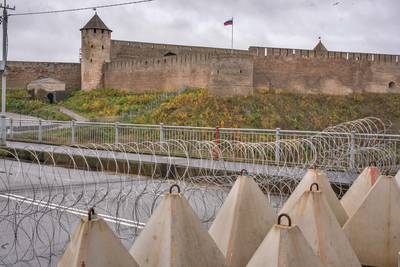
This view emphasizes the imposing nature of Hermann Castle while revealing the stark reality of the modern frontier. From this angle, the Tall Hermann Tower looms directly overhead, showcasing its 51-meter height and white-washed stone upper sections. The massive limestone walls of the fortress rise steeply from the riverbank, illustrating why this stronghold was the northernmost defensive point of Livonia. In the foreground, the Friendship Bridge is heavily fortified, contrasting sharply with the medieval architecture. Rows of concrete "dragon s teeth" (pyramidal anti-tank obstacles) and coils of razor wire block the roadway. These fortifications, installed by Estonia around 2024-2025, serve as a physical barrier against potential military threats and unauthorized vehicle crossings, marking the bridge s transformation from a trade route into a secure defensive line. A blue, black, and white flag flies from the castle wall, asserting Estonian sovereignty. Modern security cameras are mounted on the utility pole in the foreground, highlighting the intense monitoring of this border zone. Estonia, October 16, 2025  This view from the Friendship Bridge captures the imposing Hermann Castle (also known as Narva Castle) standing guard on the banks of the Narva River. The dominant structure is the medieval fortress itself, distinguished by its 51-meter-tall Tall Hermann tower. This specific vantage point is historically and geopolitically significant. The river below serves as the border between Estonia (European Union/NATO) and Russia. The view is famous for being one of the only places in the world where two hostile fortresses--Hermann Castle and Russia s Ivangorod Fortress--stand directly opposite each other within musket shot distance. Estonia, October 16, 2025  This view from the tower of St. Nicholas Church offers a fascinating contrast between medieval history, post-war reconstruction, and modern urban growth, looking east towards the city center. The most prominent building in the immediate foreground is the large, grey, L-shaped structure known as the Writers House (Kirjanike Maja) on Harju Street. Built in 1963 on the ruins of buildings destroyed during the 1944 Soviet bombing of Tallinn, this modernist structure is a significant cultural landmark. It houses the Estonian Writers Union, a well-known bookstore, and the famous Cafe Pegasus, serving as a hub for the country s literary scene. The street running along the left side of the Writers House is Harju Street, historically one of the city s main commercial arteries. The open green space visible nearby (part of the Harju Street green area) was also created following the wartime destruction, serving as a memorial and recreational space before partial reconstruction debates in recent years. In the background, the view opens up to Tallinn s modern business district. The cluster of high-rise glass buildings, including the distinct wedge-shaped Swisso^tel and the SEB Bank headquarters, illustrates the city s rapid economic development and stands in stark contrast to the red-tiled roofs of the Old Town below. Estonia, October 16, 2025  Narva River and Rybatskaya Naberezhnaya Street in Ivangorod (Russia) from Friendship Bridge at Kingiseppsoe Highway. Estonia, July 14, 2024  A section of Uus Street (New Street), a quieter and historically significant lane on the eastern edge of Tallinn s Old Town. The sign on the right marks the entrance to the Haus Gallery (Uus 17). Founded in 1997, it is one of the oldest and most respected private art galleries in Estonia, known for exhibiting both classic and contemporary Estonian art. The gallery is located in a historic building with a large courtyard often used for events. Just beyond the gallery, the flag hanging from the building (Uus 15) is the tricolor of Lithuania, identifying the Embassy of the Republic of Lithuania. This establishes the street as a diplomatic quarter as well. The image starkly contrasts the well-maintained facades of the embassy and gallery on the right with the heavily graffitied and peeling wall of the yellow building on the left (likely the rear or side of a building facing the parallel Sulevima"gi street). This juxtaposition highlights the ongoing struggle with tagging in less-monitored corners of the Old Town. Uus Street runs parallel to the old city wall (parts of which are visible nearby). Historically, it was developed later than the central merchant streets (hence "New Street"), originally serving as a defensive zone before being built up with residential houses for craftsmen and lesser merchants. Tallinn, Estonia, October 16, 2025  The view through the porticoes of one Small Chinese Bridge (often called the Second Small Chinese Bridge) that frames the Cross Bridge in the distance. The twin porticoes, with their "Chinese" peaked roofs and paired columns, create a natural proscenium that directs the eye straight down the canal. The foreground showcases the bridge s vibrant ironwork--geometric lattices and gilded details--contrasting with the brick arch of the Cross Bridge and the soft autumn foliage beyond. This alignment exemplifies the park s deliberate theatricality, using architectural "wings" (the porticoes) to stage the view of the central pavilion. Aleksandrovsky (Alexander) Park in Pushkin (former Tsarskoe Selo) near Saint Petersburg, Russia, October 10, 2025  A politically charged scene on Pikk Street (specifically at Pikk 19) in front of the Russian Embassy in Tallinn. The metal barricades lining the street have become a permanent protest installation since Russia s full-scale invasion of Ukraine in February 2022. The barriers are covered in posters, slogans, and artwork condemning the war and Russian leadership. The large banner in the foreground reads "FOR THE VICTIMS OF WARS STARTED BY RUSSIA". Other signs visible on the fence typically document war crimes or satirize political figures. A police officer in a high-visibility yellow jacket is patrolling the area. A constant police presence has been standard here to maintain order given the high tensions surrounding the embassy. The Russian Embassy occupies a historic Art Nouveau building at Pikk 19. Ironically, this street is one of the most picturesque and tourist-heavy routes in the Old Town, creating a surreal juxtaposition between medieval charm and modern geopolitical conflict. Across the street (visible in the background) is the famous Maiasmokk Cafe, the oldest operating cafe in Tallinn, further highlighting the clash between leisure tourism and serious political activism in this specific location. Tallinn, Estonia, October 16, 2025  Looking south from the Friendship Bridge, this view captures the recreational and spiritual side of the city, contrasting with the military fortifications seen on the other side. The prominent spire in the distance belongs to the Narva Alexander s Cathedral, an Evangelical Lutheran church built in the late 19th century. Its distinct octagonal tower is a major city landmark that survived severe damage during WWII. Along the riverbank, one see the modern architecture of the Joaorg Beach Building (the low, tiered structure nestled in the trees). This area serves as a popular public space with a swimming beach, gym, and promenade, offering locals a place to relax by the river. Estonia, October 16, 2025  Town Hall tower in Narva (now on Estonian territory) as seen from a wall of Ivangorod Fortress. Leningrad Region, Russia, July 17, 2005  This view from the St. Nicholas Church tower looks south-east, contrasting the medieval Old Town with the modern business district in the background. The large, L-shaped building with the dark gray roof in the center-right is the Writers House (Kirjanike Maja) on Harju Street. Completed in 1963, this Soviet-era modernist building stands out among the older red-roofed structures. It was built on the ruins of buildings destroyed in the 1944 March bombing and remains a cultural hub, housing the Estonian Writers Union and a famous bookstore. In the distance, the sleek glass high-rises of Tallinn s modern city center dominate the horizon. Key skyscrapers include the Swisso^tel Tallinn and the twin towers of the Tornima"e complex, symbolizing the city s rapid economic development since regaining independence. The open area visible to the right, just beyond the dense red roofs, is Freedom Square (Vabaduse va"ljak). Although partially obscured, this major public plaza marks the southern edge of the Old Town and is home to the Victory Column of the War of Independence. Estonia, October 16, 2025  This panoramic view from the tower of St. Nicholas Church looks south-west towards Toompea Hill, capturing the dense layering of Tallinn s medieval and religious history. The striking structure with black onion domes is the Alexander Nevsky Cathedral, an Orthodox cathedral built in 1900 in the Russian Revival style. Its imposing presence on Toompea Hill contrasts sharply with the surrounding red-tiled roofs, symbolizing the complex history of the Russian era in Estonia. In the foreground and middle distance, you can see key parts of the city s defensive network: The square tower with the tall red roof in the foreground is the Maiden Tower, a 14th-century defensive structure that now houses a cafe. Just behind and slightly to the left of the Maiden Tower (partially obscured) is the massive Kiek in de Ko"k artillery tower, whose Low German name ("Peep into the Kitchen") referred to the guards ability to see into nearby homes. Connective sections of the medieval city wall run between these towers, marking the boundary between the lower town and the upper citadel. The green space visible near the base of the wall is the Danish King s Garden (Taani kuninga aed). According to legend, this is where the Danish flag (Dannebrog) fell from the sky during a battle in 1219, turning the tide in favor of the Danes. The garden sits on the slope directly facing St. Nicholas Church. Estonia, October 16, 2025  This view of the protest installation outside the Russian Embassy on Pikk Street highlights several direct appeals and condemnations aimed at the Russian government. "STOP KILLING PEOPLE": A large, hand-painted sign on the right bluntly demands an end to the violence. This slogan has become a staple of anti-war protests worldwide. "STOP WAR CRIMINALS": The banner on the bottom left features a missile marked with the Russian flag and the demand to stop "war criminals." This reflects the widespread accusation that Russian leadership is committing war crimes in Ukraine. The large white sheet in the center is covered with drawings of cats in blue and yellow bowties, likely representing innocent lives or perhaps a specific children s art project. The text on the right translates from Estonian: "TO THE VICTIMS OF WARS STARTED BY RUSSIA" (Venemaa poolt alustatud so~dade ohvritele). This frames the current conflict as part of a longer history of Russian aggression. The central drawing includes poignant handwritten messages like "NOBODY LOVES YOU!" and "WE DON T WANT WAR!", expressing a mix of personal disdain for the aggressors and a universal plea for peace. Tallinn, Estonia, October 16, 2025 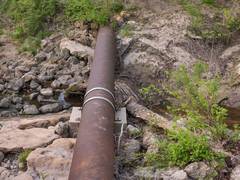 A large, heavily rusted metal pipe spanning horizontally across a ravine. The thick cylindrical pipe, completely oxidized from long-term exposure to the elements, serves as a stark piece of man-made infrastructure cutting directly through the natural landscape. Its dark, weathered surface stretches across the frame, contrasting sharply with the lighter earthy tones of the surrounding environment. In the near foreground, the engineering used to secure the pipeline is clearly visible. The heavy steel pipe rests securely on a square, poured-concrete abutment built directly into the creek bank. Two bright, unweathered metal retaining straps wrap over the top of the pipe, firmly bolted into the solid concrete base. These shiny galvanized brackets anchor the structure to the ground, designed to prevent the heavy cylinder from shifting under internal pressure or environmental stress. Lick Creek Park. College Station, Texas, March 25, 2026  A striking architectural contrast on Sauna Street (Sauna ta"nav), near the intersection with Va"ike-Karja Street. On the left, a modern glass-and-steel building features large display windows and industrial-style staircases, illuminated by neon lights. This building is part of the Helios Hall complex (formerly the Helios Cinema), which has been repurposed as an event venue and art space. The transparent facade allows a view into the contemporary interior, contrasting sharply with the solid, historic walls of the Old Town. On the right, the corner of an older, plastered building (Sauna 12) is covered in colorful, abstract graffiti. This gritty, urban element acts as a foil to the clean lines and slick surfaces of the modern building opposite it, highlighting the eclectic mix of styles in this part of the city. Tallinn, Estonia, October 16, 2025  This view of the installation near the Russian embassy on Pikk Street captures a broader perspective of the protest site, showing how it stretches along the sidewalk in front of the embassy building. The white banner in the foreground originally read "FOR THE VICTIMS OF WARS STARTED BY RUSSIA" (with the Russian translation on the right). However, someone has vandalized the sign by crossing out "RUSSIA" and scrawling "US" and a Star of David (hexagram) over it. This act of vandalism attempts to deflect blame from Russia by invoking anti-American and antisemitic tropes, a tactic often seen in pro-Kremlin disinformation campaigns. On the left side of the street, the building with the distinctive Art Nouveau facade (Pikk 18) houses the Ron Verlin salon, visible through the large arched window. This contrasts the elegant, peaceful commercial life of the street with the raw political conflict playing out just meters away. The fencing extends far down the street, covered in layers of posters, flags, and messages. This indicates the sustained nature of the demonstration, which has become a semi-permanent fixture in the Old Town since the start of the full-scale invasion. Tallinn, Estonia, October 16, 2025  Aerial view of Tallinn. The heart of the image is the medieval Old Town, identifiable by its dense cluster of red-tiled roofs, church spires (including the tall St. Olaf s Church), and the fortified Toompea Hill. Surrounding the Old Town are the modern high-rises of the financial district (left foreground), including the Swisso^tel and Tornima"e towers. To the right, the Port of Tallinn (Vanasadam) stretches out into the Baltic Sea, with ferries and cruise ships visible. The sweeping coastline of the Tallinn Bay dominates the background. The clear blue sky and the calm sea suggest a crisp, sunny morning. View from a window of an airplane from Tallinn to Helsinki. Estonia, October 17, 2025  The installation captures a vivid and direct form of protest directly facing the Russian embassy on Pikk Street. The central panel displays a graphic depiction of Vladimir Putin with a rat s body, lying dead under a Soviet flag with the slogan "Sooner rather than later" and "Putin Zdoh" (a play on words combining the "Z" war symbol with the Russian word for "died" or "croaked"). This reflects the intense anger and desire for regime change among protestors. The red poster on the right translates to "Reveal who gets Kremlin money in Estonia" (Paljastame, kes saavad Kremli raha Eestis), referencing concerns about Russian influence and corruption within Estonian politics and society. A black-and-white photo of Alexei Navalny is pinned to the fence, honoring the Russian opposition leader who died in prison in early 2024. His image serves as a symbol of resistance against the Putin regime. The fence is covered with layers of weather-beaten signs, photos of destroyed Ukrainian apartment blocks (like the one in the top right), and slogans in multiple languages (Estonian, English, Russian, Ukrainian). This accumulation shows that the protest is not a one-time event but a sustained, evolving vigil kept alive by locals and activists. The poster on the far right features a red handprint with names, symbolizing the "blood on the hands" of those complicit in the war or sympathetic to the Kremlin s actions. Tallinn, Estonia, October 16, 2025  Pikk Street (Pikk ta"nav) in Tallinn s Old Town, specifically showing the facades of two notable Art Nouveau buildings at numbers 18 and 16. The building on the right with the dramatic facade featuring dragon sculptures is the famous "Dragon Gallery" (Draakoni galerii). Designed by architect Jacques Rosenbaum and completed in 1910, it is a masterpiece of Art Nouveau architecture. The facade is adorned with fantastical elements, including two large dragons flanking the ground-floor window, Egyptian women, and sphinxes. It currently houses an art gallery managed by the Estonian Artists Association. The building directly next to it on the left (the narrower one with large windows) is Pikk 16. It currently houses the BonVerre shop, visible through the ground-floor window, which specializes in beverages and gourmet products. Further down the street on the left (the grey building with the green flag) is the Kanuti Gildi Saal (St. Canute s Guild Hall), a historic building that now serves as a contemporary performing arts center. Tallinn, Estonia, October 16, 2025  Religious and symbolic narrative of sacrifice, featuring a granite monument with an elaborate engraving of a soldier ascending a staircase toward a welcoming Christ-like figure and a birch tree, blending Christian theology with Russian nationalism. The epitaph laments, "You loved life... But the thread was cut too soon," emphasizing personal loss alongside martial duty. In the background, a chaotic array of VDV (Airborne Forces) and Russian flags flies over rows of fresh, temporary graves, contrasting the permanent serenity of the foreground monument with the raw immediacy of ongoing casualties. "Alley of Heroes" at Cemetery of the Victims of January 9, St. Petersburg, Russia, October 4, 2025  A wider view of Pikk Street (Pikk ta"nav) in Tallinn s Old Town, focusing on the Russian Embassy at Pikk 19. The elegant pink building on the right with the balcony and the Russian Federation flag is the Russian Embassy. It is a historic structure dating back to the late 19th century, originally built as a private residence before becoming a diplomatic mission. A marked Estonian police van is parked further down the street on the left. Since the start of the full-scale invasion of Ukraine in 2022, there has been a constant police presence here to monitor the protests and ensure security around the embassy. The metal barriers covered in protest art, flags, and posters run along the entire length of the sidewalk in front of the embassy. This installation has become a defining feature of the street, transforming a diplomatic zone into a site of permanent public demonstration. The view looks down Pikk Street towards the north, showing the narrow, cobblestone character of the Old Town. On the left, you can see other historic buildings, including shops and restaurants like the Cantina Texas (just visible in the distance). The contrast between the beautiful medieval architecture and the tense political atmosphere is striking. Tallinn, Estonia, October 16, 2025  This broader aerial shot, taken from an aircraft heading north towards Helsinki, captures the expansive geography of Tallinn s coastline. The large landmass stretching into the sea on the left is the Kopli Peninsula. Once an industrial zone, it is now a rapidly developing area with trendy neighborhoods like Kalamaja (closer to the center) and burgeoning cultural hubs. The calm, blue waters of Tallinn Bay dominate the background, illustrating the city s intimate connection with the Baltic Sea. Further in the distance, beyond Kopli, one can see the tip of the Paljassaare Peninsula, known for its bird conservation area and beaches. The area in the foreground, characterized by a regular grid of streets and lower-rise buildings (many of them historic wooden houses), is the Kalamaja district. On the coastline to the right, the massive concrete hangars of the Seaplane Harbour museum are visible, a key maritime landmark. Near the Seaplane Harbour, the curved, defensive walls of the Patarei Sea Fortress (a former prison) stand on the water s edge, marking a grim but significant historical site. View from a window of an airplane from Tallinn to Helsinki, Estonia, October 17, 2025  The dense concentration of recent casualties, with fresh earthen mounds tightly packed together and adorned with the ubiquitous Russian tricolor. In the foreground, the grave of Aleksandr Vladimirovich Dementyev (1962-2025) is marked by a wooden cross and a color portrait, identifying a 63-year-old soldier whose age highlights the heavy toll on older reservists and volunteers. The background reveals the integration of the cemetery into the urban fabric, with modern commercial buildings visible just beyond the sea of flags and wreaths, grounding the war[CloseCurlyQuote]s losses in the everyday reality of St. Petersburg. "Alley of Heroes" at Cemetery of the Victims of January 9, St. Petersburg, Russia, October 4, 2025  Mu"u"rivahe Street (Mu"u"rivahe ta"nav), specifically the section near the famous "Knit Market" wall. The name Mu"u"rivahe translates to "Between the Walls," referring to its historical location between the city s main defensive wall and a lower, secondary wall. This area is famous for the open-air market where local craftswomen sell traditional Estonian hand-knitted items like wool sweaters, mittens, and socks directly off the medieval stone wall. This specific spot (near Mu"u"rivahe 21) is close to the Viru Gate entrance to the Old Town and connects towards St. Catherine s Passage, another famous medieval walkway. Tallinn, Estonia, October 16, 2025  This structure is the celebrated Bridge of Pipedreams (Pont des Re^ves Tubulaires), a provocative modernist installation by the French brutalist architect Jean-Luc Beton-Brut. Conceived as a deliberate counterpoint to the park s romanticism, its design emphasizes raw honesty and the tension between industry and nature. The bridge s aesthetic lies in its stark minimalism. The unapologetic linearity of the twin pipes slices through the landscape, while their raw, oxidizing steel is intended to mirror the natural decay of autumn. The simple arch frames the surrounding forest, and the industrial grey of the metal creates a seamless chromatic dialogue with the overcast sky, blending the man-made object into its environment through color and form. See AI-generated descriptions: ( a) and ( b). Oranienbaum palace-and-park ensemble in Lomonosov (a suburb of St. Petersburg), Russia, October 13, 2025  Long Hermann tower in Medieval Hermann s castle in Narva Fortress, view from a wall of Ivangorod Fortress. Leningrad Region, Russia, July 17, 2005  The truck in this close-up is a Soviet-era GAZ-51 (or possibly its four-wheel-drive variant, the GAZ-63), which has been repurposed into a striking, semi-ruined art installation in Tallinn s Old Town. The distinct rounded hood, vertical grille slats, and cab shape identify it as a GAZ-51, one of the most widely produced trucks in the Soviet Union from 1946 to 1975. It was a workhorse of Estonian agriculture and industry during the Soviet occupation. The truck is in a state of deliberate decay, with peeling blue paint revealing rust, missing headlights, and a weather-beaten interior. This "ruined" aesthetic allows it to blend into the surrounding greenery, symbolizing the passage of time. The door features a stylized graffiti tag of a dragonfly, adding a layer of modern urban art to the vintage industrial canvas. A large, green, pipe-like structure (resembling a telescopic boom, grain auger, or water cannon) is mounted on the back. This industrial attachment gives the truck a fantastical, almost "Mad Max" or steampunk appearance, repurposing a utility vehicle into a whimsical sculpture. There is a local story that the owner of this specific plot of land (which is private, unlike the surrounding city-owned park) placed the truck and other objects (like manure heaps or potato patches in previous years) as a form of protest or disruption because the city would not grant permission to construct a new building on the site. Estonia, October 16, 2025  The "initial stage" of memorialization, where fresh earthen graves are crowded with temporary wooden crosses and a profusion of military banners, including the VDV (Airborne Forces) and St. Andrew[CloseCurlyQuote]s Naval flags. The foreground features the grave of Mikhail Ilyich Svyatkin (1986-2025), a 39-year-old casualty, whose cross is adorned with a framed photo of him in uniform, exemplifying the typical profile of recent losses. The scene is saturated with patriotic symbols, including a flag depicting a tank with the slogan "Victory will be ours" and another with the Order of the Great Patriotic War, linking the current conflict to historical narratives of Soviet heroism. "Alley of Heroes" at Cemetery of the Victims of January 9, St. Petersburg, Russia, October 4, 2025  This view from Rataskaevu Street looks directly towards the imposing St. Nicholas Church (Niguliste kirik), creating one of the most picturesque and architecturally significant scenes in Tallinn s Old Town. The dominant feature is the massive tower of St. Nicholas Church, dedicated to the patron saint of merchants and sailors. The church, originally built in the 13th century as a fortress-church, showcases a mix of Gothic and Baroque elements. The current Baroque spire (added in the late 17th century) rises high above the street, while the lower sections reveal the heavy limestone walls typical of medieval defense structures. At the base of the tower, one can see the Small Chapel (Va"ike kabel) and the Clodt Chapel. The smaller, yellow-and-white structure with the arched entrance (left foreground) is the Chapel of St. Matthew (later St. George), adding a touch of color and intricate detail to the otherwise austere stone facade. Estonia, October 16, 2025  View of Troitsky Bridge from Suvorovskaya Square. It is similar to Alexander III Bridge in Paris. Blue dome of a mosque is seen at the opposite bank of Neva River. Saint Petersburg, Russia, April 13, 1999.  Blending of religious and patriotic symbolism in the "Alley of Heroes". The foreground monument features a poignant epitaph addressing the deceased ("And you stand before our eyes, Alive... We keep you in our hearts") alongside an elaborate engraving of a soldier ascending a staircase toward a Christ-like figure, framing death as a spiritual journey. In the background, a distinctive broken-heart monument depicts a split image of a bridge at night surrounded by flags from various military branches, including the VDV and Russian Naval Infantry. Cemetery of the Victims of January 9, St. Petersburg, Russia, October 4, 2025  Kino So~prus (Cinema So~prus). Completed in 1955, this is a prime example of Stalinist Empire style architecture (Socialist Classicism). The fac,ade features a curved colonnade with 18 octagonal columns and 15 dolomite relief emblems that symbolize various arts, sciences, and industries, such as fishing and mining. "So~prus" means "Friendship" in Estonian. It was built on the site of buildings destroyed during the 1944 March bombing. For decades, it served as the city s premier cinema and was the first "multiplex" in Estonia with two halls. Tallinn, Estonia, October 16, 2025  Artificial waterfall on the Karasta River in Oranienbaum Park serving as a connection between the Upper and Lower Parks. It is a tiered spillway designed with granite steps that allow the water to cascade gracefully from the Lower Pond, flowing underneath a massive stone bridge (the Lower Bridge/Dam Bridge) Oranienbaum palace-and-park ensemble in Lomonosov (a suburb of St. Petersburg), Russia, October 13, 2025  This perspective on Harju Street captures a striking mix of Soviet-era modernism and medieval heritage in the heart of Tallinn s Old Town. The prominent grey building on the right is the Writers House (Kirjanike Maja), located at Harju 1. Designed by architects August Volberg and Heili Volberg and completed in 1963, it is a prime example of post-war modernist architecture in Estonia. The foreground reveals traces of the area s turbulent history. The open green space on the left (Harju Street Park) occupies the site of buildings destroyed during the March 1944 Soviet bombing. For decades, these ruins were a painful scar, but the area has since been redeveloped into a recreational space that memorializes the lost urban fabric while providing a breathing room in the dense Old Town. The blue truck cabin visible in the foreground of the Harju Street photo is a GAZ-51, a legendary Soviet-era truck that was a common sight in Estonia for decades. Estonia, October 16, 2025  This view of Pikk Street highlights the blend of commerce and history that has defined the area for centuries. The foreground features the large display windows of Pikk 12 and the red sign for Oh la la, a well-known gift shop at Pikk 10. These buildings continue the street s medieval legacy as the primary commercial artery connecting the harbor to the upper town. On the right, the prominent "LIVONIA" sign marks a shop specializing in traditional Estonian linen and wool products, housed in a building that respects the historic streetscape. Further down at Pikk 12 (corner), the "Veta" sign indicates a brand store known for knitwear, located in a building with a distinctive rounded corner bay window. The blue and yellow flag flying further down the street marks the location of the Swedish Embassy at Pikk 28. Housed in the magnificent von Rosen Palace (dating from the 1670s), it stands as a reminder of the Swedish era in Estonia s history. Estonia, October 16, 2025  Rustic, three-arched stone bridge (often referred to as the Ruin Bridge or simply the stone arch bridge) in the "Russian Switzerland" area in Oranienbaum s Upper Park. Built from rough-hewn boulders to mimic a natural or ancient ruin, it harmonizes perfectly with the wild, rugged aesthetic of the Karasta River valley. The bridge spans a small ravine or tributary, surrounded by a golden forest of birch and maple trees that soften the stone s heavy appearance with delicate autumn foliage. Oranienbaum palace-and-park ensemble in Lomonosov (a suburb of St. Petersburg), Russia, October 13, 2025  The "initial stage" of memorialization, where fresh earthen graves are densely covered in massive wreaths of artificial flowers and a forest of flags. In the foreground, the wooden cross of Aleksandr Vitalyevich Rogachev (1964-2025) identifies a 61-year-old casualty, representative of the older demographic of mobilized soldiers and volunteers. The scene highlights the diverse composition of the forces, with the flag of Uzbekistan visible in the background--indicating the recruitment of foreign nationals--while a lone mourner tends to a grave amidst the dense rows, adding a human scale to the extensive loss. "Alley of Heroes" at Cemetery of the Victims of January 9, St. Petersburg, Russia, October 4, 2025  View of Pikk Street (Pikk ta"nav), one of the most architecturally diverse streets in Tallinn s Old Town. The spectacular grey Art Nouveau building on the right (with the corner turret) is a masterpiece designed by architect Jacques Rosenbaum in 1910. It is famous for its fantastical facade featuring two large dragons and Egyptian-inspired motifs. Today, the ground floor houses the Draakoni Gallery. On the left side of the street (the red and grey facade), one can see the St. Canute s Guild Hall (Kanuti Gildi Saal). Originally built in the 13th century and remodeled in the 19th century with Tudor-style windows and statues of St. Canute and Martin Luther on the facade. It now serves as a contemporary performing arts center. The yellow building on the immediate right foreground is Pikk 22, which houses the Estonian Handicraft House (Eesti Ka"sito"o" Maja). This shop is a go-to place for authentic Estonian folk art and crafts. Tallinn, Estonia, October 16, 2025  Ruined Cascade situated in a deep ravine that serves as the boundary between Old Sylvia and New Sylvia. Designed by Vincenzo Brenna in 1794, it was intended to look like a collapsed antique aqueduct or bridge. The rustic birch-trunk railing (visible in your photo) is a signature element of this specific cascade, contrasting with the stone vases and masonry to emphasize the "wild" nature of the Sylvia district, October 6, 2025  View from the Small Chinese Bridge looks down the Krestovy Canal in the opposite direction from the Cross Bridge. The photo captures the linear vista of the canal, flanked by an avenue of mature maple trees displaying vibrant autumn colors. The foreground highlights the Small Chinese Bridge s decorative iron railing, featuring a geometric lattice pattern with gilded rosettes, cast in 1786. This section of the canal borders the regular "New Garden" area, leading toward the Chinese Village. Aleksandrovsky (Alexander) Park in Pushkin (former Tsarskoe Selo) near Saint Petersburg, Russia, October 10, 2025  Mu"u"rivahe Street (Mu"u"rivahe ta"nav), looking towards the intersection with Viru Street. The image is taken near Mu"u"rivahe 23, which is the location of the Armanda clothing boutique visible on the left. The narrow, cobblestone street retains its medieval charm, winding between historic buildings that date back centuries. In the background, one can see a striking turquoise-colored tower with a weathervane. This is part of the building complex at the corner of Viru and Mu"u"rivahe streets, adding a distinct vertical accent to the streetscape. Tallinn, Estonia, October 16, 2025  Graceful, humpbacked silhouette of the bridge, designed to arch elegantly over the narrow waterway connecting the ponds. The bridge s single, shallow arch is constructed from dark iron, supported by massive granite abutments on either bank. Delicate lattice pattern of the wrought-iron railing is clearly visible against the backdrop of the forest. Sergievka Park, Old Peterhof, west from Saint Petersburg, Russia, October 13, 2025  A view of the installation specifically focuses on the memorial dedicated to Alexei Navalny, the Russian opposition leader who died in a penal colony on February 16, 2024. The central poster explicitly states "PUTIN KILLED NAVALNY" in bold red and black letters, echoing the sentiments of protestors worldwide who hold the Kremlin responsible for his death. Below the text is a large, stylized black-and-white portrait of Navalny, marked with the date of his death, February 16, 2024. The main poster is surrounded by smaller photos, drawings, and messages from supporters, including a quote in Russian: "Everything will be fine. And even if it isn t, we will console ourselves that we were honest people". The memorial is integrated into the broader anti-war protest, with signs like "STOPTHEWAR" and "NETVOYNE" (No to War) visible alongside Ukrainian colors. A yellow poster in the background calls for freedom for political prisoners ("SVOBODU POLITZAKLYUCHONNYM"). Tallinn, Estonia, October 16, 2025  A perspective of Rataskaevu Street, looking up the gentle slope towards the intersection with Niguliste Street. The building on the right with the striking yellow and grey modern facade and large arched window is home to Casa Alta, an Italian restaurant. The architecture of this building stands out for its postmodern interpretation of the gabled roofline, contrasting with the older structures nearby. The pinkish-red building on the left side of the street (Rataskaevu 6) is a historic property. It currently houses Restoran O~ (or a similar establishment depending on recent changes), known for its fine dining in a medieval setting. Further down on the left, you can see signs for other venues like De 6 and Vana Tallinn. Tallinn, Estonia, October 16, 2025  Churches of Ivangorod Fortress, view from a wall near Vorotnaya (Gate) Tower. Leningrad Region, Russia, July 17, 2005  This view from the Small Chinese Bridge captures the northwestern stretch of the Krestovy Canal. The canal creates a straight, reflective corridor lined with golden maples, emphasizing the transition from the formal "New Garden" to the more naturalistic landscape park areas. Looking northwest, the canal leads toward the Alexander Palace and its kitchen buildings, which are situated to the right of this axis, hidden behind the dense tree line. The scene highlights the park s quiet, wooded character, contrasting with the architectural focus of the opposite view towards the Cross Bridge. Aleksandrovsky (Alexander) Park in Pushkin (former Tsarskoe Selo) near Saint Petersburg, Russia, October 10, 2025  A temporary protest installation located directly in front of the Russian Embassy at Pikk 19 in Tallinn s Old Town. The barricades and posters are situated along the sidewalk of Pikk Street, facing the embassy building. This narrow, historic street has become a focal point for public demonstrations since the beginning of the full-scale invasion of Ukraine in February 2022. The installation serves as a persistent protest against the Russian invasion of Ukraine. It features Ukrainian flags, anti-war messages, graphic images of war damage (such as destroyed buildings in Ukrainian cities), and tributes to figures like Alexei Navalny. The display transforms a section of the picturesque Old Town into a politically charged space, forcing diplomats and passersby to confront the realities of the conflict. The protest materials are often updated by activists and local residents to reflect ongoing events. The sign "If they decide to kill me, it means we are incredibly strong - Navalny" references the late Russian opposition leader Alexei Navalny, whose death in prison in February 2024 sparked renewed gatherings and memorials at this exact spot. Tallinn, Estonia, October 16, 2025  Marble Bridge (also known as the Palladian Bridge) in Catherine Park, Pushkin, enveloped in the vibrant colors of a Russian autumn. Built in the 1770s, it features a graceful colonnade of Ionic columns carved from blue-grey Ural marble, resting on a sturdy granite base. The bridge spans a narrow channel connecting the Great Pond to smaller neighboring ponds and the "Swan Islands." In the foreground, several mallard ducks glide peacefully across the water. Pushkin (former Tsarskoe Selo) near Saint Petersburg, Russia, October 10, 2025  This view from the St. Nicholas Church (Niguliste kirik) viewing platform offers a detailed look at the dense, red-roofed tapestry of Tallinn s Old Town, looking north towards the harbor. Dominating the skyline on the right is the spire of St. Olaf s Church (Oleviste kirik), which historically served as a navigational landmark for ships. Its green copper spire contrasts sharply with the surrounding red clay tiles. Looking directly down into the "canyon" of streets, one can trace Rataskaevu Street winding through the heart of the lower town. The prominent yellow building in the foreground (with the red roof and dormer windows) is likely part of the historic housing blocks near Rataskaevu and Ru"u"tli streets. Its bright facade stands out against the more muted tones of the neighboring structures. The view captures the intricate layers of the city s architecture--chimneys, dormer windows, and varying roof pitches that reveal the organic growth of the medieval city over centuries. Estonia, October 16, 2025  The dense visual cacophony of the cemetery s "temporary" section, where rows of wooden crosses are submerged in a sea of Russian tricolors and military intelligence (GRU/Spetsnaz) flags bearing the bat insignia. In the foreground, the grave of Kirill Arkadyevich Sharkov (1975-2025), a 49-year-old casualty, is marked by a simple cross and a photo of him in uniform, surrounded by wreaths in patriotic red, white, and blue colors. The scene conveys the sheer volume of recent losses, with flags fluttering chaotically over uneven mounds of earth, while a tractor in the far left background hints at the ongoing expansion of the burial grounds. "Alley of Heroes" at Cemetery of the Victims of January 9, St. Petersburg, Russia, October 4, 2025  View of the Karasta River near the stone bridge in Oranienbaum Park. The stone bridge, with its rustic, unpolished arches, is partially obscured by the golden leaves of a large tree, enhancing the sense of depth and discovery typical of romantic English-style gardens. Oranienbaum palace-and-park ensemble in Lomonosov (a suburb of St. Petersburg), Russia, October 13, 2025  Northern end of Vene Street (Vene ta"nav) at the intersection with Olevima"gi and Bremeni ka"ik. The red brick building on the immediate left is located at Vene 28. It is a historic structure that was originally built in 1912 as a residential building and briefly housed the Estonian Provisional Government in 1918. It stands out with its industrial-style red brick facade contrasting with the medieval stone walls nearby. The large limestone wall with the archway on the far left is part of the city s defensive fortifications, specifically near the Bremen Tower (Bremeni torn). The archway leads into Bremen Passage (Bremeni ka"ik), a short, atmospheric walkway that connects Vene Street to Uus Street through the city wall. The tower itself, a 15th-century horseshoe-shaped defensive structure, is located just behind this wall. In the background, at the end of the street, you can see the yellow tower and facade of the Orthodox Church of St. Nicholas (Nikolai kirik) at Vene 24. Designed by architect Luigi Rusca and built between 1820-1827, this Neoclassical church serves a congregation under the Moscow Patriarchate and is known for its valuable iconostasis. It sits on the site of a much older church that served Novgorod merchants in the Middle Ages. Tallinn, Estonia, October 16, 2025  The "Adam s Head" (or Golova-valun:feff) sculpture presents a striking profile view, revealing its deep-set eye and prominent nose emerging from the earth. Bright yellow maple leaves carpeting the ground and contrasting with the grey granite. A small spring flows near the base of the sculpture (visible in the foreground as a trickle), adding to the mystical atmosphere that reportedly inspired Lewis Carroll during his visit in 1867. This angle emphasizes the massive scale of the boulder relative to the path, showing how the face was carved directly into the natural granite contours. Sergievka Park, Old Peterhof, west from Saint Petersburg, Russia, October 13, 2025  The dense, chaotic stage of recent burial in the "Alley of Heroes," where fresh earthen graves are overwhelmed by a profusion of flags, including the Russian tricolor, the blue flag of the Aerospace Forces (VKS), and banners of various volunteer and assault units. The foreground shows a simple wooden cross with a framed photo of a young soldier, surrounded by vibrant wreaths of artificial flowers, while in the background, a woman walks amongst the rows, emphasizing the cemetery s role as an active site of public mourning. The sheer number of flags and the raw state of the ground visually confirm a continuous, high-volume flow of casualties processed at this site. Cemetery of the Victims of January 9, St. Petersburg, Russia, October 4, 2025  Small Lamsky Bridge (Maly Lamskoy Bridge), built in the early 20th century (around 1900) to replace an earlier wooden crossing. Aleksandrovsky (Alexander) Park in Pushkin (former Tsarskoe Selo) near Saint Petersburg, Russia, October 10, 2025  Vana turg (Old Market) square, a historic intersection where several streets meet. The white building on the right with the prominent hoist beam and red sack is the Peppersack restaurant (Vana turg 6). It is a well-known medieval-themed venue located in a 14th-century merchant s house. The large, pinkish building on the left (at the corner of Suur-Karja and Kuninga) is the Bishop s House (Piiskopi maja). It stands on the site of the medieval residence of the bishops of Tallinn. The current facade is later, but the core of the building is ancient, and it has historically housed the Consistory of the Estonian Evangelical Lutheran Church. Just out of frame or partially visible (depending on the exact angle, as it is adjacent to Peppersack), this area is also home to Olde Hansa, another famous medieval restaurant housed in a historic warehouse. Tallinn, Estonia, October 16, 2025  The ideological complexity of the war s memorialization, dominated by a large red Soviet flag flying prominently over fresh graves, invoking nostalgia for the USSR s military power alongside Russian tricolors and VDV (Airborne Forces) banners. In the foreground, the grave of Arkady Vasilyevich Kovalchuk (1974-2024), who died at age 50, exemplifies the demographic trend of older men bearing a significant share of casualties. The scene is one of dense, vibrant mourning, with mounds of artificial flowers covering the raw earth, set against a backdrop of modern commercial buildings that anchor the cemetery in the contemporary urban landscape. "Alley of Heroes" at Cemetery of the Victims of January 9, St. Petersburg, Russia, October 4, 2025  Saiakang passage where it meets the Town Hall Square (Raekoja plats) in the heart of Old Tallinn. III Draakon: The medieval-style tavern located directly in the town hall building (the large white structure on the left) is III Draakon ("The Third Dragon"). Famous for its elk soup, pies, and theatrical service where the landlady "scolds" customers, it offers an immersive medieval dining experience. The dragon waterspouts on the town hall facade give the tavern its name. The large merchant house with the stepped gable in the background (Raekoja plats 18) is known as Hopner House (Hopneri Maja). It is a prime example of a wealthy merchant s dwelling from the Hanseatic era, now used as a cultural venue. The street leading into the square is Saiakang ("White Bread Passage"). Its name dates back to the 13th century when it was lined with bakeries selling white bread, a luxury item at the time. It is one of the shortest and oldest streets in the city, connecting the square to Pikk Street. Tallinn, Estonia, October 16, 2025  Lower Lamsky Bridge (Nizhny Lamskoy Bridge). It acts as a dam between the ponds and the Kuzminka River. Aleksandrovsky (Alexander) Park in Pushkin (former Tsarskoe Selo) near Saint Petersburg, Russia, October 10, 2025  This colorful section of the installation outside the Russian Embassy on Pikk Street uses provocative imagery and slogans to confront the Russian leadership. The poster on the bottom left depicts Vladimir Putin lying dead in a coffin with a Soviet flag. The text "Putin Z-dokh" is a pun, combining the pro-war "Z" symbol with the Russian verb for "croaked" or "died like an animal." The English text "Sooner rather than later" expresses a wish for the end of his regime. "Paljastame, kes saavad Kremli raha Eestis": The red poster on the right translates from Estonian as "We reveal who receives Kremlin money in Estonia." It depicts a stylized Kremlin tower with a skull and bundles of cash at the base, addressing concerns about Russian influence operations and corruption within Estonia. A black-and-white photo of Alexei Navalny with yellow and blue ribbons hangs near the top, keeping the memory of the opposition leader alive as a symbol of resistance. "Bloody Hand": The black poster on the far right features a red handprint with names written on it, symbolizing blood guilt. It is titled with a name (partially obscured, possibly "ODANIEL") and includes lists of names, likely implicating individuals or entities considered complicit in the war or sympathetic to the Kremlin. Tallinn, Estonia, October 16, 2025  Evening view that provides a dramatic, upward-looking perspective of St. Olaf s Church (Oleviste kirik) from the street level (near Lai 48), emphasizing the towering scale of its west facade. The image is dominated by the massive limestone tower of St. Olaf s. The perspective highlights the transition from the square base to the octagonal upper stages, a typical feature of Gothic architecture in the Hanseatic region. The long, narrow window with its pointed arch (lancet window) is a defining Gothic element, allowing light into the nave. To the right, you can see the upper stories of the adjacent building (likely Lai 48 or 50). Its simple, plastered facade and regularly spaced windows provide a domestic scale that contrasts with the monumental church. The distinctive rain gutter (downspout) on the left foreground acts as a framing element, drawing the eye upward. This view underscores why St. Olaf s was once the tallest building in the world (1549-1625). The sheer verticality visible here was originally intended to serve as a landmark for trading ships approaching Tallinn s harbor. Tallinn, Estonia, October 16, 2025  Revealing the multinational and irregular composition of the Russian forces, featuring the flag of Uzbekistan prominently displayed alongside the black "Assault Troops" banner and the Russian tricolor. In the foreground, the grave of Aleksandr Borisovich Vasiliev (1973-2025), a 52-year-old soldier, is marked by a framed photograph of him in combat gear standing in a field, humanizing the older demographic of recent casualties. The scene captures the raw, crowded nature of the "initial stage" of burial, with fresh earthen mounds and a chaotic mix of personal and military symbols extending into the background. "Alley of Heroes" at Cemetery of the Victims of January 9, St. Petersburg, Russia, October 4, 2025  Nikola Church of Ivangorod Fortress. Leningrad Region, Russia, July 17, 2005  Novaya (New) Tower of Ivangorod Fortress. Leningrad Region, Russia, July 17, 2005  A lively intersection of Suur-Karja and Vana turg. The central white building with the high, decorated gable (Suur-Karja 1) is a significant medieval structure known as the Bishop s House. Dating back to the 13th-14th centuries, it historically served as the residence for the bishops of Tallinn. Its facade features Gothic niches and a hoist beam, typical of wealthy Hanseatic merchant homes. To the right, the outdoor terrace belongs to Kuldse Notsu Ko~rts (Golden Piglet Inn), located at Dunkri 8 (which intersects here). This restaurant is famous for its authentic Estonian cuisine, serving dishes like sausage feasts and pork knuckle based on traditional recipes. On the far left, the corner of the heavy stone building (Suur-Karja 18) houses residential apartments. The area is a bustling hub, filled with restaurants and cafes that spill out onto the cobblestones, overlooked by the spire of St. Nicholas Church in the background. Tallinn, Estonia, October 16, 2025  This stone bridge serves as a picturesque crossing over the Kristatelka River ravine, situated at the foot of the slope directly beneath the Leuchtenberg Palace. As part of the 19th-century Sergievka ensemble, this bridge links the wilder, lower ravine paths (near the "Adam s Head" boulder) with the landscaped grounds surrounding the palace on the upper terrace. It features a solid masonry arch topped with simple iron railings, designed to provide a functional yet scenic vantage point for viewing the deep ravine that defines the estate s geography. Sergievka Park, Old Peterhof, west from Saint Petersburg, Russia, October 13, 2025  Ruins of barracks and churches of Ivangorod Fortress. Leningrad Region, Russia, July 17, 2005  Doorway of Uspenskaya Church of Ivangorod Fortress. Leningrad Region, Russia, July 17, 2005  Mysterious passage under a wall of Ivangorod Fortress. Leningrad Region, Russia, July 17, 2005  Looking down Mu"u"rivahe Street (Mu"u"rivahe ta"nav), running alongside the medieval city wall of Tallinn. The dominant feature is the massive, 14th-century limestone defensive wall on the right. What stands out in this specific section (near Mu"u"rivahe 52) are the large concrete buttresses supporting the wall. Unlike the original medieval masonry, these are modern reinforcements added during the Soviet era (specifically in the late 1960s or 70s) to stabilize this section of the wall, which was in danger of collapsing. While effective, they are often noted for their distinct, brutalist contrast with the historic stonework. Further down the wall, you can see the red-tiled roof of the defensive walkway (chemin de ronde) and the towers (Hellemann Tower is nearby) that made Tallinn one of the best-fortified cities in Northern Europe. At the base of the wall, the original pointed arches (niches) are illuminated, highlighting the texture of the rough-hewn limestone. These niches historically housed workshops or stalls. The street name "Mu"u"rivahe" literally means "the gap between the walls," referring to the space between the main city wall and the lower defensive earthworks that once existed here. Tallinn, Estonia, October 16, 2025  Estonian Border Guard aviation unit hangar at Vaike-Sojamae 22, view from a window of a plane running in Tallinn Airport. Estonia, August 15, 2024  This panoramic view from the newly opened viewing platform of St. Nicholas Church (Niguliste kirik) offers a perspective over Tallinn s Old Town. The prominent spire on the right is St. Olaf s Church (Oleviste kirik), once the tallest building in the world (1549-1625). Its commanding height makes it a key reference point in the city skyline. The sea of red-tiled roofs is a signature feature of Tallinn, interspersed with historic merchant houses and courtyards. In the middle distance, you can spot sections of the medieval city wall and defensive towers (like the ones near the Nunne gate area) that still encircle much of the lower town. In the background, the view stretches out to the Gulf of Finland, highlighting Tallinn s historic role as a major Hanseatic port city connecting trade between East and West. Estonia, October 16, 2025  So~prus Cinema (Kino So~prus). The building is a striking example of Stalinist Empire style (Socialist Classicism) architecture, completed in 1955. Its grand fac,ade features a curved colonnade of octagonal columns and decorative reliefs symbolizing various arts and industries. Originally designed by architect Friedrich Wendach, the project was completed by Peeter Tarvas and August Volberg after Wendach was repressed by Soviet authorities. The name "So~prus" means "friendship" in Estonian. Some sources suggest it was named to mark improved relations between the Soviet Union and China at the time. In the 1990s, financial difficulties led to the closure of one hall, which was converted into a nightclub and casino. Today, the building houses both the cinema and the popular Club Hollywood. Tallinn, Estonia, October 16, 2025  Fac,ade of Pikk 18, arguably the most famous Art Nouveau building in Tallinn, known as the Dragon Gallery (Draakoni Galerii). Designed by the renowned Baltic German architect Jacques Rosenbaum and completed in 1910, this building is a prime example of late Art Nouveau (Jugendstil) architecture. The two massive, sculpted dragons flanking the ground-floor window are the building s namesake and most iconic feature. They were created by the sculptor August Volz. Above the dragons, the fac,ade features two stern female figures with Egyptian headdresses projecting from the pilasters. These, along with sphinxes and other exotic ornaments on the upper levels, reflect the eclectic and fantastical influences typical of Rosenbaum s style. The large, horseshoe-shaped window on the ground floor and the undulating gable at the top create a sense of movement and fluidity that contrasts sharply with the rigid lines of the adjacent classical and medieval buildings. Originally built as an apartment house for the merchant Reinhold Reichmann, the ground floor has housed the Draakoni Gallery since 1983, an exhibition space managed by the Estonian Artists Association. The green light visible in the window belongs to a fashion boutique or exhibition currently occupying the space. Tallinn, Estonia, October 16, 2025  Upper Park s "Russian Switzerland". A majestic, deep green spruce tree in the foreground provides a striking vertical anchor, contrasting sharply with the soft, hazy backdrop of golden maples and oaks that line the riverbanks. The shallow, rocky riverbed is visible through the clear, dark water, with scattered boulders breaking the surface, enhancing the "mountain stream" illusion intended by the landscape architects. Oranienbaum palace-and-park ensemble in Lomonosov (a suburb of St. Petersburg), Russia, October 13, 2025  Bolshoy Lamskoy Bridge (Large Lamskoy Bridge) area, which connects the Big and Upper Lamskoy Ponds. Aleksandrovsky (Alexander) Park in Pushkin (former Tsarskoe Selo) near Saint Petersburg, Russia, October 10, 2025  This view from the St. Nicholas Church tower focuses on the southwestern edge of the Old Town, dominated by medieval fortifications and the lush greenery of Toompea s slopes. The massive round tower on the right is Kiek in de Ko"k ("Peep into the Kitchen"), a 15th-century artillery tower. Its formidable stone walls, over 4 meters thick, were designed to withstand cannon fire, making it the most powerful defensive tower in the Baltic region during its time. Today, it houses a fortification museum. Below the tower, the cobblestone street running vertically is Ru"u"tli Street, historically home to the city s executioner and later a quiet residential area. To the left of Ru"u"tli Street, the large building with the expansive red-tiled roof is the Swedish St. Michael s Church (Rootsi-Mihkli kirik). Originally a medieval hospital and poorhouse, it was converted into a church for the Swedish garrison and community. Its simple, robust architecture contrasts with the more ornate merchant houses found elsewhere in the Old Town. Estonia, October 16, 2025  Bolshoy Lamskoy Bridge (Great Lamsky Bridge). It was built in 1820-1822 by the Scottish architect Adam Menelaws, who was instrumental in shaping the park s romantic "English" landscape style. The bridge spans the Lamsky Ponds near the Llama Pavilion, originally serving the utilitarian purpose of connecting the Lamsky stables (which housed exotic llamas from Peru) to the rest of the park. Originally a cast-iron structure, it has been carefully restored to preserve its intricate metal latticework railings, which feature a distinct geometric pattern characteristic of the Russian Empire style. Aleksandrovsky (Alexander) Park in Pushkin (former Tsarskoe Selo) near Saint Petersburg, Russia, October 10, 2025  St. Nicholas Church (Niguliste kirik), located at Niguliste 3 in Tallinn s Old Town. Although originally built as a fortress church in the 13th century dedicated to Saint Nicholas (patron of sailors and merchants), it is no longer a functioning place of worship. Today, it houses the Niguliste Museum, a branch of the Art Museum of Estonia, dedicated to medieval ecclesiastical art. The church was founded by Westphalian merchants in the 1230s and was one of the wealthiest in the city. It was heavily damaged during the Soviet bombing of Tallinn in March 1944, losing its roof and most of its interior, but was meticulously restored in the following decades. The tower, rebuilt with a Baroque spire, now features a glass elevator and a viewing platform offering panoramic views of the city. The church sits on a rise just south of the Town Hall Square, surrounded by a green area that was once a cemetery. The street in the foreground is Niguliste Street, leading up from the lower town. Tallinn, Estonia, October 16, 2025  A view of Pikk Street (Pikk ta"nav) in Tallinn s Old Town, capturing a section lined with colorful and historically significant buildings. The yellow building on the left with the Estonian flag is Pikk 29. It houses the Meriton Old Town Garden Hotel, which occupies a historic merchant house first mentioned in 1355. The hotel connects through a courtyard to Lai Street, preserving much of its medieval structure and atmosphere. The grand pink building on the right (partially obscured) is Pikk 28, also known as the von Rosen Palace (von Roseni palee). Built in the 1670s, it is considered the finest example of Baroque architecture in Tallinn. It has served as the Embassy of Sweden since the 1990s and is notable for its intricate stucco decorations and portal. The yellow building next to the Swedish Embassy (on the immediate right foreground) is Pikk 27, home to another branch of the Estonian Handicraft House (Eesti Ka"sito"o"). This shop showcases high-quality traditional crafts, knitwear, and folk art, supporting local artisans. This section of Pikk Street is a prime example of the "long street s" historical role as a wealthy merchant avenue, featuring a mix of Gothic, Renaissance, and Baroque facades that now house embassies, hotels, and boutiques. Tallinn, Estonia, October 16, 2025  The expanding scale of the "Alley of Heroes," with construction machinery visible in the left background clearing land for new burial plots, confirming the site s active status. The foreground displays a dense cluster of polished granite monuments flanked by diverse military insignia, including the St. Andrew[CloseCurlyQuote]s flag of the Navy and a unit banner for a Motorized Rifle formation, reflecting the hybrid force structure composed of regular troops, mobilized personnel, and specialized units. Cemetery of the Victims of January 9, St. Petersburg, Russia, October 4, 2025  This section of the protest installation outside the Russian Embassy on Pikk Street features striking posters that use language and graphic design to convey urgent anti-war messages. The black banner in the center features stylized white text that mimics the sound or urgency of a warning siren. The Ukrainian text translates to "Air raid alert" (:041f:043e:0432:0456:0442:0440:044f:043d:0430 :0442:0440:0438:0432:043e:0433:0430), followed by the command "KILL" in large red letters. This likely references the constant threat of bombardment facing Ukrainian civilians and calls for defensive action against the aggressors. The poster on the right, designed with yellow and blue text on a white background, carries a message in English: "And you thought that war is simple?" with the word "UKRAINE" stylized in the center. It challenges the viewer to confront the complexities and brutality of the conflict. To the left, there is a collage of photos showing the devastation of Ukrainian cities, including bombed-out residential buildings (likely Mariupol or Kharkiv), serving as visual evidence of war crimes. While partially obscured, other signs in this installation series often include direct messages to Vladimir Putin, such as the famous slogan "Follow your leader" (referencing Hitler s suicide in a bunker), which has been a recurring theme in protests here. Tallinn, Estonia, October 16, 2025  Petrovsky Bridge in Oranienbaum Park. The bridge is a three-arched stone structure built in 1910 (designed by O. Paulson) to replace an older wooden one. It features rough-hewn stone masonry on the lower arches contrasting with lighter brick detailing and white balustrades along the top. It spans the Karasta River, which flows through a valley currently filled with vibrant orange and golden foliage from the surrounding maple and oak trees. Oranienbaum palace-and-park ensemble in Lomonosov (a suburb of St. Petersburg), Russia, October 13, 2025  Old Passenger Terminal of Tallinn Airport. Built between 1945 and 1954 (opened in 1955), this building is a classic example of Stalinist architecture. Its symmetrical facade, rusticated ground floor, and the distinctive control tower with a viewing gallery reflect the monumental style favored in the Soviet Union during that period. An earlier Art Deco/Functionalist terminal was designed in 1938 by the architect Arthur Ju"rvetson, but construction was halted by World War II. The post-war redesign incorporated the Soviet aesthetic. This building served as the main passenger terminal until 1980, when a new, larger terminal (the current one) was built for the Moscow Olympics sailing regatta held in Tallinn. Today, this historic building has been repurposed for VIP services and administrative offices. It stands separately from the modern glass-and-steel terminal but remains an integral part of the airport s history, visible to passengers taxiing on the runway. View from a window of an airplane from Tallinn to Helsinki. Estonia, October 17, 2025  Yellow Bridge, also known as the Little Lattice Bridge on Gonzaga Road/path in Pavlovsk Park. It crosses a small tributary or drainage channel that feeds into the Slavyanka, rather than the main river itself. Pavlovsk, a suburb of Saint Petersburg, Russia, October 15, 2025  Hydraulic engineering and bank reinforcement works at Upper Ponds in Catherine Park. The piles of large fieldstones (boulders) and gravel, along with the heavy machinery (an excavator is visible in the background), indicate major landscaping and structural repairs. The area near the Upper Ponds has historically required maintenance to its complex system of dams, sluices, and cascades. Pushkin (former Tsarskoe Selo) near Saint Petersburg, Russia, October 10, 2025  Sturdy stone bridge, crossing the Kristatelka River just downstream from the famous "Adam s Head" sculpture. Sergievka Park, Old Peterhof, west from Saint Petersburg, Russia, October 13, 2025  The diverse visual languages of mourning in the "Alley of Heroes," contrasting a solemn monochrome engraving of a soldier in full combat gear--distinguished by the Order of Courage medal--with the vibrant, smiling color portrait of Yuri Bogdanov on the adjacent grave. The background is saturated with a chaotic array of flags, including the black-yellow-white Russian Imperial tricolor and red Soviet banners, visually capturing the "hybrid" ideological landscape, where conflicting historical symbols are merged to support the war effort. Cemetery of the Victims of January 9, St. Petersburg, Russia, October 4, 2025  This close-up view of the GAZ-51 truck highlights its surreal juxtaposition against the classic architecture of Tallinn s Old Town. The blue cabin is heavily weathered, with rust eating through the paint and missing headlights, emphasizing its status as a ruin or relic. The large green industrial mechanism mounted on the back--resembling a boom or auger--dominates the frame, extending horizontally like a cannon barrel. Distinct graffiti tags (like "WEK") on the door add a layer of contemporary urban decay, contrasting with the historic setting. Directly behind the truck, across the street, is a building housing a Bu"roomaailm (Office World) store. The truck sits on a grassy slope, part of the Harju Street Green Area, which covers the ruins of buildings destroyed in 1944. The contrast between the lush green grass, the rusting Soviet metal, and the maintained city street captures the eclectic spirit of this specific corner of Tallinn. Estonia, October 16, 2025  Estonian Theatre for Young Audiences (formerly known as the NUKU Theatre), located at the corner of Lai 1 and Nunne streets. This corner building is a fine example of early 20th-century architecture (completed in 1907), originally built for the Nobility Club. It blends Neo-Renaissance elements (like the balcony) with Art Nouveau influences (evident in the curved corner and roofline). The warm uplighting emphasizes its elegant proportions and decorative cornice. The building houses Estonia s only professional puppet theatre, founded in 1952, and the Museum of Puppetry Arts. The museum entrance is typically around the corner or through the main glass doors seen here. The theatre complex has expanded over the years to include modern performance halls while retaining its historic fac,ade. The view looks down Nunne Street towards the Toompea hill area. To the right, you can see the edge of the city wall fortifications. The street is paved with traditional cobblestones, and the scene is quiet, likely captured in the late evening or early morning. Tallinn, Estonia, October 16, 2025  View of Peter and Paul Fortress from Troitskiy Bridge. Saint Petersburg, Russia, April 13, 1999.  This evening view is likely a side street or courtyard just off the bustling Viru Street, possibly near the intersection with Vene Street or Sauna Street given the architectural style and proximity to nightlife areas. The most striking feature is the graffiti-covered wooden doors on the right. The words KID3:feff, PINTSEL:feff (meaning "paintbrush" in Estonian), and other tags cover the chevron-patterned double doors. This type of street art is common in the "alternative" or less-polished corners of the Old Town, often near bars and clubs. To the left, a brightly lit shop window with modern art prints or posters suggests this is a commercial area that remains active into the evening. The purple and blue lighting effects contribute to a club-like atmosphere, consistent with the nearby Viru Street and Sauna Street nightlife districts. The narrow cobblestone street slopes gently upward, flanked by tall, plastered buildings in pastel colors (pink, yellow, purple). The building on the right features a distinctive green downspout and a small blue diamond-shaped sign (likely a utility marker). Tallinn, Estonia, October 16, 2025  A stone arch bridge of the Kristatelka River situated downstream from the "Adam s Head" sculpture. The bridge features a solid, polished masonry arch topped with a simple, functional black iron railing. Spanning a cascade of moss-covered boulders and small waterfalls, the bridge sits deep within the ravine, creating a secluded atmosphere amplified by the dense canopy of trees. Sergievka Park, Old Peterhof, west from Saint Petersburg, Russia, October 13, 2025  A rare view underneath the Visconti Bridge, revealing its dual function as a dam (plotina). The metal sluice gate system shown here is what controls the water level of the Slavyanka River. By regulating the flow through these gates, the park engineers could artificially raise the water level upstream, creating the wide, mirror-like "lake" seen in the previous images. Pavlovsk, a suburb of Saint Petersburg, Russia, October 6, 2025  This street is Rataskaevu, famously known as the location of the Cat s Well and the legendary "Devil s Wedding" house. The pink building on the right (Rataskaevu 16) is one of the most famous houses in Tallinn folklore. Legend says the devil once held his wedding here in the upper-left room, which was later bricked up to trap the evil spirits inside. Today, the building houses the highly rated Rataskaevu 16 restaurant, celebrated for its warm atmosphere and modern Estonian cuisine. Just out of view (near the intersection) is the historic well that gave the street its name ("Wheel Well"). In medieval times, locals believed an evil spirit lived in it and sacrificed stray cats to prevent the water from running dry, earning it the grim nickname "Cat s Well". Estonia, October 16, 2025  This picturesque courtyard is located at Ru"u"tli 28, tucked away near the medieval city wall and the fortifications of Toompea. The site features a charming, small white building with red doors and window frames, nestled directly against the limestone cliff and city wall fortifications. The lush ivy covering the stone walls turns a vibrant red in autumn, creating a "fairytale" aesthetic that contrasts with the defensive nature of the surrounding structures. The wooden walkway visible above the cliff is part of the Kiek in de Ko"k Fortifications Museum complex. This gallery connects the Maiden Tower (Neitsitorn), the Stable Tower (Marstall), and the Kiek in de Ko"k artillery tower, allowing visitors to walk along the old defensive perimeter. The courtyard below sits in the shadow of these massive fortifications, which once protected the city from invaders. Estonia, October 16, 2025  Vana Turg (Old Market) square, dominated by the Peppersack restaurant building. The central white building with the high gable and hoist beam is Peppersack (Viru 2 / Vana turg 6). Dating back to 1370, this historic structure was originally a merchant s house and granary. The name "Peppersack" refers to a nickname given to wealthy merchants (who traded in expensive spices like pepper) or possibly a specific owner, Hans Peppersack. Today, it is a popular medieval-themed restaurant known for its sword-fighting shows and hearty Estonian cuisine. To the right of Peppersack is the Art Nouveau building housing Scheeli Restaurant (Vana turg 2). Known for its elegant interior and romantic atmosphere, it offers a contrast to the rustic medieval style of its neighbor, serving refined European cuisine in a setting that recalls the 1920s. The square features a stunning ensemble of Gothic and Art Nouveau architecture. The Peppersack building retains its medieval pulley system (visible on the facade), which was used to hoist goods into the storage floors. The red sack hanging from the facade is a playful nod to the building s name. This spot is a major intersection in the Old Town, where Viru Street meets the Old Market, just steps away from the Town Hall Square. Tallinn, Estonia, October 16, 2025  View of the city beach of Peter and Paul Fortress from Dvortsovy Bridge. Saint Petersburg, Russia, April 6, 1999.  Old granary or farmhouse featuring Seto farm architecture left standing on the grounds of the modern border facility at the Luhamaa border crossing. Estonia, September 18, 2025  Lower Pond (Nizhny Prud) with an island. The pond itself was an integral part of the fortress s original defensive and decorative water system, fed by the Karasta River, which flows down from the Upper Park. Oranienbaum palace-and-park ensemble in Lomonosov (a suburb of St. Petersburg), Russia, October 13, 2025 |