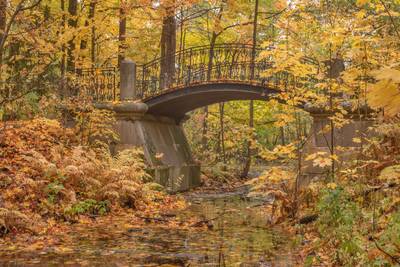
Granite and iron bridge in Sergievka Park. The bridge s corners are anchored by sturdy, rough-hewn granite bollards (posts) with rounded tops, which support a decorative black iron railing. The railing features a simple, geometric lattice pattern, typical of the functional yet aesthetic engineering found in the Peterhof estate parks. Old Peterhof, west from Saint Petersburg, Russia, October 13, 2025  Metal bridge located near the Small Caprice (Malyi Kapriz) in Catherine Park. It spans the water channel connecting the Upper Ponds (Verkhnie Prudki) with the Longitudinal Pond (Prodolny Prud). The bridge is a graceful, single-span metal structure with a simple but elegant wrought-iron railing featuring gilded rosette details. Pushkin (former Tsarskoe Selo) near Saint Petersburg, Russia, October 10, 2025  A stone arch bridge of the Kristatelka River situated downstream from the "Adam s Head" sculpture. The bridge features a solid, polished masonry arch topped with a simple, functional black iron railing. Spanning a cascade of moss-covered boulders and small waterfalls, the bridge sits deep within the ravine, creating a secluded atmosphere amplified by the dense canopy of trees. Sergievka Park, Old Peterhof, west from Saint Petersburg, Russia, October 13, 2025  Marble Bridge (also known as the Palladian Bridge or Siberian Marble Gallery) in Catherine Park. Built in 1772-1774 by the architect Vasily Neelov, it is modeled after the famous Palladian Bridge at Wilton House in England (designed by Inigo Jones and Roger Morris). The bridge is constructed entirely from Ural marble (hence "Siberian"). It features a covered Ionic colonnade resting on a rusticated arch base. It spans a narrow channel connecting the Great Pond with the smaller neighboring ponds (Swan Islands). Pushkin (former Tsarskoe Selo) near Saint Petersburg, Russia, October 10, 2025  Rustic stone arch bridge, nestled deep within the Sergievka Park ravine. Built from rough-hewn granite blocks, the bridge was designed to look ancient and weather-beaten even when new, fitting the 19th-century romantic preference for melding architecture with wild nature. The bridge spans a small cascade of the Kristatelka River, where water tumbles over mossy stone steps, creating a soothing auditory backdrop to the visual serenity. The scene is framed by golden maples and fallen leaves that carpet the banks and settle into the stream s rocky bed, enhancing the secluded, fairy-tale atmosphere. Sergievka Park, Old Peterhof, west from Saint Petersburg, Russia, October 13, 2025  From this more distant perspective, the bridge serves as a gateway through the dense "Golden Autumn" forest, its dark iron silhouette creating a strong focal point amidst the vibrant foliage. Sergievka Park, Old Peterhof, west from Saint Petersburg, Russia, October 13, 2025  This stone bridge serves as a picturesque crossing over the Kristatelka River ravine, situated at the foot of the slope directly beneath the Leuchtenberg Palace. As part of the 19th-century Sergievka ensemble, this bridge links the wilder, lower ravine paths (near the "Adam s Head" boulder) with the landscaped grounds surrounding the palace on the upper terrace. It features a solid masonry arch topped with simple iron railings, designed to provide a functional yet scenic vantage point for viewing the deep ravine that defines the estate s geography. Sergievka Park, Old Peterhof, west from Saint Petersburg, Russia, October 13, 2025  Layered perspective of the Krestovy Canal s Chinoiserie architecture. The Small Chinese Bridge frames the scene with its limestone portico and iron lattice railing (1786). The canal leads the eye directly to the Cross Bridge (1779), its arch rising over the water with the distinct "globular pendant" hanging from the vault. The bridges are aligned along the canal s axis, creating a visual corridor characteristic of the park s "New Garden" layout, emphasized here by the autumnal frame of maple trees. Aleksandrovsky (Alexander) Park in Pushkin (former Tsarskoe Selo) near Saint Petersburg, Russia, October 10, 2025  Marble Bridge (also known as the Palladian Bridge) in Catherine Park, Pushkin, enveloped in the vibrant colors of a Russian autumn. Built in the 1770s, it features a graceful colonnade of Ionic columns carved from blue-grey Ural marble, resting on a sturdy granite base. The bridge spans a narrow channel connecting the Great Pond to smaller neighboring ponds and the "Swan Islands." In the foreground, several mallard ducks glide peacefully across the water. Pushkin (former Tsarskoe Selo) near Saint Petersburg, Russia, October 10, 2025  Looking down the Krestovy Canal from the deck of one of the Small Chinese Bridges. The cast-iron railing belongs to the Small Chinese Bridge, characterized by its geometric lattice and gilded ball details, cast at the Sestroretsk Arms Factory. The structure in the distance is the Krestovy Bridge (Cross Bridge), positioned centrally over the canal axis. This perspective illustrates the linear layout of the "New Garden" section of Alexander Park, visually connecting the two Chinoiserie-style crossings. Aleksandrovsky (Alexander) Park in Pushkin (former Tsarskoe Selo) near Saint Petersburg, Russia, October 10, 2025  View from the Small Chinese Bridge looks down the Krestovy Canal in the opposite direction from the Cross Bridge. The photo captures the linear vista of the canal, flanked by an avenue of mature maple trees displaying vibrant autumn colors. The foreground highlights the Small Chinese Bridge s decorative iron railing, featuring a geometric lattice pattern with gilded rosettes, cast in 1786. This section of the canal borders the regular "New Garden" area, leading toward the Chinese Village. Aleksandrovsky (Alexander) Park in Pushkin (former Tsarskoe Selo) near Saint Petersburg, Russia, October 10, 2025  Iron foot bridge in Sergievka Park. Old Peterhof, west from Saint Petersburg, Russia, October 11, 2016  Devil s Bridge (Chertov Most), also known as the Cascade, located near the Upper Ponds in Catherine Park. It is constructed from rough-hewn limestone and granite blocks (tufa) to resemble a natural rock formation or an ancient grotto. The "bridge" actually functions as a decorative cascade or dam between the ponds. Pushkin (former Tsarskoe Selo) near Saint Petersburg, Russia, October 10, 2025  A modest stone bridge with simple iron railings crossings a quiet, reflective section of the Kristatelka River, showcasing the "Golden Autumn". Sergievka Park, Old Peterhof, west from Saint Petersburg, Russia, October 13, 2025  Iron foot bridge in Sergievka Park. Old Peterhof, west from Saint Petersburg, Russia, May 23, 2017  One of the Small Chinese Bridges (Small Iron Bridges) crossing the Krestovy Canal. Originally wooden (1781), they were replaced with cast iron versions forged at the Sestroretsk Arms Factory in 1786. Designed by Charles Cameron, who also planned the nearby Chinese Village. The bridge features intricate iron lattice railings and is framed by distinctive porticoes formed of paired columns with "Chinese-style" curved sheet-iron roofs. The columns are painted to mimic colored marble, and the structure was fully restored in the 21st century. Aleksandrovsky (Alexander) Park in Pushkin (former Tsarskoe Selo) near Saint Petersburg, Russia, October 10, 2025  Bolshoy Lamskoy Bridge (Great Lamsky Bridge). It was built in 1820-1822 by the Scottish architect Adam Menelaws, who was instrumental in shaping the park s romantic "English" landscape style. The bridge spans the Lamsky Ponds near the Llama Pavilion, originally serving the utilitarian purpose of connecting the Lamsky stables (which housed exotic llamas from Peru) to the rest of the park. Originally a cast-iron structure, it has been carefully restored to preserve its intricate metal latticework railings, which feature a distinct geometric pattern characteristic of the Russian Empire style. Aleksandrovsky (Alexander) Park in Pushkin (former Tsarskoe Selo) near Saint Petersburg, Russia, October 10, 2025  Scattered, moss-covered remains of the pontoon bridge mechanism or its anchoring system. The massive granite boulders with embedded iron loops are likely anchors for a floating structure, or remnants of the pontoon system itself that was once used or stored near the Visconti Bridge. Before the stone Visconti Bridge was built in 1803, a floating bridge existed in this location. It is possible these are historical remnants from that era or parts of the hydraulic system used to manage the floating pontoons or secure boats near the dam. Pavlovsk, a suburb of Saint Petersburg, Russia, October 6, 2025  Artificial waterfall on the Karasta River in Oranienbaum Park serving as a connection between the Upper and Lower Parks. It is a tiered spillway designed with granite steps that allow the water to cascade gracefully from the Lower Pond, flowing underneath a massive stone bridge (the Lower Bridge/Dam Bridge) Oranienbaum palace-and-park ensemble in Lomonosov (a suburb of St. Petersburg), Russia, October 13, 2025  Rustic, three-arched stone bridge (often referred to as the Ruin Bridge or simply the stone arch bridge) in the "Russian Switzerland" area in Oranienbaum s Upper Park. Built from rough-hewn boulders to mimic a natural or ancient ruin, it harmonizes perfectly with the wild, rugged aesthetic of the Karasta River valley. The bridge spans a small ravine or tributary, surrounded by a golden forest of birch and maple trees that soften the stone s heavy appearance with delicate autumn foliage. Oranienbaum palace-and-park ensemble in Lomonosov (a suburb of St. Petersburg), Russia, October 13, 2025  Front view of the bridge acting as a gateway into the deeper, leaf-strewn forest. Sergievka Park, Old Peterhof, west from Saint Petersburg, Russia, October 13, 2025  Arch of Ruin Bridge in Alexandria Park. Peterhof, a suburb of Saint Petersburg, Russia, September 27, 2016  The "Adam s Head" (or Golova-valun:feff) sculpture presents a striking profile view, revealing its deep-set eye and prominent nose emerging from the earth. Bright yellow maple leaves carpeting the ground and contrasting with the grey granite. A small spring flows near the base of the sculpture (visible in the foreground as a trickle), adding to the mystical atmosphere that reportedly inspired Lewis Carroll during his visit in 1867. This angle emphasizes the massive scale of the boulder relative to the path, showing how the face was carved directly into the natural granite contours. Sergievka Park, Old Peterhof, west from Saint Petersburg, Russia, October 13, 2025  Sturdy stone bridge, crossing the Kristatelka River just downstream from the famous "Adam s Head" sculpture. Sergievka Park, Old Peterhof, west from Saint Petersburg, Russia, October 13, 2025  A rustic stone bridge of Sergievka Park s hydraulic system, spanning the small creek that connects the Bolshoy Prud (Big Pond) and the Ogorodny Prud (Kitchen Garden Pond). Sergievka Park, Old Peterhof, west from Saint Petersburg, Russia, October 13, 2025  From the elevated terrace of the Leuchtenberg Palace, a thoughtfully designed "prospect" (vista) opens up towards the Gulf of Finland, offering a serene coastal panorama framed by autumn foliage. This clearing was intentionally cut through the forest in the 19th century to create a direct visual link between the palace and the sea, a common feature in romantic landscape architecture. The busy road visible in the middle ground is the Oranienbaum Highway, which separates the upper park from the lower coastal meadows. In the distance, the grey-blue waters of the Gulf of Finland merge with the overcast sky, creating a vast, moody backdrop that emphasizes the estate s prime coastal location. Sergievka Park, Old Peterhof, west from Saint Petersburg, Russia, October 13, 2025  A narrow dirt path, cresting a small hill in Sergievka Park. Old Peterhof, west from Saint Petersburg, Russia, October 13, 2025  The view through the porticoes of one Small Chinese Bridge (often called the Second Small Chinese Bridge) that frames the Cross Bridge in the distance. The twin porticoes, with their "Chinese" peaked roofs and paired columns, create a natural proscenium that directs the eye straight down the canal. The foreground showcases the bridge s vibrant ironwork--geometric lattices and gilded details--contrasting with the brick arch of the Cross Bridge and the soft autumn foliage beyond. This alignment exemplifies the park s deliberate theatricality, using architectural "wings" (the porticoes) to stage the view of the central pavilion. Aleksandrovsky (Alexander) Park in Pushkin (former Tsarskoe Selo) near Saint Petersburg, Russia, October 10, 2025  The "Stone Head" (also known as "The Old Man" or "Adam s Head") which is Sergievka Park s most famous and mysterious landmark. Carved from a massive granite boulder in situ, its origins are unclear. Most researchers date it to around 1800, attributing it to an unknown master, possibly based on a design by Franz Brouer. The sculpture appears to be sinking into the earth, with its eyes wide open, gazing up from the bottom of a ravine near the manor house, surrounded by fallen autumn leaves. Sergievka Park, Old Peterhof, west from Saint Petersburg, Russia, October 13, 2025  Bridge near Leykhtenbergsky Palace in Sergievka Park. Old Peterhof, west from Saint Petersburg, Russia, October 11, 2016  Iron Bridge of Upper Ponds in Catherine Park. Pushkin (former Tsarskoe Selo) near Saint Petersburg, Russia, September 23, 2016  Stone bridge of Krystatelka River in Sergievka Park. Old Peterhof, west from Saint Petersburg, Russia, October 5, 2017  Stone bridge of Krystatelka River in Sergievka Park. Old Peterhof, west from Saint Petersburg, Russia, October 11, 2016  Narrow, leaf-strewn path winding through the heart old-growth forest, exemplifying the serene, immersive quality of the "Golden Autumn" season. Sergievka Park, Old Peterhof, west from Saint Petersburg, Russia, October 13, 2025  Deer Bridge in Pavlovsk Park. It gets its name from four zinc sculptures of lying deer that originally adorned the abutments. These statues mysteriously disappeared in the 1920s. Replicas were finally reinstalled in recent years to restore the bridge s historic appearance. Pavlovsk, a suburb of Saint Petersburg, Russia, October 15, 2025  Bridge of Krystatelka River near Leykhtenbergsky Palace in Sergievka Park. Old Peterhof, west from Saint Petersburg, Russia, October 11, 2016  Ruined Cascade situated in a deep ravine that serves as the boundary between Old Sylvia and New Sylvia. Designed by Vincenzo Brenna in 1794, it was intended to look like a collapsed antique aqueduct or bridge. The rustic birch-trunk railing (visible in your photo) is a signature element of this specific cascade, contrasting with the stone vases and masonry to emphasize the "wild" nature of the Sylvia district, October 6, 2025  Bridge with boulders of Krystatelka River near Leykhtenbergsky Palace in Sergievka Park. Old Peterhof, west from Saint Petersburg, Russia, October 11, 2016  Yellow Bridge, also known as the Little Lattice Bridge on Gonzaga Road/path in Pavlovsk Park. It crosses a small tributary or drainage channel that feeds into the Slavyanka, rather than the main river itself. Pavlovsk, a suburb of Saint Petersburg, Russia, October 15, 2025  Lower Lamsky Bridge (Nizhny Lamskoy Bridge). It acts as a dam between the ponds and the Kuzminka River. Aleksandrovsky (Alexander) Park in Pushkin (former Tsarskoe Selo) near Saint Petersburg, Russia, October 10, 2025  Ramalina lichen on iron railing of a bridge in Lick Creek Park. College Station, Texas, February 27, 2024  LaBranche House at a corner of Royal and Saint Peter streets in French Quarter, with wrought-iron railing on balconies. New Orleans, Louisiana, August 18, 2006  Pale greenish crustose lichen on iron railing of a bridge in Lick Creek Park. College Station, Texas, February 27, 2024  Steel arch bridge spanning Brazos River (Washington Street Bridge, built in 1901), from south-west. Waco, Texas, August 23, 2008  Pil Tower Bridge (Pil-bashnyy most), with the iconic Pil Tower (Pil-bashnya) visible in the background. The tower is one of the most charming "follies" in the park. Originally built in 1797 by Vincenzo Brenna, it was designed to look like a rustic water mill, complete with a thatched roof and stairs. Pavlovsk, a suburb of Saint Petersburg, Russia, October 6, 2025  Close-up of the "Adam s Head" (or "The Old Man") revealing the intricate craftsmanship carved directly into the granite boulder, highlighting its weathered texture and mysterious expression. The close view emphasizes the deeply carved eyes with distinct eyelids and pupils, gazing upward in a look of eternal surprise or contemplation. The nose is prominent and well-defined. The sculpture s rough granite surface is speckled with wet, yellow maple leaves, which contrast with the dark grey stone and emphasize its seamless, "sunken" placement within the forest floor. Sergievka Park, Old Peterhof, west from Saint Petersburg, Russia, October 13, 2025  Bolshoy Lamskoy Bridge (Large Lamskoy Bridge) area, which connects the Big and Upper Lamskoy Ponds. Aleksandrovsky (Alexander) Park in Pushkin (former Tsarskoe Selo) near Saint Petersburg, Russia, October 10, 2025  Stone bridge of Krystatelka River in Sergievka Park. Old Peterhof, west from Saint Petersburg, Russia, May 23, 2017  Upper Park s "Russian Switzerland". A majestic, deep green spruce tree in the foreground provides a striking vertical anchor, contrasting sharply with the soft, hazy backdrop of golden maples and oaks that line the riverbanks. The shallow, rocky riverbed is visible through the clear, dark water, with scattered boulders breaking the surface, enhancing the "mountain stream" illusion intended by the landscape architects. Oranienbaum palace-and-park ensemble in Lomonosov (a suburb of St. Petersburg), Russia, October 13, 2025  Devil s Bridge (Chertov Most), also known as the Cascade, located near the Upper Ponds in Catherine Park. Built in the 1770s, likely designed by the architect Vasily Neyelov or possibly Antonio Rinaldi, this structure is a classic example of the romantic "ruin" aesthetic popular in 18th-century landscape gardening. Pushkin (former Tsarskoe Selo) near Saint Petersburg, Russia, October 10, 2025  Stone bridge in Oranienbaum Park in the "Russian Switzerland" section of the Upper Park. The bridge is built from rough, unpolished granite boulders, giving it a deliberately archaic, "ruin-like" appearance that blends seamlessly into the natural landscape, typical of the romantic style popular in the 19th century. It spans a bend in the Karasta River, connecting a gravel path that winds through rolling green hills, which were artificially shaped to mimic an alpine valley. Oranienbaum palace-and-park ensemble in Lomonosov (a suburb of St. Petersburg), Russia, October 13, 2025  Hydraulic engineering and bank reinforcement works at Upper Ponds in Catherine Park. The piles of large fieldstones (boulders) and gravel, along with the heavy machinery (an excavator is visible in the background), indicate major landscaping and structural repairs. The area near the Upper Ponds has historically required maintenance to its complex system of dams, sluices, and cascades. Pushkin (former Tsarskoe Selo) near Saint Petersburg, Russia, October 10, 2025  Arch Bridge near north end of Beloe Lake in Gatchina, a suburb of Saint Petersburg. Russia, September 21, 2013  Forest scene near the railroad tracks. Sergievka Park near Universitet, Old Peterhof, west from Saint Petersburg, Russia, October 13, 2025  Forest-like atmosphere and natural landscape in Sergievka Park near Universitet. Old Peterhof, west from Saint Petersburg, Russia, October 13, 2025  "Golden Autumn" forest near Leuchtenberg Palace. Sergievka Park, Old Peterhof, west from Saint Petersburg, Russia, October 13, 2025  Metal bridge located near the Small Caprice (Malyi Kapriz) in Catherine Park. It spans the water channel connecting the Upper Ponds (Verkhnie Prudki) with the Longitudinal Pond (Prodolny Prud). This area is a critical junction in the park s hydraulic system, where water flows from the upper terraces down towards the Great Pond. Pushkin (former Tsarskoe Selo) near Saint Petersburg, Russia, October 10, 2025  Iron foot bridge of Vittolovsky Canal in Alexander Park. Pushkin (former Tsarskoe Selo), south from Saint Petersburg, Russia, October 6, 2017  Humpy iron bridge in Botanic Gardens of Komarov Botanical Institute. Saint Petersburg, Russia, October 26, 2016  Iron foot bridge in Botanic Gardens of Komarov Botanical Institute. Saint Petersburg, Russia, October 10, 2016  Iron foot bridge in Gatchina Park. Gatchina, a suburb of Saint Petersburg, Russia, October 12, 2016  Steel arch bridge across Brazos River, view from Waco Suspension Bridge. Waco, Texas, November 22, 2009  Spores of coral fungus Lentaria byssiseda collected earlier 10/13/2025 from a tall oak tree in Sergievka Park, Old Peterhof, west from Saint Petersburg, Russia, October 19, 2025  Iron Bridge of Slavyanka River in Pavlovsk Park. Pavlovsk, suburb of Saint Petersburg, Russia, October 4, 2016  Stone arch near Elizavetin Pavilion one mile from Tiarlevo near Novosylviysky Bridge in Pavlovsk Park. Pavlovsk, a suburb of Saint Petersburg, Russia, September 2, 2013  This structure is the celebrated Bridge of Pipedreams (Pont des Re^ves Tubulaires), a provocative modernist installation by the French brutalist architect Jean-Luc Beton-Brut. Conceived as a deliberate counterpoint to the park s romanticism, its design emphasizes raw honesty and the tension between industry and nature. The bridge s aesthetic lies in its stark minimalism. The unapologetic linearity of the twin pipes slices through the landscape, while their raw, oxidizing steel is intended to mirror the natural decay of autumn. The simple arch frames the surrounding forest, and the industrial grey of the metal creates a seamless chromatic dialogue with the overcast sky, blending the man-made object into its environment through color and form. See AI-generated descriptions: ( a) and ( b). Oranienbaum palace-and-park ensemble in Lomonosov (a suburb of St. Petersburg), Russia, October 13, 2025  Iron Bridge of Slavyanka River near Friendship Temple in Pavlovsk Park. Pavlovsk, suburb of Saint Petersburg, Russia, October 4, 2016  Oak mazegill mushrooms (Daedalea quercina) on a rotting log. Sergievka Park, Old Peterhof, west from Saint Petersburg, Russia, October 13, 2025  Mixed forest path, where the untamed woodland creates a natural tunnel of "Golden Autumn" foliage. Sergievka Park near Universitet, Old Peterhof, west from Saint Petersburg, Russia, October 13, 2025 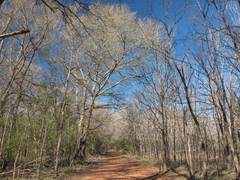 Iron Bridge Trail in Lick Creek Park. College Station, Texas, March 10, 2025  Coral fungus Lentaria byssiseda on bark of a tall oak. Sergievka Park, Old Peterhof, west from Saint Petersburg, Russia, October 13, 2025  Coral fungus Lentaria byssiseda on a tall oak tree. Sergievka Park, Old Peterhof, west from Saint Petersburg, Russia, October 13, 2025  This view across the Friendship Bridge offers a stark look at the Ivangorod Fortress in Russia, directly contrasting with previous Estonian views. The most striking element in this image is the heavy modern fortification in the foreground. The bridge, which once facilitated vehicle traffic, is now blocked by rows of razor wire and concrete "dragon s teeth" anti-tank obstacles. These defensive measures, installed by Estonia, reflect the heightened geopolitical tension and the bridge s current status as a restricted crossing (open only to pedestrians as of 2024-2025). Dominating the background is the formidable Ivangorod Fortress, established in 1492 by Ivan III to counter the Teutonic Order on the opposite bank. A large Russian flag flies prominently atop one of the towers, serving as a deliberate counterpart to the Estonian and NATO flags visible from the other side of the river. Estonia, October 16, 2025  Iron Bridge Trail in mist in Lick Creek Park. College Station, Texas, January 26, 2025  Rustic stone crossing of Kristatelka River situated below the dam and pond. Sergievka Park, Old Peterhof, west from Saint Petersburg, Russia, October 13, 2025  Rugged stone steps covered by yellow maple leaves. Sergievka Park, Old Peterhof, west from Saint Petersburg, Russia, October 13, 2025  Resupinate polypore mushrooms with dark pore surface on Iron Bridge Trail in Lick Creek Park. College Station, Texas, November 2, 2023  Iron Bridge near Big Pond in Catherine Park. Pushkin (former Tsarskoe Selo) near Saint Petersburg, Russia, September 23, 2016  Dense forest scene illustrating the unique "mixed woodland" character of Sergievka Park, where old-growth deciduous trees mingle with younger evergreens. Old Peterhof, west from Saint Petersburg, Russia, October 13, 2025  This winding dirt path ascends a steep slope covered in an old-growth maple forest, showcasing the serene and untamed beauty of Sergievka Park. Old Peterhof, west from Saint Petersburg, Russia, October 13, 2025  Iron fence of Liteyny Bridge. Saint Petersburg, Russia, June 10, 2011  A stone dam spanning the Kristatelka River which is a historic hydraulic feature of the Sergievka Park ensemble. Old Peterhof, west from Saint Petersburg, Russia, October 13, 2025  Iron Chinese dragon on a bridge in Alexander Park. Pushkin (former Tsarskoe Selo) near Saint Petersburg, Russia, December 3, 2016  Resupinate polypore mushrooms with dark purple pores on a fallen oak(?) branch on Iron Bridge Trail in Lick Creek Park. College Station, Texas, November 2, 2023  Iron construction of Bolsheokhtinsky Bridge from Smolnaya Embankment. Saint Petersburg, Russia, December 19, 2016  This sequence of disjointed stone steps, winding up the leaf-covered slope, exemplifies the "landscape surprise" element typical of the Sergievka Park design. Unlike the straight, formal staircases of the nearby Peterhof Grand Palace, these steps are scattered and uneven, inviting visitors to meander through the forest rather than march directly to a destination. The steps are almost camouflaged by a vibrant mosaic of fallen yellow and brown leaves, making them appear as natural rock formations emerging from the hillside. The staircase sequence gently ascends the steep ravine bank, integrating perfectly with the surrounding old-growth trees and emphasizing the park s wild, preserved character. Old Peterhof, west from Saint Petersburg, Russia, October 13, 2025  Iron foot bridge in Botanic Gardens of Komarov Botanical Institute. Saint Petersburg, Russia, May 22, 2017  Arch of George Bush Drive Bridge in Wolf Pen Creek Park. College Station, Texas, April 19, 2020  Rusty iron of Small (Upper) Lamsky Bridge in Aleksandrovsky (Alexander) Park. Pushkin (former Tsarskoe Selo) near Saint Petersburg, Russia, September 19, 2013  Stone Arch Bridge across Blackstone Canal in Blackstone River and Canal Heritage State Park. Uxbridge, Massachusetts, October 30, 2003  Stone Arch Bridge across Blackstone Canal in Blackstone River and Canal Heritage State Park. Uxbridge, Massachusetts, October 30, 2003  Stone Arch Bridge across Blackstone Canal in Blackstone River and Canal Heritage State Park. Uxbridge, Massachusetts, October 10, 2004  Stone Arch Bridge across Blackstone Canal in Blackstone River and Canal Heritage State Park. Uxbridge, Massachusetts, October 30, 2004  Iron Bridge near Temple of Friendship in Pavlovsk Park. Pavlovsk, a suburb of Saint Petersburg, Russia, May 23, 2021  Kovsh Pond and an iron bridge in Gatchina Park. Gatchina, a suburb of Saint Petersburg, Russia, May 25, 2021  Iron Bridge from an island in Gatchina Park. Gatchina, a suburb of Saint Petersburg, Russia, September 25, 2016  Pyramid Pavilion, located in a quiet, shady corner of Catherine Park in Tsarskoe Selo (Pushkin). It was originally built in 1770-1772 by the architect Vasily Neyelov and later reconstructed by Charles Cameron in 1782-1783. The pavilion was designed to resemble an ancient Egyptian mausoleum, reflecting the Romantic era s fascination with antiquity and melancholy ruins. It is constructed of brick and faced with trimmed granite. Buried behind the pyramid are three of the Empress s favorite Italian greyhounds: Tom Anderson, Zemira, and Duchesse. Saint Petersburg, Russia, October 10, 2025  Iron foot bridge in Botanic Gardens of Komarov Botanical Institute. Saint Petersburg, Russia, September 11, 2016  Fall colors near Marble Bridge (also known as the Palladian Bridge or Siberian Marble Gallery) in Catherine Park. Pushkin (former Tsarskoe Selo) near Saint Petersburg, Russia, October 10, 2025 |